• FluTrackers.com Inc. does not provide medical advice. Information on this web site is collected from various internet resources, and the FluTrackers board of directors makes no warranty to the safety, efficacy, correctness or completeness of the information posted on this site by any author or poster. The information collated here is for instructional and/or discussion purposes only and is NOT intended to diagnose or treat any disease, illness, or other medical condition. Every individual reader or poster should seek advice from their personal physician/healthcare practitioner before considering or using any interventions that are discussed on this website. By continuing to access this website you agree to consult your personal physican before using any interventions posted on this website, and you agree to hold harmless FluTrackers.com Inc., the board of directors, the members, and all authors and posters for any effects from use of any medication, supplement, vitamin or other substance, device, intervention, etc. mentioned in posts on this website, or other internet venues referenced in posts on this website.
  • We are not asking for any donations. Do not donate to any entity who says they are raising funds for us.

Discussion - Thoughts on a global outbreak of monkeypox

Translation Google

Jean Kaseya: "There are real risks that the Mpox epidemic will become uncontrollable"

The head of Africa CDC, the African Union's public health agency, is sounding the alarm over the danger posed by the rapid spread of monkeypox on the continent, saying intense efforts are being made to make a vaccine available.

Stanis Bujakera Tshiamala
Published on August 14, 2024
Reading time: 4 minutes.

Due to the resurgence of monkeypox in Africa, the Africa Centers for Disease Control and Prevention (Africa CDC) declared a "public health emergency" on August 13, which is the highest alert level of the sub-regional organization. Congolese doctor Jean Kaseya explains to Jeune Afrique that this decision is intended to quickly gather the financial and logistical resources needed to control the epidemic. Interview.

Jeune Afrique: What is the current situation of the monkeypox epidemic in Africa?

Jean Kaseya: 17,541 cases of Mpox, including 517 deaths, have been reported in 13 African countries in 2024: South Africa, Kenya, Rwanda, Uganda, DRC, Burundi, Central African Republic, Congo-Brazzaville, Cameroon, Nigeria, Ghana, Ivory Coast and Liberia. This represents an increase of 160% compared to 2023. The DRC is the most affected country, concentrating 96% of cases and 97% of deaths.

You have declared a public health emergency, the AU’s highest level of alert. What prompted you to take such a decision?

This is a strategic decision that aims to strengthen the collective and coordinated response to the epidemic, on a continental scale. It will mobilize the necessary resources, strengthen regional coordination, raise awareness, and ensure a rapid and effective response to control the spread of the disease.

This is due to the rapid expansion of Mpox beyond countries in non-endemic areas, which are reporting cases for the first time, and the constantly increasing number of deaths. This situation requires an urgent and coordinated response to prevent uncontrolled spread and overloading of already fragile health systems.

Finally, this statement will help combat stigma and misinformation by facilitating clear and consistent communication across the continent.

Concretely, what will this change for the populations?

Starting today, a lot of things will change. Africa CDC will coordinate the continental response and work with all partners to provide support to countries to control the outbreak. AU Member States will be required to notify us in a timely and transparent manner of any health measures put in place. The agency, which may issue temporary recommendations, will then disseminate this information to each country to improve overall situational awareness .

How can we explain this resurgence in East and Central Africa?

Largely due to lack of resources. When the WHO declared Mpox an international health emergency from June 2022 to May 2023, Western countries were provided with vaccines and medicines, and had the capacity to strengthen their health systems. They thus reduced the number of cases. At the same time, in Africa, cases continued to increase, but without any assistance being provided. This indifference of the international community had also been seen during the Covid-19 pandemic.

But this resurgence is also explained by the fact that in many parts of East and Central Africa, people live in close proximity to wildlife, particularly in rural and forested areas. Frequent interactions between humans and animals, such as rodents and primates, which are natural reservoirs of the Mpox virus, increase the risk of transmission of zoonotic diseases. Handling infected meat can also lead to direct transmission.

Massive deforestation in parts of East and Central Africa has disrupted the natural habitats of reservoir animals, forcing them closer to human-inhabited areas. This increased proximity increases the chances of contact and transmission of Mpox. Furthermore, in many countries in the region, health systems lack the resources and capacity to monitor and detect such an outbreak early. This often results in a delayed response, allowing the virus to spread. Finally, conflict and political instability in some regions have caused massive population displacements, creating conditions conducive to the spread of Mpox.

This is the first time that Africa CDC has taken such a step. Does this mean that the outbreak could spiral out of control?

There are indeed real risks that the epidemic will become uncontrollable if appropriate measures are not taken.

Precisely, what measures has the agency taken to control the spread of monkeypox?

Africa CDC has built on experience gained from fighting other outbreaks, such as Ebola and COVID-19. The idea is to strengthen surveillance and detection of Mpox cases across the African continent. This includes improving diagnostic capacity in national and regional laboratories, as well as setting up a system for rapid reporting of suspected cases. We are providing intensive training for health workers in affected countries to prepare them to identify, isolate and treat patients. Similar programs have also been set up for epidemiologists and public health experts.

Are you planning a vaccine?

Africa CDC plans to intensify its efforts to make a vaccine against Mpox available and accessible on the African continent. We are collaborating with manufacturers globally and supporting research to develop new vaccines or improve existing ones, taking into account the virus strains present in Africa.

The agency is also working with partners to develop local vaccine production capacity, through technology transfer. This aims to reduce reliance on imports and ensure a more reliable and timely supply. We are considering coordinating pooled purchases of vaccines for African countries, to negotiate better prices and ensure equitable distribution, particularly to the most affected or vulnerable areas .

https://www.jeuneafrique.com/159894...que-lepidemie-de-mpox-devienne-incontrolable/
--------------------
See also:

https://flutrackers.com/forum/forum...-reported-in-africa-up-160-percent-africa-cdc


WHO Director-General's opening remarks at the IHR Emergency Committee meeting regarding the upsurge of mpox 2024 – 14 August 2024

14 August 2024


Dear members of the Emergency Committee, colleagues and friends,

As you know, mpox has been reported in the Democratic Republic of the Congo for more than a decade, and the number of cases reported each year has increased steadily over that period.

Last year, reported cases increased significantly, and already the number of cases reported so far this year has exceeded last year’s total, with more than 14,000 cases and 524 deaths.

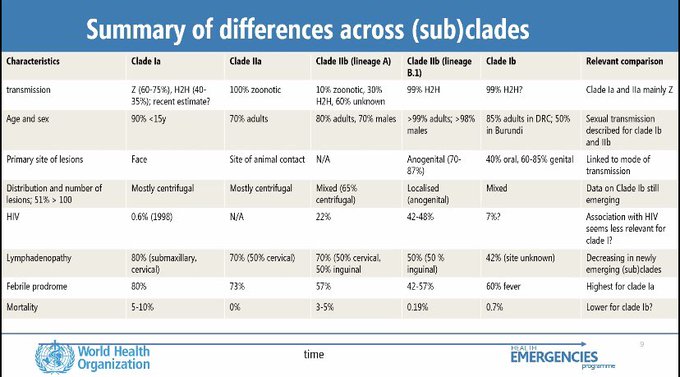
The emergence last year and rapid spread of clade 1b in DRC, which appears to be spreading mainly through sexual networks, and its detection in countries neighbouring DRC is especially concerning, and one of the main reasons for my decision to convene this Emergency Committee.

In the past month, about 90 cases of clade 1b have been reported in four countries neighbouring the DRC that have not reported mpox before: Burundi, Kenya, Rwanda and Uganda.

But we are not dealing with one outbreak of one clade – we are dealing with several outbreaks of different clades in different countries with different modes of transmission and different levels of risk.

My colleagues will provide you with a more detailed technical presentation shortly.

Stopping these outbreaks will require a tailored and comprehensive response, with communities at the centre, as always.

WHO is working with the governments of the affected countries, the Africa CDC, NGOs, civil society and other partners to understand and address the drivers of these outbreaks.

WHO has developed a regional response plan, requiring an initial US$ 15 million to support surveillance, preparedness and response activities.

To fund that response we have released US$ 1.45 million from the WHO Contingency Fund for Emergencies, and we plan to release more in the coming days. We are also appealing to donors to fund the rest of the response plan.

As you know, two vaccines for mpox are recommended by WHO’s Strategic Advisory Group of Experts on Immunization, and are also approved by WHO-listed national regulatory authorities, as well as by individual countries including Nigeria and the DRC.

Last week I triggered the process for Emergency Use Listing for mpox vaccines, which will accelerate vaccine access for lower-income countries which have not yet issued their own national regulatory approval.

Emergency Use Listing also enables partners including Gavi and UNICEF to procure vaccines for distribution.

WHO is grateful to Member States and vaccine manufacturers for working with us on vaccine donations.

We are working with all partners to facilitate equitable access to diagnostics, vaccines, supplies for clinical care and other tools.

In light of the expanding outbreak in east and central Africa, and the potential for further international spread within and outside Africa, I have convened this Emergency Committee under the International Health Regulations to advise me on whether the outbreak represents a public health emergency of international concern.

When I declared an end to the previous mpox PHEIC last year, I issued standing recommendations under the IHR, which are due to expire next week. I have decided to extend them for another year to support countries to respond to the chronic risk of mpox.

Were I to decide, on your advice, that the current situation represents a public health emergency of international concern, I would issue temporary recommendations in accordance with the IHR, again on your advice.

As you know, at this year’s World Health Assembly, WHO Member States adopted a set of amendments to the International Health Regulations. Those amendments will come into force next year, so for this meeting you will operate under the existing IHR.

Once again, thank you for committing your time and expertise to this very important process. I look forward to your advice.

https://www.who.int/director-genera...ing-the-upsurge-of-mpox-2024---14-august-2024

-------------------​
Members and advisors

Provisional list of members and advisors of the Emergency Committee regarding the upsurge of mpox 2024
 
World Health Organization (WHO)@WHO
"Today, the Emergency Committee met and advised me that in its view, the situation constitutes a public health emergency of international concern. I have accepted that advice"-
@DrTedros #mpox

image.png

...

11:25 AM · Aug 14, 2024​​
 
​WHO Director-General declares mpox outbreak a public health emergency of international concern

14 August 2024 News release

WHO Director-General Dr Tedros Adhanom Ghebreyesus has determined that the upsurge of mpox in the Democratic Republic of the Congo (DRC) and a growing number of countries in Africa constitutes a public health emergency of international concern (PHEIC) under the International Health Regulations (2005) (IHR).

Dr Tedros’s declaration came on the advice of an IHR Emergency Committee of independent experts who met earlier in the day to review data presented by experts from WHO and affected countries. The Committee informed the Director-General that it considers the upsurge of mpox to be a PHEIC, with potential to spread further across countries in Africa and possibly outside the continent.

The Director-General will share the report of the Committee’s meeting and, based on the advice of the Committee, issue temporary recommendations to countries.

In declaring the PHEIC, Dr Tedros said, "The emergence of a new clade of mpox, its rapid spread in eastern DRC, and the reporting of cases in several neighbouring countries are very worrying. On top of outbreaks of other mpox clades in DRC and other countries in Africa, it’s clear that a coordinated international response is needed to stop these outbreaks and save lives.”

WHO Regional Director for Africa Dr Matshidiso Moeti said, “Significant efforts are already underway in close collaboration with communities and governments, with our country teams working on the frontlines to help reinforce measures to curb mpox. With the growing spread of the virus, we’re scaling up further through coordinated international action to support countries bring the outbreaks to an end.”

Committee Chair Professor Dimie Ogoina said, “The current upsurge of mpox in parts of Africa, along with the spread of a new sexually transmissible strain of the monkeypox virus, is an emergency, not only for Africa, but for the entire globe. Mpox, originating in Africa, was neglected there, and later caused a global outbreak in 2022. It is time to act decisively to prevent history from repeating itself."

This PHEIC determination is the second in two years relating to mpox. Caused by an Orthopoxvirus, mpox was first detected in humans in 1970, in the DRC. The disease is considered endemic to countries in central and west Africa.

In July 2022, the multi-country outbreak of mpox was declared a PHEIC as it spread rapidly via sexual contact across a range of countries where the virus had not been seen before. That PHEIC was declared over in May 2023 after there had been a sustained decline in global cases.

Mpox has been reported in the DRC for more than a decade, and the number of cases reported each year has increased steadily over that period. Last year, reported cases increased significantly, and already the number of cases reported so far this year has exceeded last year’s total, with more than 15 600 cases and 537 deaths.

The emergence last year and rapid spread of a new virus strain in DRC, clade 1b, which appears to be spreading mainly through sexual networks, and its detection in countries neighbouring the DRC is especially concerning, and one of the main reasons for the declaration of the PHEIC.

In the past month, over 100 laboratory-confirmed cases of clade 1b have been reported in four countries neighbouring the DRC that have not reported mpox before: Burundi, Kenya, Rwanda and Uganda. Experts believe the true number of cases to be higher as a large proportion of clinically compatible cases have not been tested.

Several outbreaks of different clades of mpox have occurred in different countries, with different modes of transmission and different levels of risk.

The two vaccines currently in use for mpox are recommended by WHO’s Strategic Advisory Group of Experts on Immunization, and are also approved by WHO-listed national regulatory authorities, as well as by individual countries including Nigeria and the DRC.

Last week, the Director-General triggered the process for Emergency Use Listing for mpox vaccines, which will accelerate vaccine access for lower-income countries which have not yet issued their own national regulatory approval. Emergency Use Listing also enables partners including Gavi and UNICEF to procure vaccines for distribution.

WHO is working with countries and vaccine manufacturers on potential vaccine donations, and coordinating with partners through the interim Medical Countermeasures Network to facilitate equitable access to vaccines, therapeutics, diagnostics and other tools.

WHO anticipates an immediate funding requirement of an initial US$ 15 million to support surveillance, preparedness and response activities. A needs assessment is being undertaken across the three levels of the Organization.

To allow for an immediate scale up, WHO has released US$ 1.45 million from the WHO Contingency Fund for Emergencies and may need to release more in the coming days. The Organization appeals to donors to fund the full extent of needs of the mpox response.

https://www.who.int/news/item/14-08...lic-health-emergency-of-international-concern
 
Mpox outbreak in Africa is public health emergency, declares WHO

Outbreak resembles early days of HIV, say experts, urging accelerated access to vaccines and testing
....
Trudie Lang, a professor of global health research at Oxford University, said: “I have heard so many people refer to this as being very similar to the early days of HIV.”

She said this was particularly the case because the virus appeared to be spreading via sexual networks, with “vulnerable, young, exploited sex workers” at high risk. A “high level of stigma” would require public health campaigns to ensure people understood and sought treatment.

While data has yet to be analysed and published, Lang said the frontline teams she spoke to reported a high number of pregnancy losses due to the virus, and babies being born with mpox lesions due to transmission in the womb. There were “massive unknowns”, she said, including the number of cases outside hospitals.

Lang said: “What I’m truly worried about is the amount of cases that are not severe. If people have got a more mild infection that is potentially hidden, especially if it’s a sexually transmitted genital infection, they can be walking around with it.

“The big question that we’ve got is when is it most infectious, and when is it being transmitted?”
...

https://www.theguardian.com/world/a...k-africa-public-health-emergency-declares-who
 
Translation Google

"MONKEYPOX": TRANSMISSION, MORTALITY... HOW IS THE CURRENT MPOX EPIDEMIC DIFFERENT FROM 2022?

Tom Kerkour
THE 08/16/2024 at 1:57 p.m.

Since Wednesday, August 14, "monkey pox" (mpox) has been the subject of the highest alert from the World Health Organization. The disease had already led to a health emergency in 2022.

Two years later, "monkey pox" is once again worrying health authorities. On Wednesday, August 14, the World Health Organization declared the monkeypox epidemic a "public health emergency of international concern" after the spread of a new "variant" (clade 1b) in the Democratic Republic of Congo.

Other cases have since been identified in Burundi and Uganda. On Thursday, a first case was detected in Europe, in Sweden. In 2022, even though the epidemic had originated in Africa, it was its explosion on the Old Continent and in North America that triggered the WHO's first maximum alert.

Affected populations, lethality, symptoms... What are the differences between these two waves? While many uncertainties remain, here is what we know at this early stage of the epidemic.

• Mainly broadcast in Africa... at this stage

The first difference between the two epidemics at this stage is the area of ​​diffusion. In 2022, if the first cases were first identified in West Africa, particularly in Nigeria, mpox then spread to all continents. In May of that year, cases were first identified sporadically in the United Kingdom, Spain, Portugal... Before affecting North America, then Israel, India...

"We must not forget that in 2022, we have already experienced a real MPOX pandemic," emphasizes Benjamin Davido, infectious disease specialist at the Raymond-Poincaré hospital in Garches (Hauts-de-Seine).

For now, the new outbreak appears to be endemic in nature, rather confined to African countries. The new strain was identified in the Democratic Republic of Congo, where more than 16,000 "potential" cases and 548 deaths have been recorded this year, before spreading to Burundi, Ivory Coast, Kenya, Rwanda and Uganda.

However, rare cases of this new type of virus have been identified on the Asian continent, in Pakistan, and in Europe, in Sweden . "It is likely that other imported cases of clade 1 (a variant, editor's note) will be recorded in the European region in the coming days and weeks," warned the European branch of the WHO .

For infectiologist Benjamin Davido, the study of these new cases outside the African continent will make it possible to determine whether or not we are facing a shift in an epidemic. "The functioning of clade 1b in the Caucasian population" is poorly understood, he notes.

• The general population more concerned, a different route of contamination?

Although not a sexually transmitted infection (STI) per se, the previous outbreak of mpox had homosexual or bisexual men as its primary victims. As the CDC, the American health authority, had reported , "monkeypox" was spreading faster within this community than in the rest of the general population.

For its part, the WHO recalled that "the risk of contracting monkeypox is not limited to men who have sex with men." "Anyone who has been in close contact with an infected person is at risk," the institution added, while acknowledging that "the virus (had) been detected in queer communities."

This first strain of mpox was mainly contracted through contact with contaminated animals. But also through close contact - without necessarily involving sexual intercourse, since the presence of the virus in bodily fluids has not been established.

In 2024, the circulation of the virus looks different. "Detailed information on transmission is not available for most cases in the African region," a WHO analysis warns. But "available information suggests that modes of transmission in this region are more diverse, including human-to-human transmission due to different types of physical or close contact, direct or indirect, and, in some settings, zoonotic (animal) exposure."

Human-to-human transmission occurs through "prolonged face-to-face contact through respiratory droplets" or through "direct contact" with an infected person, notes the French Ministry of Health .

It should be noted that in the Democratic Republic of Congo, children under 15 years of age are the most affected population, according to the WHO. "In historically affected countries, such as the Democratic Republic of Congo, children under 15 years of age account for most reported smallpox cases," the institution says.

How can we explain the contamination of children, for a disease that previously mainly affected men in their forties? "It will be useful to study the mode of exposure of new patients," notes Dr. Davido. "Determine whether they were infected by exposure through proximity within the home (...) or by droplets."

These new cases will help determine whether the stronger transmission of the virus is the result of an evolution towards respiratory transmission by droplets - until now secondary - or a much stronger transmission by contact.

• Similar symptoms, but higher mortality?

One constant emerges from the various outbreaks of the disease over time and across countries. The symptoms seem to remain stable . The first and most visible sign is the appearance of skin lesions - and lesions of the mucous membranes, particularly genital, when the disease results from sexual intercourse.

Other problems may then appear: fever, headaches, body aches and asthenia. Sore throats are also reported.

What about mortality? The new type of mpox called clade 1b seems to be more deadly, "around 4%, with a large range of 1 to 10%", specifies the Parisian infectiologist. In France, no deaths from the disease have been recorded, neither in 2022 nor in 2024. But the consensus on the lethality of the new variant could evolve after the analysis of new cases outside the African continent.

https://www.bfmtv.com/sante/variole...-de-mpox-differe-de-2022_AV-202408160306.html

 
My bolding in sentences.


Mpox And Mask Bans - A Recipe For Disaster


Judy Stone
Senior Contributor
I am an Infectious Disease specialist and author of Resilience: One Family's Story of Hope and Triumph over Evil and of Conducting Clinical Research, the essential guide to the topic

Aug 16, 2024,04:02pm EDT


snip

Clade 2 mpox has been circulating globally for several years, spread primarily by sexual or close skin contact. It has a low death rate. This new clade, type 1, spreads more readily and can kill up to 10% of people. Children younger than 15 years-old, now make up more than 70% of cases and 85% of deaths. In contrast, the Omicron variant of SARS-CoV-2 had a 0.7% fatality rate, less than earlier strains.


Is mpox Transmission Airborne?


A key question is how is mpox spread. We know that clade II mpox is primarily spread sexually, and through very close contact. However, the outbreak in children suggests that clade1 is transmitted through air, respiratory droplets, or very close contact.

snip

The WHO said transmission of mpox could occur via “respiratory droplets (and possibly short-range aerosols).” The UK has a list of “high-consequence infectious diseases.” They say, “Airborne HCIDs are spread by respiratory droplets or aerosol transmission, in addition to contact routes of transmission.” Clade 1 mpox is on this list.

While the CDC is not supporting airborne transmission now, in 2022 they recommended wearing a mask to help protect you from transmission. The page, which stated that people could become infected through contact with “the skin lesions or bodily fluids of infected animals or humans (alive or dead), including respiratory droplets, was deleted.


more... https://www.forbes.com/sites/judystone/2024/08/16/mpox-and-mask-bansa-recipe-for-disaster/
 
My bolding in sentences.


Mpox And Mask Bans - A Recipe For Disaster


Judy Stone
Senior Contributor
I am an Infectious Disease specialist and author of Resilience: One Family's Story of Hope and Triumph over Evil and of Conducting Clinical Research, the essential guide to the topic

Aug 16, 2024,04:02pm EDT


snip

Clade 2 mpox has been circulating globally for several years, spread primarily by sexual or close skin contact. It has a low death rate. This new clade, type 1, spreads more readily and can kill up to 10% of people. Children younger than 15 years-old, now make up more than 70% of cases and 85% of deaths. In contrast, the Omicron variant of SARS-CoV-2 had a 0.7% fatality rate, less than earlier strains.


Is mpox Transmission Airborne?


A key question is how is mpox spread. We know that clade II mpox is primarily spread sexually, and through very close contact. However, the outbreak in children suggests that clade1 is transmitted through air, respiratory droplets, or very close contact.

snip

The WHO said transmission of mpox could occur via “respiratory droplets (and possibly short-range aerosols).” The UK has a list of “high-consequence infectious diseases.” They say, “Airborne HCIDs are spread by respiratory droplets or aerosol transmission, in addition to contact routes of transmission.” Clade 1 mpox is on this list.

While the CDC is not supporting airborne transmission now, in 2022 they recommended wearing a mask to help protect you from transmission. The page, which stated that people could become infected through contact with “the skin lesions or bodily fluids of infected animals or humans (alive or dead), including respiratory droplets, was deleted.


more... https://www.forbes.com/sites/judystone/2024/08/16/mpox-and-mask-bansa-recipe-for-disaster/


We have several CDC documents from 2022 that recommend wearing masks in mpox situations. I have no idea if these documents are still online or not:


CDC - Preventing Monkeypox Spread in Congregate Settings - June 16, 2022

CDC - Monkeypox: Disinfecting Home and Other Non-Healthcare Settings (West African clade only) - July 18, 2022

CDC - Monkeypox: Pets in the Home - June 24, 2022

CDC - Monkeypox: Isolation and Infection Control: Home - June 16, 2022

CDC - Isolation and Prevention Practices for People with Monkeypox: Updated August 2, 2022
 
Although the binding affinities of MPXV to human cells are unclear, the airborne transmission route must be considered as a possible transmission mode under the conditions of current experimental and analytical findings. Therefore, monitoring airborne viruses as well as non-pharmaceutical interventions (ventilation, aerosol control, or respirator), will help control the spread of MPXV.

https://www.thelancet.com/journals/lanmic/article/PIIS2666-5247(23)00059-9/fulltext
 
Mpox (monkeypox)

​18 April 2023
...
Transmission

Person-to-person transmission of mpox can occur through direct contact with infectious skin or other lesions such as in the mouth or on genitals; this includes contact which is
  • face-to-face (talking or breathing)
  • skin-to-skin (touching or vaginal/anal sex)
  • mouth-to-mouth (kissing)
  • mouth-to-skin contact (oral sex or kissing the skin)
  • respiratory droplets or short-range aerosols from prolonged close contact
The virus then enters the body through broken skin, mucosal surfaces (e g oral, pharyngeal, ocular, genital, anorectal), or via the respiratory tract. Mpox can spread to other members of the household and to sex partners. People with multiple sexual partners are at higher risk.

Animal to human transmission of mpox occurs from infected animals to humans from bites or scratches, or during activities such as hunting, skinning, trapping, cooking, playing with carcasses, or eating animals. The extent of viral circulation in animal populations is not entirely known and further studies are underway.

People can contract mpox from contaminated objects such as clothing or linens, through sharps injuries in health care, or in community setting such as tattoo parlours.
​...

https://www.who.int/news-room/fact-sheets/detail/monkeypox

------------------------------------------------------------

Mpox (monkeypox)

11 December 2023 | Q&A
...
How does mpox spread?

From person to person:


Mpox spreads from person-to-person through close contact with someone who is infected with the monkeypox virus. Close contact includes being face-to-face (such as talking or breathing close to one another which can generate droplets or short-range aerosols); skin-to-skin (such as touching or vaginal/anal sex); mouth-to-mouth (such as kissing); or mouth-to-skin contact (such as oral sex or kissing the skin). During the global outbreak that began in 2022, the virus mostly spread through sexual contact.

People with mpox are considered infectious until all their lesions have crusted over, the scabs have fallen off and a new layer of skin has formed underneath, and all the lesions on the eyes and in the body (in the mouth, throat, eyes, vagina and anus) have healed too, which usually takes from 2 to 4 weeks.

It is also possible for the monkeypox virus to persist for some time on clothing, bedding, towels, objects, electronics and surfaces that have been touched by a person with mpox. Someone else who touches these items may become infected, particularly if they have any cuts or abrasions or touch their eyes, nose, mouth or other mucous membranes without first washing their hands. Cleaning and disinfecting surfaces/objects and cleaning your hands after touching surfaces/objects that may be contaminated can help prevent this type of transmission.

The virus can also spread during pregnancy to the fetus, during or after birth through skin-to-skin contact, or from a parent with mpox to an infant or child during close contact.

Although being infected from someone who is asymptomatic (not showing symptoms) has been reported, there is still limited information on whether the virus can be caught from people who are infected before they get symptoms or after their lesions have healed. Although live monkeypox virus has been isolated from semen, we do not yet know whether infection can spread through semen, vaginal fluids, amniotic fluids, breastmilk or blood.
...

https://www.who.int/news-room/questions-and-answers/item/monkeypox
 
(This article has already been posted in the DRC Mpox thread}

...
July 30, 2024
...
Here, Dr. Louis Albert Massing, medical coordinator for Doctors Without Borders/Médecins Sans Frontières (MSF) in DRC, breaks down the mpox situation and explains how MSF is responding to this new emergency.
...
Historically, mpox is endemic in 11 of the country's 26 provinces. However, the number of cases has been rising sharply for more than two years, leading health authorities to declare an epidemic in December 2022. The number of cases tripled in 2023, with more than 14,600 suspected cases reported and 654 deaths. But in 2024, the situation has worsened further. Between January and mid-July, more than 12,300 suspected cases were reported, and 23 provinces were affected.

The acceleration of the epidemic is worrying, especially as a genetic mutation has been identified in South Kivu, with human-to-human transmission going uninterrupted for months. Another cause for concern is that the disease has been recorded in the camps for displaced people around Goma in North Kivu, where the extreme population density is making the situation very critical. There is a real risk of an explosion, given huge population movements in and out of the DRC.
...

https://www.doctorswithoutborders.org/latest/mpox-dr-congo-who-what-when-where-and-why
 
Translation Google

MONKEYPOX

Virologist José Antonio López, on the mpox: "We must not say 'we will all die' or return to the nightmare of the Dynamic Duo"

The professor of microbiology believes that the international emergency is a wake-up call for governments and calls for caution among people who engage in risky sexual practices.

Paul Linde
Madrid - AUG 18, 2024 - 23:30 EDT

There is still much to learn about the outbreak of monkeypox (renamed mpox) that is spreading across Africa and has caused the WHO to declare a health emergency of international concern , its highest level of alert. A new variant raises several unknowns about its transmission and danger that will have to be resolved over time. Taking this into account, with the caution that a health crisis advises, José Antonio López Guerrero, professor of Microbiology at the Autonomous University of Madrid, advises caution to people with risky practices (especially unprotected sex). Born in Madrid, 62 years ago, he answers the phone on the way to Esparragalejo (Badajoz), his town, where there is a park with his name.

Question: Are you worried about the mpox outbreak?

Answer. Well, it's not good news. As Nobel Prize winner Peter Medawar said , viruses are bad news wrapped in proteins. Pox viruses are very complex, but they have good things: it's a DNA virus, so it evolves less and mutates less than RNA viruses, such as the coronavirus. In addition, it has many parts that cannot mutate much because they would lose viability. This means, for example, that those of us who are vaccinated against smallpox, those over 50 or 60 years old, still have memory. Because of that and because of certain risky sexual practices that are more frequent in younger people, previous outbreaks have mainly affected people under that age.

Q. Until now, it was known that the virus was transmitted mainly through very intimate contact, almost always during sexual relations, but we are seeing that in Africa the most affected are children . What has changed?

A. Yes, we know that this was the way it was transmitted until now, but also through contact with the pustules it generates, with clothing that has been in contact with these blisters , through mucous membranes, by speaking very close, through the droplets we project when we speak. It can be passed on to children through this type of contact with parents. But, from what we know today, we are not talking about the coronavirus aerosols that float in the air and can travel meters. That is the good news.

Q. The new variant that has caused the outbreak in the Democratic Republic of Congo appears to be more lethal and dangerous.

A. As a virologist, I have my doubts. The tendency of viruses when they are in contact with a species is to find an equilibrium. It seems that clade 1B, which is the one that is currently spreading in Africa, has a fatality rate of around 3%, even higher in children. But this calculation is made by comparing the number of infected people with the number of deaths. What happens is that there are probably many more infected people and they may even be asymptomatic or not seriously ill and, therefore, are not reported. Someone who develops pustules in Africa may not go to the doctor, while in Spain they probably do. So I would take with some caution what the real fatality rate of the virus may be.

Q. What does seem to be more transmissible, right?

A. Yes, but we need more data. There are things we still don't know, such as whether a person who is asymptomatic all the time, that is, who never develops symptoms, can be infectious. It does seem that it can be transmitted three or four days before having symptoms, but from what we know, those people who transmit the virus eventually end up developing them.

Q. Could these asymptomatic people be driving the spread of the virus?

A. Yes, but then they develop symptoms. That is why we must focus more on raising awareness among people who do risky activities so that they are careful, which is in some way what controlled the outbreaks in the West. What happens is that the capacity for persuasion and dissuasion in Africa is less, because there are millions dying there from malaria, sleeping sickness… It is more difficult to transmit this change of habits. Although it is something that we achieved with Ebola . We achieved, for example, that they did not have contact with the dead.

P. Another important axis will be vaccines.

A. Of course. There are companies that have developed specific recombinant vaccines for mpox, different from the traditional vaccine for smallpox that has been used. People also need to be made aware that the vaccines are two doses [in Spain, only half of the 40,000 people vaccinated have received both]. Of course, you can tell a person to travel 300 kilometers to go to Kinshasa to the reference hospital in the Democratic Republic of Congo to get vaccinated twice. New antivirals are also being investigated, including some antibiotics, which seem to be effective, but that remains to be seen. The combination of antibiotics with immunotherapy with specific antibodies against the virus is being considered. That's where the plans lie.

Q. It is inevitable that the declaration of an international emergency brings to mind Covid, but neither the virus nor the situation have anything to do with it.

A. They are completely different things. This virus has nothing to do with Covid or Ebola. The emergency does not mean that social restriction measures must be taken , it is rather to raise awareness among people to be careful in their risky practices, that if for example they have a headache, fatigue and may have rashes and so on, skin eruptions, they should be careful. But as I said, this is easier to transmit in Europe. In Africa, until people see the wolf's ears more, they start to see dead people in the streets, it is more difficult to raise awareness. We should also raise awareness among tourists, there are African countries with a lot of sexual tourism, more than we imagine. Well, there we must raise awareness, because from what we know, the main route of transmission is intimate contact that occurs in sexual relations.

Q. The European Centre for Disease Control estimates that the risk in Europe is low . Do you agree?

A. Yes, it is still at that level of risk. The previous outbreaks that occurred in Spain, which was one of the most affected countries, have already been controlled. The fact that the WHO has declared this emergency is also a bit of a warning to governments to start getting their act together, to investigate, to carry out epidemiological surveillance, to check how and where the increases in cases occur, perhaps to monitor the genetic evolution of the virus, and to start coordinating. But it is not time to say: “My God, we are all going to die”, or to lock ourselves in our houses with masks and return to the nightmare of the Dynamic Duo. At the moment we are very far from that. We must learn from the mistakes of the past, and it is good that all the alerts are activated. But I would not sound the alarm beyond those groups in which, due to risky practices, they should be more cautious.

https://elpais.com/sociedad/2024-08...-la-pesadilla-del-duo-dinamico.html?ssm=TW_CC
 
Mpox outbreaks in Africa constitute a public health emergency of continental security

21 August 2024
...​
The Democratic Republic of the Congo (DRC) accounts for 96% of all cases and 97% of all deaths reported in 2024.

Investigations in the DRC suggest that heterosexual transmission, especially among female sex workers (9%), is driving the outbreak, contrasting with the spread mainly among men who have sex with men in Europe in 2022. The high prevalence among women raises concerns about vertical transmission risks and adverse pregnancy outcomes.
...​

GO TO POST
 
Argentina Health Officials Rule Out Suspected Case of Mpox on Grains Ship

By Reuters
|
Aug. 21, 2024, at 11:54 a.m.​

BUENOS AIRES (Reuters) -Health officials in Argentina said on Wednesday that a test to determine if a crew member on a quarantined grains cargo ship was infected with the mpox virus had come back negative, according to a statement from the health ministry.

The crew member, an Indian national who had developed cyst-like skin lesions on his chest and face, was working on the ship that was traveling along a key commodities route near the inland river port city of Rosario.

Authorities had quarantined the ship in the Parana River as a precaution.

In its statement, the health ministry said the individual tested negative for mpox, but positive for chicken pox.


https://www.usnews.com/news/world/a...as-false-suspected-case-of-mpox-virus-on-ship
 
Translation Google

DRC: A health worker, dogs, pigs and bats die from Mpox (By Miphy Buata, Debora Lusamba and Pierre Matadi)

August 26, 2024

Kinshasa, August 25, 2024 (ACP).- A health worker, dogs, pigs and bats have died from Mpox (Monkeypox) in the Democratic Republic of Congo, where the outbreak, declared an "emergency of international concern" by the World Health Organization (WHO) on August 14, has caused the death of nearly 600 people.

" This year, we have recorded 15 health workers infected with Mpox, including one death in Equateur ," said Dr. Cris Kacita, head of the Mpox operations section of the National Program to Combat Mpox and Viral Hemorrhagic Fevers (PNLMPOX-FHV).

In an internal document of the National Institute of Public Health (INSP), it is reported that in domestic fauna, 7 cases of dogs tested positive with 5 deaths were recorded; 5 pigs contaminated with 4 deaths. In wild fauna, 3 cases of bats were suspected.

Initially, scientists had indicated that monkeys and rodents were the main agents spreading the disease to humans.

With this announcement, it is worth noting that a new trend has taken up residence in the DRC, with dogs found in almost every household. It is not certain that all these domestic animals are followed by veterinarians.

The cumulative number of cases in 2024 rises to 18,077 suspected cases, including 4,843 confirmed cases, 615 deaths with a lethality of 3.4% and 3,456 recoveries, according to INSP statistics on Friday.
...

https://acp.cd/nation/rdc-un-agent-...-miphy-buata-debora-lusamba-et-pierre-matadi/
 
WHO identifies droplets as 'minor' Mpox transmission risk

Hespress EN

Tuesday 27 August 2024 - 23:43

The World Health Organization (WHO) announced on Tuesday that droplets are considered a “minor” route of transmission for mpox, while emphasizing the need for additional research to fully understand how the virus spreads.

According to the WHO, mpox (formerly known as ‘monkeypox’) primarily spreads through close physical contact, including skin-to-skin, mouth-to-mouth, and mouth-to-skin interactions.

WHO spokesperson Margaret Harris explained during a press briefing that while it is possible for droplets to transmit the virus when an infected person speaks or breathes closely on another individual, this is a relatively minor source of transmission.

“if you’re talking closely to someone, breathing on them, physically close, face-to-face, there is a possibility” of viral spread,” Harris noted. However, she stressed that such cases are less common compared to other modes of transmission.
...

https://en.hespress.com/90274-who-identifies-droplets-as-minor-mpox-transmission-risk.html
 
Back
Top