Translation Google
Mpox in the DRC: residents of a Kinshasa shanty town on the front line
Published: February 4, 2025 7:29am EST
Author
Yap Boom
Professor in the faculty of Medicine, Mbarara University of Science and Technology
...
Walking through the crowded streets of the Pakadjuma neighborhood in Kinshasa, capital of the Democratic Republic of Congo, I am struck by the vibrant atmosphere around me.
Children play happily in puddles, surrounded by piles of plastic bags and open sewage ditches. Shacks patched together with pieces of corrugated iron fill the city. Rumba music fills the air as young people party in open bars, waiting for grilled pork or chicken. Sex workers sit outside tin shacks in narrow alleys, hailing clients.
Nearby, a Médecins Sans Frontières sorting center is the only reminder that this shantytown is the epicentre of Kinshasa’s mpox outbreak. There are no posters, brochures or banners warning residents of the dangers of this viral disease that was declared a continental and global emergency in August last year.
At the clinic, patients suspected of having MPOX are referred to one of three specialized centers in the city. The most common symptoms are fever, headache, muscle aches, chills, exhaustion, swollen lymph nodes and lesions. With symptomatic care, most patients recover within 7 to 35 days, depending on the severity of the case.
As an epidemiologist co-leading the MPOX response for the Africa Centres for Disease Control and Prevention , I travelled to Pakadjuma to get a clearer picture of the situation on the ground.
MPOX is historically a rural disease in the DRC. This microcosm of Kinshasa highlights the complex challenges of managing the epidemic in a city.
Fighting on two fronts
With a population of over 17 million, Kinshasa is Africa's largest megacity . Pakadjuma is one of the city's many overcrowded neighborhoods where people live in extreme poverty.
Kinshasa, often called “Kin the Beautiful,” is facing a unique crisis in the fight against MPOX. Both strains of the virus, clade Ia and clade Ib, are circulating simultaneously in the city. This is the first time this has happened.
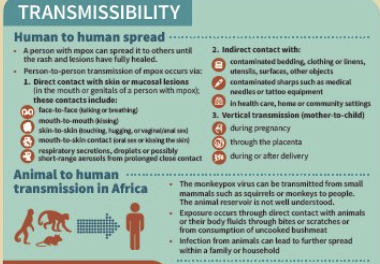
Clade Ia , which is transmitted primarily from animals to humans and then within households through touch, has been endemic in Africa for decades.
Clade Ib is a new strain that is primarily contracted through sexual contact. This is the strain that has spread rapidly across 21 African countries during the current outbreak in East and Central Africa.
This dual transmission makes the fight against MPOX even more complicated: how do we tackle a public health crisis rooted both in intimate human relationships and in structural inequalities such as living in crowded areas?
Although the strains are treated clinically similarly, their spread and transmission differ.
Clade Ia is primarily associated with zoonotic (animal-to-human) transmission in rural areas. Animal surveillance and community education are needed to control spillovers.
Clade Ib, which has higher human-to-human transmissibility, requires intensified contact tracing, vaccination and preventive measures in urban and peri-urban areas.
Adapting strategies to these differences is essential to contain the epidemic.
When Condoms Don't Work
Pakadjuma, in the northeast of the city, is known for its poverty and high crime rates. For many girls and young women, sex work is the only option available to survive.
One of the most pressing challenges in combating the virus in the region is curbing sexual transmission.
Unlike HIV, for which condoms can significantly reduce the risk of spread, smallpox poses a different problem: because the virus is transmitted by touch, there is no practical preventative measure for sexual transmission other than total abstinence.
Smallpox lesions develop in the groin, making any movement excruciating. For these sex workers, abstinence is not an option. It would mean losing their livelihood and the ability to feed their children.
As for their clients, who come from all over the city, they would have to change a key aspect of their lives for a disease they consider less deadly than Ebola . There is no easy answer to this dilemma.
Trace the spread
Contact tracing, a cornerstone of epidemic control, is another obstacle.
Identifying and tracing contacts of sex workers is complex. As a result, only a tiny fraction of MPOX cases are confirmed by laboratory testing.
On average, each mpox case has about twenty contacts, but it is virtually impossible to trace the clients of a highly confidential sex network.
In the absence of effective contact tracing, infected people remain in the community and often only seek treatment when their condition worsens. Discussions with Médecins Sans Frontières staff in the triage area show that suspected cases of COPD usually arrive at an advanced stage of the disease, when symptoms are clearly visible. Many patients first try other remedies, such as traditional healing methods, before seeking medical care.
Fortunately, Kinshasa has a strong network of laboratories led by the National Institute of Biomedical Research, and test results are available within 48 to 72 hours. This cutting-edge institute was created by Dr. Jean Jacques Muyembe , the microbiologist who discovered the Ebola virus.
During the first week of January 2025, there were 1,155 confirmed cases and 27 deaths in the city, according to the DRC Ministry of Health.
Even for those seeking treatment at specialist centres to combat the disease, navigating the chaotic and congested roads is a nightmare. The yellow minibuses - known locally as the "spirit of death" - are packed and it can take hours to reach their destination.
With the number of patients increasing, the city's MPOX treatment centres are overwhelmed.
The fight on all fronts
The fight against the MPOX epidemic in Kinshasa requires a multifaceted approach:
Vaccination: Widespread vaccination campaigns offer the best hope for controlling the outbreak in hotspots such as Pakadjuma, where contact tracing is nearly impossible. In these cases, the entire community must be vaccinated.
This could break chains of transmission while allowing those at risk, such as sex workers, to continue to work.
Prevention and control: Home-based care is essential, especially in informal settlements like Pakadjuma. Providing food and material support to patients and their families and encouraging isolation of infected relatives will help limit the spread of the disease.
These measures, however, require a new way of thinking as people try to survive day to day.
Engaging with the community: This is difficult because of the stigma surrounding the disease, but it must be at the heart of the response.
Amplify the message: Media, local leaders and trusted community members must be mobilized to get the message across effectively.
All this must be done without delay, otherwise the epidemic will be almost impossible to contain in this vast and sprawling city. The consequences would be disastrous.
https://theconversation.com/mpox-en...donville-de-kinshasa-en-premiere-ligne-248564