• FluTrackers.com Inc. does not provide medical advice. Information on this web site is collected from various internet resources, and the FluTrackers board of directors makes no warranty to the safety, efficacy, correctness or completeness of the information posted on this site by any author or poster. The information collated here is for instructional and/or discussion purposes only and is NOT intended to diagnose or treat any disease, illness, or other medical condition. Every individual reader or poster should seek advice from their personal physician/healthcare practitioner before considering or using any interventions that are discussed on this website. By continuing to access this website you agree to consult your personal physican before using any interventions posted on this website, and you agree to hold harmless FluTrackers.com Inc., the board of directors, the members, and all authors and posters for any effects from use of any medication, supplement, vitamin or other substance, device, intervention, etc. mentioned in posts on this website, or other internet venues referenced in posts on this website.
  • We are not asking for any donations. Do not donate to any entity who says they are raising funds for us.

Discussion: Chinese Academy of Sciences (CAS) in Wuhan has been working with bats and coronavirus for many years - DNA manipulations, cloning.... - Ja

Source: https://thebulletin.org/2022/08/nih...o-deliver-information-on-coronavirus-studies/


NIH to terminate EcoHealth Alliance grant after its Wuhan partners refuse to deliver information on coronavirus studies
By Matt Field | August 24, 2022

The National Institute of Health (NIH) is partially terminating a grant to a nonprofit that worked extensively with the Wuhan Institute of Virology on bat coronavirus research. In letters posted by Republicans on the House Oversight Committee this month, an NIH official said EcoHealth Alliance had not been able to hand over lab notebooks and other records from its Wuhan partner that relate to controversial experiments involving modified bat viruses, despite multiple requests.

In an Aug. 19 letter to Kentucky Rep James Comer, the top Republican member of the US House Oversight Committee, Michael Lauer, the deputy director of extramural research at NIH, said the agency had informed EcoHealth that it was terminating the sub-award to the Wuhan Institute of Virology “for failure to meet award terms and conditions requiring provision of records to NIH upon request.”

The termination notice comes after the NIH chided EcoHealth last fall for not immediately notifying the agency after its experiments showed modified coronaviruses replicated at a faster rate in experimental mice than an unmodified virus. The agency then asked for lab notebooks and other files pertaining to the experiments, and EcoHealth reported that it would relay the request to the Wuhan Institute of Virology. According to the new NIH letters, the Wuhan institute never delivered...
 
Originally posted on this thread in April 2020 (post #80).


You can judge the amount of work by the volume of publications especially those with high citations. It’s indisputable that Wuhan has worked on this since at least mid-2000s, and some really groundbreaking work has come out of that team in recent years. The Wuhan Institute of Virology (WIV) was a BSL3 lab that upgraded to BSL4 in 2018, but by checking author affiliations, we know that some of the work involving dissection of bats to recover e.g. hantavirus is done at the Wuhan CDC (WHCDC) lab which is only BSL2 but which is <300m from the seafood market, plus also being right next door to the hospital with first major HCW outbreak in Dec, from asymptomatic neurosurgical patient.

In fact, this is a district with a large number of hospitals, and one can just as easily say the outbreak started with patients that arrived in those hospitals in that district, people who worked, lived, went to market there. Everything, market, lab, hospitals, are within 1km of each other, except for the WIV lab which is 9 miles away.

The conventional wisdom was bats are the natural reservoir, but bat CoV are not well adapted enough to jump directly to humans, and an intermediate host is required (e.g. civets or camels for MERS). So when a new virus of such transmissibility appears, one of the most urgent things to do is to try and find the intermediate host, because you know, it could still be spreading. Suspicions were first aroused because of the unusual behavior of the Wuhan authorities. Guan Yi was the HKU expert (top 11th cited in microbiology in world) who uncovered the connection with civets in 2003. He went to Wuhan mid-January and then gave an extraordinary interview, that a) the market was shut and decontaminated b) he was denied access to market or any environmental samples taken c) he knocked on several doors of scientific community but "epidemiology experts and scientists do not seem to be welcomed in the city."

That is a red flag, and it's been reinforced by the fact that Chinese researchers don’t seem particularly keen to work on this either. Wuhan is a center of expertise on this very subject, it’s inconceivable that they would decontaminate the market without taking animal samples. That’s like a researcher’s dream to be the first to identify the source. So either they were actively stopped, or they did take samples but kept quiet. (Raw data from environmental as opposed to animal samples have since been shared privately between researchers but not published, and it appears that these are poorly labelled with regards to where exactly they were taken. These partial sequences match patient samples, so they could well be from human shedding only.) The other thing is, even if that market was closed, it would be reasonable to go and take samples from other wildlife markets, because the stuff was being sold on the streets all through January. Nobody has published anything, even though a ton has been published on all other aspects of this outbreak, including from WIV scientists. The data from market surveillance is so important that even negative results would have been useful (perhaps too useful).

I’m skeptical in general with the bioweapons theory because it’s hard to control a respiratory virus, but I looked into some of these allegations, specifically that the virus may have been subject to human engineering because certain mutations seem suspiciously well adapted to humans or appear to be similar to other sequences from other viruses. But here’s the thing. There’s still a vast universe of bat CoV that’s not yet mapped, but the ones already sequenced show a great deal of heterogeneity and recombination (i.e. these viruses in the wild are mixing and exchanging genetic materials all the time), plus if you dig deeper, there’s published data that some of these specific regions are in fact found in wild-type bat-CoV, so it isn’t as unusual as some would make out, to find such features. Plus, it’s a basic requirement that a virus has to acquire human adaptations to be capable of h2h transmission, so it just seems circular logic to assert human intervention on such grounds alone.

With the 2003 virus, it was found that viruses found in humans and civets were very similar, with a mutation that allow the virus to bind to human-type ACE2 receptors, which was absent from the corresponding bat SLCoV. Since then many labs have done sampling of bat CoV from all over China. Despite diversity, not one sample showed the human-adapted receptor binding domain RBD, so it was believed that bat CoV would have difficulty infecting humans without adaptation via an intermediate host. Secondly, nobody had ever isolated a live bat-SL-CoV, one that could be grown in cell culture.

All that changed in 2013 when the WIV published a study, based on 5 years of surveillance of a particular bat population in Yunnan. link They found a bunch of bat-SL-CoV and published 2 representative sequences. For the first time, these had the human-adapted RBD mutation. Also, they were able to isolate a live virus, now called WIV1, with which they were able to do experiments. Prior to this experiments were done with genetically engineered viruses using the sequence under investigation on a backbone of a virus that’s lab-adapted to infect e.g. mice but is otherwise harmless. This is common practice. But now they had this wild-type virus with a human-adapted RBD, which is a whole different ballgame. On top of that, they took samples from villagers and found some of them had antibodies to this wild-type bat virus, thus showing that no intermediate host is required for human infection, although no evidence of h2h was found. All sorts of alarm bells started ringing and other labs started collaborating; one paper was explicitly titled SARS-like WIV1-CoV poised for human emergence.by researchers from N Carolina, Harvard, FDA, Switzerland, a whole who’s who of this field. link

Amazingly before 2002 the WIV lab was an agricultural lab (insect-borne viruses and pesticide testing), but converted to work on human pathogens in 2003, the same year during which approval was given to convert from BSL3 to BSL4. That seems a degree of haste, but in line with China government policy on rapid expansion of biotech sector. By the time construction was finished in 2015 (but before certification for actual research 2018) 3 other BSL4 were in various stages of completion. This is reminiscent of Chernobyl, when the Soviets brought nuclear power plants online without prototype and without sufficient time for the first one to be robustly tested. It doesn’t help that the French institute that was supposed to build the lab had its contract prematurely terminated and the Chinese finished the work on its own (having copied/stolen the plans to build the other 3). This hastiness is reckless, but also prompts suspicion of dual use intentions, because one can always do with more power plants, but the amount of civilian, medical research that requires such capabilities is kind of limited. SARS itself requires only BSL3, but experiments with non-human primates would require BSL4. In the 2013 paper and others that followed, they described transmission experiments in mice with WIV1 plus some chimera viruses with the human ACE2 affinity. The next logical step from rodents would be primates, but even smaller mammals they were using such as raccoon cats (simulating civets) would have been perfectly adequate intermediate hosts that could, if biosecurity was lax, result in a human-adapted virus escaping the lab. We already know that the 2003 virus escaped numerous times from a Beijing lab. Bear in mind their own finding, that you don’t even need an intermediate host.

With all that in mind, now check this out. In Jan, scientists studied the new virus in comparison to known sequences in the public database, and found some that were 89% match. And then, a bomb shell. The WIV lab published that the closest match 96% is actually a sequence RaTG13, from their own collection from the 2013 Yunnan studies. At first it was mystifying, because the paper did not give citations for RaTG13. Turns out this sequence was submitted to GISAID database (for researchers) only on Jan 27 2020, by the very same WIV lab! In other words, the closest match for this pandemic virus is a sample they’ve had in their lab but left unpublished all these years. Now, having a sequence is not the same as having a virus, and not publishing all your findings is not necessarily a sign of nefarious intentions, but at a minimum it shows that the same set of samples that produced the by-now well studied WIV1 group, also contained all along the closest one to this pandemic virus. And, as we know, they’ve been working hard at this, doing all sorts of experiments, all along.

One can still stick with the eating wildlife story, as many still do, and I can’t discount it, but what’s the statistical probability that this once-in-a-century virus would emerge, of all places, out of the millions of wet markets in China, in the exact same city that is on the forefront of this research, that hosts the lab with the closest sequence?

The possibility of lab escape is not hot air, with the WIV, but there’s also the WHCDC. On the surface, they appear to be working on viruses that do not require higher biosafety (BSL2 = general hospital precautions), but who knows?. I read one paper from that lab on hantavirus, and it is concerning, because for this study they were capturing wild animals, a total of 450 bats, 81 insectivores and 2 shrews from different provinces, all kept alive in cages until they were dissected. So if we were to ask, where in the city of Wuhan could you find large numbers of bats kept in close proximity with other wild animals so that the virus could cross species, well, by all accounts, no bats were found in the wet market, but lo and behold, you can find these exact conditions in the WHCDC lab. The bats in the study were from different provinces including Yunnan although not from same region as the 2013 samples, but some were of the same genus that carried RaTG13. So while they might have thought they were working on the hantavirus, did they not realize that CoV was also in there, being shed all over the place? And that’s just one study; I’m sure that line of work has been ongoing for some years.

We know that in the wild mixing and recombination among bat SL-CoV is very common, but the diversity at one single location is still limited geographically. Plus RBD is never the whole story, and even 96% similarity is quite a ways off from human adaptation. For a bat virus to get to h2h, most likely several changes are needed. It’s likely these mutations already exist in the wild, but not necessarily in the same virus, and most importantly not in the same geographic location. One particular mutation may be prevalent in a cave in Yunnan, but another may exist only in Zhejiang or elsewhere, so they would not have a chance to meet and mix, except now they’re being collected and brought together, not just as blood or swab samples as in the WIV study, but as live animals. Bats are naturally sequestered in their habitats, but when you remove them and put them together with those from other locations, and/or with other animals, you drastically increase the chance of mixing until eventually you hit the (pandemic) jackpot. And if you do that in a metropolis with 11 million people that’s also a transport hub, as opposed to a remote cave in Yunnan, and only under BSL2, technically you may not be deliberately making a bioweapon, but you ought to be accountable for the consequences just the same. Just saying.

More on biosafety. One author of the hantavirus paper, who also published other work in collaboration with WIV on CoV (working in both labs appears to be a common practice), had gotten some national fame for working on bat viruses, having described in media interviews being splashed with bat blood, and being peed on by bats in caves. On both occasions, he recounted having to self-quarantine for 14 days, so they understood perfectly well their exposure risk. I’m not sure, though, that BSL2 containment measures are sufficient for say, disposal of contaminated waste with such pathogens. I’m not just talking about carelessness and lack of adherence to protocol, both rampant in China. There’s also a whole underground industry of re-packaging medical waste to be sold as new, from syringes, IV sets to bandages and test swabs. Also the sale of ‘surplus’ experimental animals for meat, which in one officially reported case resulted in millions in profit. So biological waste is one entirely plausible route, for a virus with pandemic potential, to leak into the community.

Another equally plausible but less dramatic possibility would be quite simply someone got infected but was either asymptomatic or had such mild symptoms that they never got tested, but nevertheless infected others, as we now know happens frequently with this virus. The seemingly explosive transmission at the wet market is likely to be a super-spreader event, which has happened so many time all over the world that it should no longer be a curiosity, and certainly not an indicator of origins.



Richard H. Ebright

@R_H_Ebright
COVID: summary of lab-origin hypothesis: 1) Pandemic caused by a bat SARS-like coronavirus emerged in Wuhan--a city 1,000 miles from nearest wild bats with SARS-like coronaviruses, but that contains labs conducting world's largest research program on bat SARS-like coronaviruses.
12:30 PM · Sep 5, 2022·Twitter Web App
5,238
Retweets
741
Quote Tweets
17.5K
Likes

Tweet your reply

Reply
Richard H. Ebright

@R_H_Ebright
·
Sep 5
Replying to
@R_H_Ebright
2) In 2015-2017, scientists and science-policy specialists expressed concern that the Wuhan Institute of Virology (WIV) was conducting and contemplating research that posed an unacceptable risk of lab accident and pandemic (https://nature.com/articles/nature.2017.21487…; https://nature.com/articles/nature.2015.18787…),

nature.com
Engineered bat virus stirs debate over risky research
Nature - Lab-made coronavirus related to SARS can infect human cells.
26
622
3,164
Richard H. Ebright

@R_H_Ebright
·
Sep 5
3) In 2017-2018, WIV constructed a novel chimeric SARS-like coronavirus that was able to infect and replicate in human airway cells and that had 10,000x enhanced viral growth and 4x enhanced lethality in mice engineered to display human receptors on cells.
14
346
2,405
Richard H. Ebright

@R_H_Ebright
·
Sep 5
4) In 2018, in an NIH grant proposal, WIV and collaborators proposed to construct more novel chimeric SARS-like coronaviruses, targeting chimeras that replace natural spike gene with novel spike genes encoding spikes that have higher binding affinities to human cells.
14
296
2,119
Richard H. Ebright

@R_H_Ebright
·
Sep 5
5) Also in 2018, in a DARPA grant proposal, WIV and collaborators proposed to construct novel "consensus" bat SARS-like coronaviruses, and to insert furin cleavage site (FCS) sequences at the spike gene S1-S2 border of bat SARS-like coronaviruses,
13
280
1,963
Richard H. Ebright

@R_H_Ebright
·
Sep 5
6) In 2017-2019, WIV constructed and characterized novel SARS-like coronaviruses at biosafety level 2, a biosafety level patently inadequate for work with enhanced potential pandemic pathogens and patently inadequate to contain a virus having transmission properties of SARS-CoV-2
8
250
1,930
Richard H. Ebright

@R_H_Ebright
·
Sep 5
7) In 2019 a novel SARS-like coronavirus having a spike with high binding affinity for human cells, and having an FCS at the spike S1-S2 border--a virus having the properties set forth in the 2018 WIV NIH and DARPA grant proposals--emerges on the doorstep of WIV.
8
287
2,034
Richard H. Ebright

@R_H_Ebright
·
Sep 5
8) SARS-CoV-2 is the only one of more than 100 known SARS-like coronaviruses that contains an FCS. This is a feature that does not rule out a natural origin, but that is more easily explained by a lab origin. Especially since insertion of FCS had been explicitly proposed in 2018.
9
363
2,335
Richard H. Ebright

@R_H_Ebright
·
Sep 5
9) The FCS of SARS-CoV-2 has codon usage unusual for bat SARS-related coronaviruses and has an 8-of-8 amino-acid-sequence identity to the FCS of human ENaCa. These are features that do not rule out a natural origin, but that are more--much more--easily explained by a lab origin.
7
275
2,104
Richard H. Ebright

@R_H_Ebright
·
Sep 5
10) In 2020-present, WIV and its funders/collaborators at EcoHealth Alliance have withheld information, misrepresented facts, and obstructed investigation...even though, if not connected to origin, they most easily could clear their name though cooperation with investigation.


---------------------------------------------------------------------------


Justin B. Kinney
@jbkinney
·
Sep 5
Good summary of the publicly available evidence for SARS-CoV-2 having a lab leak origin, as opposed to a natural zoonotic origin. This evidence is not dispositive, but were the lab leak hypothesis incorrect, it would represent a staggering set of coincidences.
Quote Tweet
QKnVZiPX_normal.jpg

Richard H. Ebright
@R_H_Ebright
· Sep 5
COVID: summary of lab-origin hypothesis: 1) Pandemic caused by a bat SARS-like coronavirus emerged in Wuhan--a city 1,000 miles from nearest wild bats with SARS-like coronaviruses, but that contains labs conducting world's largest research program on bat SARS-like coronaviruses.
Show this thread
24
143
500
Justin B. Kinney
@jbkinney
·
Sep 5
I for one find this evidence much more compelling than the evidence recently published by Worobey et al. and Pekar et al. in Science.
5
5
82Justin B. Kinney Retweeted
 
https://www.thelancet.com/journals/lancet/article/PIIS0140-6736(22)01585-9/fulltext#
The Lancet Commission on lessons for the future from the COVID-19 pandemic
Published:September 14, 2022DOI:https://doi.org/10.1016/S0140-6736(22)01585-9
....

The second possible pathway is a research-related or laboratory-associated release of the pathogen. Such a pathway could have involved a researcher becoming infected in the field or in the laboratory with a natural virus, or becoming infected in the laboratory with a genetically manipulated virus. Advances in biotechnology in the past two decades have made it possible to create new and highly dangerous pathogens through genetic manipulation—for example, creating chimeric viruses by combining the genetic material of more than one viral pathogen, or mutant viruses through the deliberate insertion of a furin cleavage site. The bioengineering of SARS-CoV-like viruses for the study and testing of potential drugs and vaccines advanced substantially after the outbreak of severe acute respiratory syndrome in the 2000s.[SUP]52[/SUP]
[SUP], [/SUP][SUP]64[/SUP]
Laboratory experiments included the creation of novel viruses (eg, so-called consensus viruses that average the genetic code across a set of natural viruses), the mutation of viruses (such as through the insertion of a furin cleavage site), the creation of chimeric viruses, and the serial passaging of viruses through cell cultures to test their transmissibility, virulence, immunogenicity, and host tropism. Research that can increase the transmissibility and virulence of pathogens is called gain-of-function research of concern, although which specific experiments should fall into this category is contested by scientists. As laboratory technologies have rapidly advanced, many scientists have warned of the increasing risks of undersupervised and under-regulated genetic manipulation of SARS-CoV-like viruses and other potential pandemic pathogens.[SUP]65[/SUP]
There is currently no system for the global monitoring and regulation of gain-of-function research of concern.

As of the time of publication of this report, all three research-associated hypotheses are still plausible: infection in the field, infection with a natural virus in the laboratory, and infection with a manipulated virus in the laboratory. No independent, transparent, and science-based investigation has been carried out regarding the bioengineering of SARS-like viruses that was underway before the outbreak of COVID-19. The laboratory notebooks, databases, email records, and samples of institutions involved in such research have not been made available to independent researchers. Independent researchers have not yet investigated the US laboratories engaged in the laboratory manipulation of SARS-CoV-like viruses, nor have they investigated the details of the laboratory research that had been underway in Wuhan.[SUP]47[/SUP]
Moreover, the US National Institutes of Health (NIH) has resisted disclosing details of the research on SARS-CoV-related viruses that it had been supporting,[SUP]66[/SUP]
providing extensively redacted information only as required by Freedom of Information Act lawsuits.[SUP]67[/SUP]


In brief, there are many potential proximal origins of SARS-CoV-2, but there is still a shortfall of independent, scientific, and collaborative work on the issue. The search for the origins of the virus requires unbiased, independent, transparent, and rigorous work by international teams in the fields of virology, epidemiology, bioinformatics, and other related fields, and supported by all governments....
______________________________

Hat tip RT.
 
WHO responds to The Lancet COVID-19 Commission

15 September 2022

WHO welcomes the overarching recommendations of The Lancet COVID-19 Commission’s report on “Lessons for the future from the COVID-19 pandemic,” which align with our commitment to stronger global, regional and national pandemic preparedness, prevention, readiness and response.

At the same time, there are several key omissions and misinterpretations in the report, not least regarding the public health emergency of international concern (PHEIC) and the speed and scope of WHO’s actions. ...

WHO’s rapid response

The Commission does not, however, convey the full arc of WHO’s immediate, multi-year, life-saving response, detailed below:
  • On 30 December 2019, WHO received the first alerts of cases of pneumonia of unknown cause in Wuhan, China, and notified the IHR focal point, seeking further information from Chinese health authorities the next day.
  • On 1 January 2020, WHO activated its Incident Management System to manage daily action. The team, which includes focal points on clinical care, infection prevention and control, diagnostics, logistics, communications and more, met daily throughout 2020, into 2021 and continues to meet this year.
  • On 5 January 2020, WHO issued a global alert to all Member States through a formal IHR system – the Event Information System – based on our initial risk assessment of the situation in China. This alerted Member States and advised them to take measures to identify cases, care for patients, and prevent infection and onward human-to-human transmission for acute respiratory pathogens with epidemic and pandemic potential. This was WHO’s first global warning to take concrete measures for an unknown respiratory disease. WHO has consistently driven knowledge-sharing through dedicated briefings for countries, during which the critical experiences of early-affected countries were shared and the elements of WHO’s comprehensive response were outlined.
  • On 9 January 2020, WHO convened the first of many teleconferences with established global expert networks, to discuss all available information on the cluster reported from China. These networks enabled the real-time exchange of direct knowledge, experience and early study findings, which fed directly into WHO’s early advice and recommendations.
  • Between 10 and 12 January 2020, WHO published a comprehensive package of technical guidance for countries. This package covered how to test for a high threat respiratory coronavirus, treat patients for severe acute respiratory infection, inform the public to prevent infection and human- to-human transmission, and to prepare health systems to deal with more cases.
  • On 13 January 2020, WHO published the first protocol to develop PCR tests to identify cases based on the release of the full genome sequence two days earlier. By 2 February 2020, WHO began shipping validated PCR assays to countries around the world.
  • On 22 and 23 January 2020, when there were nine cases and no deaths reported outside China, the Director-General convened the Emergency Committee (EC) under the IHR to meet, and advise whether the event constituted a public health emergency of international concern (PHEIC). The Committee advised that it did not. The Director-General saidpublicly: “Make no mistake. This is an emergency in China, but it has not yet become a global health emergency. It may yet become one”.
  • From 27 to 28 January, following the EC, the Director-General and senior staff travelled to China to meet with top government officials, gather information about the outbreak and seek cooperation.
  • On 30 January 2020, when there were 98 reported cases (and no deaths) in 18 countries outside China, the Director-General reconvened the Emergency Committee. It advised that the outbreak constituted a PHEIC. The DG took their advice and declared a PHEIC, issuing temporary recommendations for how countries could further prepare and respond.
  • On 4 February 2020, WHO’s Strategic Preparedness and Response Plan (SPRP) was published. It outlined comprehensive measures all countries needed to take to suppress transmission and save lives, using a package of interventions including early identification and isolation and care of cases, contact tracing and supported quarantine, use of medical masks, distancing, ventilation, infection prevention and control in health facilities, taking a risk-based approach to small and large gatherings, and for travel.
  • Following regular media briefings held in January, daily briefings began on 5 February 2020. Media briefings continue on a weekly basis, alongside regular live social media conversations with senior WHO experts, demonstrating the priority placed on communicating with leaders and the public.
  • From 11 to 12 February 2020, WHO led a Global Research and Innovation Forum on the new virus, convening nearly 900 experts and funders from more than 40 countries, to take stock of what was known about the novel coronavirus and to set the agenda going forward. A follow-up achievement was WHO’s Solidarity trial, which became one of the largest clinical trials for COVID-19 therapeutics, involving more than 30 countries, over 14 000 patients and nearly 500 hospitals at its peak. ...
https://www.who.int/news/item/15-09-2022-who-responds-to-the-lancet-covid-19-commission
 

Ashley Rindsberg
@AshleyRindsberg
The incredible thing about my story on Harvard, Evergrande, China and Fauci is it's not even the whole story. The key (not in my piece) is that
@harvardmed
was party to the gain-of-function research called a "prototype" for lab-made SARS-Cov-2: https://twitter.com/AshleyRindsberg/status/1570354711223492608…
Quote Tweet
xnA9WAuY_normal.jpg

Marty Makary MD, MPH
@MartyMakary
· Sep 16
Evergrande, a company with close ties to the Chinese Communist Party, donated $115M to Harvard Med Sch. Days after the donation, Harvard-linked experts (some who had proposed a lab leak origin) suddenly changed their position, condemning the lab leak idea https://spectatorworld.com/topic/fauci-harvard-and-the-ccp/…
5:37 AM · Sep 18, 2022·Twitter Web App
 
https://www.federalregister.gov/doc...on-for-a-sustainable-safe-and-secure-american
Advancing Biotechnology and Biomanufacturing Innovation for a Sustainable, Safe, and Secure American Bioeconomy


A Presidential Document by the Executive Office of the President on 09/15/2022

...
Simultaneously, we must take concrete steps to reduce biological risks associated with advances in biotechnology. We need to invest in and promote biosafety and biosecurity to ensure that biotechnology is developed and deployed in ways that align with United States principles and values and international best practices, and not in ways that lead to accidental or deliberate harm to people, animals, or the environment. In addition, we must safeguard the United States bioeconomy, as foreign adversaries and strategic competitors alike use legal and illegal means to acquire United States technologies and data, including biological data, and proprietary or precompetitive information, which threatens United States economic competitiveness and national security.
...
(h) elevate biological risk management as a cornerstone of the life cycle of biotechnology and biomanufacturing R&D, including by providing for research and investment in applied biosafety and biosecurity innovation;
...

b) Each report specified in subsection (a) of this section shall identify high-priority basic research and technology development needs to achieve the overall objectives described in subsection (a) of this section, as well as opportunities for public-private collaboration. Each of these reports shall also include recommendations for actions to enhance biosafety and biosecurity to reduce risk throughout the biotechnology R&D and biomanufacturing lifecycles.
...

Sec. 9 . Reducing Risk by Advancing Biosafety and Biosecurity. (a) The United States Government shall launch a Biosafety and Biosecurity Innovation Initiative, which shall seek to reduce biological risks associated with Start Printed Page 56856 advances in biotechnology, biomanufacturing, and the bioeconomy. Through the Biosafety and Biosecurity Innovation Initiative—which shall be established by the Secretary of HHS, in coordination with the heads of other relevant agencies as determined by the Secretary—agencies that fund, conduct, or sponsor life sciences research shall implement the following actions, as appropriate and consistent with applicable law:

(i) support, as a priority, investments in applied biosafety research and innovations in biosecurity to reduce biological risk throughout the biotechnology R&D and biomanufacturing lifecycles; and

(ii) use Federal investments in biotechnology and biomanufacturing to incentivize and enhance biosafety and biosecurity practices and best practices throughout the United States and international research enterprises.

(b) Within 180 days of the date of this order, the Secretary of HHS and the Secretary of Homeland Security, in coordination with agencies that fund, conduct, or sponsor life sciences research, shall produce a plan for biosafety and biosecurity for the bioeconomy, including recommendations to:

(i) enhance applied biosafety research and bolster innovations in biosecurity to reduce risk throughout the biotechnology R&D and biomanufacturing lifecycles; and

(ii) use Federal investments in biological sciences, biotechnology, and biomanufacturing to enhance biosafety and biosecurity best practices throughout the bioeconomy R&D enterprise.
...

(vii) develop, and work to promote and implement, biosafety and biosecurity best practices, tools, and resources bilaterally and multilaterally to facilitate appropriate oversight for life sciences, dual-use research of concern, and research involving potentially pandemic and other high-consequence pathogens, and to enhance sound risk management of biotechnology- and biomanufacturing-related R&D globally; and

(viii) explore how to align international classifications of biomanufactured products, as appropriate, to measure the value of those products to both the United States and global bioeconomies...
 
https://www.msn.com/en-gb/news/worl...-ppe-months-before-covid-outbreak/ar-AA12KtJf
The Telegraph
China ‘began stockpiling PPE months before Covid outbreak’

Ashley Rindsberg - Yesterday 14:21

China began severely restricting the export of personal protective equipment (PPE), such as gowns and masks, months before notifying the world of the outbreak of Covid-19, it has emerged.
PPE exports to the US fell by around 50 per cent between August and September of 2019, in a significant drop which raised alarm bells at key US government agencies.

China also started to buy up global PPE stocks in Europe, Australia and the US around the same time, experts said.

The fall in PPE supplies exiting China, the world’s biggest manufacturer of PPE, raises new questions about the true timeline of the emergence of SARS-CoV-2.

An altered timeline would significantly challenge the theory that the pandemic originated from a seafood market in Wuhan, where the first cases emerged in December 2019.

The anomaly was uncovered by former US government officials including Dr Tom McGinn, a Senior Health Advisor at the Department of Homeland Security (DHS), and Colonel John Hoffman, a Senior Research Fellow with the Food Protection and Defence Institute whose career spans decades in US government and military.

The pair were unconvinced that the virus had started at the Wuhan Wet Market in December 2019, after and began looking for an alternative theory.

After scouring a Customs and Border Protection database which tracks goods entering the US, they noticed China had started hoarding PPE far earlier than the initial date of the outbreak...
 
Alex Washburne


19h • 24 tweets • 7 min read Bookmark Save as PDF My Authors
Pre-print:

Endonuclease fingerprint indicates a synthetic origin of SARS-CoV-2

A collaborative product by @VBruttel, @tony_vandongen, and myself.

Here's what we found:

biorxiv.org/cgi/content/sh…

1/
The origin of SARS-CoV-2 is unknown.

Some hypothesized 2 spillover events at the wet market, but methodological flaws make that work inconclusive.

biorxiv.org/content/10.110…

Unroll available on Thread Reader

We need to know the true origin of SARS-CoV-2 to prevent pandemics.

2/

Statistical challenges for inferring multiple SARS-CoV-2 spillovers with early outbreak phylodynamicsUnderstanding how SARS-CoV-2 entered the human population, thereby causing the COVID-19 pandemic, is one of the most urgent questions in science today. Two hypotheses are widely acknowledged as being …https://www.biorxiv.org/content/10.1...10.10.511625v1
We examined whether SARS-CoV-2 was synthesized in a lab.

We studied a common method for synthesizing CoVs in the lab.

This method was thought to not leave a fingerprint.

We found the fingerprint.

That fingerprint is in the SARS-CoV-2 genome.

3/
Here's how you make a CoV in the lab:

To make a 30kb RNA virus in the lab, you need a 30kb DNA clone

To assemble a 30kb DNA clone, scientists glue together several smaller fragments

A popular method for DNA assembly is ‘golden gate assembly’

en.wikipedia.org/wiki/Golden_Ga…
4/

Golden Gate Cloning - Wikipediahttps://en.wikipedia.org/wiki/Golden_Gate_Cloning
Golden gate assembly requires the DNA sequence have special “cutting” sites (type IIS restriction sites).
Cutting sites creates 3-4 nt “sticky ends”

Sticky ends help you ‘paste’ DNA segments together, ensuring faithful assembly of your 30kb DNA copy of a viral genome.

5/
RNA viruses like CoVs are not under selection specifically for this kind of cutting & pasting.

So, wild viruses tend to have cutting/pasting sites randomly scattered in their genome.

Researchers building viruses in a lab will often add/remove cutting sites…

6/
We collected examples of CoV infectious clones assembled with these type IIS cutting/pasting systems from 2000-2019.

We found a clear pattern in how researchers tended to add/remove cutting/pasting sites.

7/
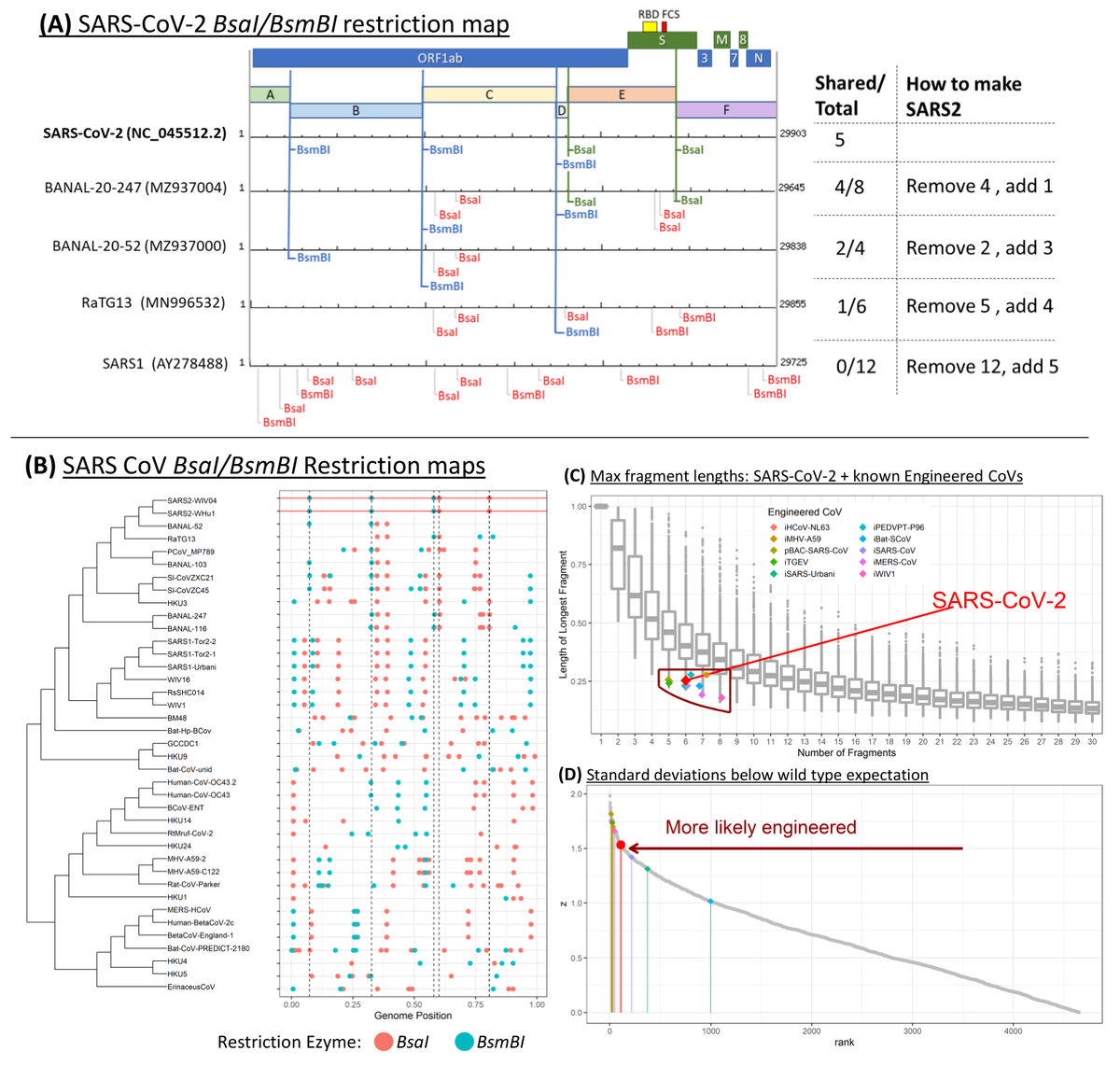
Researchers tend to turn randomly-spaced restriction maps into regularly-spaced ones (A-B).

Regular spacing comes from desiring fewer fragments (typically 5-8) while keeping the longest fragment lengths low.

8/
Digesting 70 CoVs with 200+ restriction enzymes yields a “wild type distribution”, a null model for how long the longest fragment may be as a function of the number of fragments.

The red box is the ideal range for reverse genetic systems used to make infectious clones

9/
CoVs engineered to be infectious clones will move from having restriction maps falling within the wild type distribution…

To being outliers under the wild-type distribution, falling within the lab-ideal range of fragment number & low longest-fragment-length

10/
Having found this fingerprint, we examine specific cutting/pasting sites in the SARS-CoV-2 genome (BsaI/BsmBI)

BsaI + BsmBI are very popular enzymes for this kind of in vitro assembly

They also have many conserved sites in CoVs. Very useful for making chimeras.

11/
The SARS-CoV-2 BsaI/BsmBI restriction map falls neatly within the ideal range for a reverse genetic system

It is an anomaly (bottom 1%) amongst wild type CoVs.

It is a midpoint amongst engineered CoVs.

12/
Digesting CoVs with only type IIS enzymes that could be used for assembly, SARS-CoV-2 is an even greater outlier

It’s in the bottom 1% max-fragment-length for all restriction enzymes

It’s the single largest outlier (<0.07%) of 1491 type IIS digestions

13/
We then tested the lab-assembly hypothesis

If SARS2 has a synthetic origin via golden gate assembly, several other criteria must be met.

For example: all sticky ends must be unique, non-palindromic, and contain at least one A/T.

SARS2 passed this test (60% chance of this)

14/
The mutations separating SARS-CoV-2 BsaI/BsmBI sites from its close relatives must all be silent mutations.

All 14 mutations in BsaI/BsmBI sites are silent.

84% of mutations in SARS2 & close relatives are silent, so 9% chance all 14 distinct mutations will be silent.

15/
There’s a significantly higher concentration of silent mutations per nucleotide within BsaI/BsmBI recognition sequences than in the rest of the genome

P=0.004 for BANAL52-SARS2

P=9e-8 for RaTG13-SARS2

16/
Such an idealized reverse genetic system is unlikely to evolve by chance from the close relatives of SARS-CoV-2.

There’s a 1% of random RaTG13 mutants having as great or greater z-score

and 0.1% chance for BANAL52.

17/
Testing this from multiple angles, we could not reject the hypothesis that SARS-CoV-2 has a synthetic origin.

Each test also decreased the odds of SARS-CoV-2 having a natural origin

The BsaI/BsmBI fingerprint of SARS-CoV-2 indicates synthetic origin of SARS-CoV-2.

18/
Please read our MS for our careful language & limitations. These are important.

For example, our results are independent of the Furin Cleavage Site.

While the RBD is docked in fragment 5, we shine no light on the origin of the FCS.

19/
Our research does not identify the lab

We hypothesize this restriction map would enable construction of chimeric viruses...

much like the recent controversial work done in Boston (but with a different method for in vitro assembly)

vox.com/future-perfect…

20/

Why do labs keep making dangerous viruses?A controversial new study involving an engineered version of Covid’s omicron variant raises new questions about research oversight.https://www.vox.com/future-perfect/2...emic-biosafety
Our theory of a synthetic origin of SARS-CoV-2 can & should be tested.

Further tests may reject our theory

We welcome these tests.

Our code is available on GitHub and we point to future research that can reject our hypothesis and/or refine our understanding of this issue.

21/
Making chimeric viruses in vitro carries risks

We encourage transparency from researchers studying CoVs in Wuhan.

We strongly encourage global coordination on biosafety.

22/
We encourage open, civil, and compassionate discourse on this important topic

This pre-print was not rushed.

It was reviewed by many colleagues, truly world experts.

We thank them all immensely for their feedback.

23/
For a popular science write-up of our work, see below.

I’m eternally grateful for colleagues like @VBruttel and @tony_vandongen. This has been an incredible project.

Yet, for obvious reasons, this is the saddest paper I’ve ever written.

alexwasburne.substack.com/p/a-synthetic-…

24/24

A synthetic origin of SARS-CoV-2What we know, and what we don'thttps://alexwasburne.substack.com/p/...-of-sars-cov-2
• • •
 
Source: https://zenodo.org/record/7212687#.Y1KpvVLMJa4

October 9, 2022 Journal article Open Access
Zoonosis at the Huanan Seafood Market: A Critique

Zhang, Daoyu; Demaneuf, Gilles; Jones, Adrian; Massey, Steven E; Quay, Steven; Deigin, Yuri; Nemzer, Louis

Here we review data supporting a zoonosis hypothesis at the Huanan Seafood Market (HSM). We undertake statistical analysis of case locations and wildlife stall locations. We additionally analyze environmental sampling and review the likelyhood of susceptible animals carrying a SARS-CoV-2 projenitor virus causing a spillover in Wuhan and only Wuhan of all locations in China. We find insufficient data to support a zoonosis hypothesis and instead conclude that the most likely scenario is that an infected person brought SARS-CoV-2 to the HSM, sparking a superspreader event...
 
B19313128.svg

An Infectious cDNA Clone of SARS-CoV-2

13 May 2020

https://doi.org/10.1016/j.chom.2020.04.004

XupingXie[SUP]1 [/SUP]AntonioMuruato[SUP]1[/SUP][SUP]2 [/SUP]Kumari G.Lokugamage[SUP]2 [/SUP]KrishnaNarayanan[SUP]2 [/SUP]XianwenZhang[SUP]1 [/SUP]JingZou[SUP]1 [/SUP]JianyingLiu[SUP]2 [/SUP]CraigSchindewolf[SUP]2 [/SUP]Nathen E.Bopp[SUP]3 [/SUP]Patricia V.Aguilar[SUP]3[/SUP][SUP]4[/SUP][SUP]5 [/SUP]Kenneth S.Plante[SUP]2[/SUP][SUP]4 [/SUP]Scott C.Weaver[SUP]2[/SUP][SUP]4[/SUP][SUP]5[/SUP][SUP]6[/SUP][SUP]7[/SUP][SUP]8 [/SUP]ShinjiMakino[SUP]2[/SUP][SUP]5[/SUP][SUP]10 [/SUP]James W.LeDuc[SUP]2[/SUP][SUP]9 [/SUP]Vineet D.Menachery[SUP]2[/SUP][SUP]5[/SUP][SUP]7 [/SUP]Pei-YongShi [SUP]1[/SUP][SUP]5[/SUP][SUP]8[/SUP][SUP]10[/SUP][SUP]11[/SUP][SUP]12[/SUP]

Highlights

•A reverse genetic system has been established for SARS-CoV-2
•Recombinant SARS-CoV-2 replicates as efficiently as the original clinical isolate
•A stable mNeonGreen reporter SARS-CoV-2 has been developed
•The mNeonGreen SARS-CoV-2 can be used to screen antiviral inhibitors

Summary

The ongoing pandemic of COVID-19, caused by severe acute respiratory syndrome coronavirus 2 (SARS-CoV-2), underscores the urgency to develop experimental systems for studying this virus and identifying countermeasures. We report a reverse genetic system for SARS-CoV-2. Seven complimentary DNA (cDNA) fragments spanning the SARS-CoV-2 genome were assembled into a full-genome cDNA. RNA transcribed from the full-genome cDNA was highly infectious after electroporation into cells, producing 2.9 × 10[SUP]6[/SUP] plaque-forming unit (PFU)/mL of virus. Compared with a clinical isolate, the infectious-clone-derived SARS-CoV-2 (icSARS-CoV-2) exhibited similar plaque morphology, viral RNA profile, and replication kinetics. Additionally, icSARS-CoV-2 retained engineered molecular markers and did not acquire other mutations. We generated a stable mNeonGreen SARS-CoV-2 (icSARS-CoV-2-mNG) by introducing this reporter gene into ORF7 of the viral genome. icSARS-CoV-2-mNG was successfully used to evaluate the antiviral activities of interferon (IFN). Collectively, the reverse genetic system and reporter virus provide key reagents to study SARS-CoV-2 and develop countermeasures.

https://www.sciencedirect.com/science/article/pii/S1931312820302316?via%3Dihub
 
Here is a rebuttal to the paper in post #698:

Flo Débarre


3h • 13 tweets • 5 min read Bookmark Save as PDF My Authors
Here is a curated collection of threads and tweets rebutting a preprint that made the rounds, illustrating the many ways in which the study is problematic. ▫️1/n
Before we start:

- Disclaimer: I am a "dry-lab" evolutionary biologist. Part 3️⃣ is outside my strict domain of expertise.

- If you are unfamiliar with the names of the different restriction enzymes, here is how to pronounce them (sound on)▫️2/n

international.neb.com/products/restr…

https://international.neb.com/produc...-endonucleases
1️⃣ Evolution

SARS-CoV-2's BsaI/BsmBI restriction sites are consistent with expectations from evolutionary theory. They do not look anomalous.

1a) 🧵 ▫️3/n

Unroll available on Thread Reader

1b) 🧵▫️4/n

Unroll available on Thread Reader

1c) a tweet complementing to the two previous threads with another close relative of SARS-CoV-2 that was omitted by the preprint authors ▫️5/n


2️⃣ Statistics

2a) The statistical analysis done in the preprint is an example of P-hacking*

*If you think they got the restriction enzymes right on their first try, see part 3 ▫️6/n


2b) The preprint authors are looking for even spaced fragments, but did their stats only on the length of the longest fragment. ▫️7/n


Endonuclease fingerprint indicates a synthetic origin of SARS-CoV-2To prevent future pandemics, it is important that we understand whether SARS-CoV-2 spilled over directly from animals to people, or indirectly in a laboratory accident. The genome of SARS-COV-2 contai…https://disq.us/p/2rj2xh2
3️⃣ Molecular biology

3a) The standard way of using the restriction enzymes picked in the preprint would not lead to SARS-CoV-2, because the restriction sites would be gone in the final product…▫️8/n

Unroll available on Thread Reader

3b) … as exemplified by a reference (erroneously) chosen by the authors to back up their claim ▫️9/n


3c) Even the lengths of some fragments do not make sense▫️10/n


4️⃣ People

So far we have only concentrated on the preprint’s arguments. But an exhaustive description should include a presentation of its authors. Have a look at their Twitter profiles to understand where these authors are talking from, ▫️11/n
… and to understand why researchers expressed frustration to have to spend time on the preprint, which got attention essentially because it was an extraordinary claim retweeted by big Twitter accounts, and not because it was sound work. ▫️12/n
 
A paper only has to provide a small chance of probability that SARS-CoV-2 could have been created in a lab for credibility. There can be every rebuttal in the world but the chance that it was a lab manipulation still exists - hence, it was possible.

For example:

Role of spike in the pathogenic and antigenic behavior of SARS-CoV-2 BA.1 Omicron
"We generated chimeric recombinant SARS-CoV-2 encoding the S gene of Omicron in the backbone of an ancestral SARS-CoV-2 isolate and compared this virus with the naturally circulating Omicron variant."
https://www.biorxiv.org/content/10.1101/2022.10.13.512134v1.full
 
Good to see a big, bad 'domain expert' and busy scientist get that off his chest. I'm suitably impressed.

ETA: The link removed by Sharon was to a video of a big gorilla beating its chest to intimidate other gorillas. It was relevant because that is my impression of Anderson's communication on Twitter that you posted. If he actually has something better to do than promote how wonderful he is on Twitter, he should be doing it instead of cursing about other scientists.
 
Last edited:
Source: https://news.bloomberglaw.com/healt...eory-gets-boost-from-senate-republican-report

Covid ‘Lab Leak’ Theory Gets Boost From Senate Republican Report
Oct. 27, 2022, 1:01 PM

GOP senator says report should guide further research
  • Most scientists suspect the virus originated in animals
Senate Republicans who investigated the origin of the virus that caused Covid-19 lay out how it could have started from a laboratory leak, although they underscore the findings lack indisputable evidence.
The report Republicans on the Senate Health, Education, Labor, and Pensions Committee released Thursday is the latest GOP attempt to pressure the Biden administration and congressional Democrats to consider more seriously the theory that Covid started in a lab.
Questions about the origins of Covid-19 have become an increasingly partisan issue. House Energy and Commerce Republicans have pressed the National Institutes of Health on the lab leak theory.
However, most scientists support the conclusion in a Science Magazine paper published in August that the virus jumped from animal to human, likely in the crowded wet markets in Wuhan, China.
“I worry, because the crowd that is pushing this narrative is not motivated by scientific fact,” Gigi Gronvall, an immunologist and senior scholar at the Johns Hopkins Center for Health Security said about the lab leak theory before seeing the report. She said her work concluded the science behind an animal trade origin is “very solid.”
The Senate HELP report summarizes publicly available, open-source information related to the potential origin of SARS-CoV-2, the virus that causes Covid-19. Sen. Richard Burr (R-N.C.), the panel’s ranking member, said he hopes the report will guide the World Health Organization and other international institutions and researchers...
 
Source: https://www.vanityfair.com/news/2022/10/covid-origins-investigation-wuhan-lab

COVID-19 Origins: Investigating a “Complex and Grave Situation” Inside a Wuhan Lab
The Wuhan Institute of Virology, the cutting-edge biotech facility at the center of swirling suspicions about the pandemic’s onset, was far more troubled than previously known, explosive documents unearthed by a Senate research team reveal. Following the trail of evidence, Vanity Fair and ProPublica provide the clearest picture yet of a laboratory institute in crisis.
By Katherine Eban and Jeff Kao
October 28, 2022

Toy Reid has always had a gift for languages—one that would carry him far from what he calls his “very blue-collar” roots in Greenville, South Carolina. In high school, Spanish came easily. At nearby Furman University, where he became the first person in his family to attend college, he studied Japanese. Then, “clueless but curious,” as he puts it, he channeled his fascination with the Dalai Lama into a master’s degree in East Asian philosophy and religion at Harvard. Along the way, he picked up Khmer, the national language of Cambodia, and achieved fluency in Chinese.

But it was his career as a China specialist for the Rand Corporation and as a political officer in East Asia for the US State Department that taught him how to interpret a notoriously opaque language: the “party speak” practiced by Chinese Communist officials.

Party speak is “its own lexicon,” explains Reid, now 44 years old. Even a native Mandarin speaker “can’t really follow it,” he says. “It’s not meant to be easily understood. It’s almost like a secret language of Chinese officialdom. When they’re talking about anything potentially embarrassing, they speak of it in innuendo and hushed tones, and there’s a certain acceptable way to allude to something.”

For 15 months, Reid loaned this unusual skill to a nine-person team dedicated to investigating the mystery of COVID-19’s origins. Commissioned by Senator Richard Burr (R-N.C.), the team examined voluminous evidence, most of it open source but some classified, and weighed the major credible theories for how the novel coronavirus first made the leap to humans. An interim report, released on Thursday by the minority oversight staff of the US Senate Committee on Health, Education, Labor & Pensions (HELP), concludes that the COVID-19 pandemic was “more likely than not, the result of a research-related incident.”

As part of his investigation, Reid took an approach that was artful in its simplicity. Working out of the Hart Senate Office Building in Washington, DC, and a family home in Florida, he used a virtual private network, or VPN, to access dispatches archived on the website of the Wuhan Institute of Virology (WIV). These dispatches remain on the internet, but their meaning can’t be unlocked by just anyone. Using his hard-earned expertise, Reid believes he unearthed secrets that were hiding in plain sight....
 
Source: https://www.bnnbloomberg.ca/china-dismisses-fabricated-virus-leak-theory-revived-by-report-1.1839434

1h ago
China Dismisses ‘Fabricated’ Virus Leak Theory Revived by Report
Bloomberg News, Bloomberg News

(Bloomberg) -- China lashed out at a report about a lab in the city of Wuhan where the coronavirus first appeared, saying it was driven by politics in the US.

“US politicians are rehashing the lab-leak theory to smear China in disregard of facts,” Foreign Ministry spokesman Zhao Lijian said Monday at a regular press briefing in Beijing. “Such acts are driven by ill-intentions. This will only hamper science-based origins tracing and undermine international anti-Covid cooperation.”

The Asian nation has “made it clear on multiple occasions that the lab-leak theory from Wuhan is nothing but a lie fabricated by anti-China forces for political purposes and it has nothing to do with science,” he said.

Vanity Fair and the investigative news outlet ProPublica published an article on Friday that alleged that the Wuhan Institute of Virology was more troubled than previously known. It also says Chinese President Xi Jinping may have been briefed on problems at the facility in November 2019, months before the virus was first detected in Wuhan.

Zhao sidestepped a question about Xi and the lab at the press briefing...
 
https://www.newsmax.com/newsmax-tv/newsmaxtv-sen-cotton-bigtech/2022/11/02/id/1094623/
Sen. Cotton to Newsmax: White House Attempting to 'Silence Dissent'

By Luca Cacciatore | Wednesday, 02 November 2022 06:23 PM EDT
Sen. Tom Cotton told Newsmax that the Biden administration is still attempting to "silence dissent" through Big Tech even after tabling the Department of Homeland Security's disinformation board.

During a Wednesday interview on "Rob Schmitt Tonight," the Arkansas Republican recalled his own experiences in receiving backlash for questioning the accepted narrative on COVID-19's origins.

"In the earliest days of the pandemic, when I was trying to ring the alarm ... I said ... 'This probably didn't originate in a food market in Wuhan. If anything, it likely originated in the labs of Wuhan where they are researching coronaviruses,'" Cotton explained.

But President Joe Biden and top Democrats claimed that "it was nativist and xenophobic and racist when in reality most people ... look at the facts now and say, 'It almost certainly came from those labs,'" he added...
 
https://theconversation.com/gain-of...d-be-more-strictly-regulated-or-banned-193306
‘Gain of function’ research can create experimental viruses. In light of COVID, it should be more strictly regulated – or banned

Published: November 14, 2022 9.07pm EST

Colin D. Butler
Honorary Professor, Australian National University

The United Nations Environment Programme recently published a scientific review that looks at environmental threats and risks in light of the COVID pandemic. It analyses links between human infectious diseases and nature and what we know about how diseases (zoonoses) can transfer from animals to humans.

The report (which I wrote) argues laboratory procedures (including “gain of function” research) should be recognised as one potential driver of zoonotic “spillover”...
 
Published December 1, 2022 2:39pm EST

Fauci says 'it's very important' to learn COVID origin, explains what to do if lab leak theory proven true
...
Ronn BlitzerBy Ronn Blitzer | Fox News
...
"As you know, there's this debate of whether it is a lab leak from something that was going on in a Chinese lab or a natural occurrence."

Fauci added that data in peer reviewed journals "strongly indicate but don't absolutely prove" that it came from a natural occurrence, specifically going from a bat to an "intermediary host" and then to a human. He then acknowledged that "there's also the possibility… that we don't know precisely what the origin is. It could have been something like studying a virus that they got out of the environment and perhaps having it leaked out into the community."
...
He then described what steps could be taken if the lab leak theory is proven true.

"If it turns out that it's a lab leak, then you want to do everything you can to have a lot of restrictions and guidelines about the kinds of things that could be done in the lab," Fauci said.
...

https://www.foxnews.com/politics/fa...-explains-what-do-lab-leak-theory-proven-true
 
Back
Top