• FluTrackers.com Inc. does not provide medical advice. Information on this web site is collected from various internet resources, and the FluTrackers board of directors makes no warranty to the safety, efficacy, correctness or completeness of the information posted on this site by any author or poster. The information collated here is for instructional and/or discussion purposes only and is NOT intended to diagnose or treat any disease, illness, or other medical condition. Every individual reader or poster should seek advice from their personal physician/healthcare practitioner before considering or using any interventions that are discussed on this website. By continuing to access this website you agree to consult your personal physican before using any interventions posted on this website, and you agree to hold harmless FluTrackers.com Inc., the board of directors, the members, and all authors and posters for any effects from use of any medication, supplement, vitamin or other substance, device, intervention, etc. mentioned in posts on this website, or other internet venues referenced in posts on this website.
  • We are not asking for any donations. Do not donate to any entity who says they are raising funds for us.

Dengue in Indonesia

Status
Not open for further replies.
Re: Dengue in Indonesia

Published: April 21, 2007 at 4:12

Jakarta struggling with dengue fever fight

JAKARTA April 21 (UPI) -- Attempts to control the potential spread of dengue fever in Jakarta have been thwarted by area residents' hesitancy to embrace the health movement.

The Jakarta Post reported Saturday that recent efforts in the Indonesian capital to prevent the spread of dengue fever have been limited as local residents have kept prevention teams from entering their homes.

"We are facing difficulties monitoring each house because most of the residents do not let us enter their homes even though we've already worn uniforms as identification," a community unit team member named Rosita said.

The prevention officials said local residents appeared ill-informed of the growing health threat and hesitant to help in the fight against its spread.

The dengue virus is carried by the Aedes aegypti mosquito and the prevention effort has been oriented toward eliminating the insect's larvae within city limits.

The newspaper said that while some students in the city have been educated about the hazard, that knowledge has not spread throughout Jakarta to date.

http://www.upi.com/NewsTrack/Science/2007/04/21/jakarta_struggling_with_dengue_fever_fight/
 
Re: Dengue in Indonesia

From the Opinion Page in the Jakarta Post

Creating healthy cities responsibility of all

Nirwono Joga, Jakarta

Jakarta seems to be continuously plagued by misfortunes. The dengue fever epidemic is not surprising; it is a simple reflection of the city's worsening environmental quality.

The city's many disasters, including floods, fires, air pollution, clean water crises, land subsidence, sea water infiltration -- and diseases such as dengue, bird flu, diarrhea and acute respiratory infections -- have never been properly overcome.

A revision of the Spatial Layout Law was endorsed by the House of Representatives on March 27, 2007.

One crucial point in this law is the creation of healthy cities.

Each city is required to spare a 30 percent green belt, comprising 20 percent public open space and 10 percent private open space.

The phenomenon of ecological suicide (JO Simmonds, 1960) and urban suicide (John Rennie Short, 2006) is a political reality.

The collusion between executives, legislators, developers and city planners has caused environmental degradation and cyclic mishaps.

Jakarta's green belt target has been increasingly reduced from 37.2 percent in the 1965-1985 Jakarta Master Plan, to 25.85 percent in the 1985-2005 Jakarta Spatial Layout Plan -- and further to 13.94 percent in the 2000-2010 Regional Spatial Layout Plan.

In a Jakarta neighborhood-area-evaluation for 2010, during the period 2000-2005, the city lost 3,860 ha of open space (known as RTH).

This huge loss saw 476 ha of parks or sports grounds, and 3,384 ha of water resorption areas completely disappear.

The Indonesian Environment Forum (Walhi) says the city's RTH shrank by 450 ha during 2000-2004 or 90 ha annually.

In 2006, only 9.12 percent or 6,900 ha were left. This was mainly due to the construction of shopping centers, horizontal (or landed) housing and gigantic infrastructure -- at the expense of open space for purposes of short-term economic development. This yardstick of city development success has been ignoring urban environment sustainability and public health.

Meanwhile, the world's major cities are racing for appropriate rates of open space: New York is targeting 25.2 percent for 2020; Tokyo is raising its goal from 29 percent to 32 percent (2015); London is aiming for 39 percent (2020); Singapore 19 percent plus a 37 percent green belt reserve (2034); Beijing is increasing its score from 38 percent to 43 percent (2008); and Curitiba (Brazil) is seeking to reach 17 percent plus a 13 percent green belt reserve (2020).

Curitiba sets its RTH standard at 50 m2/capita, quadrupling the minimum standard recommended by the World Health Organization.

The ratio of RTH in Japan is 5m2/capita, Britain 7-11 m2/capita, Malaysia 2m2/capita -- against 0.45 m2/capita in Bandung and 0.55 m2/capita in Jakarta.

Singapore puts it at 0.4 ha per 1,000 people in housing/real estates, while requiring a 10-ha park in a district, a 1.5-ha park in each apartment/hotel block, a green base coefficient of 60 percent for a settlement complex and 40 percent for a commercial complex.

A healthy city is one whose residents can lead a decent life, meet their basic needs (food, clothing, shelter), get proper education and jobs, and where public space is available with the basic health guarantee of freedom from the threat of neighborhood epidemics.

A healthy and economically growing city is like two sides of the same coin.

According to the World Health Organization (1992), a healthy city project is rooted in the concept of what a city is -- and a vision of what a healthy city can become.

A city is viewed as a complex organism -- a living, breathing, growing and constantly changing organism.

A healthy city is one that improves its environment and expands its resources so that people can support each other and achieve their highest potential.

A lot of evidence has shown the correlation between a city with appropriate open green space and neatly arranged environment, and the creation of a healthy city. A city with a sustainable and sound economy never fails to adopt the concept of a healthy city.

To this end, the government and planners should accurately design city spatial layout schemes so that developers and city dwellers utilize urban space properly.

The government and the city's urban residents should strictly control spatial designation.

Development projects occupying RTH areas must have their licenses suspended, reviewed and revoked.

The government and society should improve neighborhood and housing areas to make them clean and healthy, with clean water supply, hygienic sanitation, smooth drainage channels, environment-friendly waste management, sound public behavior and a proven response to disasters.

With Jakarta's population density standing at 14,000/km2 (2007) and the city's current land limitations, the government should promote public awareness -- particularly in crowded and building-packed locations vulnerable to disasters and epidemics.

Residents should be able to move to decent vertical housing with lower collective costs of drinking water and electricity, collective septic tanks for better sanitation and more public parks.

Jakarta's provincial administration has to increase the number of public parks, cemeteries, sports grounds and urban forests in order to expand RTH significantly.

The governments must do more than create green yards, revitalize mangrove forests and restore the functions of green belts along river plains, rail tracks, beneath flyovers and high voltage transmission lines -- they must do all of this and more in a humane manner.

The development of healthy cities has been carried out in neighboring countries such as in Kuala Lumpur, Bangkok, Manila and certainly Singapore, which is well-known for maintaining a clean and healthy city environment.

In fact, Singapore administration is so serious on this matter, it will soon be recorded under the Global Healthy Cities Movement.

So what about Jakarta and the other cities in Indonesia?

Healthy cities cannot be built within a short time.

There must be a continuous effort from the government. It must illustrate its transparent, accountable and motivating stance.

And the public -- the community -- must ensure its contribution and participation, because these are badly needed. Otherwise, we will always be at a loss whenever disasters and epidemics hit our city.

The writer is Chairman of the Indonesian Landscape Architecture Study Group, Jakarta.

http://www.thejakartapost.com/detaileditorial.asp?fileid=20070424.E03&irec=2

 
Re: Dengue in Indonesia

From Ministry of Health

Not only sang, Crush pinched the DBD Cause

on April 24 2007

Fogging mass in the Special Capital District was begun in RW 08 Great districts of the Wood forest, on April 20 2007 with the song Jumantik glance at, mosquitoes kusikat, pinched was crushed by me.

Governor "Propinsi Daerah Khusus Ibukota Jakarta (the Special Capital District of Jakarta) Sutiyoso in this agenda opening berkomentar,"Sudah our 3 years launched PSN, but did not have results, because only sang."

Already during him while singing seriously did PSN. Sutiyoso "stressed that Dengue Fever could not be overcome by government apparatus then."

The father's efforts, the mother and children in the family to maintain the environment by throwing away the garbage, cleaning the pool of water, and avoiding the mosquitoes bite was more effective prevented the community being affected by DBD.

Apparatus was not possible to enter the house one by one to do PSN (the Eradication of the mosquitoes Nest). "In Cuba, PSN continually, was done all the country," Sutiyoso gave the example.

"So, the family's member better proceeding in a bershaf manner, took all plastic, the cigarettes package, tins." "Like that appealed Bang Yos."
Special Capital District Governor considered PSN was efforts of Dengue Fever Dengue Fever (DBD) most important.

Fogging was done to kill mature mosquitoes. The mosquitoes egg was not disrupted by his development by chemicals fogging. Because of this places of egg-laying mosquitoes, that is in clear water, must be cleaned.

With drainage or the cleaning of the forum for water, then the mosquitoes egg was throw away or cleaned, so as to not have the breeding mosquitoes opportunity.

Another thing that must be guarded against was the existence of places that deliberately were aimed as the forum for water, but gathered clear water so as the mosquitoes egg could remain and pinched continued to live until becoming mosquitoes.

Much less rain, dew could cause the pool of water. The pool of water could happen in the branch hole, the basin in the page, the roof, and many other places.

In the house, according to Juru the Observer Pinch (Jumantik), pinched most was easy to be obtained in the place of the dirty water reception the refrigerator. But, the owners of the refrigerator often forgot this.

According to Jumantik also, the community's member more often not carry out PSN. was difficult very much they could ask the family's members to co-operate, in fact allowed Jumantik entered checked the house.

To the couple worked, often the servant did not allow them to enter.
The servants also often careless maintained the cleanliness in accordance with the PSN suggestion that could be still being informed by the employers.

So, the house that apparently clean not necessarily was clean from pinching Aedes Aegypti mosquitoes, the DBD cause.

PSN is normally done with help Jumantik, but that was more again important, was carried out by the community in a manner share the worked of on the Jum?at day, striking seven until half of the eight days.

However, of course this schedule was not too stiff. ?Yang important was sacrificed by us time seriously. All went out of the house.

The neighbour that did not do must diteriaki,? the suggestion of Bang Yos.

In fact, maintained the environment in order to not become the nest and the developing place of DBD mosquitoes not too much was difficult.

Carry out the movement 3M Plus, that is closing and draining the forum for water, and burying the waste that possibly became the place of water welled up. Finally, avoided the mosquitoes bite.

Only, several families that did not find it easy to get water were certainly rather sad threw water away and drained the bath.

If this keadaa him, used the powder abate to be spread in water.
The other method, tried the torch pinched-pinched mosquitoes in the forum for water.

Pinched that is involved in approaching the light direction, usually was to pinch the candidate of the disseminator's mosquitoes DBD. took pinched and discarded to the land, definitely not in the pool or even did not cause the pool.

Usually, apart from his life environment, pinched will die personally in time 3 minutes then. Also could pinch was gathered in the bucket, afterwards dissolved disinfectant like clothes bleach, to kill pinched.

All must be carried out by the owner of the house and the environment.
Was not possible to base control efforts of Dengue Fever on the Regional Government, the TNI or Republic of Indonesia State Police because of the number of limited personnel.

The certain community could maintain his health by means of simple above.
Did immediately immediately. Might while singing.

This news was broadcasted by the Centre of the Public's Communication, the Secretariat General the Department of the Health.

For information further could contact through the number of the telephone/fax: 021-5223002 and 52960661, or the e-mail address puskom.publik@yahoo.co.id.

http://www.depkes.go.id/index.php?option=news&task=viewarticle&sid=2560
 
DBD Article

DBD Article

Indosiar.com, Jakarta - the Plague of dengue fever was still becoming the fear of the resident.
In Jakarta up until Wednesday (25/04/07) the illness sufferer resulting from the dengue fever virus still was continuing to flow.
The patient of the sufferer of dengue fever dengue fever (DBD) that was treated in the regional Public Hospital of Tarakan Jakarta the Centre was still continuing to arrive.
Today the number of patients DBD that was treated is recorded by as many as 75 patients.
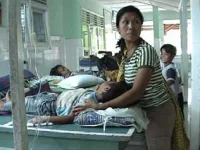
Because keterbatan the bed that was available in this maintenance space, some patients were forced to be placed in the bed feltbed like that was experienced by Dea, the resident of the Loyal Rubber District this Character.
According to the Special Capital District of Jakarta note of the Health Service up until today the number of cases of the dengue fever sufferer is still being high namely 13.732 cases with casualties died totalling 45 people.
The most case or the category of the red area was received in Southern Jakarta with the number 4.487 cases were followed by Jakarta East with the number 3.903 cases, Jakarta West, 2070 cases.
{these numbers must be for 2007? No. That can't be.}

The section head the Health Special Capital District of Jakarta Wibowo Sukijat acknowledged, efforts fogging or fumigation that was carried out was not yet maximal to combat pinched mosquitoes.
So was needed by the active role of the community by carrying out the eradication of the mosquitoes nest through 3M (drained, closed and buried or accumulated) that was judged more effective.
http://news.indosiar.com/news_read.htm?id=60868
 
Re: Dengue in Indonesia


April 30th 2007 ; 6:35:52 PM
First Dead dengue fever case
demam%20berdarah%20h.jpg
BeritaJakarta.com Erwin Zanuar (11) citizens of North Petojo RW 03/03, Gambir sub-district, Central Jakarta was dead on Sunday (29/4) at 15.30 WIB in RSUD Tarakan. Zanuar is the first dengue fever patients who died after mass fogging program in Central Jakarta. Head of Bidang Kebidanan RSUD Tarakan, Zuraidah, said that the patient condition was weak since he was come on Friday (27/4).

There are 17 dengue fever sufferers were died in RSUD Tarakan in 2007, and 4 people were died on April. Zuraidah added that dengue fever patients were increase after the second phase of mass fogging. ?Last week we have 66 dengue fever patients, but now we have 89 people,? said Zuraidah on Monday (30/4).

Dengue fever patients who get hospitalized in RSUD Tarakan in 2007 were 1.376 people. Meanwhile, April 2007 the numbers of patients are 483 people or higher than April 2006 which was 325 patients.:tiphat:


http://www.beritajakarta.com/english/NewsView.asp?ID=6137
 
Re: Dengue in Indonesia

Nine die of dengue

KUPANG, East Nusa Tenggara: There have been nine reported deaths from dengue fever in Kupang city and Belu regency in the past several weeks. East Nusa Tenggara province has seen a rise in the number of people affected by the disease following a change in weather.

Data from the province's social affairs secretary found Thursday that Kupang city has the highest number of casualties, with seven people dying of dengue fever out of 385 residents suffering the disease in the four worst-hit districts.

In Belu regency, two people died out of 82 residents that had sought treatment for the virus, which hit six districts.

East Nusa Tenggara governor, Piet A. Tallo, said the relevant offices had been instructed to intensify efforts in fighting the virus. -- JP

http://www.thejakartapost.com/detailnational.asp?fileid=20070430.G09&irec=8
 
Re: Dengue in Indonesia

Boy dies of dengue in spite of public eradication campaign

The Jakarta Post, Jakarta

Another death from dengue fever has been recorded in the city, bringing Jakarta's yearly toll from the disease to 46, despite a high-profile campaign to tackle the mosquito-borne disease head-on.

An eleven-year-old boy, Erwin, from North Petojo, Central Jakarta, died Saturday from the disease.

"Erwin was in Tarakan Hospital for treatment for less than 24 hours due to his critical condition," the hospital's intensive care unit head Zuraidah said.

Tarakan hospital has been swamped with dengue fever patients since January, with the number of sick increasing monthly. 1,376 patients have been treated in Tarakan so far this year.

The hospital treated 206 patients with dengue fever on January. 256 on February, 429 on March and 487 on April.

The hospital has seen 17 deaths since the start of the year.


Residents of Jakarta have become depressingly well-acquainted with dengue fever, with outbreaks an almost yearly occurrence.

The city administration has declared the current dengue outbreak to be an "extraordinary occurrence".

According to the Jakarta health agency, five people died from dengue in Jakarta in April. Eight people died in January, 20 in February, and 12 in March.

The city's dengue fever prevention program is currently in place with all five municipalities intensifying their anti-mosquito drives.

Some plans remain unimplemented, however, including one scheme to mobilize school students to educate their neighbors on disease prevention.

The city administration also started massive fumigations of designated critical areas last week, after earlier saying it lacked the funds to carry out such an operation.

The fumigation is targeting 135 neighborhoods categorized as "red zones", as well as another 127 dengue prone-areas across the city.

Some 2,400 fumigators have been sent to the targeted areas.

The city administration is one the way to adopting Singapore-inspired regulations to encourage the extermination of mosquito larvae.

The draft bylaw would give up to three months jail or Rp 50 million in fines for building operators and residents found with mosquito larvae on their property

http://www.thejakartapost.com/detailcity.asp?fileid=20070501.C01&irec=0
 
Re: Dengue in Indonesia

Banda Aceh, was on the alert Online
Mayor Banda Aceh Ir. Mawardy Nurdin, MSc, almost this week it was reported took medicine to Mount Elisabeth, Singapore.
He was attacked by the high fever illness, after being checked by the doctor in the Lion country, he positive was affected by dengue fever dengue fever (DBD).

In the meantime, the circle DPRD the Banda Aceh City most startled to hear Mawardy Nurdin being treated in some of RS in Singapore because of being affected by the virus of DBD. "Mr the Guardian was hit by DBD how the normal resident," said the member of the city council.
Sekda the Banda Aceh City Drs. T. Syaifuddin TA, MSi permitted the mayor to be hit by DBD and up to now still was treated in Singapore.
The "temperature" of "his body the high fever and the doctor's words there trombosit him descended."
But currently his condition begins to improve, said Sekda that received information via smsed directly from Mawardy Nurdin.

T. Syaifuddin TA justified Banda Aceh Mayor since Tuesday, then departed from Banda Aceh for Singapore.
He did not mention, Mr Wali to Singapore only because of the illness DBD. but the other source, Mawardy Nurdin to Singapore, did chek up, was related to one of his body organs, that is the kidney that had been operated on in Beijing, several years ago, experienced the deviation.
The DBD matter, yesterday was on the alert could confirm Kadindes Banda Aceh, Marzuki.
But, he apologised because his condition was also more unfit and asked confirmed his representative.
However, the number of the MOBILE PHONE that was given also inactive.
Until being not known by the certain figure of the number of DBD sufferers in {TT stopped working}

Edit: Here's the rest (took 10 minutes for TT to translate}:

Banda Aceh.
However the figure last March mentioned, there were approximately 54 residents who were attacked by DBD in Banda Aceh.
In fact, this figure could be categorised Banda Aceh KLB (the extraordinary incident), because every month the sufferer DBD his figure continued to improve.
"To state KLB or not that the authority" of the "mayor," said an official in Dinkes Banda Aceh, to this daily.
Post the Banda Aceh tsunami of the situation of the City environment was indeed again unhealthy.
Many residents were affected by various illness kinds.
For the DBD virus since the last six months often has claimed casualties.
Generally, that was attacked not only from children's group, but the adult also many that were bitten by mosquitoes aedes aegypti that.</pre>
http://www.waspada.co.id/berita/aceh/artikel.php?article_id=90664
 
Re: Dengue in Indonesia

Local clinics neglect disease prevention work: Experts

Adianto P. Simamora, The Jakarta Post, Jakarta

Better management of community health centers (Puskesmas) could have prevented recurring outbreaks of preventable diseases in the capital, health experts argued Wednesday.

Health experts at a health seminar at the Jakarta Media Center in Central Jakarta called on the city administration to restore Puskesmas' role in disease prevention education.

Azrul Azwar of the University of Indonesia's School of Medicine said the centers were currently only functioning as clinics to cure the sick, even though they were originally designed to educate the public on general health and sanitary practices.

"Puskesmas have moved too far away from their original purpose," he said.

Azrul said Puskesmas had become too concerned with appearing to be high-quality institutions, at the expense of their traditional role.

"It's even a mistake if the city administration encourages the centers to secure ISO (International Organization of Standardization) certificates because that will only make the center operators neglect their function as public health education centers."

The tasks of Puskesmas include family planning education, communicable disease control and environmental health, sanitation and nutrition campaigns.

Puskesmas were initially launched in 1974. The centers are each headed by a doctor who supervises all activities.

Jakarta has 337 centers -- at the district and subdistrict levels -- and 68 mobile units.

But rapid economic growth in the capital has affected the popularity of Puskesmas among middle-to-high income households that tend to visit hospitals or private doctors.

Azrul said dysfunctional Puskesmas were the main causes of recurring outbreaks of preventable disease in Jakarta.

"Jakarta will never manage preventable diseases such as dengue and bird flu if the administration does not reform Puskesmas."

Meanwhile, W Maruid, an activist from the Health Consumers Foundation, said the lack of disease prevention had worsened the quality of public health in the city.

"The administration's policy is currently centered on curative efforts and providing free medicine to residents."

It is the city's duty to provide better health services for Jakartans, he said.

"They (city officials) can't carry out restrictions on people when they can't even carry out their duty to provide better services," Maruid said, referring to the city's get-tough moves on poultry restriction and its draft bylaw on dengue control.

In addition to dengue and bird flu, Jakarta, which is home to more than 10 million people, has long faced problems with diarrhea, polio, hepatitis and cholera.

Currently, dengue prevention efforts such as the regular cleaning of water containers have been ineffective because of non-cooperation by many residents.

Jakarta already carries out a campaign requiring residents to allocate half an hour each Friday to keeping their homes clean of the larvae of the Aedes Aegypti mosquito, the carrier of the dengue virus.

The draft bylaw on dengue containment would require residents to keep the surroundings of their homes clean or face penalties up to Rp 50 million or six months in prison.

http://www.thejakartapost.com/detailcity.asp?fileid=20070503.C01&irec=0
 
Re: Dengue in Indonesia

Woman ill with Dengue fever

The Centre for Health Protection has confirmed an imported Dengue fever case involving a 76-year-old woman living in Tsing Yi, bringing this year's total number of Dengue fever cases to eight, all imported.

The woman travelled to Indonesia from March 27 to April 20, and came down with fever on April 26. She was sent to Princess Margaret Hospital the next day and discharged yesterday. Her condition is stable and her travel companion does not have any Dengue fever symptoms.

Hong Kong saw 31 Dengue fever cases last year, all imported.

http://www.news.gov.hk/en/category/healthandcommunity/070509/html/070509en05008.htm
 
Re: Dengue in Indonesia

From Jakarta Post:

May 11, 2007

DENGUE OUTBREAK: Children suffering from dengue fever are treated on a table tennis table at a community health center in Central Lombok regency, West Nusa Tenggara, on Wednesday.

The outbreak of the virus has infected dozens of residents from the Jonggat district in the regency during the last two months.

http://www.thejakartapost.com/national.asp
 

Attachments

  • DENGUE IN LOMBOK.jpg
    DENGUE IN LOMBOK.jpg
    26 KB · Views: 0
Re: Dengue in Indonesia

[FONT=Helvetica, Arial]Dengue outbreak kills three in Central Java[/FONT] [FONT=Arial, Helvetica]CILACAP, Central Java: Three people have died in a dengue fever outbreak that has affected more than 200 people in Cilacap regency, Central Java, over the last five months.[/FONT]
[FONT=Arial, Helvetica] "The rate of infection is higher than year. Last year, for example, only one patient died and 37 people were affected," Mariah Chilfati, head of the communicable disease prevention unit at the Cilacap Health Office, said Wednesday. [/FONT]
[FONT=Arial, Helvetica] Mariah blamed the severity of this year's outbreak on the number of rain-filled potholes in the regency, which provide an ideal breeding ground for mosquitoes. [/FONT]
[FONT=Arial, Helvetica] She said authorities had ordered a massive fumigation campaign across the regency to halt the spread of the disease. [/FONT]
[FONT=Arial, Helvetica] "Fumigation has been carried out over the last two months. We immediately send a team to fumigate the moment we receive a report of new dengue patients."
http://www.thejakartapost.com/detailnational.asp?fileid=20070511.G10&irec=9
[/FONT]
 
Re: Dengue in Indonesia

The patient DBD Masih Fluktuatif
RSHS, (GM).
- The Number Of patients of dengue fever dengue fever (DBD) in the Hasan Sadikin Hospital (RSHS) Bandung and RS Cibabat were still fluctuating (fluctuating).
One of the cause factors still the number of patients DBD, was indicated because of the uncertain season.
"We estimated the patient DBD will continue to be available."
Estimated to the end of May, the Gawat Darurat RSHS Installation headword, Dr. Tri Wahyu Murni, on Thursday (10/5).
Tri said, the other factor that made the patient DBD continue to improve, was bad him the community's sanitation.
At first again, to the densely-populated community.
"Between the owner" of the "house of one and that was other, sometimes did not pay attention to mutual cleanliness."
So as the development pinched mosquitoes will continue to be available, said Tri while added, pinched mosquitoes aedes aegepty also lived in the clean environment.

Because, Tri suggested, the government again did fogging in the densely-populated house region.
Although too much did not give the significant influence, at least the development of mature mosquitoes could be pressed.
The "eradication pinched his mosquitoes personally, must be able to be carried out by the community by means of carrying out the eradication" of the "mosquitoes nest (PSN) and 3M (drained, closed, and buried) places that were suspected as the mosquitoes nest," explained Tri.
According to the broad data keperawatan, the number of patients DBD that was recorded till Wednesday (9/5), totalling 48 cases (the child's 13 patients and 35 mature patients).
From the number, 11 people (5 children and 6 mature) was the new patient.
Whereas being based on the same note, the total number treated inap achieved 110 cases (the child's 39 patients and 71 mature patients), with one person including dying.

In the meantime, Section Head Kesehatan (Kadinkes) the Cimahi City, Dr. Endang Kusumah Wardani said, his side will carry out fumigation (fogging) in one area in accordance with the occurrence of the case or if in the area many that terjangkit DBD.
"However, concerning the implementation fogging, till at this time we were still carrying him out."
Because, the DBD control program was during Cimahi stated by KLB. Namun until this fogging this still continued to go, said Endang.

http://www.klik-galamedia.com/20070511/kolomlengkap.php?kolomkode=20070511003150
 
Re: Dengue in Indonesia

Around the Yogyakarta Special District, 44 Endemic districts DBD
on Saturday, 12/05/2007


Yogyakarta (SINDO) ? Setelah the spreading of the case of bird flu to the poultry that increasingly spread, the Yogyakarta City was again disturbed with the spreading of the illness of dengue fever dengue fever (DBD).
The Dinas Kesehatan data of the City (ET AL) Yogyakarta for five last months mentioned, 44 from 45 districts in Yogyakarta were the endemic territory of DBD. Satu-satunya the district in the Yogyakarta City territory that was freest from the DBD case was Suryatmajan, Kec Danurejan.
Now the district the most emerged the DBD case in Muja-Muju, Kec Umbulharjo as well as Suryodiningratan, Kec Mantrijeron.
The head of the Pengendalian Field of the Illness and Sanitation of Lingkungan DKK Yogyakarta Dr Sri Wulanningsih said, in five last months was recorded by the sufferer DBD reached 333 people.
Two sufferers including dying.
Seen from the age group, that was most serious terjangkit DBD was the group of the school of the age child, that is 5?14 the year.
?Dari the data that we the survey, to the group of this school of the age child, the number of DBD sufferers for 2007 reached 135 children.
As many as 63 were suffered by the male child and 72 perempuan,? said Wulan.
More: http://www.seputar-indonesia.com/ed...-istimewa-yogyakarta-44-kelurahan-endemi.html
 
Re: Dengue in Indonesia

RSUD Magetan Kebanjiran Pasien DBD

MAGETAN -- MIOL: for a last week, the Daerah Public Hospital (RSUD) Dr Sayidiman Magetan was with the patient of dengue fever dengue fever (DBD).
At least 30 patients were treated in the hospital.
Director RSUD Dr Sayidiman, Dr Harry Susanto that was contacted by the Indonesian Media, on Saturday (12/5), said in fact be with or exploded the DBD patient in RSUD.
"The number of rooms in the hospital indeed very limited, so as to have the patient that until was treated in paths," he said.
According to him, the last position jumpah the patient who was treated in RSUD Dr Sayidiman Magetan numbering 10 people.
"Generally they came from the Kota Magetan Subdistrict," he said.
In the meantime, information that was received by the Indonesian Media mentioned most patients came from the Banjarejo Village, Kecamatan Ngariboyo, that is as many as 12 patients, where seven patients came from one RT that was same.
Responded to this matter, Dr Harry Susanto said the Ngariboyo Subdistrict was the area of the person who has moved to the city.
His resident of most immigrants.
"If only his resident wanted to pay attention to the cleanliness, the spreading" of the "virus that was spread by mosquitoes could be prevented," he said.
Touched on the RSUD capacity Dr Sayidiman, Harry Susanto said maintenance space of the child was as many as 24, that then including for the maintenance of the mother.
Whereas the amount of maintenance space, the installation treated inap (Irna) in this RSUD numbering 177 rooms, including isolation space.
"So still not all that many if wanting the health service and the maintenance was increased."
We were still being waiting for the fall of the budget in order to increases the capacity of the hospital capacity, he said.
The jump of the number of patients who was treated in the hospital, he said, also because the awareness of the community about the health that was cheap as well as the ease of the service in the hospital, increased.
"Because the poor family received the ease got the maintenance, was sick just a few people at once ran to the hospital," he said.
http://www.media-indonesia.com/berita.asp?id=132957
 
Re: Dengue in Indonesia

Multiplex RT-PCR Mampu Identifikasi of the Dengue Dalam Empat Jam
Virus

Yogyakarta (Antara News) - the Technique of Multiplex RT-PCR that was developed by the Centre of the Study of Universitas Gadjah Mada Biotechnology (UGM) Yogyakarta could identify the dengue fever virus to the patient Dengue Dengue Fever (DBD) only in time four hours.
It was "increasingly short that time that was needed to check the existence" of the "virus to the patient then the possibility" of the "patient DBD was helped to be increasingly big also," said the senior researcher the Centre of the Study of UGM Biotechnology, Prof Dr Sutaryo, on Saturday.
He said, by means of for a long time went through the media culture-cell at least was needed by time one week to identify the kind of the dengue fever virus that infected the patient, the virus dengue fever-1, dengue fever-2, dengue fever-3, or dengue fever-4 that respectively needed the different handling.
The virus kind that was dangerous in Indonesia was dengue fever-3, when to identify was needed by minimal time one week then was estimated even more casualties died resulting from the delay of help, he said.
According to him, technically Multiplex RT-PCR, blood was taken from the patient at the time of the first day fever to the fourth day because during so the virus often circulated in the patient's body.
"Was different from the other laboratory inspection that still could not diagnose the illness at the beginning of the fever, with this implement was increasingly early was taken his blood then will be increasingly good," he said.
Apart from fast determined the existence of the dengue fever virus in the patient's body, according to Sutaryo, with Multiple RT-PCR at once could be known by his virus kind, dengue fever-1, 2, 3, or 4 so as the patient could be handled exactly at the same time as early warning for the doctor that treated when being found by the virus dengue fever-3.
"From the side of the technical cost of Multiplex RT-PCR indeed still was relatively expensive, to very much checked minimal was needed Rp300 thousand," he said.
The other superiority of this technique, said he, Multiplex RT-PCR could be done in each laboratory that had the PCR machine.
Despite this, was needed by the special expertise for the PCR machine operator to check the sample of blood Technically Multiplex RT-PCR that could be received through the special training.
To mensosialisasikan the use of this technique, the Centre of the Study of Biotechnology of UGM Yogyakarta, held this special training last May 14-15.
"When the existence" of the "virus could be anticipated since early, then I was sure Indonesia still does not become endemic DBD that claimed thousands of casualties," said Sutaryo

http://www.antara.co.id/arc/2007/5/...pu-identifikasi-virus-dengue-dalam-empat-jam/
 
Re: Dengue in Indonesia

Jakarta ? Jakarta still in the status of the extraordinary incident dengue fever dengue fever (KLB DBD) although the number of patients of the illness sufferer showed the decline in several regional public hospitals (RSUD) in Jakarta.
However, the high rainfall these days were still potential caused again the sufferer's explosion DBD.
Hal Itu to be said by Kesehatan Jakarta Wibowo Sukijat Section Head when being contacted by SH, this Saturday morning (19/5).
He said, the handling of the patient of dengue fever dengue fever (DBD) in Jakarta still with the status of the extraordinary incident, although the number of sufferers DBD Jakarta has descended against the week beforehand.
He mentioned, as long as 2007 was recorded by 17,453 affected DBD people with casualties died 59 people.
His details were: in January terdapatt 2,459 patients by dying eight people, in February totalling 3,553 20 died, in March 4,406 sufferers with 12 patients died, in April 5,112 penderia, 11 died, and in May totalling 1,923, eight among them died.
?Karena during the last two days the holiday and two days in the future did still not go to work, the figure that we had only up until May 16.
But, if being compared the week beforehand the sufferer's figure menurun,? he said.
Wibowo estimated, before late May the DBD number will descend.
However, with the uncertain rainfall at this time casualties DBD could again fell.
Therefore, he reminded the resident so that always increased the eradication of the mosquitoes nest (PSN) and did 3 M. (buried, drained and closed).
?Dengan the rainfall that was uncertain like this became the DBD mosquitoes opportunity of laying eggs or developing good.
Continue to be on the alert.
Not only was waiting for the official.
But we ourselves who surrounded the house and guarded kebersihan,? he added.
http://www.sinarharapan.co.id/berita/0705/19/sh05.html
</pre>
 
Re: Dengue in Indonesia

RSUD Budi Asih Masih Dibanjiri Pasien

Indosiar.com, Jakarta - the Public Hospital of Budi Asih Jakarta Timur, till Sunday (20/5/2007) yesterday still was filled by the patient deman was bloody, in fact had the increase from the previous day.
Recorded by the dengue fever patient who entered RSUD Budi Asih, was recorded by as many as 85 patients.
This number improved 4 patients compared with last Saturday (19/5).
With classification 55 mature patients and children's 30 patients.
The DBD cause was acknowledged by most of the patient's families, as a result of the condition in and around his house environment that was more unclean.
Although having the increase in the number of sufferers DBD, the hospital side could be still accommodating the patient DBD. Hal Ini was seen from the nonexistence of the patient who was treated outside maintenance space or dilorong-path.
Till last Sunday, did not yet have casualties DBD that died.
(Sudrajat and Ahmad Syarifuddin/Idh)
http://news.indosiar.com/news_read.htm?id=61461
 
Re: Dengue in Indonesia

Excerpt:

The CASE DBD in Garut reached 224 KASUS

Garut, 21/5/2007 (Kominfo-Newsroom) ? Dinas Kesehatan Garut, West Java, recorded since early January till May 14 2007 the number suspect Dengue Dengue Fever (DBD) in the Garut Regency totalling 224 with one victim died.
This DBD case was spread especially in five big the subdistrict, namely Kec.
Karangpawitan, Garut Kota, Tarogong Kidul, Tarogong Kaler, and Cibatu.
According to Head of Sector Pemberantasan of infectious diseases (P2M) Dinkes Garut, Dede Rohmansyah, just recently said, despite the number of his cases like that did not yet poke, there is tren the increase in the DBD case in Garut.
That was seen from the number in general the case per the day, the aspect of the weather, as well as the height of the mobility of the Garut inhabitants.
However, be different from the year beforehand, this year happened the shift in the endemic area of DBD. Biasanya that became the endemic customer DBD was Kec.
Cibatu.
However at this time, this endemic DBD area was the urban territory, that is Kec.
Garut Kota, Tarogong Kaler, and Tarogong Kidul.
The three subdistricts entered in the status ought to be guarded against resulting from the height of the case of DBD. Namun, in Kec.
Cibatu precisely at this time happened the decline in the DBD case was compared years beforehand.
In an effort to handle the DBD case, Dinkes carried out several steps, in part carry out fogging towards 17 focuses or as many as 1,613 houses, larvasida against 2,610 houses, and FE totalling 24 times.
http://www.bipnewsroom.info/index.p..._insideSubNo=&newsid=20823&_link=loadnews.php
 
Re: Dengue in Indonesia

INDONESIA: DENGUE FEVER OUTBREAK POSES 'LOW RISK' TO TOURISTS

Denpasar, Indonesia, 17 May (AKI) - The Dengue fever outbreak that has struck Bali, one of the world's top tourist destinations poses a "low risk" to visitors to the Indonesian island, says a state health official. "Most of those who have fallen ill come from parts of the island that have a high population density and where it is difficult to control garbage collection such as the town of Denpasar, the districts of Badung and Ganyar," the health official Subrata- who as is common in Indonesia uses just one name - told Adnkronos International (AKI).

The main tourist centres on Bali, ? Sanur, Kuta and Ubud ? fall under the Denpasar muncipality, as do the districts of Badung and Gianyar, and hygienic and sanitary conditions are of a higher level than in other parts of the island.

According to reports by local broadcaster Metro TV at least 10 more people every day have been treated for Dengue fever in the island's main Sanglah Hospital, in Denpasar since the outbreak in January.

Like malaria, Dengue fever is transmitted to humans by mosquitoes which carry four closely related virus types. The mosquitoes the Aedes aegypti (or rarely Aedes albopictus) who breed close to piles of refuse and garbage tend to bite just after dawn and just before sunset.

Subrata told AKI that more than 1,163 cases of Dengue fever have been identified since January with eight people dying of the disease.

The lack of space at Sanglah forcing many of the patients to lie in beds placed in the hospital's corridors.

Dengue fever symptoms include high temperature, muscle pain, headache and skin rashes.

http://www.adnki.com/index_2Level_English.php?cat=Trends&loid=8.0.415488134&par=
 
Status
Not open for further replies.
Back
Top