Outbreaks and Emergencies Bulletin, Week 22: 27 May - 02 June 2019
Chikungunya Republic of Congo
7 811 Cases
0 Deaths
0% CFR
EVENT DESCRIPTION
The outbreak of chikungunya in the Republic of Congo continues, with
increasing incidence and wider geographical spread. Since our last
report on 21 April 2019 (Weekly Bulletin 16), an additional 2 539 cases
have been registered. In week 18 (week ending 5 May 2019), 685 new
suspected chikungunya cases were reported from eight health districts:
Bouenza (255), Nairi (213), Pointe-Noir (103), Leoumou (71), Kouilou
(16), Brazzaville (15), Plateau (10), and Pool (2). This is an increase
over the 459 suspected cases reported in the previous week (week 17).
Three health districts, namely Nkayi (Leoumou department), Talanga?
(Brazzaville department) and Zanaga (Lekoumou department) have
notified cases for the first time during the reporting week 18. Eight out of
the 12 departments in the Republic of Congo have so far been affected.
Since the onset of the outbreak on 9 January 2019, a total of 7 811
suspected cases have been reported, with no deaths, and the number
of health districts reporting suspected cases of chikungunya among the
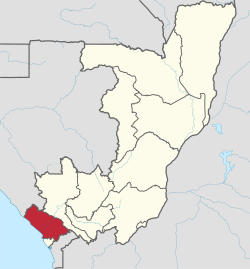
eight affected departments is 27. The Department of Kouilou remains
the most affected, with 2 698 of the cases, followed by Niari, with 1
388 cases. The number of cases reported weekly has fluctuated since
January 2019, reaching a peak of 868 cases in week 15 (week ending 14
April 2019), and has remained high since then.
The outbreak of chikungunya started in Kouillou and Pool health districts
in early-February 2019 and was formally declared by the Ministry of
Health on 9 February 2019. The vector has been identified as the Aedes
albopictus mosquito.
PUBLIC HEALTH ACTIONS
The Ministry of Health continues to coordinate response activities
and is conducting supervisory missions to the affected departments
with the support of WHO.
Surveillance is being strengthened, including collecting information
at district level, while the Early Warning and Alert System is
strengthening data compilation from four departments.
Fumigation and insecticide spraying was carried out in Diosso,
Loango, Kakamoeka, Makola (Kouilou), Kimongo and Dolisie
(Niari).
Regular health promotion messages continue to be transmitted on
local radio and television channels.
SITUATION INTERPRETATION
The outbreak of chikungunya in the Republic of Congo continues, with high numbers
of cases reported in several health departments. Challenges remain around effective
coordination, with a lack of a single framework for planning and monitoring multisectoral
response activities, along with a lack of a comprehensive operational response
plan and inadequate funding. In the absence of a sensitive surveillance system to clearly
characterize the outbreak, it is a big challenge to identify effective public health actions to
control the epidemic. All these challenges need to be addressed to allow local authorities
and partners to mount a robust response to this outbreak and bring it to a close.
Reduction of the number of natural and artificial breeding sites for mosquitoes has a
significant impact on the prevention and control of chikungunya outbreaks. This requires
affected communities to be mobilized to institute control measures, including covering
water collection containers, proper waste disposal and improved environmental sanitation.
https://apps.who.int/iris/bitstream/handle/10665/325086/OEW22-270502062019.pdf
https://www.afro.who.int/publications/outbreaks-and-emergencies-bulletin-week-22-27-may-02-june-2019