
• FluTrackers.com Inc. does not provide medical advice. Information on this web site is collected from various internet resources, and the FluTrackers board of directors makes no warranty to the safety, efficacy, correctness or completeness of the information posted on this site by any author or poster. The information collated here is for instructional and/or discussion purposes only and is NOT intended to diagnose or treat any disease, illness, or other medical condition. Every individual reader or poster should seek advice from their personal physician/healthcare practitioner before considering or using any interventions that are discussed on this website. By continuing to access this website you agree to consult your personal physican before using any interventions posted on this website, and you agree to hold harmless FluTrackers.com Inc., the board of directors, the members, and all authors and posters for any effects from use of any medication, supplement, vitamin or other substance, device, intervention, etc. mentioned in posts on this website, or other internet venues referenced in posts on this website.
  • We are not asking for any donations. Do not donate to any entity who says they are raising funds for us.

CDC - ​​​​​​​H5 Bird Flu: Current Situation - January 24+ *official human head count is incorrect*

sharon sanders

Editor-in-Chief & President
January 24, 2025
Español


H5 Bird Flu: Current Situation

What to know
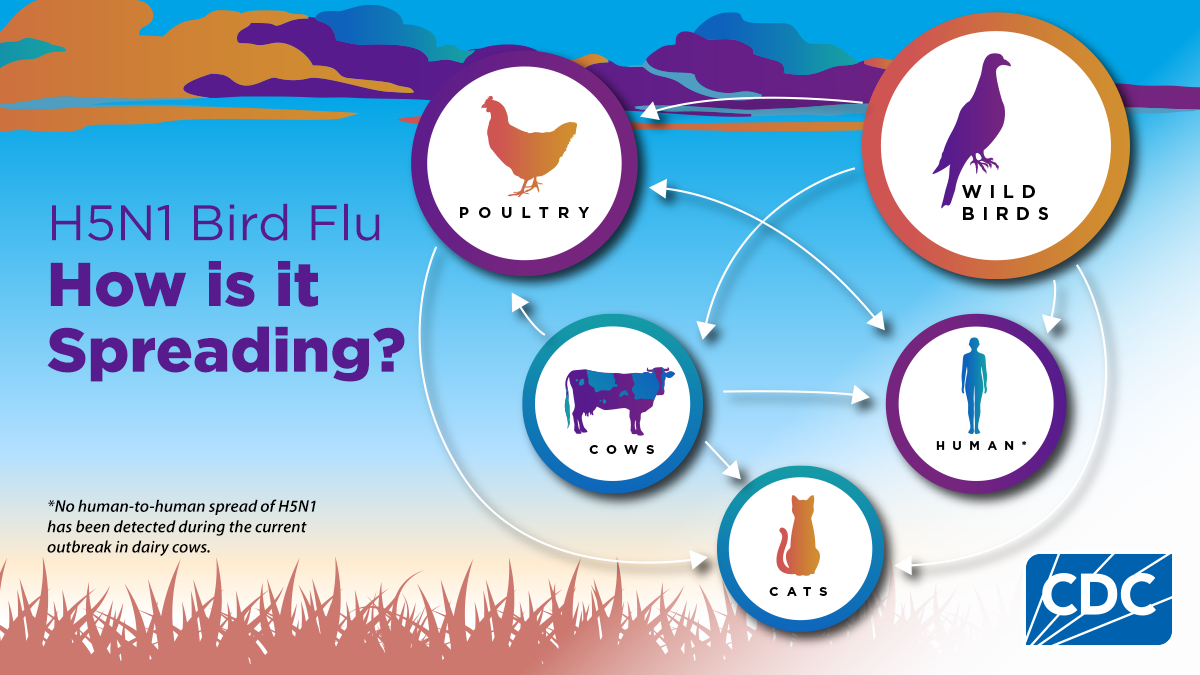
  • H5 bird flu is widespread in wild birds worldwide and is causing outbreaks in poultry and U.S. dairy cows with several recent human cases in U.S. dairy and poultry workers.
  • While the current public health risk is low, CDC is watching the situation carefully and working with states to monitor people with animal exposures.
  • CDC is using its flu surveillance systems to monitor for H5 bird flu activity in people.
how-it-is-spreading-1200x627-1.png

Current situation

H5 Bird Flu Detections in USA


• Dairy cattle: Ongoing multi-state outbreak

• Wild Birds: Widespread

• Poultry Flocks: Sporadic outbreaks

• Mammals: Sporadic infections

• Person-to-person spread: None

• Current public health risk: Low

67 Confirmed Total Reported Human Cases in the United States

1 Death Associated with H5N1 Bird Flu Infection in the United States


Confirmed human case summary since 2024, by state and exposure source

Exposure Source
3600238
190010
01001
00101
20002
00011
01001
10001
0110011
01001
40231367
NOTE: One additional case was previously detected in a poultry worker in Colorado in 2022. Louisiana reported the first H5 bird flu death in the U.S.

[SUP]†[/SUP]Exposure was related to other animals such as backyard flocks, wild birds, or other mammals
[SUP]‡[/SUP]Exposure source was not able to be identified
Probable human case summary during the 2024 outbreak, by state and exposure source


When a case tests positive for H5 at a public health laboratory but testing at CDC is not able to confirm H5 infection, per Council of State and Territorial Epidemiologists (CSTE) guidance, a case is reported as probable.
  • Probable cases with commercial poultry exposure (e.g., poultry farms or culling operations):
    • Washington (3)
    • Arizona (2)
  • Probable cases with commercial dairy (cattle) exposure:
    • California (1)
  • Probable cases with exposure source unknown:
    • Delaware (1)
Confirmed and probable cases are typically updated by 5 PM EST on Mondays (for cases confirmed by CDC on Friday, Saturday, or Sunday), Wednesdays (for cases confirmed by CDC on Monday or Tuesday), and Fridays (for cases confirmed by CDC on Wednesday and Thursday). Affected states may report cases more frequently.


H5 Monitoring in People


CDC influenza (flu) surveillance systems show no indicators of unusual influenza activity in people, including avian influenza A(H5).
Monitoring Current Situation


National flu surveillance (since February 25, 2024)

Specimens tested

96,000+

specimens tested that would have detected influenza A(H5) or other novel influenza viruses


Human cases

3

case detected through national flu surveillance


Targeted H5 surveillance (since March 24, 2024)

Total people monitored

13,400+

after exposure to infected animals


Total people tested

600+

after exposure to infected animals


Human cases

64

cases detected through targeted H5 surveillance

Total people monitored and total people tested will be updated weekly on Fridays. Human cases are typically updated by 5 PM EST on Mondays, Wednesdays and Fridays. CDC numbers on specimens tested for national flu surveillance is the number of seasonal flu tests conducted by public health labs. CDC numbers on H5 testing and monitoring are based on weekly state aggregate reports since 2022. CDC defers to states for updated information on people being monitored and tested. March 24, 2024, was the date of the first reported dairy cow infections in the United States. April 1, 2024, was the date of the first reported human case in the United States since the outbreaks in dairy cows began. Infected animals include poultry, dairy cows, and other birds and mammals.


Detections in Animals
  • 10,969 wild birds detected as of 1/16/2025 | Full Report
  • 51 jurisdictions with bird flu in wild birds
  • 136,327,394 poultry affected as of 1/17/2024 | Full Report
  • 51 states with outbreaks in poultry
  • 928 dairy herds affected as of 1/16/2024 | Full Report
  • 16 states with outbreaks in dairy cows
These data will be updated daily, Monday through Friday, after 4 p.m. to reflect any new data.

Cumulative data on wild birds have been collected since January 20, 2022. Cumulative data on poultry have been collected since February 8, 2022. Cumulative data on humans in the U.S. have been collected since April 28, 2022. Cumulative data on dairy cattle have been collected since March 25, 2024.

What CDC is doing

CDC Activities and Accomplishments to Date in 2024—2025 H5 Bird Flu Response
The current outbreak began in late March 2024 with the detection of H5N1 bird flu in dairy cows.Jan 17, 2025
H5 Bird Flu Response: Focus Areas for Ongoing Public Health Risk Assessment
CDC continues to assess that the current H5N1 bird flu risk to the general public remains low.Jan 15, 2025
Interim Guidance for Employers to Reduce Exposure to Avian Influenza A Viruses for People Working with Animals
This guidance identifies select occupational groups that may be at risk to novel influenza A virusesJan 10, 2025
Information for Employers Providing Personal Protective Equipment to Reduce Exposure to Avian Influenza A Viruses
This guidance identifies select occupational groups that may be at risk to novel influenza A virusesJan 6, 2025
Information for Workers Exposed to H5N1 Bird Flu
H5N1 bird flu is a virus that has recently been detected for the first time in cows.Jan 6, 2025
Genetic Sequences of Highly Pathogenic Avian Influenza A(H5N1) Viruses Identified in a Person in Louisiana
CDC has sequenced the influenza viruses in specimens collected from the patient in Louisiana who was Dec 26, 2024

Protective Actions for People
On This Page
Related Pages
View AllBird Flu
Back to Top
Bird Flu in Humans
Sources​​

https://www.cdc.gov/bird-flu/situation-summary/index.html?CDC_AA_refVal=https://www.cdc.gov %2Fbird-flu%2Fphp%2Favian-flu-summary%2Findex.html
 
January 27, 2025
H5 Bird Flu: Current Situation

WHAT TO KNOW
  • H5 bird flu is widespread in wild birds worldwide and is causing outbreaks in poultry and U.S. dairy cows with several recent human cases in U.S. dairy and poultry workers.
  • While the current public health risk is low, CDC is watching the situation carefully and working with states to monitor people with animal exposures.
  • CDC is using its flu surveillance systems to monitor for H5 bird flu activity in people.
Current Situation
H5 Bird Flu Detections in USA

• Dairy cattle: Ongoing multi-state outbreak

• Wild Birds: Widespread

• Poultry Flocks: Sporadic outbreaks

• Mammals: Sporadic infections

• Person-to-person spread: None

• Current public health risk: Low

Click image for larger version  Name:	Screenshot 2025-01-27 at 4.55.51 PM.png Views:	4 Size:	43.3 KB ID:	1005951

Probable human case summary during the 2024 outbreak, by state and exposure source

When a case tests positive for H5 at a public health laboratory but testing at CDC is not able to confirm H5 infection, per Council of State and Territorial Epidemiologists (CSTE) guidance, a case is reported as probable.
  • Probable cases with commercial poultry exposure (e.g., poultry farms or culling operations):
    • Washington (3)
    • Arizona (2)
  • Probable cases with commercial dairy (cattle) exposure:
    • California (1)
  • Probable cases with exposure source unknown:
    • Delaware (1)
Confirmed and probable cases are typically updated by 5 PM EST on Mondays (for cases confirmed by CDC on Friday, Saturday, or Sunday), Wednesdays (for cases confirmed by CDC on Monday or Tuesday), and Fridays (for cases confirmed by CDC on Wednesday and Thursday). Affected states may report cases more frequently. H5 Monitoring in People


CDC influenza (flu) surveillance systems show no indicators of unusual influenza activity in people, including avian influenza A(H5).


​Continued: https://www.cdc.gov/bird-flu/situation-summary/index.html
 
Posted on January 31, 2025. No changes. No new update for Monday, February 3, 2025.


January 31, 2025

Español CDC’s website is being modified to comply with President Trump’s Executive Orders.


H5 Bird Flu: Current Situation

What to know
  • H5 bird flu is widespread in wild birds worldwide and is causing outbreaks in poultry and U.S. dairy cows with several recent human cases in U.S. dairy and poultry workers.
  • While the current public health risk is low, CDC is watching the situation carefully and working with states to monitor people with animal exposures.
  • CDC is using its flu surveillance systems to monitor for H5 bird flu activity in people.
how-it-is-spreading-1200x627-1.png

Current situation

H5 Bird Flu Detections in USA


• Dairy cattle: Ongoing multi-state outbreak

• Wild Birds: Widespread

• Poultry Flocks: Sporadic outbreaks

• Mammals: Sporadic infections

• Person-to-person spread: None

• Current public health risk: Low

67Confirmed Total Reported Human Cases in the United States

1Death Associated with H5N1 Bird Flu Infection in the United States Confirmed human case summary since 2024, by state and exposure source

Exposure Source
3600238
190010
01001
00101
20002
00011
01001
10001
0110011
01001
40231367
NOTE: One additional case was previously detected in a poultry worker in Colorado in 2022. Louisiana reported the first H5 bird flu death in the U.S.

[SUP]†[/SUP]Exposure was related to other animals such as backyard flocks, wild birds, or other mammals
[SUP]‡[/SUP]Exposure source was not able to be identified
Probable human case summary during the 2024 outbreak, by state and exposure source


When a case tests positive for H5 at a public health laboratory but testing at CDC is not able to confirm H5 infection, per Council of State and Territorial Epidemiologists (CSTE) guidance, a case is reported as probable.
  • Probable cases with commercial poultry exposure (e.g., poultry farms or culling operations):
    • Washington (3)
    • Arizona (2)
  • Probable cases with commercial dairy (cattle) exposure:
    • California (1)
  • Probable cases with exposure source unknown:
    • Delaware (1)
Confirmed and probable cases are typically updated by 5 PM EST on Mondays (for cases confirmed by CDC on Friday, Saturday, or Sunday), Wednesdays (for cases confirmed by CDC on Monday or Tuesday), and Fridays (for cases confirmed by CDC on Wednesday and Thursday). Affected states may report cases more frequently. H5 Monitoring in People


CDC influenza (flu) surveillance systems show no indicators of unusual influenza activity in people, including avian influenza A(H5).
Monitoring Current Situation National flu surveillance (since February 25, 2024)

Specimens tested

104,000+

specimens tested that would have detected influenza A(H5) or other novel influenza viruses Human cases

4

case detected through national flu surveillance Targeted H5 surveillance (since March 24, 2024)

Total people monitored

14,100+

after exposure to infected animals Total people tested

660+

after exposure to infected animals Human cases

63

cases detected through targeted H5 surveillance

Total people monitored and total people tested will be updated weekly on Fridays. Human cases are typically updated by 5 PM EST on Mondays, Wednesdays and Fridays. CDC numbers on specimens tested for national flu surveillance is the number of seasonal flu tests conducted by public health labs. CDC numbers on H5 testing and monitoring are based on weekly state aggregate reports since 2022. CDC defers to states for updated information on people being monitored and tested. March 24, 2024, was the date of the first reported dairy cow infections in the United States. April 1, 2024, was the date of the first reported human case in the United States since the outbreaks in dairy cows began. Infected animals include poultry, dairy cows, and other birds and mammals. Detections in Animals
  • 11,065wild birds detected as of 1/28/2025 | Full Report
  • 51 jurisdictions with bird flu in wild birds
  • 149,964,521poultry affected as of 1/31/2024 | Full Report
  • 51 states with outbreaks in poultry
  • 951 dairy herds affected as of 1/31/2024 | Full Report
  • 16 states with outbreaks in dairy cows
These data will be updated daily, Monday through Friday, after 4 p.m. to reflect any new data.

Cumulative data on wild birds have been collected since January 20, 2022. Cumulative data on poultry have been collected since February 8, 2022. Cumulative data on humans in the U.S. have been collected since April 28, 2022. Cumulative data on dairy cattle have been collected since March 25, 2024.

What CDC is doing

CDC Activities and Accomplishments to Date in 2024—2025 H5 Bird Flu Response
The current outbreak began in late March 2024 with the detection of H5N1 bird flu in dairy cows.Jan 17, 2025
H5 Bird Flu Response: Focus Areas for Ongoing Public Health Risk Assessment
CDC continues to assess that the current H5N1 bird flu risk to the general public remains low.Jan 15, 2025
Interim Guidance for Employers to Reduce Exposure to Avian Influenza A Viruses for People Working with Animals
This guidance identifies select occupational groups that may be at risk to novel influenza A virusesJan 10, 2025
Information for Employers Providing Personal Protective Equipment to Reduce Exposure to Avian Influenza A Viruses
This guidance identifies select occupational groups that may be at risk to novel influenza A virusesJan 6, 2025
Information for Workers Exposed to H5N1 Bird Flu
H5N1 bird flu is a virus that has recently been detected for the first time in cows.Jan 6, 2025
Genetic Sequences of Highly Pathogenic Avian Influenza A(H5N1) Viruses Identified in a Person in Louisiana
CDC has sequenced the influenza viruses in specimens collected from the patient in Louisiana who wasDec 26, 2024
Protective Actions for People
On This Page
Related Pages
View AllBird Flu
Back to Top
Bird Flu in Humans
Sources


https://www.cdc.gov/bird-flu/situation-summary/index.html?CDC_AA_refVal=https%3A%2F%2Fwww.cdc.gov %2Fbird-flu%2Fphp%2Favian-flu-summary%2Findex.html

 
No changes to human case count.


February 7, 2025


H5 Bird Flu: Current Situation

What to know
  • H5 bird flu is widespread in wild birds worldwide and is causing outbreaks in poultry and U.S. dairy cows with several recent human cases in U.S. dairy and poultry workers.
  • While the current public health risk is low, CDC is watching the situation carefully and working with states to monitor people with animal exposures.
  • CDC is using its flu surveillance systems to monitor for H5 bird flu activity in people.
how-it-is-spreading-1200x627-1.png

Current situation

H5 Bird Flu Detections in USA


• Dairy cattle: Ongoing multi-state outbreak

• Wild Birds: Widespread

• Poultry Flocks: Sporadic outbreaks

• Mammals: Sporadic infections

• Person-to-person spread: None

• Current public health risk: Low

67Confirmed Total Reported Human Cases in the United States

1Death Associated with H5N1 Bird Flu Infection in the United States


Confirmed human case summary since 2024, by state and exposure source

Exposure Source
3600238
190010
01001
00101
20002
00011
01001
10001
0110011
01001
40231367
NOTE: One additional case was previously detected in a poultry worker in Colorado in 2022. Louisiana reported the first H5 bird flu death in the U.S.

[SUP]†[/SUP]Exposure was related to other animals such as backyard flocks, wild birds, or other mammals
[SUP]‡[/SUP]Exposure source was not able to be identified
Probable human case summary during the 2024 outbreak, by state and exposure source


When a case tests positive for H5 at a public health laboratory but testing at CDC is not able to confirm H5 infection, per Council of State and Territorial Epidemiologists (CSTE) guidance, a case is reported as probable.
  • Probable cases with commercial poultry exposure (e.g., poultry farms or culling operations):
    • Washington (3)
    • Arizona (2)
  • Probable cases with commercial dairy (cattle) exposure:
    • California (1)
  • Probable cases with exposure source unknown:
    • Delaware (1)
Confirmed and probable cases are typically updated by 5 PM EST on Mondays (for cases confirmed by CDC on Friday, Saturday, or Sunday), Wednesdays (for cases confirmed by CDC on Monday or Tuesday), and Fridays (for cases confirmed by CDC on Wednesday and Thursday). Affected states may report cases more frequently.


H5 Monitoring in People


CDC influenza (flu) surveillance systems show no indicators of unusual influenza activity in people, including avian influenza A(H5).
Monitoring Current Situation


National flu surveillance (since February 25, 2024)

Specimens tested

116,000+

specimens tested that would have detected influenza A(H5) or other novel influenza viruses


Human cases

4

case detected through national flu surveillance


Targeted H5 surveillance (since March 24, 2024)

Total people monitored

14,400+

after exposure to infected animals


Total people tested

700+

after exposure to infected animals


Human cases

63

cases detected through targeted H5 surveillance

Total people monitored and total people tested will be updated weekly on Fridays. Human cases are typically updated by 5 PM EST on Mondays, Wednesdays and Fridays. CDC numbers on specimens tested for national flu surveillance is the number of seasonal flu tests conducted by public health labs. CDC numbers on H5 testing and monitoring are based on weekly state aggregate reports since 2022. CDC defers to states for updated information on people being monitored and tested. March 24, 2024, was the date of the first reported dairy cow infections in the United States. April 1, 2024, was the date of the first reported human case in the United States since the outbreaks in dairy cows began. Infected animals include poultry, dairy cows, and other birds and mammals.


Detections in Animals
  • 11,627wild birds detected as of 2/5/2025 | Full Report
  • 51 jurisdictions with bird flu in wild birds
  • 156,254,271poultry affected as of 2/6/2025 | Full Report
  • 51 jurisdictions with outbreaks in poultry
  • 959 dairy herds affected as of 2/6/2025 | Full Report
  • 16 states with outbreaks in dairy cows
These data will be updated daily, Monday through Friday, after 4 p.m. to reflect any new data.

Cumulative data on wild birds have been collected since January 20, 2022. Cumulative data on poultry have been collected since February 8, 2022. Cumulative data on humans in the U.S. have been collected since April 28, 2022. Cumulative data on dairy cattle have been collected since March 25, 2024.

What CDC is doing

CDC Activities and Accomplishments to Date in 2024—2025 H5 Bird Flu Response
The current outbreak began in late March 2024 with the detection of H5N1 bird flu in dairy cows.Jan 17, 2025
H5 Bird Flu Response: Focus Areas for Ongoing Public Health Risk Assessment
CDC continues to assess that the current H5N1 bird flu risk to the general public remains low.Jan 15, 2025
Interim Guidance for Employers to Reduce Exposure to Avian Influenza A Viruses for People Working with Animals
This guidance identifies select occupational groups that may be at risk to novel influenza A virusesJan 10, 2025
Information for Employers Providing Personal Protective Equipment to Reduce Exposure to Avian Influenza A Viruses
This guidance identifies select occupational groups that may be at risk to novel influenza A virusesJan 6, 2025
Information for Workers Exposed to H5N1 Bird Flu
H5N1 bird flu is a virus that has recently been detected for the first time in cows.Jan 6, 2025
Genetic Sequences of Highly Pathogenic Avian Influenza A(H5N1) Viruses Identified in a Person in Louisiana
CDC has sequenced the influenza viruses in specimens collected from the patient in Louisiana who wasDec 26, 2024


Protective Actions for People
On This Page
Related Pages
View AllBird Flu
Back to Top
Bird Flu in Humans


https://www.cdc.gov/bird-flu/situation-summary/index.html?CDC_AA_refVal=https%3A%2F%2Fwww.cdc.gov%2Fbird-flu%2Fphp%2Favian-flu-summary%2Findex.html

 
H5 Bird Flu: Current Situation

​FEBRUARY 10, 2025 WHAT TO KNOW
  • H5 bird flu is widespread in wild birds worldwide and is causing outbreaks in poultry and U.S. dairy cows with several recent human cases in U.S. dairy and poultry workers.
  • While the current public health risk is low, CDC is watching the situation carefully and working with states to monitor people with animal exposures.
  • CDC is using its flu surveillance systems to monitor for H5 bird flu activity in people.
Current situation

H5 Bird Flu Detections in USA


• Dairy cattle: Ongoing multi-state outbreak

• Wild Birds: Widespread

• Poultry Flocks: Sporadic outbreaks

• Mammals: Sporadic infections

• Person-to-person spread: None

• Current public health risk: Low

Screenshot 2025-02-10 at 3.25.16 PM.png

Screenshot 2025-02-10 at 3.26.36 PM.png


NOTE: One additional case was previously detected in a poultry worker in Colorado in 2022. Louisiana reported the first H5 bird flu death in the U.S.

[SUP]†[/SUP]Exposure was related to other animals such as backyard flocks, wild birds, or other mammals
[SUP]‡[/SUP]Exposure source was not able to be identified
Probable human case summary during the 2024 outbreak, by state and exposure source


When a case tests positive for H5 at a public health laboratory but testing at CDC is not able to confirm H5 infection, per Council of State and Territorial Epidemiologists (CSTE) guidance, a case is reported as probable.
  • Probable cases with commercial poultry exposure (e.g., poultry farms or culling operations):
    • Washington (3)
    • Arizona (2)
  • Probable cases with commercial dairy (cattle) exposure:
    • California (1)
  • Probable cases with exposure source unknown:
    • Delaware (1)
Confirmed and probable cases are typically updated by 5 PM EST on Mondays (for cases confirmed by CDC on Friday, Saturday, or Sunday), Wednesdays (for cases confirmed by CDC on Monday or Tuesday), and Fridays (for cases confirmed by CDC on Wednesday and Thursday). Affected states may report cases more frequently.

Screenshot 2025-02-10 at 3.27.54 PM.png

Detections in Animals
  • 11,627wild birds detected as of 2/5/2025 | Full Report
  • 51 jurisdictions with bird flu in wild birds
  • 156,254,271poultry affected as of 2/6/2025 | Full Report
  • 51 jurisdictions with outbreaks in poultry
  • 959 dairy herds affected as of 2/6/2025 | Full Report
  • 16 states with outbreaks in dairy cows
These data will be updated daily, Monday through Friday, after 4 p.m. to reflect any new data.

Cumulative data on wild birds have been collected since January 20, 2022. Cumulative data on poultry have been collected since February 8, 2022. Cumulative data on humans in the U.S. have been collected since April 28, 2022. Cumulative data on dairy cattle have been collected since March 25, 2024.


https://www.cdc.gov/bird-flu/situation-summary/index.html
 
April 11, 2025
Español


H5 Bird Flu: Current Situation

What to know
  • H5 bird flu is widespread in wild birds worldwide and is causing outbreaks in poultry and U.S. dairy cows with several recent human cases in U.S. dairy and poultry workers.
  • While the current public health risk is low, CDC is watching the situation carefully and working with states to monitor people with animal exposures.
  • CDC is using its flu surveillance systems to monitor for H5 bird flu activity in people.
how-it-is-spreading-1200x627-1.png
crlogo.svg

Current situation

National situation summary

Person-to-person spread

None

There is no known person-to-person spread at this time.


Current public health risk

Low

The current public health risk is Low.


Cases in the U.S.


70 cases


Deaths in U.S.


1 death


Situation summary of confirmed and probable human cases since 2024
State or territoryNationalCaliforniaColoradoIowaLouisianaMi chiganMissouriNevadaOregonTexasWashingtonWisconsin Wyoming
National Total Cases: 70
41Dairy Herds (Cattle)*
24Poultry Farms and Culling Operations*
2Other Animal Exposure†
3Exposure Source Unknown‡
NOTE: One additional case was previously detected in a poultry worker in Colorado in 2022. Louisiana reported the first H5 bird flu death in the U.S.

*Exposure Associated with Commercial Agriculture and Related Operations
[SUP]†[/SUP]Exposure was related to other animals such as backyard flocks, wild birds, or other mammals
[SUP]‡[/SUP]Exposure source was not able to be identified Skip Over Map Container


Total cases


01-56-10>10 Download Data (CSV) Skip Data Table Skipped data table.
When a case tests positive for H5 at a public health laboratory but testing at CDC is not able to confirm H5 infection, per Council of State and Territorial Epidemiologists (CSTE) guidance, a case is reported as probable.

Confirmed and probable cases are typically updated by 5 PM EST on Mondays (for cases confirmed by CDC on Friday, Saturday, or Sunday), Wednesdays (for cases confirmed by CDC on Monday or Tuesday), and Fridays (for cases confirmed by CDC on Wednesday and Thursday). Affected states may report cases more frequently.


H5 Monitoring in People


CDC influenza (flu) surveillance systems show no indicators of unusual influenza activity in people, including avian influenza A(H5).
Monitoring Current Situation


National flu surveillance (since February 25, 2024)

Specimens tested


179,095+ specimens tested that would have detected influenza A(H5) or other novel influenza viruses Human cases


6 case detected through national flu surveillance

Targeted H5 surveillance (since March 24, 2024)

Total people monitored


16,400+ after exposure to infected animals


Total people tested


880+ after exposure to infected animals


Human cases


64 cases detected through targeted H5 surveillance


Detections in Animals
  • 12,706 wild birds detected as of 4/8/2025 | Full Report
  • 51 jurisdictions with bird flu in wild birds
  • 168,331,727 poultry affected as of 4/9/2025 | Full Report
  • 51 jurisdictions with outbreaks in poultry
  • 1,005dairy herds affected as of 4/9/2025 | Full Report
  • 17 states with outbreaks in dairy cows
These data will be updated daily, Monday through Friday, after 4 p.m. to reflect any new data.

Cumulative data on wild birds have been collected since January 20, 2022. Cumulative data on poultry have been collected since February 8, 2022. Cumulative data on humans in the U.S. have been collected since April 28, 2022. Cumulative data on dairy cattle have been collected since March 25, 2024.

What's New

What CDC Is Doing to Respond to Bird Flu Outbreaks
CDC monitors the H5N1 bird flu situation and provides updates as information is available.
Geographic Location: United States
CDC A(H5N1) Bird Flu Response Update March 19, 2025
CDC provides updates on recent lab findings.
Risk to People in the United States from Highly Pathogenic Avian Influenza A(H5N1) Viruses
Geographic Location: United States
CDC A(H5N1) Bird Flu Response Update February 26, 2025
CDC provides an update on recent developments in the multistate outbreak of avian influenza A(H5N1)
Geographic Location: Nevada, Ohio, Wyoming
CDC Activities and Accomplishments to Date in 2024—2025 H5 Bird Flu Response
The current outbreak began in late March 2024 with the detection of H5N1 bird flu in dairy cows.
Geographic Location: United States
H5 Bird Flu Response: Focus Areas for Ongoing Public Health Risk Assessment
CDC continues to assess that the current H5N1 bird flu risk to the general public remains low.
Geographic Location: United StatesView More
Resources
On This Page
Bird Flu in Humans
Sources

https://www.cdc.gov/bird-flu/situation-summary/index.html

 
April 23, 2025
Español


H5 Bird Flu: Current Situation

What to know
  • H5 bird flu is widespread in wild birds worldwide and is causing outbreaks in poultry and U.S. dairy cows with several recent human cases in U.S. dairy and poultry workers.
  • While the current public health risk is low, CDC is watching the situation carefully and working with states to monitor people with animal exposures.
  • CDC is using its flu surveillance systems to monitor for H5 bird flu activity in people.

Current situation

National situation summary

Person-to-person spread

None

There is no known person-to-person spread at this time.


Current public health risk

Low

The current public health risk is Low.


Cases in the U.S.


70 cases


Deaths in U.S.


1 death


Situation summary of confirmed and probable human cases since 2024
State or territoryNationalCaliforniaColoradoIowaLouisianaMi chiganMissouriNevadaOregonTexasWashingtonWisconsin Wyoming
National Total Cases: 70
41Dairy Herds (Cattle)*
24Poultry Farms and Culling Operations*
2Other Animal Exposure†
3Exposure Source Unknown‡
NOTE: One additional case was previously detected in a poultry worker in Colorado in 2022. Louisiana reported the first H5 bird flu death in the U.S.

*Exposure Associated with Commercial Agriculture and Related Operations
[SUP]†[/SUP]Exposure was related to other animals such as backyard flocks, wild birds, or other mammals
[SUP]‡[/SUP]Exposure source was not able to be identified Skip Over Map Container Total cases


01-56-10>10 Download Data (CSV) Skip Data Table Skipped data table.
When a case tests positive for H5 at a public health laboratory but testing at CDC is not able to confirm H5 infection, per Council of State and Territorial Epidemiologists (CSTE) guidance, a case is reported as probable.

Confirmed and probable cases are typically updated by 5 PM EST on Mondays (for cases confirmed by CDC on Friday, Saturday, or Sunday), Wednesdays (for cases confirmed by CDC on Monday or Tuesday), and Fridays (for cases confirmed by CDC on Wednesday and Thursday). Affected states may report cases more frequently. H5 Monitoring in People


CDC influenza (flu) surveillance systems show no indicators of unusual influenza activity in people, including avian influenza A(H5).
Monitoring Current Situation National flu surveillance (since February 25, 2024)

Specimens tested


181,476+ specimens tested that would have detected influenza A(H5) or other novel influenza viruses Human cases


6 case detected through national flu surveillance

Targeted H5 surveillance (since March 24, 2024)

Total people monitored


16,600+ after exposure to infected animals Total people tested


880+ after exposure to infected animals Human cases


64 cases detected through targeted H5 surveillance Detections in Animals
  • 12,875 wild birds detected as of 4/23/2025 | Full Report
  • 51 jurisdictions with bird flu in wild birds
  • 168,623,727 poultry affected as of 4/21/2025 | Full Report
  • 51 jurisdictions with outbreaks in poultry
  • 1,025 dairy herds affected as of 4/22/2025 | Full Report
  • 17 states with outbreaks in dairy cows
These data will be updated daily, Monday through Friday, after 4 p.m. to reflect any new data.

Cumulative data on wild birds have been collected since January 20, 2022. Cumulative data on poultry have been collected since February 8, 2022. Cumulative data on humans in the U.S. have been collected since April 28, 2022. Cumulative data on dairy cattle have been collected since March 25, 2024.

What's New

What CDC Is Doing to Respond to Bird Flu Outbreaks
CDC monitors the H5N1 bird flu situation and provides updates as information is available.
Geographic Location: United States
CDC A(H5N1) Bird Flu Response Update March 19, 2025
CDC provides updates on recent lab findings.
Risk to People in the United States from Highly Pathogenic Avian Influenza A(H5N1) Viruses
Geographic Location: United States
CDC A(H5N1) Bird Flu Response Update February 26, 2025
CDC provides an update on recent developments in the multistate outbreak of avian influenza A(H5N1)
Geographic Location: Nevada, Ohio, Wyoming
CDC Activities and Accomplishments to Date in 2024—2025 H5 Bird Flu Response
The current outbreak began in late March 2024 with the detection of H5N1 bird flu in dairy cows.
Geographic Location: United States
H5 Bird Flu Response: Focus Areas for Ongoing Public Health Risk Assessment
CDC continues to assess that the current H5N1 bird flu risk to the general public remains low.
Geographic Location: United StatesView More
Resources
On This Page
Bird Flu in Humans
Sources

https://www.cdc.gov/bird-flu/situation-summary/index.html
 
MAY 2, 2025 reatment of Bird Flu WHAT TO KNOW
  • There are influenza (flu) antiviral medications (drugs) that can be used to treat people who are sick with seasonal flu or novel flu, including avian (bird) flu.
  • People who get bird flu symptoms after exposure to infected or potentially infected birds, poultry, dairy cows, or other animals should be evaluated by a healthcare provider.
  • People who have or are suspected to have bird flu should be treated with the flu antiviral drug, oseltamivir, as soon as possible.
  • Antiviral drugs can help make a person's illness milder and may shorten the time they are sick and can reduce some complications.
  • In general, flu antiviral drugs, including oseltamivir, work best when started as soon as possible, ideally within two days after bird flu symptoms begin. However, starting them later can still be helpful, especially if the sick person is at higher risk of developing serious flu complications or is very sick.
​Continued:

https://www.cdc.gov/bird-flu/treatment/index.html
 
H5 Bird Flu: Current Situation

​ JULY 7, 2025
ESPAÑOL

WHAT TO KNOW
  • H5 bird flu is widespread in wild birds worldwide and is causing outbreaks in poultry and U.S. dairy cows with several recent human cases in U.S. dairy and poultry workers.
  • While the current public health risk is low, CDC is watching the situation carefully and working with states to monitor people with animal exposures.
  • CDC is using its flu surveillance systems to monitor for H5 bird flu activity in people.
[Image...]

Current situation

H5N1 Bird Flu Human Cases in U.S.


On July 7, 2025, CDC streamlined H5N1 bird flu updates with routine influenza data updates and updated reporting cadences to reflect the current public health situation. As such, the following changes were made to this page:
  • Data on the number of people monitored and tested for bird flu are reported monthly.
  • USDA data on HPAI detections in animals will no longer be reported on the CDC website. These data can be found on USDA's website.
CDC will continue to report any additional human cases of H5 bird flu here and in FluView.

National situation summary

Person-to-person spread
NONE
There is no known person-to-person spread at this time.

Current public health risk
LOW
The current public health risk is Low.

Cases in the U.S.
70 cases

Deaths in U.S.
1 death

Situation summary of confirmed and probable human cases since 2024
State or territoryNationalCaliforniaColoradoIowaLouisianaMi chiganMissouriNevadaOregonTexasWashingtonWisconsin Wyoming
National Total Cases: 70
41Dairy Herds (Cattle)*
24Poultry Farms and Culling Operations*
2Other Animal Exposure†
3Exposure Source Unknown‡
NOTE: One additional case was previously detected in a poultry worker in Colorado in 2022. Louisiana reported the first H5 bird flu death in the U.S.

*Exposure Associated with Commercial Agriculture and Related Operations
[SUP]†[/SUP]Exposure was related to other animals such as backyard flocks, wild birds, or other mammals
[SUP]‡[/SUP]Exposure source was not able to be identified Skip Over Map Container

Total cases
01-56-10>10 Download Data (CSV) Skip Data Table Skipped data table.
When a case tests positive for H5 at a public health laboratory but testing at CDC is not able to confirm H5 infection, per Council of State and Territorial Epidemiologists (CSTE) guidance, a case is reported as probable.

National flu surveillance (since February 25, 2024)
Note: National flu surveillance data will be updated on the first Friday of every month.

Specimens tested
201,714+ specimens tested that would have detected influenza A(H5) or other novel influenza viruses

Human cases
6 case detected through national flu surveillance

Targeted H5 surveillance (since March 24, 2024)
Note: Targeted H5 surveillance data will be updated on the first Friday of every month.

Total people monitored
18,600+after exposure to infected animals

Total people tested
880+ after exposure to infected animals

Human cases
64 cases detected through targeted H5 surveillance

Detections in Animals
For data on HPAI detections in animals, visit the USDA website.

https://www.cdc.gov/bird-flu/situation-summary/index.html#:~:text=The current outbreak bega n%20in,bird%20flu%20in%20dairy%20cows.&text=CDC%20 continues%20to%20assess%20that,the%20general%20pub lic%20remains%20low.
 
H5N1 Bird Flu Surveillance and Human Monitoring

Situation through July, 7 2025​

AT A GLANCE
CDC influenza (flu) surveillance systems show no indicators of unusual influenza activity in people, including avian influenza A(H5N1).​


Overview

H5N1 Bird Flu Surveillance in U.S.
On July 7, 2025, CDC streamlined H5N1 bird flu updates with routine influenza data updates and updated reporting cadences to reflect the current public health situation. As such, several changes were made to this page:
CDC uses multiple systems to monitor national, state, and local level influenza data during the current avian influenza A(H5N1) situation.
  • Influenza virus and illness activity are monitored year-round through a collaborative effort between CDC and many partners, including state, local, and territorial health departments; public health and clinical laboratories; clinics; and emergency departments.
  • Human cases of novel influenza, which are human infections with non-human influenza A viruses that are different from currently spreading seasonal human influenza viruses, are nationally notifiable. Every identified case is investigated and reported to CDC.
  • CDC is actively looking at multiple flu indicators during the current situation to monitor for influenza A(H5N1) viruses, including looking for spread of the virus to, or among people, in jurisdictions where the virus has been identified in people or animals. More information is available: FluView.
Main Findings from Surveillance Systems


CDC has multiple surveillance systems that are used year-round to monitor key flu indicators. These data are reviewed comprehensively each week. Taken together, through June 2025, these systems did not show indicators of unusual flu activity in people, including avian influenza A(H5N1) viruses.

Case Reporting

For the latest case counts, please visit the H5 Bird Flu: Current Situation page.


Public Health Laboratory Monitoring

For more information on Public Health Laboratory testing visit FluView

Clinical Laboratory Trends

For more information on Clinical Laboratory trends visit FluView

Emergency Departments

For data on emergency department visits visit data.cdc.gov

Wastewater Surveillance

For more information on wastewater surveillance visit CDC’s National Wastewater Surveillance System (NWSS)

Monitoring of Persons Exposed to Infected Animals*


Note: Monitoring data of persons exposed to infected animals will be updated on the first Friday of every month.

February 2022 – May 2025

CDC and state and local health departments monitor people exposed to infected birds, poultry, dairy cows or other animals for 10 days after exposure. Between February 2022 and May 2025, there have been
  • At least 27,900 people monitored and
  • At least 1,180 people tested for novel influenza A
Current HPAI Outbreak (March 2024-Present)

CDC and state and local health departments monitor people exposed to infected birds, poultry, dairy cows and other animals for 10 days after exposure. Between March 24, 2024, and May 31, 2025, there have been
  • At least 18,600 people monitored
    • At least 9,600 with exposures to dairy cows
    • At least 9,000 with exposures to birds and other animals including poultry (non-dairy cow source)
  • At least 880 persons tested for novel influenza A
    • At least 218 with exposures to dairy cows
    • At least 670 with exposures to birds and other animals including poultry (non-dairy cow source)
*CDC numbers are based on weekly state aggregate reports since 2022. CDC defers to states for updated information on people being monitored and tested. March 24, 2024, was the date of the first reported dairy cow infections in the United States.

Monitoring for Novel Influenza A virus infections among people, including Influenza A(H5)


Note: Animal and epidemiologically linked human cases will be updated on the first Friday of every month. Influenza H5 virus infections in humans exposed to affected animals by state

Select the animal type below to filter the map:All AnimalsDairy HerdsCommercial Poultry FlocksBackyard FlocksSkip Over Map Container ALAKAZARCACOCTDEFLGAHIIDILINIAKSKYLAMEMDMAMIMNMSMO MTNENVNHNJNMNYNCNDOHOKORPARISCSDTNTXUTVTVAWAWVWIWY CACOIALAMIMONVOHORTXWAWIWY U.S. territories

PR Number of affected dairy herds, commercial poultry flocks, or backyard flocks

01-1011-5051-100>100 Total human cases exposed to any animal

1-1011-20>20 Skip Data Table
Data Table Download Data (CSV) Skipped data table.
Data presented through: 06/28/2025; Data as of: 07/1/2025 Influenza A H5 affected dairy herds and epidemiologically linked human cases
Skip Over Chart Container
020406080100120CountMar. 12024Jul. 1Nov. 1Mar. 12025Jul. 1Week Human case(s)
Dairy herd(s) affected
Data presented through: 06/28/2025; Data as of: 07/1/2025 Influenza A H5 affected commercial poultry flocks and epidemiologically linked human cases
Skip Over Chart Container
0102030CountMar. 12024Jul. 1Nov. 1Mar. 12025Jul. 1Week Human case(s)
Commercial poultry flock(s) affected Influenza A H5 affected backyard flocks and epidemiologically linked human cases
Skip Over Chart Container
051015CountMar. 12024Jul. 1Nov. 1Mar. 12025Jul. 1Week Human case(s)
Backyard flock(s) affected
Data presented through: 06/28/2025; Data as of: 07/1/2025 Resource

Additional novel influenza surveillance information for current and past seasons:
Surveillance Methods | FluView Interactive

Wastewater Data for Avian Influenza A(H5)


Wastewater surveillance may complement other existing human influenza surveillance systems to monitor influenza. Data on wastewater testing for influenza A viruses can be found through CDC's National Wastewater Surveillance System (NWSS).

Explore Deeper

FluView
Novel A FluView Interactive
Respiratory Illnesses Data Channel


Last edited by a moderator:
Weekly US Influenza Surveillance Report: Key Updates for Week 28, ending July 12, 2025

​ For Everyone
JULY 18, 2025 KEY POINTS


Seasonal influenza activity is low.
U.S. virologic surveillance

Clinical Laboratories

The results of tests performed by clinical laboratories nationwide are summarized below. Data from clinical laboratories (the percentage of specimens tested that are positive for influenza) are used to monitor whether influenza activity is increasing or decreasing. Nationally, during Week 28, the percentage of respiratory specimens testing positive for influenza virus in clinical laboratories was 0.8%.
No. of specimens tested29,6853,706,766
No. of positive specimens (%)243 (0.8%)488,429 (13.2%)
Positive specimens by type
Influenza A137 (56.4%)434,146 (88.9%)
Influenza B106 (43.6%)54,283 (11.1%)
Public Health Laboratories

The results of tests performed by public health laboratories nationwide are summarized below. Data from public health laboratories are used to monitor the proportion of circulating viruses that belong to each influenza virus type/subtype/lineage. Viruses known to be associated with recent live attenuated influenza vaccine (LAIV) receipt or found upon further testing to be a vaccine virus are not included as they are not circulating influenza viruses.
No. of specimens tested463150,130
No. of positive specimens1599,170
Positive specimens by type/subtype
Influenza A15 (100%)93,379 (94.2%)
Subtyping Performed10 (66.7%)83,769 (89.7%)
(H1N1)pdm0910 (100%)44,278 (52.9%)
H3N2039,412 (47.0%)
H3N2v[SUP]†[/SUP]00
H5*079 (0.1%)
Subtyping not performed5 (33.3%)9,610 (10.3%)
Influenza B05,791 (5.8%)
Lineage testing performed03,230 (55.8%)
Yamagata lineage00
Victoria lineage03,230 (100%)
Lineage not performed02,561 (44.2%)
[SUB]*These data reflect specimens tested, and the number determined to be positive for influenza viruses at the public health labs (specimens tested is not the same as cases). The data do not reflect specimens tested only at CDC and could include more than one specimen tested per person. The guidance for avian influenza A(H5) virus testing recommends testing both a conjunctival and respiratory swab for people with conjunctivitis which has resulted in more specimens testing positive for avian influenza A(H5) virus than the number of human A(H5) cases. For more information on the number of people infected with avian influenza A(H5) viruses, please visit the "How CDC is monitoring influenza data among people to better understand the current avian influenza A (H5N1) situation"[/SUB]

[SUB][SUP]†[/SUP]When an influenza virus that normally circulates in swine (but not people) is detected in a person, it is called a "variant" influenza virus. Most human infections with variant influenza viruses occur following exposure to swine, but human-to-human transmission can occur. It is important to note that in most cases, variant influenza viruses have not shown the ability to spread easily and sustainably from human-to-human.[/SUB]

[SUB]*This graph reflects the number of specimens tested and the number determined to be positive for influenza viruses at the public health lab (specimens tested is not the same as cases). It does not reflect specimens tested only at CDC and could include more than one specimen tested per person. Specimens tested as part of routine influenza surveillance as well as those tested as part of targeted testing for people exposed to avian influenza A(H5) are included.[/SUB]

Additional virologic surveillance information for current and past seasons:

Surveillance Methods | FluView Interactive: National, Regional, and State Data or Age Data

Novel Influenza A Virus Infections

No confirmed human infections with influenza A(H5) virus were reported to CDC this week. To date, human-to-human transmission of avian influenza A(H5) virus (H5 bird flu) has not been identified in the United States.

The CSTE position statement, which includes updated case definitions for confirmed, probable, and suspected cases is available at http://www.cste.org/resource/resmgr/position_statements_files_2023/24-ID-09_Novel_Influenza_A.pdf.

An up-to-date human case summary during the current outbreak by state and exposure source is available at www.cdc.gov/bird-flu/situation-summary/index.html.

Information about avian influenza is available at https://www.cdc.gov/flu/avianflu/index.htm.

A(H5N1) virus interim recommendations for Prevention, Monitoring, and Public Health Investigations are available at https://www.cdc.gov/bird-flu/prevention/hpai-interim-recommendations.html.

The latest case reports on avian influenza outbreaks in wild birds, commercial poultry, backyard or hobbyist flocks, and mammals in the United States are available from the USDA at https://www.aphis.usda.gov/h5n1-hpai#detections-hpai.

Additional information regarding human infections with novel influenza A viruses:

Surveillance Methods | FluView Interactive
Outpatient and Emergency Department Illness Surveillance

Outpatient Respiratory Illness Visits

The U.S. Outpatient Influenza-like Illness Surveillance Network (ILINet) monitors outpatient visits for respiratory illness referred to as influenza-like illness [ILI (fever plus cough or sore throat)], not laboratory-confirmed influenza, and may capture respiratory illness visits due to infection with any pathogen that can present with similar symptoms, including influenza, SARS-CoV-2, and RSV. Therefore, it is important to evaluate syndromic surveillance data, including that from ILINet, in the context of other sources of surveillance data to obtain a complete and accurate picture of influenza, SARS-CoV-2, and other respiratory virus activity.

Nationally, during Week 28, 1.1% of patient visits reported through ILINet were due to respiratory illness that included fever plus a cough or sore throat, also referred to as ILI. Multiple respiratory viruses are co-circulating, and the relative contribution of influenza virus infection to ILI varies by location.

Outpatient Respiratory Illness Visits by Age Group

More than 70% of ILINet participants provide both the number of patient visits for respiratory illness and the total number of patient visits for the week broken out by age group. Data from this subset of providers are used to calculate the percentages of patient visits for respiratory illness by age group.

During Week 28, the percentage of visits for respiratory illness reported in ILINet was 3.6% among those 0-4 years, 1.4% among those 5-24 years, 0.9% among those 25-49 years, 0.7% among those 50-64 years, and 0.5% among those 65 years and older.

Outpatient Respiratory Illness Activity Map

Data collected in ILINet are used to produce a measure of ILI activity* by state/jurisdiction and Core Based Statistical Areas (CBSA).
Week 28
(Week ending
Jul. 12, 2025)
Week 27
(Week ending
Jul. 5, 2025)
Week 28
(Week ending
Jul. 12, 2025)
Week 27
(Week ending
Jul. 5, 2025)
Very High0000
High0000
Moderate0000
Low0021
Minimal5455679695
Insufficient Data10248233

Continued: https://www.cdc.gov/fluview/surveil...te, human-to-,identified in the United States.
 
The above report is inaccurate. For instance we have 15 cumulative avian flu cases (including the H5N5 case) for Washington state and the CDC shows 12.


United States - H5N5 - Older adult, prelim test positive, hospitalized in King county after care in 2 other counties, unknown source at this time, Washington state, November 13, 2025

United States - 2 more cases added by Washington state as poultry exposure. No details. Nov. 6, 2024

United States - 3 more "probable" cases in Washington state - poultry contact.

United States - 1 additional human case from poultry in Washington state

United States - 3 additional human cases from poultry in Washington state - diagnosed in Oregon

United States - 1 additional poultry worker in Washington state​​

United States - 4 poultry workers in Washington state

 
Back
Top