• FluTrackers.com Inc. does not provide medical advice. Information on this web site is collected from various internet resources, and the FluTrackers board of directors makes no warranty to the safety, efficacy, correctness or completeness of the information posted on this site by any author or poster. The information collated here is for instructional and/or discussion purposes only and is NOT intended to diagnose or treat any disease, illness, or other medical condition. Every individual reader or poster should seek advice from their personal physician/healthcare practitioner before considering or using any interventions that are discussed on this website. By continuing to access this website you agree to consult your personal physican before using any interventions posted on this website, and you agree to hold harmless FluTrackers.com Inc., the board of directors, the members, and all authors and posters for any effects from use of any medication, supplement, vitamin or other substance, device, intervention, etc. mentioned in posts on this website, or other internet venues referenced in posts on this website.
  • We are not asking for any donations. Do not donate to any entity who says they are raising funds for us.

Canada April 26 + A/H1N1 Cases - 427 total deaths as of 02/04/2010

Canada Confirms Six New Swine Flu Cases, Bringing Total to 19

Canada Confirms Six New Swine Flu Cases, Bringing Total to 19

via email -

Canada Confirms Six New Swine Flu Cases, Bringing Total to 19
2009-04-29 20:47:58.829 GMT


(For related stories, see {EXT3 <GO>}.)

By Greg Quinn
April 29 (Bloomberg) -- Canada confirmed six new cases of
swine flu today, raising the total to 19. The patients with the
illness have had generally ?mild? symptoms.
Health Minister Leona Aglukkaq made the comment at a press
conference in Ottawa. Three of the new cases were reported in
Ontario, and three in British Columbia.

For Related News and Information:
Top health stories: HTOP <GO>
Most-read health stories: MNI HEA <GO>
Medical science stories: TNI MEDICAL SCIENCE <GO>
On swine flu: NSE "SWINE FLU" <GO>
Stories about avian flu virus: NI BIRDFLU <GO>
News about Mexico: NI MEX <GO>

--Editors: David Scanlan
 
Re: Canada at 23 cases

Re: Canada at 23 cases

Source: http://www.canada.com/Life/cases+swine+confirmed+Canada/1549709/story.html

8 new cases of swine flu confirmed in Canada
Pandemic threat prompts global preparations, calls for calm

By Meagan Fitzpatrick, Canwest News ServiceApril 30, 2009 2:23 PM

Eight more confirmed cases of swine flu were reported in Canada on Thursday, bringing the national total to 27.

Four more cases were confirmed in Alberta ? three men and a woman from Calgary, all of whom recently returned from Mexico. The four, all young adults, were recovering from what was described as mild cases.

The other four new cases are in Windsor, N.S., bringing the total there to eight. All of the cases are related to four sick students at King's-Edgehill School. The cases there are all mild and health officials warned more people will likely contract the illness.


Governments around the world are mobilizing their plans for a widespread outbreak of swine flu, after the World Health Organization raised its alert level a day earlier to phase five to signal that a pandemic of swine flu is close to reality.

During a press briefing from Geneva, a WHO official said the alert level will stay one below six, the pandemic phase, until further notice.

"Today that assessment holds steady and we do not have any evidence that we should move to phase six today or any such move is imminent right now," said WHO acting assistant director general Keiji Fukuda.

He reported a jump in the number of confirmed cases in Mexico, where the outbreak of the new H1N1 strain is centred, to 97. The number will likely continue to increase at a quicker pace now that Mexico has its own testing capacity to verify cases. Health experts from several countries, including Canada, have been in Mexico to help authorities there get a laboratory up and running. Samples from Mexico are also being tested at Canada's National Microbiology Laboratory in Mexico.

The United States updated its number of cases Thursday to 109 and more cases in other countries were also confirmed by laboratory testing.

The swine flu virus has now been confirmed in 13 countries and infected a total of 265 people, according to WHO's figures but it is also known to be in four more nations and is suspected in at least a dozen others.

Canadian health officials say a pandemic plan was kicked into motion days ago and that WHO's change in alert level doesn't change their course of action.

American officials also said the new designation does little to alter its plans but that the alert change "is a good thing."

"It's really a wakeup call to the rest of the global community that if you haven't been paying attention to what's going on here and in Mexico, it's time to pull out your pandemic plans and think about what you would do if this infection were occurring in your own borders," Richard Besser, head of the U.S. Centers for Disease Control and Prevention, said at a daily briefing.

But WHO's increase in alert level to five from four did prompt further actions from other governments Thursday, such as increased screening at airports and other ports of entry. Countries are also checking their stockpiles of antiviral medications and WHO announced it has begun distributing some drugs from its stockpiles to developing countries.

Pharmaceutical companies are also busy investigating how to scale up their productions of medications including Tamiflu and Relenza.

A number of governments have been pitching in to help Mexico deal with the outbreak, which has forced the closure of schools, businesses and other public places and hit its tourism sector hard. On Thursday, a plane carrying masks, gloves, thermometers and other supplies left Beijing as part of China's emergency aid package for Mexico.

In other developments Thursday, WHO announced from now on that it would refer to the new virus strain as influenza A H1N1, instead of swine flu.

Because of the association of the new virus with pigs, pork farmers around the world are being hit hard, even though the illness is being spread by humans, not animals. About a dozen countries have banned pork and live pig imports from Canada, Mexico and the United States, and Egypt ordered the cull of pigs in that country.

The travel industry is also being affected and on Thursday, the International Air Transport Association made a plea for governments to follow WHO's advice that travel restrictions are ineffective in trying to stem the spread of the virus. The airline industry, already struggling because of the global recession, said passengers should be reassured that the air filtration systems in planes are similar to those in hospitals and that the aircraft are regularly disinfected.

The European Union's health ministers met and decided against recommending a travel ban to Mexico on Thursday. Several countries around the world, including Canada, have issued their own advisories warning to avoid travelling to the popular tourist destination unless necessary and tour operators have cancelled trips there.

Health officials continue to remind the public that the seasonal flu is also responsible for making thousands of people sick and for killing an average of 4,000 Canadians every year. Normally, fewer than 0.1 per cent of people with influenza die, if they have no underlying medical conditions.
 
Re: Canada at 27 confirmed cases

Re: Canada at 27 confirmed cases

http://www.theglobeandmail.com/servlet/story/RTGAM.20090430.wswinecanada0430/BNStory/Front

(emphasis added)


OLIVER MOORE AND KATHERINE O'NEILL

Canadian Press and Globe and Mail Update

April 30, 2009 at 3:44 PM EDT

HALIFAX and EDMONTON ? The number of confirmed swine flu cases in Canada climbed to 28 on Thursday as Prime Minister Stephen Harper attempted to assure Canadians that governments around the world are working together on the issue.

Mr. Harper said everything possible is being done to respond to swine flu and encouraged everyone to comply with the advice of health care officials.?We are all very concerned about the situation,? Mr. Harper said. ?At the same time, people should rest assured that governments around the world are responding to this in an appropriate and co-ordinated way.?

Four new cases have been confirmed at King's-Edgehill school in small-town Nova Scotia, bringing the total there to eight, while four new cases have been confirmed in Calgary. The one new case in Ontario was in Toronto.

"We expected to see new cases and we anticipate more in the coming days," he told a briefing Thursday. "This is a constantly evolving situation and the important thing is for people to be aware of the situation and take the necessary precautions."

About two dozen students from the prestigious private boarding school in Windsor, 45 minutes north of Halifax, were on a school trip to Mexico early this month.

Andre Corriveau, Alberta's Chief Medical Officer of Health, told reporters Thursday in Edmonton that officials have found four new cases of swine flu in Calgary ? one female and three males, all young adults. The four people had been travelling together in Mexico and recently returned home.

That brings Alberta's total swine flu cases to six. According to health officials, all of the cases have been mild and none of the patients have been hospitalized.

Dr. Corriveau said that as more Albertans continue to return from Mexico, he ?expects to see more cases.?

However, Alberta Health Minister Ron Liepert said there is still no need to raise undue alarm.

?At this stage, there are no plans to do anything differently,? he said.

Mr. Liepert said recent decisions by two Edmonton school boards to cancel field trips outside of Alberta may have been ?premature.?

?Take precautions but let's not overreact,? he said.

With reports from OLIVER MOORE and KATHERINE O'NEILL
 
15 new 'mild' swine flu cases in Canada

15 new 'mild' swine flu cases in Canada

The number of confirmed swine flu cases in Canada climbed to 34 today with five new confirmations in British Columbia and Quebec's first confirmed case.

Quebec health officials say the person from the Montreal area was in Mexico recently and is now at home with a mild case of the flu.

Fifteen new cases have been reported in Canada today ? five in B.C., four in Alberta, four in Nova Scotia, one in Ontario and one in Quebec.
http://www.theglobeandmail.com/serv...30/BNStory/National/home?cid=al_gam_mostemail
 
Canadian swine flu total moves to 51

Canadian swine flu total moves to 51

Source: http://www.metronews.ca/edmonton/canada/article/222189--canadian-swine-flu-total-moves-to-47

Canadian swine flu total moves to 47

METRO NEWS SERVICES
May 01, 2009 3:02 p.m.

British Columbia has four additional confirmed cases of swine flu and Nova Scotia has six new cases, bringing the national total to 47.

Premier Gordon Campbell said B.C. has 15 cases in total now and there will be more ? and that some of them could be fatal.

Alberta has confirmed two more mild cases today and New Brunswick now has its first case of swine flu. The additional cases today bring the total number of cases across the country to 47.

All of the cases in Canada have been described as mild, and there have been no deaths.

Campbell says of the 15 people infected with the virus in B.C., all are recovering or already recovered.

The B.C. premier says health experts expect there will be more cases of the H1N1 influenza A virus, and that some may be fatal. He reassured residents that the provincial Centre for Disease Control has a plan in place to deal with the outbreak.


In the United States, the confirmed case count stood at more than 130.

State lab operators say there have been more cases than are counted, because officials are not testing all suspected cases, focusing instead on finding new outbreak hot spots and limiting the flu?s spread.

The flu has reached several countries. Asia?s first confirmed case of swine flu has been detected in Hong Kong.

The Chinese territory?s leader, Donald Tsang, tells reporters the patient is a Mexican citizen who developed a fever Thursday after arriving in Hong Kong via Shanghai.

Tsang said tests by both Hong Kong?s Department of Health and the University of Hong Kong confirmed the patient has swine flu ? or H1N1 influenza A, as the World Health Organization is now calling it.

He said the patient has been isolated in hospital and is in stable condition.

In Mexico, the outbreak?s epicentre, new cases and the death rate were levelling off, the country?s top medical officer said.
 
Re: Canadian swine flu total moves to 47

Re: Canadian swine flu total moves to 47

Source: http://cnews.canoe.ca/CNEWS/Canada/2009/05/01/9314256-cp.html

New cases of swine flu confirmed
Canadian total moves to 51
By THE CANADIAN PRESS

OTTAWA - The federal government is expanding its swine flu prevention campaign to Facebook, Twitter and YouTube as the number of confirmed cases continue to climb.

Officials announced the new "citizen readiness campaign" Friday as the number of confirmed cases of the virulent flu strain known as H1N1 jumped to 51.

To date, British Columbia leads the tally with 15 cases, followed by Nova Scotia with 14, Ontario with 12, Alberta with eight and Quebec and New Brunswick with one case each.

"We continue to see mild cases and full recovery in Canada," said Public Health Officer David Butler-Jones.

"But as we've been saying, the more surveillance we conduct, the more we look, the more cases we are likely to find. Severity will vary and we might see deaths as we do with every seasonal flu."

Still, Butler-Jones said there's reason for optimism given that summer is coming and the cases so far have been mild.


He said the expanded prevention campaign - which will target mainstream media and social networking sites - will emphasize the importance of hand-washing, covering sneezes and staying home when sick.

He reminded people to visit www.fightflu.ca for more information.

Prime Minister Stephen Harper said he's confident that Canadians, while taking the necessary precautions and eyeing developments with a sense of concern, are not getting carried away.

"My sense is the public is, like ourselves, concerned, but I don't sense a panic," he said in Edgeley, Sask.

"I sense the public is listening very carefully to various advisories and warnings they are getting and responding appropriately and that's what we encourage."

Harper was asked about the World Health Organization's decision Thursday to begin referring to the virus by its formal name rather than the more colloquial "swine flu."

"This is obviously a medical condition so it makes sense to refer to it that way and I gather that's a standard that the World Health Organization is now trying to encourage," Harper said.

"The health risks here are to humans; that's the concern ... It is not the health of the hog industry in any way that is at stake here, so we will encourage that terminology."

B.C.'s four new cases involved one youngster, one teenager and two adults - all in the province's Lower Mainland, all mild and all involving people who were either recently in Mexico or in contact with people who were, said Premier Gordon Campbell.

While neither the status nor the number of cases in Canada should be considered cause for alarm, the level of worry surrounding a virus that's fuelling fears of a global pandemic is perfectly justified, Campbell told a news conference.

"Unfortunately, we may see some deaths. We have deaths from flu every year. It's important for us to recognize that and it's important for us to recognize that, again, there is no reason we can't deal with this constructively and positively if we all pay attention to it."

Much the same warning came from health officials in Nova Scotia, which is where Canada's first cases of H1N1 came to light last weekend, all of them from a private school where a group of students had recently returned from a school trip to Mexico.

All the new cases are students from the King's Edgehill private school in Windsor, N.S., said Dr. Robert Strang, Nova Scotia's chief public health officer.

"At this point we're not seeing severe cases such as have been experienced in Mexico," Strang said. The province's total caseload is now 14, he added.

"We do expect to see new cases and we anticipate more in the coming days. As with normal flu, once the number of cases does increase, it is normal to see more severe cases and potentially even some deaths."

Ontario reported four more mild cases, all in the Toronto area, bringing the province's total to 12.

In Alberta, two more mild cases involving two women from Calgary, one a recent returnee from Mexico and the other from Tennessee, brought the total number in the province to eight, said Dr. Andre Corriveau, the province's chief medical officer of health.

Corriveau said health officials have heard that some businesses in Alberta are requiring any staff who have recently visited Mexico to see a doctor before they return to work, a step he described as unnecessary.

"We are appealing to people to be reasonable - not to clog our health-care system unnecessarily."

On Friday, the Catholic Archdiocese of Edmonton said it was asking parishes to make changes to help prevent the spread of infection.

Priests have been asked to stop distributing consecrated wine from the common cup and to encourage parishioners who usually receive communion wafers on their tongue to receive it in their hands instead.

"It is important to note that the Phase 5 WHO alert does not mean a life-threatening health situation in the Archdiocese and that the steps being recommended are precautionary," Archbishop Richard Smith said in his letter to priests.

An official with the Canadian Conference of Catholic Bishops said it was not immediately clear how many of the other 14 Archdiocese across the country are taking similar measures.

Strang said all of the Nova Scotia students who had swine flu were now better, after spending at least seven days in isolation, and are no longer infectious.

One of the six students who became infected with swine flu was actually on the trip to Mexico, while the other five caught it after the students came back to Canada. Fifteen students at the school are still in isolation, he added.

 
Cases of swine flu confirmed in Canada increases to 76

Cases of swine flu confirmed in Canada increases to 76

Cases of swine flu confirmed in Canada increases to 76
Last Updated: Saturday, May 2, 2009 | 3:39 PM ET Comments1Recommend4
CBC News

Health officials in Nova Scotia, British Columbia and Quebec confirmed a spate of new swine flu cases Saturday, boosting the national count to 76.

The Nova Scotia Department of Health said lab testing had confirmed 17 new cases in the province.

Eleven of the cases are related to the King's-Edgehill school community in Windsor, but the breakdown between students and staff is not known, according to the Nova Scotia Department of Health. Six other cases are outside of the school population.

"We have been expecting this and are prepared," said Dr. Robert Strang, chief public health officer for Nova Scotia. "Right now we are working to gather more information about the individual confirmed cases outside of King's-Edgehill."

The cases are all mild, says the health department.
Province Confirmed cases of H1N1 flu virus (human swine flu)
Alberta 8
British Columbia 22
Nova Scotia 31
New Brunswick 1
Ontario 12
Quebec 2
Total 76

Nova Scotia's first cases of the H1N1 virus were confirmed at the private school last weekend. Officials believe students who went on a school trip to Mexico carried the infection back home.

None of the Canadian cases have been as severe as those in the Mexican outbreak of the swine flu.
3 new cases in B.C., one in Quebec

The B.C. Centre for Disease Control confirmed three more cases Saturday, raising its total to 22. Details of the new case were not immediately clear.

Health officials in Quebec confirmed another case of swine flu in the province on Saturday. There are now two confirmed cases in the province.

Ontario confirmed four additional cases Friday, and there are now 12 confirmed cases in the province.

Alberta also confirmed two more cases on Friday for a total of eight. New Brunswick recorded its first case Friday.

So far, Saskatchewan, Manitoba, Newfoundland and Labrador, P.E.I. and the territories have not confirmed any cases of this particular flu strain.

The virus, which has been identified as a new strain of the H1N1 subtype of type A influenza, is believed to have originated in Mexico and has since appeared in Canada, the U.S., Europe and elsewhere.
 
Number of confirmed swine flu cases in Canada now at 83 (Doesn't include 2 new Ontario - Really 85)

Number of confirmed swine flu cases in Canada now at 83 (Doesn't include 2 new Ontario - Really 85)

Number of confirmed swine flu cases in Canada now at 83
Last Updated: Saturday, May 2, 2009 | 4:05 PM ET Comments3Recommend20
CBC News

Health officials in Nova Scotia, Alberta British Columbia and Quebec confirmed a spate of new swine flu cases Saturday, boosting the national count to 83.

The Nova Scotia Department of Health said lab testing had confirmed 17 new cases in the province.

Eleven of the cases are related to the King's-Edgehill school community in Windsor, but the breakdown between students and staff is not known, according to the Nova Scotia Department of Health. Six other cases are outside of the school population, and were confirmed by testing in a Halifax hospital.

The virus, which has been identified as a new strain of the H1N1 subtype of type A influenza, is believed to have originated in Mexico and has since appeared in Canada, the U.S., Europe and elsewhere.

"We have been expecting this and are prepared," said Dr. Robert Strang, chief public health officer for Nova Scotia. "Right now we are working to gather more information about the individual confirmed cases outside of King's-Edgehill."

The cases are all mild, says the health department.
Province Confirmed cases of H1N1 flu virus (human swine flu)
Alberta 15
British Columbia 22
Nova Scotia 31
New Brunswick 1
Ontario 12
Quebec 2
Total 83

Nova Scotia's first cases of the H1N1 virus were confirmed at the private school last weekend. Officials believe students who went on a school trip to Mexico carried the infection back home.

None of the Canadian cases have been as severe as those in the Mexican outbreak of the swine flu.
7 new cases in Alberta, 3 in B.C., one in Quebec

The Alberta Department of Health confirmed seven new cases Saturday, four of them in the Edmonton area, two in the north and one in the Calgary area.

Five of those infected are female. Two are children ? one male and the other female.

None of the cases require hospitalization, said the Department of Health in a release posted on its website. There is no further information.

Health officials in Quebec confirmed another case of swine flu in the province on Saturday. There are now two confirmed cases in the province.

Dr. Alain Poirier, Quebec's director of public health, said the virus had been found in a child who had travelled to Mexico with his parents.

He said he would not name the child or the school he attended until all teachers and parents associated with the school had been contacted.

The B.C. Centre for Disease Control confirmed three more cases Saturday, raising its total to 22. Details of the new cases were not immediately clear.

So far, Saskatchewan, Manitoba, Newfoundland and Labrador, P.E.I. and the territories have not confirmed any cases of this particular flu strain.
 
Re: Canada Suspected/Confirmed Swine Flu Cases April 26 +

Re: Canada Suspected/Confirmed Swine Flu Cases April 26 +

Source: http://www.phac-aspc.gc.ca/alert-alerte/swine-porcine/surveillance-eng.php

Cases of H1N1 Flu Virus in Canada

The Public Health Agency of Canada (PHAC) is committed to sharing information about H1N1 flu virus cases with Canadians. Confirmed cases are posted Monday, Wednesday and Friday at 16:00 EDT.

As of May 25 2009, a total of 921 laboratory-confirmed cases of H1N1 flu virus have been reported in 9 provinces and 1 territory in Canada (see Table 1 below).

Table 1: Summary of laboratory-confirmed cases of H1N1 flu virus reported to the Public Health Agency of Canada, by the provinces and territories as of May 25, 2009 at 15:00 EDT.

Province / Territory--NEW Laboratory-Confirmed Cases as of May 25, 2009--TOTAL Laboratory-confirmed Cases (including today’s cases)--- Total Deaths (1)

British Columbia 0-115-0

Alberta 2-96-1

Saskatchewan 14-91-0

Manitoba NR-6-0

Ontario(2) 2-58-352

Quebec 0-42-185

New Brunswick 0-2-0

Nova Scotia 0-71-0

Prince Edward Island 0-3-0

Newfoundland 0-0-0

Yukon 0-1-0

Northwest Territories 0-0-0

Nunavut 0-0-0

Total 116-921-1

(1) Number of deaths is included in the number of cases

(2) Ontario announced in a press release today that a person with H1N1 flu virus died on May 23, 2009. The case numbers officially reported by Ontario to PHAC today are current up to May 22 at 8:30 a.m. Therefore, the death reported today is not currently reflected in the national case count, but will be in the next update on May 27 after it is officially reported to PHAC.

Note: Manitoba did not report their confirmed cases by 15:00 EDT

As of May 25, 2009, the average age reported is 22 years or younger (median: 17 years; range: <1 – 86 years). To date 29 hospitalizations, including one death, have been reported among laboratory-confirmed cases. The most recent date of symptom onset is May 16, 2009.

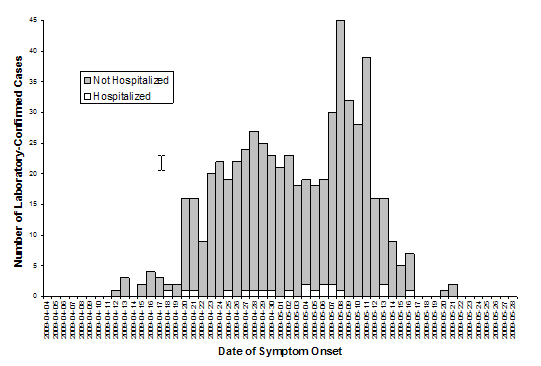
The following graph, also known as an epidemic curve, is up to date as of May 22, 2009. The graph illustrates the course of the current H1N1 flu virus outbreak in Canada. It shows the date when symptoms of H1N1 flu virus began for each of the laboratory-confirmed cases.


f1_20090525a-eng.gif


Figure 1. Number of Laboratory-Confirmed H1N1 Flu Virus Cases in Canada by Date of Onset as reported to the Public Health Agency of Canada as of May 22, 2009 15:00 EDT (N=557).

Source: Provincial/Territorial Ministries of Health

When interpreting the graph, it should be noted that:

* The graph is prepared retrospectively and is updated daily using the information available at that time. It is not as current as Table 1 that contains the summary of laboratory-confirmed cases, as information about the date of onset of symptoms takes more time to compile.
* There is always a delay from the date that an illness starts to the date the case is reported to public health authorities. This delay is the result of the time required for patients to see their physicians, laboratory testing to be completed, and results to be communicated to public health authorities.
 
Re: Canada Suspected/Confirmed Swine Flu Cases April 26 +

Re: Canada Suspected/Confirmed Swine Flu Cases April 26 +

Source: http://www.phac-aspc.gc.ca/alert-alerte/swine-porcine/surveillance-eng.php

As of May 27 2009, a total of 1,118 laboratory-confirmed cases of H1N1 flu virus have been reported in 9 provinces and 1 territory in Canada (see Table 1 below)

Table 1: Summary of laboratory-confirmed cases of H1N1 flu virus reported to the Public Health Agency of Canada, by the provinces and territories as of May 27, 2009 at 15:00 EDT.

Province / Territory/ (1)NEW Laboratory-Confirmed Cases reported since May 25, 2009 / TOTAL Laboratory-confirmed Cases (including today?s cases)/Total Deaths (2)

British Columbia 5-120-0

Alberta 13-109-1

Saskatchewan 13-104-0

Manitoba 0-6-0

Ontario 143-495-1

Quebec 22-207-0

New Brunswick 0-2-0

Nova Scotia 1-71-0

Prince Edward Island 0-3-0

Newfoundland 0-0-0

Yukon 0-1-0

Northwest Territories 0-0-0

Nunavut 0-0- 0

Total 197-1,118-2

(1) Note: P/Ts may choose to announce cases that have been confirmed after 15:00 EDT.
These cases will be reflected in the next epidemiological update.

(2) Number of deaths is included in the number of cases


As of May 27, 2009, the average age reported is 22 years or younger (median: 17 years; range: <1 ? 86 years). To date 43 hospitalizations and two deaths, have been reported among laboratory-confirmed cases. The most recent date of symptom onset is May 21, 2009.

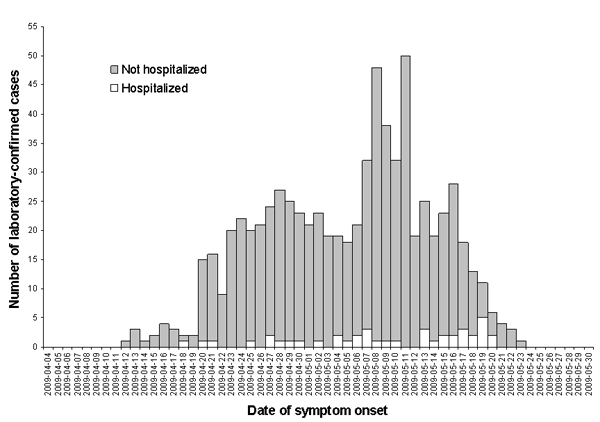
The following graph, also known as an epidemic curve, is up to date as of May 25, 2009. The graph illustrates the course of the current H1N1 flu virus outbreak in Canada. It shows the date when symptoms of H1N1 flu virus began for each of the laboratory-confirmed cases.

Number of Laboratory-Confirmed H1N1 Flu Virus Cases in Canada by Date of Onset as reported to the Public Health Agency of Canada as of May 25, 2009 15:00 EDT (N=588)

f1_20090527-eng.gif


Figure 1. Number of Laboratory-Confirmed H1N1 Flu Virus Cases in Canada by Date of Onset as reported to the Public Health Agency of Canada as of May 25, 2009 15:00 EDT (N=588).

Source: Provincial/Territorial Ministries of Health

When interpreting the graph, it should be noted that:

* The graph is prepared retrospectively and is updated daily using the information available at that time. It is not as current as Table 1 that contains the summary of laboratory-confirmed cases, as information about the date of onset of symptoms takes more time to compile.
* There is always a delay from the date that an illness starts to the date the case is reported to public health authorities. This delay is the result of the time required for patients to see their physicians, laboratory testing to be completed, and results to be communicated to public health authorities.
 
Re: Canada Suspected/Confirmed Swine Flu Cases April 26 +

Re: Canada Suspected/Confirmed Swine Flu Cases April 26 +

Thanks Shiloh for this presentation and updates.

Looking at the graph one would conclude that the epidemic phase of the A/N1N1 in Canada has peaked and now about nil.

Is this true or have the Canadian PH authorities stopped testing as is the case in the US?

Grattan Woodson, MD
 
Re: Canada Suspected/Confirmed Swine Flu Cases April 26 +

Re: Canada Suspected/Confirmed Swine Flu Cases April 26 +

I found this very interesting in that his symptoms got better and quickly trned worse.

Wed May. 27 2009 8:01:10 PM

Man who died from H1N1 was otherwise healthy: family

The family of a Scarborough man whose death has been linked to H1N1 flu says the 44-year-old diabetic was very healthy until developing a cough last week.

The father of two took some time off but went back to work on Friday because he was feeling better. He started feeling sick again later that day, according to his colleagues.

His family says he suddenly started coughing Saturday morning and couldn't stop. He was not responsive by the time paramedics arrived on the scene, and they were unable to revive him.

He leaves behind a wife and two young children.

Ontario's acting chief medical officer has said people with certain chronic medical conditions appear to be at greater risk of dying from swine flu if they catch it.

With files from The Canadian Press

http://www.cp24.com/servlet/an/local/CTVNews/20090527/090527_scarborough_h1n1/20090527/?hub=CP24Home
 
Re: Canada Suspected/Confirmed Swine Flu Cases April 26 +

Re: Canada Suspected/Confirmed Swine Flu Cases April 26 +

Don't know the answer to you question Dr. Woodson. However in Ontario it is expected to wane and they will continue surveillance throughout the summer as mentioned below:

...Seasonal flu wanes

At the start of the province's investigation of the outbreak, cases of seasonal H3N2 flu were running three to one over H1N1 cases, Williams noted.

"It's now switched around. So in the last week, 60 per cent of the tests being done were H1N1, so it's reversed."


Cases of seasonal flu, which leads to 5,000 premature deaths in Canada each year, tend to decline heading into summer.

"I think as we see these little waves or blips where it seems to bounce, it's like waves coming ashore. They tend to get shallower and shallower as you move into the summer season," Williams said.


As of May 22, a total of 805 laboratory-confirmed cases of H1N1 flu virus have been reported in Canada, according to the Public Health Agency of Canada.

Ontario plans to continue its regular flu surveillance throughout the summer.

The aim is not to count all cases, Williams said, but to spot check whether the virus is present and whether new cases are arising. The information will guide health officials on whether to ramp up enhanced surveillance in the fall...


Source: http://www.cbc.ca/canada/toronto/sto...swine-flu.html
 
Re: Canada Suspected/Confirmed Swine Flu Cases April 26 +

Re: Canada Suspected/Confirmed Swine Flu Cases April 26 +

Dr. Woodson,

I think things are settling a bit in BC.

The flu reports here are compiled from 3 main sources:
-ILI sentinel reports
-MSP (Medical Services Plan) tracking - every doctor visit is billed to the province and must be coded for the presentig condition
-lab results

These three data inputs do give a generally good picture of the situation on the ground IMO.

The current BC report for weeks 17-19
http://www.bccdc.org/downloads/pdf/epid/reports/InfluUpdate_Number22_Weeks17-19_0809.pdf

indicates high ILI activity for weeks 17 and 18 and a subsequent drop in week 19. Of course it could be that people are simply not going in to see their practitioner as the general opinion is that the flu is no longer something to see a dr about unless symptoms are very severe.

Also, there was a surge in testing but the positive cases as a percentage remain low.
 
Re: Canada Suspected/Confirmed Swine Flu Cases April 26 +

Re: Canada Suspected/Confirmed Swine Flu Cases April 26 +

Some excerpts about the Ontario numbers from the source below:


Swine flu cases on the rise in GTA
MAP
Theresa Boyle
Health Reporter

The latest results of confirmed swine flu cases in Ontario show a 41 per cent increase in the number of infected people, the majority of them in the Greater Toronto Area....

...Provincial officials say the increase in numbers is due to more monitoring, testing and clearing of a backlog of cases.

"The large increase in cases is due to enhanced surveillance, increased laboratory testing capacity and the processing of a backlog of tests conducted on the weekend by public health officials," Dr. David Williams, Ontario's acting chief medical officer of health, stated in a news release.

Toronto has had 237 cases, or almost half of the total cases in the province....

...Provincial numbers are a day or two old and Yaffe said there are actually even more cases in the city.

"I hope the numbers will go down but at this point they are still going up," she said.

Yaffe offered some reasons Toronto is seeing larger numbers than other parts of the province.

"We have a larger population to begin with and a more dense population. People are closer together and it spreads person to person," she said.

"It depends on the behaviour of people who get ill, whether they go to their physician or hospital. Then it depends on the behaviour of the physician or hospital they see in terms of whether they get tested or not," she added.

The number of cases reported is also a reflection of testing behaviour, Yaffe explained.

"Not everyone with the flu gets tested so those numbers only reflect the people who got tested and were positive," she said, adding she would not be surprised if more people in Toronto get tested than in other areas of the province.

"In Toronto, we are more sensitized post-SARS," she said.

...The province is currently recommending testing for the virus for people who are severely ill.[/B]

"We know the virus is here so it makes no significant difference to the individual's care. Where it makes a difference is knowing if the virus is circulating," Yaffe said.

Source: http://www.thestar.com/newsfeatures/swineflu/article/641892
 
Re: Canada Suspected/Confirmed Swine Flu Cases April 26 +

Re: Canada Suspected/Confirmed Swine Flu Cases April 26 +

Source: http://www.phac-aspc.gc.ca/alert-alerte/swine-porcine/surveillance-eng.php

Epidemiological Update Map for Canada, by Province & Territory
Laboratory-Confirmed Cases of H1N1 Flu Virus
May 29, 2009, 15h00 EDT

h1n1-canada-map-20090529-eng.gif


As of May 29 2009, a total of 1,336 laboratory-confirmed cases of H1N1 flu virus have been reported in 9 provinces and 2 territory in Canada (see Table 1 below).
********************************************


Table 1: Summary of laboratory-confirmed cases of H1N1 flu virus reported to the Public Health Agency of Canada, by the provinces and territories as of May 29, 2009 at 15:00 EDT.


Province / Territory -- (1)NEW Laboratory-Confirmed Cases reported since May 27, 2009-- TOTAL Laboratory-confirmed Cases (including today?s cases)---Total Deaths(2)

British Columbia 2-122-0
Alberta 12-121-1
Saskatchewan 19-123-0
Manitoba 5-11- 0
Ontario 131-626-1
Quebec 46-253-0
New Brunswick 0-2-0
Nova Scotia 2-73- 0
Prince Edward Island 0-3-0
Newfoundland 0-0-0
Yukon 0-1-0
Northwest Territories 0-0-0
Nunavut 1-1-0
Total 218-1,336- 2

(1) Note: P/Ts may choose to announce cases that have been confirmed after 15:00 EDT.
These cases will be reflected in the next epidemiological update.

(2) Number of deaths is included in the number of cases

*******************************************

As of May 29, 2009, the average age reported is 22 years or younger (median: 17 years; range: <1 ? 80 years). To date 47 hospitalizations and two deaths have been reported among laboratory-confirmed cases. The most recent date of symptom onset is May 23, 2009.

The following graph, also known as an epidemic curve, is up to date as of May 27, 2009. The graph illustrates the course of the current H1N1 flu virus outbreak in Canada. It shows the date when symptoms of H1N1 flu virus began for each of the laboratory-confirmed cases.

f1_20090529-eng.gif


Figure 1. Number of Laboratory-Confirmed H1N1 Flu Virus Cases in Canada by Date of Onset as reported to the Public Health Agency of Canada as of May 27, 2009 15:00 EDT (N=732).

Source: Provincial/Territorial Ministries of Health

When interpreting the graph, it should be noted that:

* The graph is prepared retrospectively and is updated daily using the information available at that time. It is not as current as Table 1 that contains the summary of laboratory-confirmed cases, as information about the date of onset of symptoms takes more time to compile.
* There is always a delay from the date that an illness starts to the date the case is reported to public health authorities. This delay is the result of the time required for patients to see their physicians, laboratory testing to be completed, and results to be communicated to public health authorities.
 
Re: Canada Suspected/Confirmed Swine Flu Cases April 26 +

Re: Canada Suspected/Confirmed Swine Flu Cases April 26 +

Source: http://www.phac-aspc.gc.ca/alert-alerte/swine-porcine/surveillance-eng.php

Epidemiological Update Map for Canada, by Province & Territory
Laboratory-Confirmed Cases of H1N1 Flu Virus
June 1, 2009, 15h00 EDT

h1n1-canada-map-20090601-eng.gif


As of June 1st 2009, a total of 1,530 laboratory-confirmed cases of H1N1 flu virus have been reported in 9 provinces and 3 territories in Canada (see Table 1 below).
*************************************

Table 1: Summary of laboratory-confirmed cases of H1N1 flu virus reported to the Public Health Agency of Canada, by the provinces and territories as of June 1st , 2009 at 15:00 EDT.

Province / Territory (1)NEW Laboratory-Confirmed Cases reported since May 29, 2009 TOTAL Laboratory-confirmed Cases (including today?s cases) (2)Total Deaths
British Columbia 10-132-0
Alberta 5-126-1
Saskatchewan 30-153-0
Manitoba 0-11- 0
Ontario 89-715-1
Quebec 56-309-0
New Brunswick 0-2-0
Nova Scotia 0-73- 0
Prince Edward Island 0-3-0
Newfoundland 0-0-0
Yukon 0-1-0
Northwest Territories 1-1-0
Nunavut 3-4-0
Total 194-1530-2

(1) Note: P/Ts may choose to announce cases that have been confirmed after 15:00 EDT.
These cases will be reflected in the next epidemiological update.

(2) Number of deaths is included in the number of cases

****************

As of May 29, 2009, the average age reported is 22 years or younger (median: 17 years; range: <1 ? 80 years). To date 57 hospitalizations and two deaths have been reported among laboratory-confirmed cases. The most recent date of symptom onset is May 23, 2009.

The following graph, also known as an epidemic curve, is up to date as of May 27, 2009. The graph illustrates the course of the current H1N1 flu virus outbreak in Canada. It shows the date when symptoms of H1N1 flu virus began for each of the laboratory-confirmed cases.

f1_20090601-eng.gif


Figure 1. Number of Laboratory-Confirmed H1N1 Flu Virus Cases in Canada by Date of Onset as reported to the Public Health Agency of Canada as of May 27, 2009 15:00 EDT (N=732).

Source: Provincial/Territorial Ministries of Health

When interpreting the graph, it should be noted that:

* The graph is prepared retrospectively and is updated daily using the information available at that time. It is not as current as Table 1 that contains the summary of laboratory-confirmed cases, as information about the date of onset of symptoms takes more time to compile.
* There is always a delay from the date that an illness starts to the date the case is reported to public health authorities. This delay is the result of the time required for patients to see their physicians, laboratory testing to be completed, and results to be communicated to public health authorities.
 
Re: Canada Suspected/Confirmed Swine Flu Cases April 26 +

Re: Canada Suspected/Confirmed Swine Flu Cases April 26 +

Source: http://www.phac-aspc.gc.ca/alert-alerte/swine-porcine/surveillance-eng.php

Epidemiological Update Map for Canada, by Province & Territory
Laboratory-Confirmed Cases of H1N1 Flu Virus
June 3, 2009, 15h00 EDT

h1n1-canada-map-20090603-eng.gif


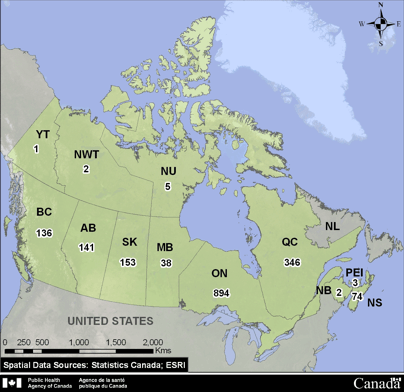
As of June 3rd 2009, a total of 1,795 laboratory-confirmed cases of H1N1 flu virus have been reported in 9 provinces and 3 territories in Canada (see Table 1 below).

*************************************
Table 1: Summary of laboratory-confirmed cases of H1N1 flu virus reported to the Public Health Agency of Canada, by the provinces and territories as of June 3, 2009 at 15:00 EDT.

Province / Territory NEW Laboratory-Confirmed Cases reported since June 1, 2009(1) TOTAL Laboratory-confirmed Cases (including today?s cases) (2) Total Deaths
British Columbia 4-136-0
Alberta 15-141-1
Saskatchewan 0-153-0
Manitoba 27-38-0
Ontario 179-894-2
Quebec 37-346-0
New Brunswick 0-2-0
Nova Scotia 1-74- 0
Prince Edward Island 0-3-0
Newfoundland 0-0-0
Yukon 0-1-0
Northwest Territories 1-2-0
Nunavut 1-5-0
Total 265-1,795- 3

(1) Note: P/Ts may choose to announce cases that have been confirmed after 15:00 EDT.
These cases will be reflected in the next epidemiological update.

(2) Number of deaths is included in the number of cases

******************************************
As of June 1, 2009, the average age reported is 23 years (median: 17 years; range: <1 ? 80 years). To date 98 hospitalizations and three deaths have been reported among laboratory-confirmed cases. The most recent date of symptom onset is May 27, 2009.

The following graph, also known as an epidemic curve, is up to date as of 1 June, 2009. The graph illustrates the course of the current H1N1 flu virus outbreak in Canada. It shows the date when symptoms of H1N1 flu virus began for each of the laboratory-confirmed cases.

Number of laboratory-confirmed H1N1 flu virus cases in Canada by date of onset as reported to the Public Health Agency of Canada as of 1 June 2009 15:00 EDT (N=863).

f1_20090603a-eng.gif


Figure 1. Number of laboratory-confirmed H1N1 flu virus cases in Canada by date of onset as reported to the Public Health Agency of Canada as of 1 June 2009 15:00 EDT (N=863).

Source: Provincial/Territorial Ministries of Health

When interpreting the graph, it should be noted that:

* The graph is prepared retrospectively and is updated daily using the information available at that time. It is not as current as Table 1 that contains the summary of laboratory-confirmed cases, as information about the date of onset of symptoms takes more time to compile.
* There is always a delay from the date that an illness starts to the date the case is reported to public health authorities. This delay is the result of the time required for patients to see their physicians, laboratory testing to be completed, and results to be communicated to public health authorities.
 
Re: Canada Suspected/Confirmed Swine Flu Cases April 26 +

Re: Canada Suspected/Confirmed Swine Flu Cases April 26 +

Source: http://www.canadaeast.com/wellness/article/688059


Manitoba health officials won't comment on mystery flu on northern reserve
Published Wednesday June 3rd, 2009
Steve Lambert, THE CANADIAN PRESS


WINNIPEG - Manitoba health officials refused to comment Wednesday on a mysterious flu that has sent at least a dozen people from an isolated reserve to hospital in Winnipeg.

While most people are experiencing mild symptoms, the flu has caused two pregnant women to fall seriously ill, including one who lost her child, according to Chief David McDougall of the St. Theresa Point First Nation.

It has also prompted the community to cancel some public events.

"People like to play canasta with each other at the community hall. It's those kind of social interactions that people have had to hold in abeyance for now," McDougall said from the community roughly 500 kilometres northeast of Winnipeg.

Tests are underway to see if the illnesses are being caused by the new H1N1 swine flu virus that has circulated in many countries. The provincial and federal governments have sent more doctors and nurses to the remote community of 3,200, which is accessible only by air.

Health officials would not discuss St. Theresa Point on Wednesday, and would only say that 27 new cases of swine flu have been confirmed across the province, bringing the total to 38. Of the new cases, three were from the sprawling health region that includes St. Theresa Point.

"We don't provide community names because we don't want to breach any personal health information," said Elise Weiss, the province's acting chief public health officer.

The uncertainty has prompted some residents of the reserve to wear masks. Band officials are asking people to wash their hands frequently and take other precautions. But they say they don't want to overreact.

"People are asked to limit contact with each other and also to use proper coughing etiquette," McDougall said. "I don't want people to get overly alarmed."

Limiting contact is a tall order in St. Theresa Point, where a housing shortage has forced some families to share homes. Some two-bedroom homes are shared by up to 12 people.

Such conditions make it harder for reserves to fight disease outbreaks, says the Assembly of Manitoba Chiefs.

"Those communities in that area, many of them lack even running water (and) there's overcrowding," assembly Grand Chief Ron Evans said. "Those are real big issues that we all have to try and contend with and find a workable solutio
 
Re: Canada Suspected/Confirmed Swine Flu Cases April 26 +

Re: Canada Suspected/Confirmed Swine Flu Cases April 26 +

Source: http://www.phac-aspc.gc.ca/alert-alerte/swine-porcine/surveillance-eng.php

Epidemiological Update Map for Canada, by Province & Territory
Laboratory-Confirmed Cases of H1N1 Flu Virus
June 5, 2009, 15h00 EDT

h1n1-canada-map-20090605-eng.gif


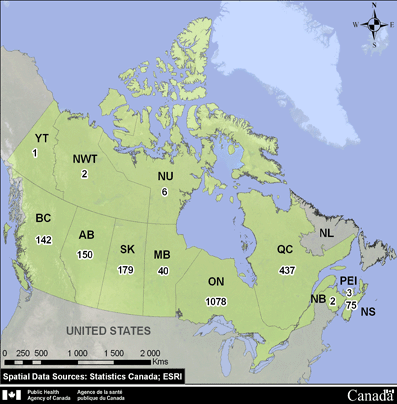
As of June 5, 2009, a total of 2,115 laboratory-confirmed cases of H1N1 flu virus have been reported in 9 provinces and 3 territories in Canada (see Table 1 below).

*******************
Table 1: Summary of laboratory-confirmed cases of H1N1 flu virus reported to the Public Health Agency of Canada, by the provinces and territories as of June 5, 2009 at 15:00 EDT.

Province / Territory NEW Laboratory-Confirmed Cases reported since June 3, 2009(1) TOTAL Laboratory-confirmed Cases (including today?s cases) (2)Total Deaths
British Columbia 6 142 0
Alberta 9 150 1
Saskatchewan 26 179 0
Manitoba 2 40 0
Ontario 184 1078 2
Quebec 91 437 0
New Brunswick 0 2 0
Nova Scotia 1 75 0
Prince Edward Island 0 3 0
Newfoundland 0 0 0
Yukon 0 1 0
Northwest Territories 0 2 0
Nunavut 1 6 0
Total 320 2115 3

(1) Note: P/Ts may choose to announce cases that have been confirmed after 15:00 EDT. These cases will be reflected in the next epidemiological update.

(2) Number of deaths is included in the number of cases

***************************************************

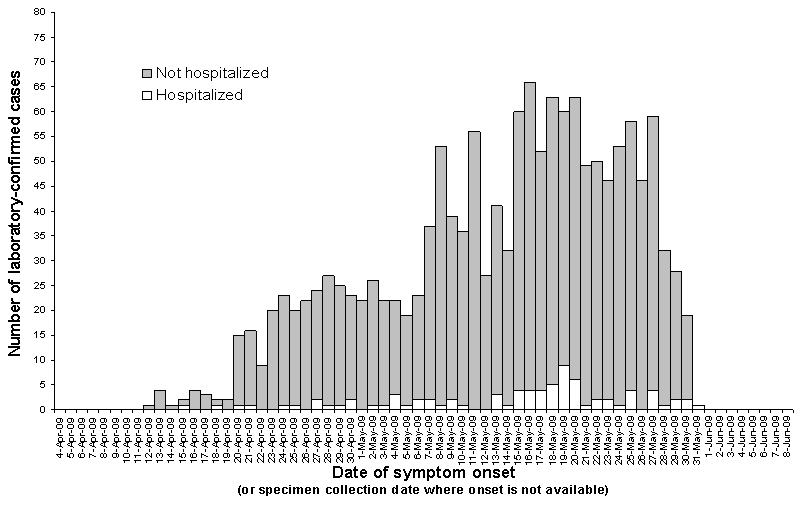
As of June 3rd 2009, the median age reported is 17 years (mean 22 years; range: <1 ? 80 years). To date 96 hospitalizations and three deaths have been reported among laboratory-confirmed cases. The most recent date of symptom onset is May 31st, 2009. Please note that an incorrect number of hospitalizations were previously reported therefore the value today has decreased.

The following graph, also known as an epidemic curve, is up to date as of June 3rd, 2009. The graph illustrates the course of the current H1N1 flu virus outbreak in Canada. It shows the date when symptoms of H1N1 flu virus began for each of the laboratory-confirmed cases.

f1_20090605a-eng.gif


Figure 1. Number of laboratory-confirmed H1N1 flu virus cases in Canada by date of onset (or specimen collection date where onset is not available) as reported to the Public Health Agency of Canada as of 3 June 2009 15:00 EDT (N=1,503).

Source: Provincial/Territorial Ministries of Health

When interpreting the graph, it should be noted that:

* The graph is prepared retrospectively and is updated daily using the information available at that time. It is not as current as Table 1 that contains the summary of laboratory-confirmed cases, as information about the date of onset of symptoms takes more time to compile.
* There is always a delay from the date that an illness starts to the date the case is reported to public health authorities. This delay is the result of the time required for patients to see their physicians, laboratory testing to be completed, and results to be communicated to public health authorities.
 
Back
Top Bottom