Re: Canadian swine flu total moves to 47
Re: Canadian swine flu total moves to 47
Source:
http://cnews.canoe.ca/CNEWS/Canada/2009/05/01/9314256-cp.html
New cases of swine flu confirmed
Canadian total moves to 51
By THE CANADIAN PRESS
OTTAWA - The federal government is expanding its swine flu prevention campaign to Facebook, Twitter and YouTube as the number of confirmed cases continue to climb.
Officials announced the new "citizen readiness campaign" Friday as the number of confirmed cases of the virulent flu strain known as H1N1 jumped to 51.
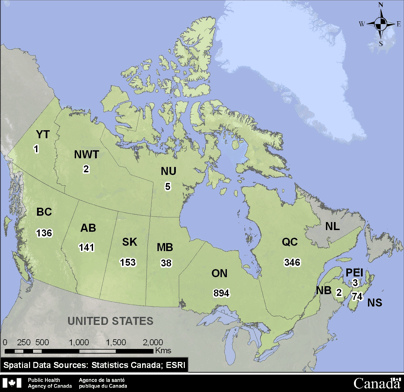
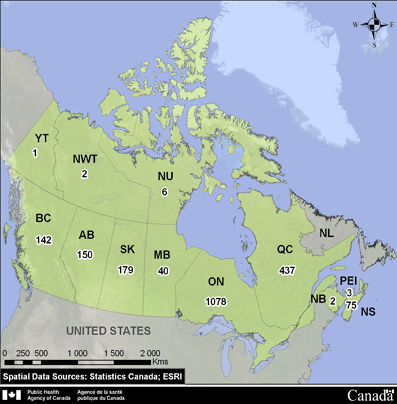
To date, British Columbia leads the tally with 15 cases, followed by Nova Scotia with 14, Ontario with 12, Alberta with eight and Quebec and New Brunswick with one case each.
"We continue to see mild cases and full recovery in Canada," said Public Health Officer David Butler-Jones.
"But as we've been saying, the more surveillance we conduct, the more we look, the more cases we are likely to find. Severity will vary and we might see deaths as we do with every seasonal flu."
Still, Butler-Jones said there's reason for optimism given that summer is coming and the cases so far have been mild.
He said the expanded prevention campaign - which will target mainstream media and social networking sites - will emphasize the importance of hand-washing, covering sneezes and staying home when sick.
He reminded people to visit
www.fightflu.ca for more information.
Prime Minister Stephen Harper said he's confident that Canadians, while taking the necessary precautions and eyeing developments with a sense of concern, are not getting carried away.
"My sense is the public is, like ourselves, concerned, but I don't sense a panic," he said in Edgeley, Sask.
"I sense the public is listening very carefully to various advisories and warnings they are getting and responding appropriately and that's what we encourage."
Harper was asked about the World Health Organization's decision Thursday to begin referring to the virus by its formal name rather than the more colloquial "swine flu."
"This is obviously a medical condition so it makes sense to refer to it that way and I gather that's a standard that the World Health Organization is now trying to encourage," Harper said.
"The health risks here are to humans; that's the concern ... It is not the health of the hog industry in any way that is at stake here, so we will encourage that terminology."
B.C.'s four new cases involved one youngster, one teenager and two adults - all in the province's Lower Mainland, all mild and all involving people who were either recently in Mexico or in contact with people who were, said Premier Gordon Campbell.
While neither the status nor the number of cases in Canada should be considered cause for alarm, the level of worry surrounding a virus that's fuelling fears of a global pandemic is perfectly justified, Campbell told a news conference.
"Unfortunately, we may see some deaths. We have deaths from flu every year. It's important for us to recognize that and it's important for us to recognize that, again, there is no reason we can't deal with this constructively and positively if we all pay attention to it."
Much the same warning came from health officials in Nova Scotia, which is where Canada's first cases of H1N1 came to light last weekend, all of them from a private school where a group of students had recently returned from a school trip to Mexico.
All the new cases are students from the King's Edgehill private school in Windsor, N.S., said Dr. Robert Strang, Nova Scotia's chief public health officer.
"At this point we're not seeing severe cases such as have been experienced in Mexico," Strang said. The province's total caseload is now 14, he added.
"We do expect to see new cases and we anticipate more in the coming days. As with normal flu, once the number of cases does increase, it is normal to see more severe cases and potentially even some deaths."
Ontario reported four more mild cases, all in the Toronto area, bringing the province's total to 12.
In Alberta, two more mild cases involving two women from Calgary, one a recent returnee from Mexico and the other from Tennessee, brought the total number in the province to eight, said Dr. Andre Corriveau, the province's chief medical officer of health.
Corriveau said health officials have heard that some businesses in Alberta are requiring any staff who have recently visited Mexico to see a doctor before they return to work, a step he described as unnecessary.
"We are appealing to people to be reasonable - not to clog our health-care system unnecessarily."
On Friday, the Catholic Archdiocese of Edmonton said it was asking parishes to make changes to help prevent the spread of infection.
Priests have been asked to stop distributing consecrated wine from the common cup and to encourage parishioners who usually receive communion wafers on their tongue to receive it in their hands instead.
"It is important to note that the Phase 5 WHO alert does not mean a life-threatening health situation in the Archdiocese and that the steps being recommended are precautionary," Archbishop Richard Smith said in his letter to priests.
An official with the Canadian Conference of Catholic Bishops said it was not immediately clear how many of the other 14 Archdiocese across the country are taking similar measures.
Strang said all of the Nova Scotia students who had swine flu were now better, after spending at least seven days in isolation, and are no longer infectious.
One of the six students who became infected with swine flu was actually on the trip to Mexico, while the other five caught it after the students came back to Canada. Fifteen students at the school are still in isolation, he added.