• FluTrackers.com Inc. does not provide medical advice. Information on this web site is collected from various internet resources, and the FluTrackers board of directors makes no warranty to the safety, efficacy, correctness or completeness of the information posted on this site by any author or poster. The information collated here is for instructional and/or discussion purposes only and is NOT intended to diagnose or treat any disease, illness, or other medical condition. Every individual reader or poster should seek advice from their personal physician/healthcare practitioner before considering or using any interventions that are discussed on this website. By continuing to access this website you agree to consult your personal physican before using any interventions posted on this website, and you agree to hold harmless FluTrackers.com Inc., the board of directors, the members, and all authors and posters for any effects from use of any medication, supplement, vitamin or other substance, device, intervention, etc. mentioned in posts on this website, or other internet venues referenced in posts on this website.
  • We are not asking for any donations. Do not donate to any entity who says they are raising funds for us.

At least 35 sea turtles found dead along Mississippi beaches

Pathfinder

Editor, Senior Moderator
20 sea turtles found dead along Miss. beaches

By BRIAN SKOLOFF (AP) – 1 hour ago


GULFPORT, Miss. — At least 20 sea turtles have been found dead this weekend along a 30-mile stretch of Mississippi beaches from Biloxi to Bay St. Louis.

While wildlife officials can't say with certainty the turtles, some endangered, died as a result of the oil spill, the number concerns them.

Moby Solangi, director of the Institute for Marine Mammal Studies in Gulfport, Miss., said Sunday this is typically the time of year when turtles wash up on shore.

Solangi says even though no oil appears to be on the turtles, they may still have been sickened by consuming oil-coated fish. He says that won't be clear until necropsies are performed on Monday.

Some of the dead reptiles are endangered Kemps ridley turtles.

http://www.google.com/hostednews/ap/article/ALeqM5gQCigab_EXcwMV8d4kNQelDLVbXgD9FF0F4G2
 
Last edited:
Re: 20 sea turtles found dead along Mississippi beaches

Re: 20 sea turtles found dead along Mississippi beaches

Miss. coast town has little to do, but wait

Sunday, May. 02, 2010
By MARIA BURNHAM - Associated Press Writer

PASS CHRISTIAN, Miss. -- Gus Holliman has spent the last two days riding the beaches in this coastal Mississippi town, hoping not to find dead animals.

On Saturday the sea turtles started washing up on shore. On Sunday, the turtles were joined by dead catfish, horseshoe crabs, and birds - a duck, a pelican and a seagull.

Before the April 20 rig explosion and oil started pouring into the Gulf, the city might see a small turtle wash up every six months - one that got caught in a net, or died from some natural cause, said Holliman, a City of Pass Christian patrol officer, who works the harbor.

<!-- CLOSE: #story_body_top -->
"But we've never seen this many," he says, shaking his head. "Something's going on; we just don't know what."

The animals don't appear to be coated in oil, but some of the turtles have damaged shells. Though sea turtles can be seen out near the barrier islands, no one is sure where these dead ones are coming from.

The dead animals are being bagged and taken to the Institute for Marine Mammal Studies, where scientists are trying to determine what caused their deaths. So far, there are no answers.

Aside from the dead animals, which residents here are viewing as an ominous sign of what's to come, there isn't much to do, but wait.

"We're in a hurry up and wait situation with no answers," said Adam Pace, 26, a local developer.

Pace says as a recreational fisherman, he's periodically spotted the sea turtles, which are an endangered species - but that it was a rare treat.

"I haven't seen 12 in my life, much less 12 wash up on a beach," he said Sunday, sitting at Shaggy's Harbor Bar & Grill, just down the beach from where the animals were found.

People are going about their lives in this small town - attending church services, having lunch with friends, making plans for the week ahead - but almost every conversation seems to start with a discussion of wind, water and oil.
...

Read more: http://www.sunherald.com/2010/05/02/2147041/miss-coast-town-has-little-to.html#ixzz0mpAf8GLR
 
Re: 20 sea turtles found dead along Mississippi beaches

Re: 20 sea turtles found dead along Mississippi beaches

Oil has differing chemical signatures depending on its origins, both in terms of petrochemical composition and in terms of heavy metals and other contaminants naturally found within it, that could be taken up in measurable concentrations within water.

I have been searching for some data, but have not found any information on the chemical analysis of this oil source: aside and apart from the actual oil and tar issues, this is also a concern to measure environmental impact of contaminant dissolution. If anyone monitoring this disaster finds such reports they would be worth posting here to give a full picture.
 
Re: 20 sea turtles found dead along Mississippi beaches

Re: 20 sea turtles found dead along Mississippi beaches

any information on the chemical analysis of this oil source ...
If anyone monitoring this disaster finds such reports they would be worth posting here to give a full picture.

even the generic data about seems enaugh bad,

and such mega-pollution can't be payed
- no money can repair the wide enviro-marine life-damage by this continuous strong leakeage


http://www.msnbc.msn.com/id/36878803/ns/technology_and_science-science/

Oil spill is the ‘bad one’ experts feared

Environmental effect compared to Category 5 hurricane

By Seth Borenstein
APTRANS.gif
updated 6:21 p.m. ET April 30, 2010

"The current spill "is kind of a worst-case scenario," Tunnell said.What makes this spill relentless and most similar to Ixtoc 1 is that it's an active well that keeps flowing. The Exxon Valdez was a tanker with a limited supply of oil. The rig 40 miles from the Gulf Coast may leak for months before a relief well can be drilled to stop the flow, Kinner said.
And LSU's Overton said: "I'm not very optimistic that they'll be drilling a relief well in three months."

Type of oil also a problem

The type of oil involved is also a major problem
. While most of the oil drilled off Louisiana is a lighter crude, this isn't. It's a heavier blend because it comes from deep under the ocean surface, Overton said.
"If I had to pick a bad oil, I'd put this right up there. The only thing that's not bad about this is that it doesn't have a lot of sulfur in it and the high sulfur really smells bad."
The first analysis of oil spill samples showed it contains asphalt-like substances that make a major sticky mess, he said. This is because the oil is older than most oil in the region and is very dense.
This oil also emulsifies well, Overton said. Emulsification is when oil and water mix thoroughly together, like a shampoo, which is mostly water, said Penn State engineering professor Anil Kulkarni.
It "makes a thick gooey chocolate mousse type of mix," Kulkarni said.
And once it becomes that kind of mix, it no longer evaporates as quickly as regular oil, doesn't rinse off as easily, can't be eaten by oil-munching microbes as easily, and doesn't burn as well, experts said.
That type of mixture essentially removes all the best oil clean-up weapons, Overton and others said.
Under better circumstances, with calmer winds and water, the oil might have a chance of rising without immediately emulsifying, but that's not happening here, Kulkarni said. It's pretty much mixed by the time it gets to the surface."
___

http://www.treehugger.com/files/2010/04/anatomy-of-an-oil-spill-cleanup.php

The Anatomy of an Oil Spill Cleanup: What Works and What Doesn't

by John Laumer, Philadelphia on 04.30.10

In responding to the Exxon Valdez oil spill, much was learned about what works for cost effective oil spill cleanup, and logistics turned out to be the key to it all. Inventing a dispersant (chemical agents such as surfactants, solvents, and other compounds used to reduce the effect of oil spills by changing the chemical and physical properties of the oil) or bioremediation agent (microorganismsor biological agents used to break down or remove oil) was only a small part of the solution then, and it still is that way. Some of the spill response treatments proposed after Valdez were found to be more hazardous than oil for marine organisms. For example, steam cleaning rocks, in retrospect, wasn't such a good idea. (Think about the carbon footprint.) And you can't remove all the oil from a duck's feathers; it would die. The nuances of what it is used and how it used have everything to do with "successful" clean up.
 
Re: 20 sea turtles found dead along Mississippi beaches

Re: 20 sea turtles found dead along Mississippi beaches

http://www.epa.gov/emergencies/content/ncp/product_schedule.htm

National Contingency Plan Product Schedule

The table below shows all products currently listed in the <acronym title="National Contingency Plan">NCP</acronym> Product Schedule. To limit the view to a specific category, use the drop down box in the "Category" column.

For more information on the Product Schedule, contact the NCP Product Schedule Information Line.
<table class="tablebord" style="border-bottom: 1px solid rgb(204, 204, 204);" id="prod_table" summary="Links to NCP products by category" cellspacing="0" width="90%"><thead> <tr><th style="" id="product">Product</th><th style="" id="category">Category</th></tr> </thead> <tbody> <tr><td nowrap="nowrap"><input class="flt" id="flt0_prod_table" type="hidden">
</td><td nowrap="nowrap"><select class="flt" id="flt1_prod_table"><option value="">View by: All Categories</option><option value="Bioremediation Agent">Bioremediation Agent</option><option value="Dispersant">Dispersant</option><option value="Miscellaneous Oil Spill Control Agent (MOSCA)">Miscellaneous Oil Spill Control Agent (MOSCA)</option><option value="Miscellaneous Oil Spill Control Agent - MOSCA">Miscellaneous Oil Spill Control Agent - MOSCA</option><option value="Surface Washing Agent">Surface Washing Agent</option></select></td></tr><tr><td headers="product">ALSOCUP</td><td headers="category">Miscellaneous Oil Spill Control Agent - MOSCA</td></tr> <tr><td headers="product">AQUACLEAN</td><td headers="category">Surface Washing Agent </td></tr> <tr><td headers="product">AQUA N-CAP? POLYMER</td><td headers="category">Miscellaneous Oil Spill Control Agent - MOSCA</td></tr> <tr><td headers="product">B&S INDUSTRIAL (see STEP ONE)</td><td headers="category">Bioremediation Agent </td></tr> <tr><td headers="product">BET BIOPETRO (formerly BET BIOPETRO HEAVY)</td><td headers="category">Bioremediation Agent </td></tr> <tr><td headers="product">BG-CLEAN? 401</td><td headers="category">Surface Washing Agent </td></tr> <tr><td headers="product">BILGE CLEAR (see S-200)</td><td headers="category">Bioremediation Agent </td></tr> <tr><td headers="product">BIODISPERS (formerly PETROBIODISPERS)</td><td headers="category">Dispersant</td></tr> <tr><td headers="product">BIOSOLVE<sup>?</sup> HYDROCARBON MIGRATION TECHNOLOGY?</td><td headers="category">Surface Washing Agent</td></tr> <tr><td headers="product">BIOWORLD BIOREMEDIATION HYDROCARBON TREATMENT PRODUCTS</td><td headers="category">Bioremediation Agent</td></tr> <tr><td headers="product">CIAGENT (formerly CI AGENT, CHEAP INSURANCE, and PETRO-CAPTURE)</td><td headers="category">Miscellaneous Oil Spill Control Agent - MOSCA</td></tr> <tr><td headers="product">CLEAN SPLIT (see SPLIT DECISION SC)</td><td headers="category">Surface Washing Agent</td></tr> <tr><td headers="product">CN-110</td><td headers="category">Surface Washing Agent</td></tr> <tr><td headers="product">COREXIT<sup>?</sup> EC7664A (formerly COREXIT 7664)</td><td headers="category">Surface Washing Agent</td></tr> <tr><td headers="product">COREXIT<sup>?</sup> EC9500A (formerly COREXIT 9500)</td><td headers="category">Dispersant</td></tr> <tr><td headers="product">COREXIT<sup>?</sup> EC9580A (formerly COREXIT 9580 SHORELINE CLEANER)</td><td headers="category">Surface Washing Agent</td></tr> <tr><td headers="product">COREXIT<sup>?</sup> EC9527A (formerly COREXIT 9527)</td><td headers="category">Dispersant</td></tr> <tr><td headers="product">CYTOSOL</td><td headers="category">Surface Washing Agent</td></tr> <tr><td headers="product">DISPERSIT SPC 1000?</td><td headers="category">Dispersant</td></tr> <tr><td headers="product">DO-ALL #18</td><td headers="category">Surface Washing Agent</td></tr> <tr><td headers="product">DUO-SPLIT (see SPLIT DECISION SC)</td><td headers="category">Surface Washing Agent</td></tr> <tr><td headers="product">ELASTOL</td><td headers="category">Miscellaneous Oil Spill Control Agent - MOSCA</td></tr> <tr><td headers="product">ENVIROCLEAN (formerly ENVIRO CLEAN 165)</td><td headers="category">Surface Washing Agent</td></tr> <tr><td headers="product">E-SAFE<sup>?</sup></td><td headers="category">Surface Washing Agent </td></tr> <tr><td headers="product">F-500</td><td headers="category">Surface Washing Agent</td></tr> <tr><td headers="product">FINASOL OSR 52</td><td headers="category">Dispersant</td></tr> <tr><td headers="product">FIREMAN'S BRAND SPILLCLEAN (see SPILLCLEAN)</td><td headers="category">Dispersant</td></tr> <tr><td headers="product">GENISIS WE-F (see OPPENHEIMER FORMULA)</td><td headers="category">Bioremediation Agent </td></tr> <tr><td headers="product">GOLD CREW SW</td><td headers="category">Surface Washing Agent</td></tr> <tr><td headers="product">INIPOL EAP 22</td><td headers="category">Bioremediation Agent </td></tr> <tr><td headers="product">JD-109</td><td headers="category">Dispersant</td></tr> <tr><td headers="product">JD-2000?</td><td headers="category">Dispersant</td></tr> <tr><td headers="product">JE1058BS</td><td headers="category">Bioremediation Agent </td></tr> <tr><td headers="product">LAND AND SEA RESTORATION</td><td headers="category">Bioremediation Agent </td></tr> <tr><td headers="product">MARE CLEAN 200 (formerly MARE CLEAN 505)</td><td headers="category">Dispersant</td></tr> <tr><td headers="product">MARI-ZYME (see ZYME-FLOW)</td><td headers="category">Miscellaneous Oil Spill Control Agent - MOSCA</td></tr> <tr><td headers="product">MICRO-BLAZE<sup>?</sup></td><td headers="category">Bioremediation Agent </td></tr> <tr><td headers="product">MICRO CLEAN (see NATURE'S WAY HS)</td><td headers="category">Surface Washing Agent</td></tr> <tr><td headers="product">MIGHT MIKE BPT (see OPPENHEIMER FORMULA)</td><td headers="category">Bioremediation Agent </td></tr> <tr><td headers="product">NALE-IT</td><td headers="category">Surface Washing Agent</td></tr> <tr><td headers="product">NATURAL ENVIRO 8000 BIOREMEDIATION (see OPPENHEIMER FORMULA)</td><td headers="category">Bioremediation Agent </td></tr> <tr><td headers="product">NATURE'S WAY HS</td><td headers="category">Surface Washing Agent</td></tr> <tr><td headers="product">NATURE'S WAY PC (see NATURE'S WAY HS)</td><td headers="category">Surface Washing Agent</td></tr> <tr><td headers="product">NEOS AB3000</td><td headers="category">Dispersant</td></tr> <tr><td headers="product">NOKOMIS 3-AA</td><td headers="category">Dispersant</td></tr> <tr><td headers="product">NOKOMIS 3-F4</td><td headers="category">Dispersant</td></tr> <tr><td headers="product"><ins datetime="2009-12-16">OIL SOLUTIONS POWDER </ins></td><td headers="category">Miscellaneous Oil Spill Control Agent (MOSCA)</td></tr> <tr><td headers="product"><ins datetime="2009-10-07">OIL SPILL EATER II </ins></td><td headers="category">Bioremediation Agent</td></tr> <tr><td headers="product">OPPENHEIMER FORMULA</td><td headers="category">Bioremediation Agent </td></tr> <tr><td headers="product">PES-51</td><td headers="category">Miscellaneous Oil Spill Control Agent - MOSCA</td></tr> <tr><td headers="product">PETRO-CLEAN</td><td headers="category">Surface Washing Agent</td></tr> <tr><td headers="product">PETRO-GREEN ADP-7 (formerly D-14)</td><td headers="category">Surface Washing Agent</td></tr> <tr><td headers="product">PETROTECH 25</td><td headers="category">Surface Washing Agent</td></tr> <tr><td headers="product">PETRO-TREAT (see OPPENHEIMER FORMULA)</td><td headers="category">Bioremediation Agent </td></tr> <tr><td headers="product">POWERCLEAN (see NATURE'S WAY HS)</td><td headers="category">Surface Washing Agent</td></tr> <tr><td headers="product">PREMIER 99</td><td headers="category">Surface Washing Agent</td></tr> <tr><td headers="product">PRISTINE SEA II</td><td headers="category">Bioremediation Agent </td></tr> <tr><td headers="product">PROCLEANS</td><td headers="category">Surface Washing Agent</td></tr> <tr><td headers="product">PX 700?</td><td headers="category">Miscellaneous Oil Spill Control Agent - MOSCA</td></tr> <tr><td headers="product">RAPIDGRAB 2000?</td><td headers="category">Miscellaneous Oil Spill Control Agent - MOSCA</td></tr> <tr><td headers="product">S-200</td><td headers="category">Bioremediation Agent </td></tr> <tr><td headers="product">S-200C (see S-200)</td><td headers="category">Bioremediation Agent </td></tr> <tr><td headers="product">SAF-RON GOLD</td><td headers="category">Dispersant</td></tr> <tr><td headers="product">SC-1000?</td><td headers="category">Surface Washing Agent</td></tr> <tr><td headers="product">SEA BRAT #4</td><td headers="category">Dispersant</td></tr> <tr><td headers="product">SEACARE E.P.A. (see DISPERSIT SPC 1000?)</td><td headers="category">Dispersant</td></tr> <tr><td headers="product">SF-GOLD DISPERSANT (see SAF-RON GOLD)</td><td headers="category">Dispersant</td></tr> <tr><td headers="product">SHEENCLEAN (see S-200)</td><td headers="category">Bioremediation Agent </td></tr> <tr><td headers="product">SHEEN-MAGIC<sup>?</sup></td><td headers="category">Surface Washing Agent </td></tr> <tr><td headers="product">SIMPLE GREEN<sup>?</sup></td><td headers="category">Surface Washing Agent</td></tr> <tr><td headers="product"><ins datetime="2009-12-16">SPILL GREEN LS </ins></td><td headers="category">Miscellaneous Oil Spill Control Agent (MOSCA)</td></tr> <tr><td headers="product">SPILLCLEAN (SW-36) or SPILLCLEAN ["Concentrate"] (a/k/a FIREMAN'S BRAND SPILLCLEAN)</td><td headers="category">Surface Washing Agent</td></tr> <tr><td headers="product">SPILLREMED (MARINE)<sup>?</sup></td><td headers="category">Bioremediation Agent </td></tr> <tr><td headers="product">SPLIT DECISION SC (formerly SPLIT DECISION)</td><td headers="category">Surface Washing Agent</td></tr> <tr><td headers="product">STEP ONE</td><td headers="category">Bioremediation Agent </td></tr> <tr><td headers="product">SUPERALL #38 (see TOPSALL #30)</td><td headers="category">Surface Washing Agent</td></tr> <tr><td headers="product">SX-100?</td><td headers="category">Surface Washing Agent</td></tr> <tr><td headers="product">SYSTEM E.T. 20 (formerly MCW.B 20)</td><td headers="category">Bioremediation Agent </td></tr> <tr><td headers="product">The OPPENHEIMER FORMULA I (see OPPENHEIMER FORMULA)</td><td headers="category">Bioremediation Agent </td></tr> <tr><td headers="product">TOPSALL #30</td><td headers="category">Surface Washing Agent</td></tr> <tr><td headers="product">TXCHEM HE-1000?</td><td headers="category">Surface Washing Agent</td></tr> <tr><td headers="product">UNITED 658 PETRO-ZYME (see ZYME-FLOW)</td><td headers="category">Miscellaneous Oil Spill Control Agent - MOSCA</td></tr> <tr><td headers="product">VB591?, VB997?, BINUTRIX? (formerly MYCOBAC TX-20)</td><td headers="category">Bioremediation Agent </td></tr> <tr><td headers="product">WASTE-SET #3200?</td><td headers="category">Miscellaneous Oil Spill Control Agent - MOSCA</td></tr> <tr><td headers="product">WASTE-SET #3400?</td><td headers="category">Miscellaneous Oil Spill Control Agent - MOSCA</td></tr> <tr><td headers="product">WMI-2000</td><td headers="category">Bioremediation Agent </td></tr> <tr><td headers="product">ZI-400</td><td headers="category">Dispersant</td></tr> <tr><td headers="product">ZI-400 OIL SPILL DISPERSANT (see ZI-400)
</td><td headers="category">Dispersant</td></tr> <tr><td headers="product">ZYME-FLOW</td><td headers="category">Miscellaneous Oil Spill Control Agent - MOSCA</td></tr> <tr><td headers="product">ZYME-TREAT (see ZYME-FLOW)</td><td headers="category">Miscellaneous Oil Spill Control Agent - MOSCA</td></tr></tbody></table>
 
Re: 20 sea turtles found dead along Mississippi beaches

Re: 20 sea turtles found dead along Mississippi beaches

Oil-spill disaster: Chemicals used in cleanup add to toxic mix

By Kevin Spear, Orlando Sentinel
May 2, 2010

Excerpts:

"Coast Guard and oil-industry officials, however, are desperate to control the slick, which began fouling Louisiana's Mississippi River delta with a light sheen Friday and spread to within 85 miles or so of Pensacola. Instead of only using airplanes and boats to douse crude with dispersant, cleanup workers have lowered a spray nozzle nearly a mile underwater."

"We are now going to go to a novel, a novel, absolutely novel idea ? 5,000 feet below the surface and deploying dispersants on the outflow from the well," U.S. Coast Guard Rear Adm. Mary Landry said last week.
-------------------
But according to Jackie Savitz, senior campaign director for the ocean-conservation group Oceana, the heavy use of dispersants is only slightly less horrendous than the Gulf spill itself.

"You're basically pouring chemicals into the ocean, which is never a good thing," Savitz said. "We have no option but to trust the responders and know that they are doing the best they can."
-------------------
Dennis Takahashi-Kelso, executive vice president of the environmental group Ocean Conservancy, said dispersants come in three main varieties but have in common the risk of damaging ecosystems and hurting wildlife.
-------------------
By Saturday evening, crews had applied nearly 150,000 gallons of dispersant.

"You're in a situation where you don't have a lot of norms ? this is a huge amount of oil," said Richard Dodge, dean of Nova Southeastern University's Oceanographic Center. "If you have a huge, huge amount of oil, the effectiveness of dispersant decreases to some extent because you need so much of it."


Much more at:
http://www.orlandosentinel.com/news...mical-cleanup-20100502,0,6337561.story?page=2
 
Re: 29 sea turtles found dead along Mississippi beaches

Re: 29 sea turtles found dead along Mississippi beaches

<TABLE class=Box_72083764_Tb cellSpacing=0 cellPadding=0 width="98%" border=0><TBODY><TR align=left><TD class=Box_72083764_Td width="100%">Posted: Tuesday, 04 May 2010 9:50AM

No oil found on 29 dead turtles in Gulf of Mexico

Associated Press Reporting

<TABLE class=Box_72083764_Tb height=220 cellSpacing=0 cellPadding=0 width=330 border=0><TBODY><TR><TD class=Box_72083764_Image_Td>
1558854.jpg
</TD></TR><TR><TD class=Box_72083764_Image_Caption></TD></TR></TBODY></TABLE>
Posted: Tuesday, 04 May 2010 9:50AM

</TD></TR><TR align=left><TD class=Box_72083764_Td width="100%">The head of an organization that cares for sick marine life is saying that oil has not been found on 29 dead turtles that washed up on Mississippi beaches.

Moby Solangi, director of the Institute for Marine Mammal Studies in Gulfport, said Tuesday necropsies had been completed on the turtles and found no oil. Experts are still warning the turtles may have eaten fish contaminated by the oil spill in the Gulf of Mexico.

Solangi says tissue samples are being sent to labs for further review. The results could take a week.

The turtles were endangered Kemp's ridley sea turtles. They nest only on beaches in Mexico and southern Texas along the gulf coast.

They were about two or three years old.


</TD></TR></TBODY></TABLE>

http://www.wwl.com/pages/6962603.php?contentType=4&contentId=6043455
 
Last edited:
Re: At least 35 turtles found dead along Mississippi beaches

Re: At least 35 turtles found dead along Mississippi beaches

Govt. Investigates Shrimpers In Gulf Turtle Deaths


BRIAN SKOLOFF, Associated Press Writer

POSTED: 11:18 am CDT May 5, 2010
UPDATED: 3:53 pm CDT May 5, 2010


GULFPORT, Miss. -- Federal authorities are investigating whether fishermen eager to maximize their catch ahead of the massive oil slick threatening the Gulf Coast have been killing endangered sea turtles, an official said Wednesday.


Wildlife officials say at least 35 endangered sea turtles have washed up on Gulf coast beaches, but it's not clear what's killing them. Necropsies have shown no signs of oil.


Investigators will look into whether some shrimp boats taking part in an emergency shrimping season removed devices from their nets that are intended to allow turtles to escape, said Sheryan Epperly, sea turtle team leader for the National Marine Fisheries Service.


snip

/.../
http://www.wdsu.com/news/23465008/detail.html
 
Re: At least 35 sea turtles found dead along Mississippi beaches

DATE: May 05, 2010 16:40:01 CST

NOAA update on sea turtle stranding in the Gulf of Mexico‏

ROBERT, La. - There have been 38 sea turtle strandings reported from Alabama through the Louisiana delta since April 30. Sea turtle stranding responders working under the guidance of NOAA ? who responds to thousands of sea turtle strandings every year ? recovered all but one of the turtles. All those recovered were dead except one, which died shortly thereafter. Most of the turtles identified so far are endangered juvenile Kemp?s ridley turtles. No evidence of oil was found on the beaches where the strandings occurred.

?Based on careful examination, NOAA scientists do not believe that these sea turtle strandings are related to the oil spill. NOAA and its partners have conducted 10 necropsies so far ? none of ten turtles showed evidence of oil, externally or internally,? said Barbara Schroeder, NOAA national sea turtle coordinator.

The turtles have been sent to the Institute for Marine Mammal Studies in Gulfport, Miss. to determine, if possible, whether their deaths are linked to oil, or another cause. Based on careful examination, NOAA scientists do not believe that these sea turtle strandings are related to the oil spill. NOAA and its partners have conducted 10 necropsies so far ? none of ten turtles showed evidence of oil, externally or internally. At least 15 more necropsies of dead sea turtles are planned in the coming days. While the complete results can take several weeks because of the time needed to analyze tissue, preliminary results are available immediately after the necropsy itself, which takes several hours.

Potential Causes

There are thousands of sea turtle strandings reported every year in the Gulf of Mexico. In recent years, sea turtles in the Gulf of Mexico have shown a pattern of increased stranding during this time of year. NOAA believes the stranding numbers are higher than normal and are working to understand why.

Sea turtles die of natural causes, and are also affected by natural factors such as algal blooms. Primary human causes for sea turtle deaths include being caught in fishing nets, shrimp trawls and vessel strikes.

Monitoring

Overflights of the oil spill area yesterday showed 30-50 sea turtles (species unknown) swimming in or near the oil spill. As weather allows, NOAA will continue to do daily overflights of the slick, which will guide mitigation efforts, such as burning of oil and application of dispersants.

NOAA is working on a plan to address large numbers of oiled sea turtles.
There are five sea turtle species in the Gulf of Mexico. Kemp?s ridley, leatherback, and green sea turtles are listed as endangered under the Endangered Species Act; loggerhead and hawksbill sea turtles are listed as threatened.

http://www.deepwaterhorizonresponse.com/go/doc/2931/539971/
 
Re: At least 35 sea turtles found dead along Mississippi beaches

LDWF Recovers Two Oil-Impacted Sea Turtles

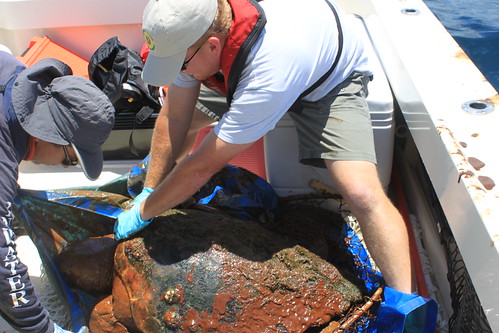
BATON ROUGE (May 21, 2010) - Louisiana Department of Wildlife and Fisheries biologists recovered two oiled sea turtles yesterday approximately 25 miles offshore from Venice, La. Biologists netted a small Kemp's ridley sea turtle and a mature loggerhead sea turtle that were originally spotted in a daily aerial tour and reported to LDWF.

"We plan to return to this area in the coming days to survey for more distressed sea turtles," said LDWF Secretary Robert Barham. "LDWF is giving these oil-impacted animals their best chance for survival. I hope these sea turtles make a full recovery, as they are a resilient species."


A team of five fisheries biologists conducted a three-day rescue attempt of these sea turtles. The team traveled along rip tides, which sea turtles are known to follow, searching for the distressed animals; they were found on day three floating in an oil line. After locating, the sea turtles were captured using nets.

Once aboard the LDWF vessel the sea turtles were properly sampled and documented, as the animals were transported back to Venice. LDWF then transported the turtles to the Audubon Aquarium of the America's Institute staff who are then charged with cleaning and rehabilitating the animals.

LDWF is continually monitoring beaches and waters of Louisiana to survey for any animals that may need rescue. In addition, aerial surveys are performed regularly by USFWS under the direction of the Unified Command Center in Houma. Any observed animals are reported back to LDWF at which point fisheries biologists further investigate the report and follow full sampling protocols.http://emergency.louisiana.gov/Releases/05202010-seaTurtles.html
4626872749_0bae102712.jpg
<SCRIPT type=text/javascript>Y.E.onDOMReady(show_notes_initially);</SCRIPT>
<SCRIPT type=text/javascript>F.decorate(_ge('photo_notes'), F._photo_notes).notes_go_go_go(4626872749, 'http://farm5.static.flickr.com/4027/4626872749_0bae102712_t.jpg', '3.1444');</SCRIPT><FORM id=fave_form style="VISIBILITY: hidden" method=post><INPUT type=hidden value=7dfa78368f78f1683d796e1cd13d96cf name=magic_cookie><INPUT type=hidden value=0 name=faveadd><INPUT type=hidden value=0 name=faveremove></FORM><!-- PHOTO CONTENT: DESCRIPTION, NOTES, COMMENTS -->
Photo courtesy of Louisiana Department of Wildlife and Fisheries


4627480432_543a974952.jpg
<SCRIPT type=text/javascript>Y.E.onDOMReady(show_notes_initially);</SCRIPT>
<SCRIPT type=text/javascript>F.decorate(_ge('photo_notes'), F._photo_notes).notes_go_go_go(4627480432, 'http://farm5.static.flickr.com/4070/4627480432_543a974952_t.jpg', '3.1444');</SCRIPT>
<FORM id=fave_form style="VISIBILITY: hidden" method=post><INPUT type=hidden value=7dfa78368f78f1683d796e1cd13d96cf name=magic_cookie><INPUT type=hidden value=0 name=faveadd><INPUT type=hidden value=0 name=faveremove></FORM>
<!-- PHOTO CONTENT: DESCRIPTION, NOTES, COMMENTS -->Photo courtesy of Louisiana Department of Wildlife and Fisheries
<NOSCRIPT></NOSCRIPT><!-- ############## COMMENTS -->

4626873569_75f5b4190d.jpg
<SCRIPT type=text/javascript>Y.E.onDOMReady(show_notes_initially);</SCRIPT>
<SCRIPT type=text/javascript>F.decorate(_ge('photo_notes'), F._photo_notes).notes_go_go_go(4626873569, 'http://farm4.static.flickr.com/3345/4626873569_75f5b4190d_t.jpg', '3.1444');</SCRIPT><FORM id=fave_form style="VISIBILITY: hidden" method=post>Photo courtesy of Louisiana Department of Wildlife and Fisheries


http://emergency.louisiana.gov/Releases/05202010-seaTurtles.html</FORM>
 
Last edited:
Re: At least 35 sea turtles found dead along Mississippi beaches

Many turtles found dead after Gulf oil spill probably died in nets, biologist says

The Associated Press
Posted: 06/24/2010 3:43 PM


render.htm;jsessionid=8A3D533FCC158FBDAFB81CBEC80775EA

Associated Press archive Institute of Marine Mammal Sciences researcher Justin Main takes photographs of a dead sea turtle on the beach in Pass Christian, Miss., in May.


More than half the endangered sea turtles dissected after being found dead in Mississippi in the wake of the Gulf oil spill -- 21 of 40 -- had sediment in their lungs, indicating they probably drowned in trawl nets near the sea floor, a federal biologist said Thursday.

The bodies are still being tested for toxins, especially those from algae blooms, but that's unlikely as a cause of death, said Brian Stacey of the National Oceanographic and Atmospheric Administration.

The numbers make other causes of drowning unlikely, Stacey said.

"We do get sporadic entrapment in wrecks, or entanglements in nets," but not nearly that many, he said.

Authorities have said they were investigating whether turtles might have drowned in shrimp nets.

All five species of sea turtles in the Gulf of Mexico are threatened or endangered; federal law requires escape hatches called turtle excluder devices on shrimp nets, which are towed along the bottom where shrimp congregate.

Most of the 411 dead and 128 live turtles found since April 30, when collections began, have been Kemp's Ridley sea turtles, the smallest and most endangered.

According to figures compiled by the U.S. Fish and Wildlife Service, 210 dead turtles were found in Mississippi, 88 in Louisiana, 66 in Alabama, 43 in Florida and four in the Gulf of Mexico. Only five turtles found dead on the shore had oil on them.

Collections started a day after Louisiana opened an emergency season to let shrimpers harvest a crop ahead of the oil spill.

On Monday, Mississippi authorities ordered shrimpers trawling in the Mississippi Sound to pull up their nets every 30 minutes rather than every 55 minutes, to reduce the chance of drowning turtles.

Turtle strandings are common along the Gulf of Mexico, but this year's numbers are higher than usual, Stacey said.
He spoke by phone from Gainesville, Fla., where he was about to resume necropsies -- animal autopsies -- on sea turtles.

He said the 67 necropsied so far included 26 too decomposed for detailed study.

More than 120 live sea turtles, 84 of them found covered in oil, are in rehabilitation centers. They include 76 found swimming in oil out in the Gulf of Mexico, two caught in oil skimming operations, and two each found in Alabama, Florida and Louisiana waters.

Another 42 rescued turtles did not have any visible oil on them, and two have not been classified. At least four were released.

../

http://mobile.nola.com/advnola/db_/...0775EA?contentguid=uTSovKAi&full=true#display
 
Re: At least 35 sea turtles found dead along Mississippi beaches

BP Kills Turtles in Oil Containment Burns, Lawsuit Says

<CITE class=byline>By Laurel Brubaker Calkins - Jul 1, 2010 </CITE>

(Corrects court district in case citation in last paragraph.)

Endangered sea turtles are being killed in BP Plc?s ?controlled burns? in the Gulf of Mexico by getting trapped inside the booms the company uses to collect spilled oil, wildlife activists said in a lawsuit.

London-based BP, which is struggling to control the largest spill in U.S. history, should be forced to stop the burns or ensure no turtles are caught inside the floating ?corrals? before the oil is ignited, the environmentalists said in the suit. BP?s killing of the turtles constitutes an illegal ?taking? of an endangered species under environmental laws, they claim.

The plaintiffs seek a temporary order restraining BP from any activities in the Gulf of Mexico that could risk killing or injuring endangered and threatened sea turtles, William Eubanks and Jason Burge, lawyers for the environmentalists, said in papers filed in New Orleans federal court yesterday.

The case was reassigned to U.S. District Judge Carl Barbier, who set a hearing on the request for July 2. Barbier already presides over 35 lawsuits claiming spill-related damages by fishing industry workers, property owners, tourism businesses and other environmental groups.
Leatherneck, Loggerhead

?BP has already killed or otherwise harmed? hundreds of rare Kemp?s Ridley, Leatherback, Loggerhead and other species of endangered sea turtles through its use of controlled burns or as a result of contamination from the oil spill itself,? the lawsuit claims. The animals become trapped when shrimp boats encircle patches of floating oil with fire-resistant booms to create ?burn boxes? 60 to 100 feet in diameter, they said.

In affidavits filed with the lawsuit, boat captains and turtle rescue workers say that in recent weeks they?ve saved numerous sea turtles that were trapped in heavy oil-sludge lines offshore, many from the same areas where trawlers are corralling sludge for controlled burns. The turtles are too heavily oiled to free themselves from the sludge and swim to safety, although out of the oil they respond well to rehabilitation, the witnesses said.

?Although I assume that such acts are an unintentional consequence of BP?s controlled burning strategy, I expect that these incidental burnings are almost certainly occurring based on my personal observations,? said Kevin Aderhold, a Louisiana charter boat captain involved in the sea turtle rescue effort.

BP spokesman Tony Odone said the company had no comment on pending litigation.

.../

http://www.bloomberg.com/news/2010-...-containment-burns-activists-suit-claims.html
 
Re: At least 35 sea turtles found dead along Mississippi beaches

BP oil spill: Scientists hatch plan in desparate race to save sea turtle eggs

By Steve Gorman, McClatchy June 30, 2010


<SCRIPT type=text/javascript> showTab("text/html"); </SCRIPT>

<SCRIPT type=text/javascript> function resizeImage() { var imgBox = document.getElementById('imageBox'); var photo = document.getElementById('storyphoto'); if (imgBox != null && photo != null) { if(photo.width >= 460) { imgBox.className = 'imagesize460'; } else { if(photo.width >= 300) { imgBox.className = 'imagesize310'; } else { imgBox.className = 'imageboxpadding'; } imgBox.style.width = photo.width + 'px'; } } } function getStoryFontSize() { var storyfontsize = getCookie('storyfontsize'); var storyfontimage = getCookie('storyfontimage'); // use cookied value, if present if (storyfontsize != null) { setClass('story_content',storyfontsize); if (storyfontimage != null) { setClass('fontsizecontainer',storyfontimage); } } else // default it to para14 if no cookie { setClass('story_content','para14'); setClass('fontsizecontainer','size02'); } } function setStoryFontSize(storyfontsize,storyfontimage) { setClass('story_content',storyfontsize); setClass('fontsizecontainer',storyfontimage); setCookie('storyfontsize', storyfontsize, '365', '/', '', ''); setCookie('storyfontimage', storyfontimage, '365', '/', '', ''); } function setCookie( name, value, expires, path, domain, secure ) { // set time var today = new Date(); today.setTime( today.getTime() ); if ( expires ) { expires = expires * 1000 * 60 * 60 * 24; //days } var expires_date = new Date( today.getTime() + (expires) ); document.cookie = name + "=" + escape( value ) + ( ( expires ) ? ";expires=" + expires_date.toGMTString() : "" ) + ( ( path ) ? ";path=" + path : "" ) + ( ( domain ) ? ";domain=" + domain : "" ) + ( ( secure ) ? ";secure" : "" ); } function getCookie( check_name ) { // split this cookie up into name/value pairs var a_all_cookies = document.cookie.split( ';' ); var a_temp_cookie = ''; var cookie_name = ''; var cookie_value = ''; var b_cookie_found = false; // set boolean t/f default f for ( i = 0; i < a_all_cookies.length; i++ ) { // split apart each name=value pair a_temp_cookie = a_all_cookies.split( '=' ); // and trim left/right whitespace while we're at it cookie_name = a_temp_cookie[0].replace(/^\s+|\s+$/g, ''); // if the extracted name matches passed check_name if ( cookie_name == check_name ) { b_cookie_found = true; // we need to handle case where cookie has no value but exists (no = sign, that is): if ( a_temp_cookie.length > 1 ) { cookie_value = unescape( a_temp_cookie[1].replace(/^\s+|\s+$/g, '') ); } // note that in cases where cookie is initialized but no value, null is returned return cookie_value; break; } a_temp_cookie = null; cookie_name = ''; } if ( !b_cookie_found ) { return null; } } </SCRIPT>
Mike Reynolds, director of Share the Beach, by a turtle nest in Gulf Shores, Alabama, where some 80 sea turtles are due to come ashore to nest this month. "By this time of year, we should have 11 nests. We have six," Reynolds says. The nests of the endangered turtles are well marked and will be watched ca

Photograph by: Carolyn Cole, MCT

LOS ANGELES ? U.S. wildlife experts are preparing to collect tens of thousands of endangered sea turtle eggs and move them hundreds of miles away in an unprecedented bid to protect them from the BP oil spill in the Gulf of Mexico.

Plans call for relocating 700 to 800 clutches of eggs left newly buried on the sandy beaches of Alabama and northwestern Florida ? accounting for the bulk of turtle nests in the northern Gulf, U.S. Fish and Wildlife Service spokesman Charles Underwood said on Monday.

"Relocating sea turtle nests on occasion, nest by nest, in very small numbers, has been done before (but) nothing has even been considered at this massive scale," Underwood told Reuters. "It?s never been attempted anywhere in the world."

Most of the nests designated for removal are those of the loggerhead turtle, the world?s largest hard-shelled turtle, growing to an average adult weight of 250 pounds (113 kg). The loggerhead is the most prevalent of five species of threatened or endangered sea turtles that inhabit the U.S. Gulf Coast.

The project, developed by the Fish and Wildlife Service, the National Marine Fisheries Service and the state of Florida, also will include a handful of nests from other species ? Kemp?s ridley, leatherback and green turtles.

Concerns about the well-being of turtles have run especially high since the spill began because it coincided with the reptiles? breeding season.
While the strategy is largely untested, the grave consequences of leaving the nests undisturbed are certain.

If allowed to hatch on their own without being moved, the baby turtles emerging from those nests would likely swim directly into the mass of crude oil spewing into the Gulf since late April from a ruptured BP well and now encroaching on Alabama and the Florida panhandle.
"It?s almost certainly a death sentence," Underwood said. "We?d expect to lose most, if not all of them."

Later this month, wildlife teams will begin the painstaking process of digging up eggs from the nests, placing them in special containers covered with sand and shipping them by truck to the Atlantic coast of central Florida.

There the eggs will be kept in temperature-controlled holding facilities until their incubation is complete and they begin to hatch. The hatchlings will then be carried by hand to the beach and released near the water?s edge, Underwood said.

At least 50,000 baby turtles are expected to emerge, assuming roughly 70 eggs from each of 700 nests survive the transfer and incubation period.

The clutch size, or number of eggs per nest, generally vary from 100 to 126 eggs, each laid by a single female turtle who may come ashore to nest as many as four times during the spring.

Some 4,000-plus turtle nesting sites along the beaches of southwestern Florida and the Florida Keys are being left undisturbed because the spill poses a far smaller threat to them, Underwood said.

The success of the relocation remains to be seen, but biologists are taking care to improve the turtles? odds such as placing the eggs in storage as closely as possible to their exact orientation in the nests, Underwood said.

According to the Fish and Wildlife Service, more than 550 sea turtles have been found dead and debilitated along the U.S. Gulf Coast to date, about double the number reported a month ago when the agency first began posting daily tallies.

Many were found without visible signs of oil exposure, and further tests are necessary to determine if oil was a culprit, said Dr. Michael Ziccardi, a professor at the University of California at Davis who heads the Oiled Wildlife Care Network.

He has overseen rescue efforts for sea turtles and marine mammals throughout the Gulf since the spill.

One potential spill-related cause of turtle mortality that has raised alarms but remains unconfirmed is the controlled burning of patches of oil slick at the Gulf surface. Ziccardi said some turtles had "likely" perished in the process but "we don?t have any evidence to prove it one way or the other."

As a precaution, wildlife observers are being assigned to work with the controlled-burn teams to look for and collect turtles around parts of the slick before they are set ablaze, he said. And no burning is allowed in areas where turtles and other wildlife have been spotted.

The controlled burns are still widely regarded as preferable to letting the slick wash into sensitive coastal areas where they do greater environmental harm, he said.

"There are trade-offs," he said. "The Coast Guard has been extremely cooperative on the things we?re attempting to do to get turtles out of harms? way, if possible."

http://www.vancouversun.com/news/sp...+turtle+eggs/3221295/story.html#ixzz0sRihm3sT
 
Re: At least 35 sea turtles found dead along Mississippi beaches

Animal Autopsies in Gulf Yield a Mystery</NYT_HEADLINE>
15necropsyspan-cnd-articleLarge.jpg
Nicole Bengiveno/The New York Times
Dr. Brian Stacy, a veterinary pathologist who works for the National Oceanic and Atmospheric Administration, is conducting necropsies on sea turtles found dead in the Gulf of Mexico, to begin the process of determining what killed them.
pixel.gif


<NYT_BYLINE>By SHAILA DEWAN

</NYT_BYLINE>Published: July 14, 2010


GAINESVILLE, Fla. ? The Kemp?s ridley sea turtle lay belly-up on the metal autopsy table, as pallid as split-pea soup but for the bright orange X spray-painted on its shell, proof that it had been counted as part of the Gulf of Mexico?s continuing ?unusual mortality event.?

Under the practiced knife of Dr. Brian Stacy, a veterinary pathologist who estimates that he has dissected close to 1,000 turtles over the course of his career, the specimen began to reveal its secrets: First, as the breastplate was lifted away, a mass of shriveled organs in the puddle of stinking red liquid that is produced as decomposition advances. Next, the fat reserves indicating good health. Then, as Dr. Stacy sliced open the esophagus, the most revealing clue: a morsel of shrimp, the last thing the turtle ate.

?You don?t see shrimp consumed as part of the normal diet? of Kemp?s ridleys, Dr. Stacy said.

This turtle, found floating in the Mississippi Sound on June 18, is one of hundreds of dead creatures collected along the Gulf Coast since the Deepwater Horizon oil rig exploded. Swabbed for oil, tagged and wrapped in plastic ?body bags? sealed with evidence tape, the carcasses ? many times the number normally found at this time of year ? are piling up in freezer trucks stationed along the coast, waiting for scientists like Dr.

Stacy, who works for the National Oceanic and Atmospheric Administration, to begin the process of determining what killed them.
Despite an obvious suspect, oil, the answer is far from clear. The vast majority of the dead animals that have been found ? 1,866 birds, 463 turtles, 59 dolphins and one sperm whale ? show no visible signs of oil contamination. Much of the evidence in the turtle cases points, in fact, to shrimping or other commercial fishing, but other suspects include oil fumes, oiled food, the dispersants used to break up the oil or even disease.

The efforts to finger a culprit ? or culprits ? amount to a vast investigation the likes of which ?CSI? has never seen. The trail of evidence leads from marine patrols in Mississippi, where more than half the dead turtles have been found, to a toxicology lab in Lubbock, Tex., to this animal autopsy room at the University of Florida in Gainesville. And instead of the fingerprint analysis and security camera video used in human homicides, the veterinary detectives are relying on shrimp boat data recorders and chromatographic spectrum analysis that can tell if the oil residue found in an animal has the same ?chemical signature? as BP crude.
The outcome will help determine how many millions BP will pay in civil and criminal penalties ? which are far higher for endangered animals like sea turtles ? and provide a wealth of information about the little-known effects of oil on protected species in the Gulf.

?It is terribly important to know, in the big scheme of things, why something died,? said Moby Solangi, the director of the Institute for Marine Mammal Studies in Gulfport, Miss., where the initial turtle necropsies and some dolphin necropsies were performed.

?We might be doing what we can to address the issues of today and manage the risk,? he said. ?But for tomorrow, we need to know what actually happened.?

Searching for a Smoking Gun

In a laboratory at Texas Tech University in Lubbock, Jennifer Cole, a graduate student, was slicing a precious chunk of living dolphin tissue into 0.3-millimeter sections.

Supervised by C?line Godard-Codding, an endangered species toxicologist, Ms. Cole was studying cytochrome P450 1A1, an enzyme that breaks down hydrocarbons.

Tissue samples are one of the only ways to learn more about poisonous substances in marine mammals and sea turtles, whose protected status limits the type of studies that can be done ? researchers cannot do experiments to determine how much oil exposure the animals can withstand.

Oil ? inhaled or ingested ? can cause brain lesions, pneumonia, kidney damage, stress and death. Scientists working on the BP spill have seen oil-mired animals that are suffering from extreme exhaustion and hyperthermia, with the floating crude reaching temperatures above 130 degrees, Dr. Stacy said.

Far less is known about the effects of dispersants, either by themselves or mixed with oil, though almost two million gallons of the chemicals have been used in the BP spill.

Studies show that dispersants, which break down oil into tiny droplets and can also break down cell membranes, make oil more toxic for some animals, like baby birds. And the solvents they contain can break down red blood cells, causing hemorrhaging. At least one fresh dolphin carcass found in the Gulf was bleeding from the mouth and blowhole, according to Lori Deangelis, a dolphin tour operator in Perdido Bay.

Investigators plan to take skin and mouth swabs, stomach contents, slices of organ tissue and vials of bile from animals that have died and test them for disease and hydrocarbons, as well as for dispersants, before a final report on the cause of death is written. But no samples have yet been sent to labs, because scientists are still evaluating what type of tests will prove most useful.

Jacqueline Savitz, a marine biologist with Oceana, an ocean conservation group, said there was no excuse for any delay in testing.

?It?s absolutely urgent that it should be done immediately,? she said, because the findings could influence response measures like BP?s experimental use of dispersants underwater.

In the meantime, at places like the Texas Tech institute, the oil spill has set off a mad scramble to fill in the gaps in knowledge. In one laboratory, jars of BP crude in various stages of weathering await analysis to determine their relative toxicity. In another lab, graduate students paint precise amounts of oil on incubating duck eggs. Tanks of fiddler crabs awaited a shipment of Corexit 9500, the dispersant being used by BP in the Gulf.

In the end, Dr. Godard-Codding said, scientists will not find a single smoking gun. The evidence ? results of laboratory tests, population counts, assessments of how well oil-drenched animals survive after rehabilitation ? will all be circumstantial.

Suspicions Fall on Shrimpers

When Lt. Donald Armes of the Mississippi Marine Patrol heard about the rash of dead sea turtles littering the state?s shores, his first thought was not of oil but of shrimp boats.

?Right off the bat, you figure somebody?s gear was wrong,? he said recently, after patrolling for shrimpers in the Mississippi Sound, a few days before floating islands of oil forced officials to close it. By gear, Lieutenant Armes meant turtle excluder devices, which shrimp trawlers are supposed to have. Without them, trawls can be one of the biggest dangers for turtles, which can get trapped in the nets and drown. The devices provide an escape hatch. Another kind of shrimp net, called a skimmer, is not required to have an excluder device ? instead, the length of time the skimmers can be dragged is limited by law to give trapped turtles a chance to come up for air.

When shrimp season began in Mississippi on June 3, the marine patrol inspected all the boats and found no violations involving the excluders, Lieutenant Armes said. But on June 6, 12 dead turtles were found in Mississippi in a single day. Similar spikes have occurred when parts of Louisiana waters were opened to shrimpers, and since most of the waters in the spill area have closed, the turtle deaths have subsided.

Shrimpers emerged as a prime suspect in the NOAA investigation when, after a round of turtle necropsies in early May, Dr. Stacy announced that more than half the carcasses had sediment in the airways or lungs ? evidence of drowning. The only plausible explanation for such a high number of drowning deaths, he said, was, as he put it, ?fisheries interaction.?

Environmentalists saw the findings as confirmation of their suspicions that shrimpers, taking advantage of the fact that the Coast Guard and other inspectors were busy with the oil spill, had disabled their turtle excluder devices.

The devices are so contentious that Louisiana law has long forbidden its wildlife and fisheries agents to enforce federal regulations on the devices. Last month, Gov. Bobby Jindal vetoed legislation that would have finally lifted the ban, citing the ?challenges and issues currently facing our fishermen.? By contrast, Mississippi officials strengthened turtle protections by decreasing the allowable tow time for skimmers, posting observers on boats, and sending out pamphlets on turtle resuscitation.

Officials in both states say that turtles die in shrimp season even when shrimpers follow the law, from boat strikes and other accidents. They also say there have been far fewer shrimpers working since the spill, in part because many have hired out their boats to BP. That should mean fewer, not more, turtle deaths.

But there has also been illegal activity. In Louisiana, agents have seized more than 20,000 pounds of shrimp and issued more than 350 citations to commercial fishermen working in waters closed because of the oil spill. In Mississippi in June, three skimmer boats were caught exceeding legal tow times ? one just hours after the shrimper had been given a handout explaining that the maximum time had been reduced, Lieutenant Armes said.

As for the piece of shrimp that Dr. Stacy found lodged in the turtle?s throat during the necropsy, it, too, pointed to shrimpers. A turtle is normally not quick enough to catch shrimp, Dr. Stacy said. Unless, of course, it is caught in a net with them.

Diagnosing Difficulties

In the necropsy lab in Gainesville, Dr. Stacy was slitting open the turtle?s delicate windpipe, looking for traces of sediment, a tell-tale sign of drowning. He finds none there, so he examines a crinkled papery membrane barely recognizable as lungs. Nothing.

?Drowning can be a difficult diagnosis,? he said. He has requested data that will show the level of commercial fishing in the area. But, he cautioned, ?A lot of times our evidence is fairly indirect.?

In a sense, the necropsies so far have posed more questions than answers, demonstrating how oil has become just another variable in an already complex ecosystem. Late in June, a dolphin examined at the Institute for Marine Mammal Studies in Gulfport showed signs of emaciation, but its belly was full of fish, suggesting that it may have gorged itself after a period of difficulty finding food.

Another dolphin, its ribs broken, was hit by a boat, a catastrophe that dolphins are normally nimble enough to avoid. The veterinarian, Dr. Connie Chevis, found a tarlike substance in the dolphin?s throat. The substance will be analyzed to see if it is oil, but one theory is that the animal could have been disoriented by oil exposure, which can have a narcotic effect, rendering it incapable of avoiding a boat strike. Ms. Deangelis said the dolphins on her recent tours have been ?acting like they?ve had three martinis.?

The results raise questions about oil?s indirect effects. Is crude, for example, responsible for what anecdotal reports say is a steep increase in turtles in Mississippi and Louisiana waters? The population of Kemp?s ridleys has been rebounding thanks to years of protective measures. But some scientists have speculated that the spill is driving wildlife toward the coast, crowding areas where there is more boat traffic and setting the stage for fatal accidents.

In a normal year, one or two turtles might get snagged on the hooks of recreational fishermen at the piers. Now, the marine mammal institute in Gulfport is caring for 30 such turtles, a possible indication that they are desperate for food. In recent weeks, Dr. Chevis said, she has begun to see elevated white blood cell counts and signs of pneumonia in rescued turtles, both of which are symptoms of oil exposure, but could easily have other explanations.

In Gainesville, Dr. Stacy returned the jumbled remains of the turtle that ate the shrimp to its plastic wrapper and sent it back to the freezer. There, it will be stored indefinitely, just one piece of evidence among thousands.

http://www.nytimes.com/2010/07/15/science/earth/15necropsy.html?_r=1&pagewanted=all

 
Back
Top