• FluTrackers.com Inc. does not provide medical advice. Information on this web site is collected from various internet resources, and the FluTrackers board of directors makes no warranty to the safety, efficacy, correctness or completeness of the information posted on this site by any author or poster. The information collated here is for instructional and/or discussion purposes only and is NOT intended to diagnose or treat any disease, illness, or other medical condition. Every individual reader or poster should seek advice from their personal physician/healthcare practitioner before considering or using any interventions that are discussed on this website. By continuing to access this website you agree to consult your personal physican before using any interventions posted on this website, and you agree to hold harmless FluTrackers.com Inc., the board of directors, the members, and all authors and posters for any effects from use of any medication, supplement, vitamin or other substance, device, intervention, etc. mentioned in posts on this website, or other internet venues referenced in posts on this website.
  • We are not asking for any donations. Do not donate to any entity who says they are raising funds for us.

2010-2012: HPA Weekly National Influenza Report Weeks 49 - 26: 607 fatalities confirmed

Re: HPA Weekly National Influenza Report Weeks 49 - 9: 539 fatalities confirmed

Re: HPA Weekly National Influenza Report Weeks 49 - 9: 539 fatalities confirmed

10 March 2011 ? Week 10

Summary
Influenza activity continues to decline in the UK. GP consultation rates are low in England, Wales, Scotland and Northern Ireland. All influenza subtypes are decreasing. The H1N1 (2009) virus strain is virologically and epidemiologically similar to that seen during the pandemic. The virus strains circulating are overall well matched to the current influenza vaccine. In week 9 (ending 6 March) the weekly primary care ILI consultation rate decreased in England (7.6 per 100,000), Northern Ireland (14.0 per 100,000) and Wales (4.1 per 100,000), but slightly increased in Scotland (35.9 per 100,000). The proportion of NHS Direct calls for cold/flu has remained at the threshold level this week. The proportion of calls for fever have decreased, remaining below baseline levels. No acute respiratory disease outbreaks were reported in the UK in week 9. The total reported this season remains at 170. The proportion of respiratory specimens reported to Data Mart (England) as positive for influenza decreased to 1.7% (12 of 698). The proportion of positive samples increased for RSV, rhinovirus, HMPV and adenovirus, and remained stable for parainfluenza. Since week 36, 546 deaths in the UK associated with confirmed influenza infection have been reported. Following the excess all-cause mortality observed over the Christmas period, excess mortality remains below the upper limit of expected levels for this time of year. Up to the week ending 27 February, 72.8% of people in England aged over 65 years had received the 2010/11 influenza vaccine. For those in a risk group aged under 65 years, it was 50.3%. Amongst frontline health-care workers the provisional uptake was 34.2% by 31 January 2011. Iceland, Luxembourg and Romania report high influenza activity in Europe. However transmission of influenza appears to have peaked in much of Western Europe, though case counts of severe and fatal cases continue to accumulate. The appearance of severe cases in Europe is similar to the 2009-2010 season; the highest number have been in the age group from 15-64 years, 60-70% have a pre-existing medical condition associated with increased risk of severe influenza, and most have not been vaccinated. Higher numbers of influenza A than influenza B virus detections have been reported. Of the influenza A viruses that were subtyped, 98.9% were H1N1 (2009). Influenza activity remains elevated in the United States while the majority of regions in Canada reported decreased activity. Although H1N1 (2009) activity has increased in the United States, the dominant virus in North America is still currently influenza A (H3N2).

...

http://www.hpa.org.uk/web/HPAwebFile/HPAweb_C/1296682596600
 
Re: HPA Weekly National Influenza Report Weeks 49 - 10: 546 fatalities confirmed

Re: HPA Weekly National Influenza Report Weeks 49 - 10: 546 fatalities confirmed

17 March 2011 ? Week 11

Summary
Influenza activity and GP consultation rates remain low in England, Wales, Scotland and Northern Ireland. All influenza subtypes are decreasing. The H1N1 (2009) virus strain is virologically and epidemiologically similar to that seen during the pandemic. The virus strains circulating are overall well matched to the current influenza vaccine. In week 10 (ending 13 March) the weekly primary care ILI consultation rate remained stable in England (7.8 per 100,000), increased slightly in Scotland (39.8 per 100,000) and Northern Ireland (19.2 per 100,000) and decreased in Wales (2.8 per 100,000). The proportion of NHS Direct calls for cold/flu has remained at the threshold level this week. The proportion of calls for fever has increased but remains below baseline levels. No acute respiratory disease outbreaks have been reported in the UK since week 6. The total reported this season remains at 170. The proportion of respiratory specimens reported to Data Mart (England) as positive for influenza decreased to 1.0% (6 of 590). The proportion of positive samples remained stable for RSV, decreased for rhinovirus, HMPV and adenovirus, and increased for parainfluenza. Since week 36, 553 deaths in the UK associated with confirmed influenza infection have been reported. Following the excess all-cause mortality observed over the Christmas period, excess mortality remains below the upper limit of expected levels for this time of year. Up to the week ending 27 February, 72.8% of people in England aged over 65 years had received the 2010/11 influenza vaccine. For those in a risk group aged under 65 years, it was 50.3%. Amongst frontline health-care workers the provisional uptake was 34.2% by 31 January 2011. During week 9, no country reported high influenza activity in Europe, though there is continuing active circulation in Eastern Europe. Although influenza A (H1N1) 2009 has been the most commonly detected virus in Europe, influenza type B has been increasing and is now the more common virus seen in many countries. Of the influenza A viruses that were subtyped, 97.2% were H1N1 (2009). Influenza activity decreased in the United States in week 9 while in Canada influenza activity continues mostly in British Columbia, Ontario, Quebec and the Atlantic provinces. The dominant virus in North America is still currently influenza A (H3N2). On the basis of current surveillance data, the Department of Health advises that the use of antiviral medicines according to NICE guidance for the treatment or prophylaxis of influenza is no longer justified.

http://www.hpa.org.uk/web/HPAwebFile/HPAweb_C/1296683191106
 
Re: HPA Weekly National Influenza Report Weeks 49 - 11: 553 fatalities confirmed

Re: HPA Weekly National Influenza Report Weeks 49 - 11: 553 fatalities confirmed

HPA Weekly National Influenza Report
Summary of UK surveillance of influenza and other seasonal respiratory illnesses
24 March 2011 ? Week 12

Summary
Influenza activity and GP consultation rates remain low in England, Wales, Scotland and Northern Ireland. The H1N1 (2009) virus strain is virologically and epidemiologically similar to that seen during the pandemic. The virus strains circulating are overall well matched to the current influenza vaccine. In week 11 (ending 20 March) the weekly primary care ILI consultation rate remained stable in England (7.4 per 100,000) and Scotland (40.0 per 100,000), increased in Wales (7.8 per 100,000) and decreased in Northern Ireland (14.4 per 100,000). The proportion of NHS Direct calls for cold/flu and fever are below threshold levels. No acute respiratory disease outbreaks have been reported in the UK since week 6. The total reported this season remains at 170. The proportion of respiratory specimens reported to Data Mart (England) as positive for influenza increased slightly to 1.4% (7 of 496). The proportion of positive samples decreased slightly for RSV, increased for parainfluenza and HMPV, and remained stable for rhinovirus and adenovirus. Since week 36, 560 deaths in the UK associated with confirmed influenza infection have been reported. Following the excess all-cause mortality observed over the Christmas period, excess mortality remains below the upper limit of expected levels for this time of year. Up to the week ending 27 February, 72.8% of people in England aged over 65 years had received the 2010/11 influenza vaccine. For those in a risk group aged under 65 years, it was 50.3%. Amongst frontline health-care workers the provisional uptake was 34.2% by 31 January 2011. During week 10, no country reported high influenza activity in Europe, with only Bulgaria reporting increasing trends of influenza activity. In week 10/2011, the proportion of positives due to influenza B (58.9%) in sentinel specimens was higher than the proportion due to influenza A (41.1%). Influenza type B is now reported as the dominant type in seven countries. Of the influenza A viruses that were subtyped, 98.3% were H1N1 (2009). Influenza activity decreased in the United States and in Canada in week 10. The dominant virus in North America is still currently influenza A (H3N2) but influenza B levels are increasing.
On the basis of current surveillance data, the Department of Health advises that the use of antiviral medicines according to NICE guidance for the treatment or prophylaxis of influenza is no longer justified.

http://www.hpa.org.uk/web/HPAwebFile/HPAweb_C/1296683915952
 
Re: HPA Weekly National Influenza Report Weeks 49 - 12: 560 fatalities confirmed

Re: HPA Weekly National Influenza Report Weeks 49 - 12: 560 fatalities confirmed

HPA Weekly National Influenza Report
Summary of UK surveillance of influenza and other seasonal respiratory illnesses
31 March 2011 ? Week 13

Summary
Influenza activity and GP consultation rates remain low in England, Wales, Scotland and Northern Ireland. The H1N1 (2009) virus strain is virologically and epidemiologically similar to that seen during the pandemic. The virus strains circulating are overall well matched to the current influenza vaccine. In week 12 (ending 27 March) the weekly primary care ILI consultation rate decreased in England (5.5 per 100,000) and Wales (4.5 per 100,000) and increased in Scotland (44.8 per 100,000) and Northern Ireland (14.6 per 100,000). The proportion of NHS Direct calls for cold/flu and fever are below threshold levels. No acute respiratory disease outbreaks have been reported in the UK since week 6. The total reported this season remains at 170. The proportion of respiratory specimens reported to Data Mart (England) as positive for influenza decreased slightly to 0.6% (3 of 480). The proportion of positive samples decreased slightly for rhinovirus and HMPV, increased for adenovirus, and remained stable for RSV and parainfluenza. Since week 36, 565 deaths in the UK associated with confirmed influenza infection have been reported. Following the excess all-cause mortality observed over the Christmas period, excess mortality remains below the upper limit of expected levels for this time of year. Up to the week ending 27 February, 72.8% of people in England aged over 65 years had received the 2010/11 influenza vaccine. For those in a risk group aged under 65 years, it was 50.3%. Amongst frontline health-care workers the provisional uptake was 34.2% by 31 January 2011. During week 11, no country reported high influenza activity in Europe, with only Iceland, Latvia and Lithuania reporting increasing trends of influenza activity. A substantially increased proportion of samples tested positive for influenza in week 11 2011 relative to week 10. It was the first week of this season that the proportion of influenza B viruses was overall higher than that of influenza A viruses. Influenza activity decreased in the United States and remained stable in Canada in week 11. The dominant virus in North America is still currently influenza A (H3N2), but influenza B levels are increasing. On the basis of current surveillance data, the Department of Health advises that the use of antiviral medicines according to NICE guidance for the treatment or prophylaxis of influenza is no longer justified.

...

http://www.hpa.org.uk/web/HPAwebFile/HPAweb_C/1296684494218
 
Re: HPA Weekly National Influenza Report Weeks 49 - 13: 565 fatalities confirmed

Re: HPA Weekly National Influenza Report Weeks 49 - 13: 565 fatalities confirmed

HPA Weekly National Influenza Report
Summary of UK surveillance of influenza and other seasonal respiratory illnesses
7 April 2011 ? Week 14

Summary
Influenza activity and GP consultation rates remain low in England, Wales, Scotland and Northern Ireland. The H1N1 (2009) virus strain is virologically and epidemiologically similar to that seen during the pandemic. The virus strains circulating are overall well matched to the current influenza vaccine. In week 13 (ending 3 April) the weekly primary care ILI consultation rate decreased in Scotland (31.9 per 100,000) and remained stable below baseline in England (7.7 per 100,000), Wales (6.3 per 100,000) and Northern Ireland (13.5 per 100,000). The proportion of NHS Direct calls for cold/flu and fever remain stable below threshold levels. No acute respiratory disease outbreaks have been reported in the UK since week 6. The total reported this season remains at 170. The proportion of respiratory specimens reported to Data Mart (England) as positive for influenza remained low at 0.9% (4 of 448). The proportion of positive samples decreased slightly for RSV and rhinovirus and remained stable for adenovirus, parainfluenza and HMPV. Since week 36, 569 deaths in the UK associated with confirmed influenza infection have been reported. Following the excess all-cause mortality observed over the Christmas period, excess mortality remains below the upper limit of expected levels for this time of year. Up to the week ending 27 February, 72.8% of people in England aged over 65 years had received the 2010/11 influenza vaccine. For those in a risk group aged under 65 years, it was 50.3%. Amongst frontline health-care workers the provisional uptake was 34.2% by 31 January 2011. During week 12, no country reported high influenza activity and increasing trends in Europe, with only Lithuania reporting widespread activity. The proportion of influenza B viruses remains overall higher than that for influenza A viruses. Influenza activity decreased in the United States and most of western Canada in week 12. The dominant virus in North America is still currently influenza A (H3N2), but influenza B levels are increasing. On the basis of current surveillance data, the Department of Health advises that the use of antiviral medicines according to NICE guidance for the treatment or prophylaxis of influenza is no longer justified. In light of the low level of influenza activity in the UK, this report will now be published biweekly with a summary bulletin in the intervening week....

http://www.hpa.org.uk/web/HPAwebFile/HPAweb_C/1296684975303
 
Re: HPA Weekly National Influenza Report Weeks 49 - 15: 569 fatalities confirmed

Re: HPA Weekly National Influenza Report Weeks 49 - 15: 569 fatalities confirmed

HPA Weekly National Influenza Report
Summary of UK surveillance of influenza and other seasonal respiratory
illnesses
21 April 2011 ? Week 16

Summary
Influenza activity remains low in England, Wales, Scotland and Northern Ireland. The H1N1 (2009) virus strain is virologically and epidemiologically similar to that seen during the pandemic. The virus strains circulating are overall well matched to the current influenza vaccine.
In week 15 (ending 17 April), the weekly primary care ILI consultation rate decreased in Scotland (28.4 per 100,000) and Northern Ireland (7.4 per 100,000) and remained low in England (5.2 per 100,000) and Wales (3.4 per 100,000).
The proportion of NHS Direct calls for cold/flu and fever remain below threshold levels.
No acute respiratory disease outbreaks have been reported in the UK since week 6. The total reported this season remains at 170.
No respiratory specimens reported to Data Mart (England) were positive for influenza. The proportion of positive samples increased slightly for adenovirus and parainfluenza, decreased for rhinovirus and remained stable for RSV and hMPV.
Since week 36, 592 deaths in the UK associated with confirmed influenza infection have been reported.
Excess mortality remains below the upper limit of expected levels for this time of year.
Up to the week ending 27 February, 72.8% of people in England aged over 65 years had received the 2010/11 influenza vaccine. For those in a risk group aged under 65 years, it was 50.3%. Amongst frontline health-care workers the provisional uptake was 34.2% by 31 January 2011.
In Europe during week 14, all countries except Sweden reported low intensity of influenza activity; Sweden reported medium activity. The proportion of influenza B viruses remains overall higher than that for influenza A viruses. Influenza activity continues to decrease in the United States and Canada.
Influenza B is reported as the dominant virus in both the US and Canada.
On the basis of current surveillance data, the Department of Health advises, in accordance with NICE guidance, that the use of antiviral medicines for the treatment or prophylaxis of influenza is no longer justified.

...
http://www.hpa.org.uk/web/HPAwebFile/HPAweb_C/1296685606379
 
Re: HPA Weekly National Influenza Report Weeks 49 - 16: 592 fatalities confirmed

Re: HPA Weekly National Influenza Report Weeks 49 - 16: 592 fatalities confirmed

HPA Weekly National Influenza Report
Summary of UK surveillance of influenza and other seasonal respiratory illnesses
28 April 2011 ? Week 17

Enhanced community surveillance
Influenza activity and GP consultation rates remain below threshold levels in all the schemes in the UK (figure 1). In week 16 (ending 24 April), the weekly influenza/influenzalike illness (ILI) consultation rate decreased slightly in England (3.0 per 100,000) and Scotland (21.3 per 100,000), remained stable in Wales (2.3 per 100,000) and increased slightly in Northern Ireland (13.4 per 100,000). The QSurveillance ILI rate decreased slightly to 2.6 per 100,000. The weekly national proportion of NHS Direct calls for cold/flu and fever in 5 14 year group for week 16 remain below threshold levels (0.8% and 3.3% respectively).

2. Virological surveillance
None of the samples submitted in week 16 through English GP-based sentinel schemes tested positive for influenza. In week 16, one of 378 (0.3%) respiratory specimens reported to the English Data Mart system was positive for influenza (one influenza B) (figure 2). Proportions positive for respiratory syncytial virus (RSV) and adenovirus remained stable (from 3.1% to 2.1% and from 8.6% to 9.3%), increased for rhinovirus (from 12.0% to 20.1%) and
decreased for parainfluenza (from 12.6% to 9.6%) and hMPV (from 9.5% to 6.4%). All influenza A viruses characterised since week 40 by RVU
are similar to the vaccine strains. The majority of influenza B viruses belong to B-Victoria lineage, similar to the current
vaccine strain; fewer than seven per cent of the characterised influenza B viruses have been found to be from the B-Yamagata lineage.
Of 1,780 influenza A H1N1 (2009) viruses reported as tested for antiviral susceptibility since week 40, 56 (3.1%) have been found to carry the H275Y mutation which confers resistance to the antiviral drug oseltamivir.

...

4. Mortality
In week 15, the Office of National Statistics reported an estimated 9,327 all-cause registered deaths in England and Wales, a decrease from 9,557 in week 14 and remaining within expected levels for this time of
year. Up to 27 April 2011, 599 fatal influenza cases from across the UK have been reported to the HPA, including 471 cases from England. Reported deaths have been mostly due to influenza A H1N1 (2009) and occurred mainly in middle-aged and younger adults with underlying risk factors. Of cases with available information on immunisation history, 228 of 306 (75%) cases had not received the 2010/11 trivalent influenza vaccine this season.

...

http://www.hpa.org.uk/web/HPAwebFile/HPAweb_C/1296685778542
 
Re: HPA Weekly National Influenza Report Weeks 49 - 17: 599 fatalities confirmed

Re: HPA Weekly National Influenza Report Weeks 49 - 17: 599 fatalities confirmed

HPA Weekly National Influenza Report
Summary of UK surveillance of influenza and other seasonal respiratory illnesses
5 May 2011 ? Week 18

Summary
Influenza activity remains low in England, Wales, Scotland and Northern Ireland. The H1N1 (2009) virus strain is virologically and epidemiologically similar to that seen during the pandemic. The virus strains circulating are overall well matched to the current influenza vaccine.
In week 17 (ending 1 May), the weekly primary care ILI consultation rate decreased in Northern Ireland (4.2 per 100,000) and remained low in England (2.6 per 100,000), Scotland (23.3 per 100,000) and Wales (1.2 per 100,000).
The proportion of NHS Direct calls for cold/flu and fever remain below threshold levels. No acute respiratory disease outbreaks have been reported in the UK since week 6. The total reported this season remains at 170.
One respiratory specimen reported to Data Mart (England) out of 332 was positive for influenza (influenza A H1N1 (2009)). The proportion of positive samples increased for parainfluenza, decreased for rhinovirus and remained stable for RSV, hMPV and adenovirus.
Since week 36, 602 deaths in the UK associated with confirmed influenza infection have been reported.
Excess mortality remains below the upper limit of expected levels for this time of year. Up to the week ending 27 February, 72.8% of people in England aged over 65 years had received the 2010/11 influenza vaccine. For those in a risk group aged under 65 years, it was 50.3%. Amongst frontline health-care workers the provisional uptake was 34.2% by 31 January 2011.
In Europe during week 16, all 23 reporting countries experienced low intensity of influenza activity. For the sixth consecutive week, influenza B virus detections were higher than those for influenza A viruses.
Influenza activity continues to decrease in both the United States and Canada. Influenza B is reported as the dominant virus in both the US and Canada.
On the basis of current surveillance data, the Department of Health advises, in accordance with NICE guidance, that the use of antiviral medicines for the treatment or prophylaxis of influenza is no longer justified.

...

http://www.hpa.org.uk/web/HPAwebFile/HPAweb_C/1296686029116
 
Re: HPA Weekly National Influenza Report Weeks 49 - 18: 602 fatalities confirmed

Re: HPA Weekly National Influenza Report Weeks 49 - 18: 602 fatalities confirmed

HPA Weekly National Influenza Report
Summary of UK surveillance of influenza and other seasonal respiratory illnesses
12 May 2011 ? Week 19

...

In week 18 (ending 8 May), the weekly influenza/influenzalike
illness (ILI) consultation rate remained stable in England
(3.2 per 100,000), Scotland (24.2 per 100,000), and Wales
(2.7 per 100,000) and increased slightly in Northern Ireland
(8.4 per 100,000). The QSurveillance ILI rate remained
stable (2.3 per 100,000).

...

No samples were submitted in week 18 through the English
GP-based sentinel schemes.
In week 18, one of 353 (0.3%) respiratory specimens
reported to the English Data Mart system was positive for
influenza (one influenza B) (figure 2). Proportions positive
for respiratory syncytial virus (RSV) (0.4%), rhinovirus
(15.5%) and hMPV (4.1%) remained stable and decreased
for parainfluenza (7.5%) and adenovirus (7.1%).

...

One new respiratory outbreak has been reported in week 18 in a residential home in the South West of
England. Nine people were affected, one of whom died. The cause has yet to be ascertained. The total
reported this season stands at 171; 130 (76%) of which are from schools. Outbreaks of acute respiratory
illness should be reported to the local Health Protection Unit and Respcdsc@hpa.org.uk.
...

In week 17, the Office of National Statistics reported an estimated 8,064 all-cause registered deaths in
England and Wales, a decrease from 8,335 in week 16 and remaining within expected levels for this time of
year. Up to 11 May 2011, 604 confirmed fatal influenza cases from across the UK have been reported to the
HPA, including 476 cases from England.
Reported deaths have been mostly due to influenza A/H1N1 (2009)
and occurred mainly in middle-aged and younger adults with underlying risk factors. Of cases with available
information on immunisation history, 234 of 312 (75%) cases had not received the 2010/11 trivalent influenza
vaccine this season.

...

http://www.hpa.org.uk/web/HPAwebFile/HPAweb_C/1296686397976
 
Re: HPA Weekly National Influenza Report Weeks 49 - 19: 604 fatalities confirmed

Re: HPA Weekly National Influenza Report Weeks 49 - 19: 604 fatalities confirmed

HPA Weekly National Influenza Report
Summary of UK surveillance of influenza and other seasonal respiratory illnesses
19 May 2011 ? Week 20

Summary
Influenza activity remains low in England, Wales, Scotland and Northern Ireland. The H1N1 (2009) virus strain is virologically and epidemiologically similar to that seen during the pandemic. The virus strains circulating are overall well matched to the current influenza vaccine.
In week 19 (ending 15 May), the weekly primary care ILI consultation rate decreased in Northern Ireland (7.8 per 100,000) and Scotland (18.7 per 100,000) and remained low in England (1.9 per 100,000) and Wales (0.7 per 100,000).
The proportion of NHS Direct calls for cold/flu and fever remain below threshold levels.
No acute respiratory disease outbreaks have been reported in week 19. The total reported this season remains at 171.
One respiratory specimen reported to Data Mart (England) out of 351 was positive for influenza (influenza A H1N1 (2009)). The proportion of positive samples slightly increased for adenovirus and rhinovirus, decreased for hMPV and remained stable for RSV and parainfluenza.
Since week 36, 607 deaths in the UK associated with confirmed influenza infection have been reported.Excess mortality remains below the upper limit of expected levels for this time of year.
Up to the week ending 27 February, 72.8% of people in England aged over 65 years had received the 2010/11 influenza vaccine. For those in a risk group aged under 65 years, it was 50.3%. Amongst
rontline health-care workers the provisional uptake was 34.2% by 31 January 2011.
In Europe during week 18, all 26 reporting countries experienced low intensity of influenza activity.
Influenza activity continues to decrease in both the United States and Canada.
On the basis of current surveillance data, the Department of Health advises, in accordance with NICE guidance, that the use of antiviral medicines for the treatment or prophylaxis of influenza is no longer justified.
This is the last full report this season. HPA will be producing a biweekly summary report over the summer.

...

http://www.hpa.org.uk/web/HPAwebFile/HPAweb_C/1296686854719
 
Re: HPA Weekly National Influenza Report Weeks 49 - 20: 607 fatalities confirmed

Re: HPA Weekly National Influenza Report Weeks 49 - 20: 607 fatalities confirmed

HPA Weekly National Influenza Report
Summary of UK surveillance of influenza and other seasonal respiratory illnesses
2 June 2011 ? Week 22

Influenza activity and GP consultation rates remain low in all
the schemes in the UK (figure 1).
In week 21 (ending 29 May), the weekly influenza/influenzalike
illness (ILI) consultation rate remained low in England
(4.8 per 100,000), Scotland (23.0 per 100,000), Wales (3.0
per 100,000) and Northern Ireland (8.5 per 100,000). The
QSurveillance ILI rate also remained low (2.9 per 100,000).
The weekly national proportion of NHS Direct calls for
cold/flu and fever in 5-14 year group for week 21 remain
below threshold levels (0.7% and 4.5% respectively).

One influenza negative sample was submitted in week 21
through the English GP-based sentinel schemes.
In week 21, two of 389 (0.5%) respiratory specimens
reported to the English Respiratory Data Mart system were
positive for influenza (both influenza B) (figure 2).
Proportions of numbers of specimens positive for respiratory
syncytial virus (RSV) (0.6%), rhinovirus (20.8%), hMPV
(1.8%), parainfluenza (7.8%) and adenovirus (9.5%) were
unchanged.
No influenza A and B viruses have been characterised since
week 20 by the HPA Respiratory Virus Unit.
No influenza A/H1N1 (2009) viruses have been found to
carry the H275Y mutation which confers resistance to the
antiviral drug oseltamivir since week 20.

In week 20, the Office of National Statistics reported an estimated 8,949 all-cause registered deaths in England and Wales, a decrease from 10,140 in week 19 and remaining within expected levels for
this time of year.
...

http://www.hpa.org.uk/web/HPAwebFile/HPAweb_C/1296687840459
 
Re: HPA Weekly National Influenza Report Weeks 49 - 22: 607 fatalities confirmed

Re: HPA Weekly National Influenza Report Weeks 49 - 22: 607 fatalities confirmed

HPA Weekly National Influenza Report
Summary of UK surveillance of influenza and other seasonal respiratory illnesses
16 June 2011 ? Week 24

Influenza activity and GP consultation rates remain low in all
the schemes in the UK (figure 1).
In week 23 (ending 12 June), the weekly influenza/influenzalike
illness (ILI) consultation rate remained low in England
(3.5 per 100,000), Scotland (22.9 per 100,000), Wales (1.3
per 100,000) and Northern Ireland (10.5 per 100,000). The
QSurveillance ILI rate also remained low (2.5 per 100,000).
The weekly national proportion of NHS Direct calls for
cold/flu and fever in 5-14 year group for week 23 remain
below threshold levels (0.6% and 3.9% respectively).

Four influenza negative samples were submitted in week 23
through the English GP-based sentinel schemes.
In week 23, none of the 341 respiratory specimens reported
to the English Respiratory Data Mart system were positive
for influenza (figure 2). Proportions of numbers of specimens
positive for rhinovirus decreased slightly (20.2%) and were
unchanged for respiratory syncytial virus (RSV) (0.0%),
hMPV (0.7%), parainfluenza (7.2%) and adenovirus (7.4%).
No influenza A and B viruses have been characterised since
week 20 by the HPA Respiratory Virus Unit.
No influenza A/H1N1 (2009) viruses have been found to
carry the H275Y mutation which confers resistance to the
antiviral drug oseltamivir since week 20.

No new acute respiratory outbreaks have been reported in the last two weeks. Outbreaks of acute
respiratory illness should be reported to the local Health Protection Unit and Respcdsc@hpa.org.uk.

In week 22, the Office of National Statistics reported an estimated 7,913 all-cause registered deaths
in England and Wales, a decrease from 9,163 in week 21 and remaining within expected levels for this time of year.

...

http://www.hpa.org.uk/web/HPAwebFile/HPAweb_C/1296688751662
 
Re: HPA Weekly National Influenza Report Weeks 49 - 22: 607 fatalities confirmed

Re: HPA Weekly National Influenza Report Weeks 49 - 22: 607 fatalities confirmed

HPA Weekly National Influenza Report
Summary of UK surveillance of influenza and other seasonal respiratory illnesses
30 June 2011 ? Week 26

1. Enhanced community surveillance
Influenza activity and GP consultation rates remain low in all
the schemes in the UK (figure 1).
In week 25 (ending 26 June), the weekly influenza/influenzalike
illness (ILI) consultation rate remained low in England
(3.2 per 100,000), Scotland (23.9 per 100,000), Wales (3.5
per 100,000) and Northern Ireland (6.9 per 100,000). The
QSurveillance ILI rate also remained low (2.5 per 100,000).
The weekly national proportion of NHS Direct calls for
cold/flu and fever in 5-14 year group for week 25 remain
below threshold levels (0.5% and 5.2% respectively).

2. Virological surveillance
No samples were submitted in week 25 through the English
GP-based sentinel schemes.
In week 25, one of the 306 respiratory specimens reported
to the English Respiratory Data Mart system was positive for
influenza A (figure 2). Proportions of numbers of specimens
positive for rhinovirus increased slightly (25.4%) and were
unchanged for respiratory syncytial virus (RSV) (0.0%),
hMPV (0.4%), parainfluenza (3.8%) and adenovirus (6.4%).
No influenza A and B viruses have been characterised since
week 20 by the HPA Respiratory Virus Unit.
No influenza A/H1N1 (2009) viruses have been found to
carry the H275Y mutation which confers resistance to the
antiviral drug oseltamivir since week 20.

3. Outbreak reporting
No new acute respiratory outbreaks have been reported in the last four weeks. Outbreaks of acute
respiratory illness should be reported to the local Health Protection Unit and Respcdsc@hpa.org.uk.

4. Mortality
In week 24, the Office for National Statistics reported 8,961 all-cause registered deaths in England
and Wales, a decrease from 9,254 in week 23 and remaining within expected levels for this time of year as calculated by the HPA.

...

http://www.hpa.org.uk/web/HPAwebFile/HPAweb_C/1296689447218
 
Re: 2010-2011: HPA Weekly National Influenza Report Weeks 49 - 26: 607 fatalities confirmed

Re: 2010-2011: HPA Weekly National Influenza Report Weeks 49 - 26: 607 fatalities confirmed

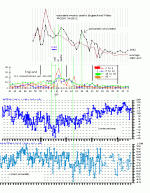
I typed in the weekly provisional figures of deaths from England and Wales
they are not easy to find in one list, partial excel-lists only
so here is week 40-week 34, so people can find it with google
I'm planning to update this by editing


weekly deaths:
8719,8705,8638,9139,9640,9042,9305,9166
9203,9828,10348,11151,8472,10514,11343,10393
10320,10117,10287,10532,11086,10945,10507,10041
9864,9634,8520,9992,10816,10238,9957,8868
9913,9602,9602,6781,10170,9054,8856,8909
8754,8684,8877,8942,8810,8776,8977

average last 5 years:
8908,9120,9240,9327,9501,9580,9654,9788
9677,10328,10501,10994,8939,12455,12851,11813
11054,10615,10317,10402,10327,10158,9962,9909
9459,9392,9643,9694,9644,9454,9375,9085
9272,9275,8223,9240,8878,8750,8718,8764
8577,8489,8549,8594,8547,8552,8577

45-64 years:
1065,1202,1130,1195,1262,1149,1208,1158
1209,1268,1243,1268,915,1255,1370,1204
1240,1245,1237,1164,1220,1310,1185,1238
1256,1170,1072,1155,1313,1227,1171,1063
1212,1177,1190,846,1217,1147,1130,1098
1123,1124,1157,1153,1124,1108,1144
 

Attachments

  • uk12d.gif
    uk12d.gif
    33.7 KB · Views: 1
Re: 2010-2011: HPA Weekly National Influenza Report Weeks 49 - 26: 607 fatalities confirmed

Re: 2010-2011: HPA Weekly National Influenza Report Weeks 49 - 26: 607 fatalities confirmed

Gs - Are these deaths from all causes per week?
 
Re: 2010-2011: HPA Weekly National Influenza Report Weeks 49 - 26: 607 fatalities confirmed

Re: 2010-2011: HPA Weekly National Influenza Report Weeks 49 - 26: 607 fatalities confirmed

... and from what year? They don't seem to correspond to the week 23 and 24 figures in post #34 immediately above.
 
Re: 2010-2011: HPA Weekly National Influenza Report Weeks 49 - 26: 607 fatalities confirmed

Re: 2010-2011: HPA Weekly National Influenza Report Weeks 49 - 26: 607 fatalities confirmed

this year, all causes.
once you have a few of these numbers you can use them for googling
they give occasional excel-files of 5-10 weeks, which also
contain regional data and age-related data
but I couldn't find systematic tables or format other than excel

these are preliminary results, presumably later the final weekly
figures will be available

-------------------------------------------------

they give a .pdf each week e.g.:

http://www.ons.gov.uk/ons/rel/vsob2...d-and-wales/week-ending-10-08-2012/index.html

http://www.ons.gov.uk/ons/rel/vsob2...pre-release-access-list-for-weekly-deaths.pdf


and an xls - file (Excel)

http://www.ons.gov.uk/ons/publications/re-reference-tables.html?edition=tcm:77-276306

http://www.ons.gov.uk/ons/rel/vsob2...g-10-08-2012/weekly-deaths---week-32-2012.xls


also on data.gov
http://data.gov.uk/dataset/weekly_provisional_figures_on_deaths_registered_in_england_and_wales

http://data.gov.uk/dataset/weekly_provisional_figures_on_deaths_registered_in_england_and_wales_

http://data.gov.uk/dataset/weekly_p...resource/5181ed18-f22a-4d8a-92ce-a96b9cd58411

I had a site which links to each week, 2012 - can't refind it now


you can use this:
http://www.ons.gov.uk/ons/rel/vsob2...d-and-wales/week-ending-08-06-2012/index.html

and then replace the date in the URL


week 34: http://www.ons.gov.uk/ons/rel/vsob2...d-and-wales/week-ending-24-08-2012/index.html

week 35: http://www.ons.gov.uk/ons/rel/vsob2...d-and-wales/week-ending-31-08-2012/index.html
(should be available tomorrow)
 
Re: 2010-2011: HPA Weekly National Influenza Report Weeks 49 - 26: 607 fatalities confirmed

Re: 2010-2011: HPA Weekly National Influenza Report Weeks 49 - 26: 607 fatalities confirmed

this year, all causes.
once you have a few of these numbers you can use them for googling
they give occasional excel-files of 5-10 weeks, which also
contain regional data and age-related data
but I couldn't find systematic tables or format other than excel

I'll make a copy of your original post and put it in the 2011-2012 thread.
http://www.flutrackers.com/forum/showthread.php?t=174681
 
Re: 2010-2011: HPA Weekly National Influenza Report Weeks 49 - 26: 607 fatalities confirmed

Re: 2010-2011: HPA Weekly National Influenza Report Weeks 49 - 26: 607 fatalities confirmed

plan is , of course, to get these data in computer-readable form
and compare England,France,Germany,USA,...
especially the death-rise in the elderly in France,Portugal and other
European countries (apparently not Germany) in Feb./Mar 2012.

Only in the elderly , but not in the <65 group this year !
So I also want the age-groups and the respiratory deaths,
but it's tedious to collect them in computer-readable form.

If I'm busy, I can maybe post a complete table
for England/Wales 2010-2012 later
especially the respiratory are being updated permanently,
so they vary :-(

Of course, we could wait some years until the final data is available ...
 
Back
Top