Ronan Kelly
Retired 2020
Re: HPA Weekly National Influenza Report Weeks 49 - 9: 539 fatalities confirmed
Re: HPA Weekly National Influenza Report Weeks 49 - 9: 539 fatalities confirmed
10 March 2011 ? Week 10
Summary
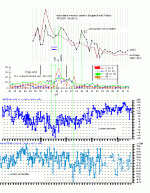
Influenza activity continues to decline in the UK. GP consultation rates are low in England, Wales, Scotland and Northern Ireland. All influenza subtypes are decreasing. The H1N1 (2009) virus strain is virologically and epidemiologically similar to that seen during the pandemic. The virus strains circulating are overall well matched to the current influenza vaccine. In week 9 (ending 6 March) the weekly primary care ILI consultation rate decreased in England (7.6 per 100,000), Northern Ireland (14.0 per 100,000) and Wales (4.1 per 100,000), but slightly increased in Scotland (35.9 per 100,000). The proportion of NHS Direct calls for cold/flu has remained at the threshold level this week. The proportion of calls for fever have decreased, remaining below baseline levels. No acute respiratory disease outbreaks were reported in the UK in week 9. The total reported this season remains at 170. The proportion of respiratory specimens reported to Data Mart (England) as positive for influenza decreased to 1.7% (12 of 698). The proportion of positive samples increased for RSV, rhinovirus, HMPV and adenovirus, and remained stable for parainfluenza. Since week 36, 546 deaths in the UK associated with confirmed influenza infection have been reported. Following the excess all-cause mortality observed over the Christmas period, excess mortality remains below the upper limit of expected levels for this time of year. Up to the week ending 27 February, 72.8% of people in England aged over 65 years had received the 2010/11 influenza vaccine. For those in a risk group aged under 65 years, it was 50.3%. Amongst frontline health-care workers the provisional uptake was 34.2% by 31 January 2011. Iceland, Luxembourg and Romania report high influenza activity in Europe. However transmission of influenza appears to have peaked in much of Western Europe, though case counts of severe and fatal cases continue to accumulate. The appearance of severe cases in Europe is similar to the 2009-2010 season; the highest number have been in the age group from 15-64 years, 60-70% have a pre-existing medical condition associated with increased risk of severe influenza, and most have not been vaccinated. Higher numbers of influenza A than influenza B virus detections have been reported. Of the influenza A viruses that were subtyped, 98.9% were H1N1 (2009). Influenza activity remains elevated in the United States while the majority of regions in Canada reported decreased activity. Although H1N1 (2009) activity has increased in the United States, the dominant virus in North America is still currently influenza A (H3N2).
...
http://www.hpa.org.uk/web/HPAwebFile/HPAweb_C/1296682596600
Re: HPA Weekly National Influenza Report Weeks 49 - 9: 539 fatalities confirmed
10 March 2011 ? Week 10
Summary
Influenza activity continues to decline in the UK. GP consultation rates are low in England, Wales, Scotland and Northern Ireland. All influenza subtypes are decreasing. The H1N1 (2009) virus strain is virologically and epidemiologically similar to that seen during the pandemic. The virus strains circulating are overall well matched to the current influenza vaccine. In week 9 (ending 6 March) the weekly primary care ILI consultation rate decreased in England (7.6 per 100,000), Northern Ireland (14.0 per 100,000) and Wales (4.1 per 100,000), but slightly increased in Scotland (35.9 per 100,000). The proportion of NHS Direct calls for cold/flu has remained at the threshold level this week. The proportion of calls for fever have decreased, remaining below baseline levels. No acute respiratory disease outbreaks were reported in the UK in week 9. The total reported this season remains at 170. The proportion of respiratory specimens reported to Data Mart (England) as positive for influenza decreased to 1.7% (12 of 698). The proportion of positive samples increased for RSV, rhinovirus, HMPV and adenovirus, and remained stable for parainfluenza. Since week 36, 546 deaths in the UK associated with confirmed influenza infection have been reported. Following the excess all-cause mortality observed over the Christmas period, excess mortality remains below the upper limit of expected levels for this time of year. Up to the week ending 27 February, 72.8% of people in England aged over 65 years had received the 2010/11 influenza vaccine. For those in a risk group aged under 65 years, it was 50.3%. Amongst frontline health-care workers the provisional uptake was 34.2% by 31 January 2011. Iceland, Luxembourg and Romania report high influenza activity in Europe. However transmission of influenza appears to have peaked in much of Western Europe, though case counts of severe and fatal cases continue to accumulate. The appearance of severe cases in Europe is similar to the 2009-2010 season; the highest number have been in the age group from 15-64 years, 60-70% have a pre-existing medical condition associated with increased risk of severe influenza, and most have not been vaccinated. Higher numbers of influenza A than influenza B virus detections have been reported. Of the influenza A viruses that were subtyped, 98.9% were H1N1 (2009). Influenza activity remains elevated in the United States while the majority of regions in Canada reported decreased activity. Although H1N1 (2009) activity has increased in the United States, the dominant virus in North America is still currently influenza A (H3N2).
...
http://www.hpa.org.uk/web/HPAwebFile/HPAweb_C/1296682596600