• FluTrackers.com Inc. does not provide medical advice. Information on this web site is collected from various internet resources, and the FluTrackers board of directors makes no warranty to the safety, efficacy, correctness or completeness of the information posted on this site by any author or poster. The information collated here is for instructional and/or discussion purposes only and is NOT intended to diagnose or treat any disease, illness, or other medical condition. Every individual reader or poster should seek advice from their personal physician/healthcare practitioner before considering or using any interventions that are discussed on this website. By continuing to access this website you agree to consult your personal physican before using any interventions posted on this website, and you agree to hold harmless FluTrackers.com Inc., the board of directors, the members, and all authors and posters for any effects from use of any medication, supplement, vitamin or other substance, device, intervention, etc. mentioned in posts on this website, or other internet venues referenced in posts on this website.
  • We are not asking for any donations. Do not donate to any entity who says they are raising funds for us.

DRC – 17th Ebola Outbreak (Bundibugyo virus) - Concerns over reliability of Government reported cumulative cases and deaths - May 2026+

image.png - Click image for larger version  Name:	image.png Views:	1 Size:	8.2 KB ID:	1035912

To the people of DRC, especially to the people of Ituri

Jambo kwenu wakahaji wa Ituri

Mbote na bino, bato ya Ituri

My name is Tedros, and I am the Director-General of the World Health Organization (@WHO). But today, I am not writing to you as an official. I am writing to you as someone who knows your region, who has walked your streets, and who cares deeply about what happens to you and your families.

I am writing because I want to be with you in these moments. And I want you to know that you are not alone.

[HASHTAG="c783"]Ebola[/HASHTAG] is not new to me personally. From 2018 to 2020, I came fourteen times to North Kivu, the epicentre of the outbreak at that time. Fourteen visits to Beni, Butembo, Katwa, Goma, and many other communities. During that outbreak, Ebola spread across North Kivu, South Kivu, and reached parts of Ituri as well. I was alongside families who had lost their loved ones. I met health workers risking their lives every day. I met community leaders, traditional healers, religious leaders and business leaders who refused to abandon their people. I saw men and women show extraordinary courage in the most difficult of circumstances. The people there, who saw me coming back again and again, wanted to give me a name that belonged to their community. They asked me whether I was the first, second, or third child of my parents. When I told them I was the firstborn, they gave me the name Dr. Paluku. I carry that name with pride. It is not just a name. It is a bond. It is a reminder that this work is not about titles or institutions. It is about people. It is about you.

That outbreak was one of the most complex in history. It did not unfold in a stable, peaceful environment. It happened in the middle of armed conflict, with communities displaced, supply routes disrupted, and health workers operating under constant threat. People were fleeing violence while also trying to protect themselves and their families from a deadly disease. I remember being in Beni on more than one occasion while fighting was taking place on the outskirts of the city. We could hear it. And yet the health workers around me did not stop. They kept working. That kind of courage is something I will never forget. The challenges of that time are not so different from what you are facing today in Ituri. I understand that. I have seen it with my own eyes.

Mistrust ran deep, and the security situation cost us precious time. Our health workers were attacked. Clinics were targeted. People who were only trying to save lives found themselves caught in the middle of a conflict they did not start. Lives were lost that we might have saved, and that weighs on me still. But I also witnessed something remarkable. When we listened, when communities felt respected and heard, things began to change. Trust grew slowly, then more quickly. People came forward. And together, we managed to contain the outbreak. We did it. The people of DRC did it. I will never forget that.

Ebola is now back. This time, the outbreak is hitting Ituri province the hardest. More than 90% of all cases have been reported in Ituri province, with a small number of cases also reported in North Kivu and South Kivu. I know how frightening that is, and I know that the people of Ituri are bearing a burden that is not easy to carry.

I know that many of you are exhausted. You are already carrying so much: malaria, hunger, insecurity, and the daily struggle to keep your families safe. And now Ebola. It is not fair, and I will not pretend otherwise.

But I also want to say something else about Ituri, because this province deserves to be seen for more than its hardships. Ituri is a place of remarkable energy. It is a province of vibrant commerce, of entrepreneurial spirit, of communities that have refused to be defined by the conflicts around them. The markets of Bunia buzz with life. Traders, farmers, teachers, and young people building their futures against all odds. That spirit, that refusal to give up, is exactly what we need now. It is the foundation on which we will build our response. We do not come to Ituri with only medicine and expertise. We come to join a community that already knows how to fight for its survival.

I want to say a special word to the young people of Ituri. You are growing up in circumstances that no young person should have to face. And yet what I see, again and again, is not despair but determination. You are the future of this province and this country. In this outbreak, you have a vital role to play. Talk to your friends and your families. Share what you know about Ebola. Help break the fear and the silence that allow this virus to spread. Your voice carries further than you know, and we need it now more than ever.

And to the health workers of Ituri, I want to say this: you are seen, and you are not alone. Every day you go to work knowing the risks, and you go anyway. You do it for your patients, for your communities, for your families. You are the backbone of this response. Without you, none of this is possible. I know the conditions are hard. I know the resources are often not enough. I know that fear and exhaustion are real. Please know that WHO stands with you, that we are working to get you the support you need, and that your courage and dedication are known and deeply valued far beyond the borders of this province.

I also know that the security situation in parts of this region remains very difficult. Conflict and displacement make everything harder, including reaching people who need care and keeping health workers safe. I want to be honest: this is one of our greatest challenges. We cannot do this work if those who are trying to help are prevented from doing so or put in danger. We are working closely with all relevant partners to ensure that the response can reach every community that needs it, and that no one is left behind because of where they live or what is happening around them.

That is why today I am making a direct appeal to all warring parties in this region: please, declare a ceasefire. Even briefly. Even just enough to let health workers through. People are dying from Ebola who do not have to die. Children are sick. Families are suffering. No cause, no conflict, no grievance is worth condemning innocent people to death from a preventable disease. A ceasefire, even a temporary one, would save lives. I urge you, I implore you: give us the space to help the people who need it most.

I also know that there is anger and mistrust in some communities, and I understand why. Trust must be earned, it cannot be assumed. We have not always done things correctly. But I promise you, we are here to learn as much as we are here to help.

I need to be honest with you about something important. Most previous Ebola outbreaks in DRC were caused by a virus called Ebola Zaire, for which we have vaccines and treatments. This outbreak is caused by a different virus called Ebola Bundibugyo. There are currently no approved vaccines or treatments for it. This is serious, and you deserve to hear that plainly. But I also want you to know this: while there are no specific treatments for Bundibugyo, there is much we can do together to prevent the spread of this virus and save lives. Early supportive care in our treatment centers can make a real difference. If you or someone you know falls ill, please do not wait. Coming forward early can make the difference between life and death. And everything we do, we will do with you. We will listen to you, we will share information with you, and we are here to help. And for those we cannot save, we will mourn with you. We will help you grieve your lost loved ones with safe and dignified burials.

We are working under the leadership of the Government of DRC, together with all relevant partners, united around one goal: to stop this outbreak and protect your communities. No one is working alone. No one is working at cross purposes. We are coordinated, we are committed, and we are here.

That is why I am coming to Bunia. I will be there in person, alongside my colleagues, meeting your leaders, listening to your concerns, and doing everything in my power to help you. I will not be managing this from a comfortable office far away.

This is the 17th Ebola outbreak in DRC. Together, you have overcome every single one before. That is not a small thing. That is a testament to the strength and resilience of your communities. I have seen that strength with my own eyes.

My brothers and sisters of Ituri, I want you to know that the world is watching your courage. You are not forgotten. Together, we will overcome this outbreak, as you have overcome every challenge before. Your resilience is the light that guides us all.

We will get through this one too. Not because of anyone, but because of you.

Our teams are already on the ground, and they will stay for as long as necessary. And when this outbreak is over, we will not quietly disappear. We will not forget you. We will stay, and we will keep working with you to build health systems that protect every person in every community.

I look forward to seeing you in Bunia soon. Until then, please know that you are in my thoughts.

With respect and solidarity,

Paluku
Tedros Adhanom Ghebreyesus
Director-General, World Health Organization​

image.png - Click image for larger version  Name:	image.png Views:	1 Size:	337.1 KB ID:	1035913

8:07 AM · May 28, 2026

 
TravelGov

@TravelGov
·
36m
Worldwide Caution - Updated Public Health Arrival Restrictions and Enhanced Ebola Disease Screening – May 28, 2026: U.S. citizens and U.S. nationals who have been present in the Democratic Republic of the Congo (DRC), Uganda, or South Sudan within 21 days of arrival in the United States must only enter through designated airports for enhanced screening. Review the U.S. Centers for Disease Control and Prevention (CDC) information on what travelers need to know about returning to the United States from DRC, Uganda, and South Sudan for the list of designated airports. The CDC and the Department of Homeland Security’s (DHS) Customs and Border Protection (CBP) will apply enhanced public health screening at the designated airports in response to the Ebola disease outbreak. This requirement applies to all U.S. citizen and U.S. national passengers who were present in those countries. Please be prepared for flight changes or cancellations. Read more: :tiphat:https://travel.state.gov/en/international-travel/travel-advisories/global-events/worldwide-caution.html
 
Translation Google

Ebola in the DRC: On the front line of the epidemic, medical staff are paying a heavy price.

In the Democratic Republic of Congo, the Ebola Bundibugyo epidemic is also killing those fighting it. On Tuesday, May 26, 2026, the Congolese Ministry of Health officially acknowledged the deaths of frontline healthcare workers and pledged to improve their working conditions.

Published on:28/05/2026 - 02:01
By : RFI

A dozen people. A coffin. Only a few meters separate them. The local head of the medical association speaks. He releases Dr. Vladimir from his oath. It is the final gesture, the one reserved for doctors who die in the line of duty. Dr. Vladimir died of Ebola at the Rwampara isolation and treatment center.

Dr. Gauthier had known him in Kisangani. He testifies: " He was a colleague who was more attached to medicine. He wanted him to be among the greats ," he says.

The following day, in the same area, Dr. Blaise also died, taken by the virus.

Six healthcare workers killed by the epidemic in the DRC

In total, according to sources at the Ministry of Health, at least six medical personnel have been killed by the epidemic since it began.

Dr. Bakandi Mbula Felly, lead coordinator of the NGO Save the Medical Profession, fears the epidemic will claim more victims among doctors. He is calling for greater protection for healthcare workers. " This is a dangerous and deadly virus. Give us the means to protect ourselves, acceptable working conditions ," he pleads.

On Tuesday, the Congolese Ministry of Health offered its condolences to the families and pledged to improve the working conditions of the teams deployed in the field.

Red Cross volunteers are also exposed

In eastern DRC , it's not just medical personnel who are dying. Three volunteers from the Congolese Red Cross have also died after likely contracting Ebola in Ituri, according to the International Federation of Red Cross and Red Crescent Societies.

The Red Cross of the DRC has launched an appeal for international solidarity in the face of the epidemic. Grégoire Mateso, the national president of the Red Cross, reminded everyone that " epidemics are not just national health crises ," but that they can be a destabilizing factor in the rest of the world.

The organization is at the forefront of the Ebola response, notably through awareness campaigns, including door-to-door outreach, as well as providing comprehensive support for bereavement. The Red Cross remains fully mobilized and is best positioned to foster community engagement, according to Gloria Lombo, Secretary General of the Red Cross in the DRC.

“ The Red Cross in the DRC relies on the local roots of its volunteers,” she explains. “[…] These volunteers are members of the affected communities. They live in the communities and they also know, for example, the rituals and traditions of the communities. ”

https://www.rfi.fr/fr/afrique/20260...mie-le-personnel-médical-paie-un-lourd-tribut
 
image.png


Ebola disease caused by Bundibugyo virus, Democratic Republic of the Congo & Uganda

29 May 2026

Situation at a glance

The Bundibugyo virus disease (BVD) outbreak in the Democratic Republic of the Congo and Uganda continues to evolve rapidly, with increasing case numbers, geographic spread, and ongoing cross-border transmission. As of 27 May, a total of 906 suspected cases and 223 deaths among suspected cases have been reported in the Democratic Republic of the Congo. As of 29 May, a total of 134 confirmed cases, including nine in Uganda, with 18 deaths among the confirmed cases, have been reported across both countries. This is an additional 49 confirmed cases, eight confirmed deaths, 160 suspected cases and 47 suspected deaths since the last update on 21 May. In addition, there is one confirmed case, an individual from the United States of America, who had treated patients in the Democratic Republic of the Congo and is currently receiving care in Germany. In the Democratic Republic of the Congo, transmission is concentrated in Ituri, as well as North Kivu and South Kivu provinces, with challenges in contact tracing and follow-up, insecurity, inadequate isolation, care, and referral systems for patients complicating response efforts. National authorities, in collaboration with WHO and partners, are implementing response measures including deployment of rapid response teams, delivery of medical supplies, strengthened surveillance, laboratory confirmation, infection prevention and control, the set-up of safe and optimized treatment centers, and community engagement.

Description of the situation


Since the last Disease Outbreak News was published on 21 May 2026, the number of suspected and confirmed cases has increased rapidly in the Democratic Republic of the Congo. In total, 906 suspected cases, including 223 deaths among suspected cases have been reported from Democratic Republic of the Congo; and 134 confirmed cases (nine in Uganda), including 18 deaths (one in Uganda) (CFR 14%) have been reported from the two countries as of 29 May. Additionally, a medical doctor from the United States of America who was exposed as part of their work caring for patients in the Democratic Republic of the Congo tested positive on 17 May and was transported to Germany for treatment and care.

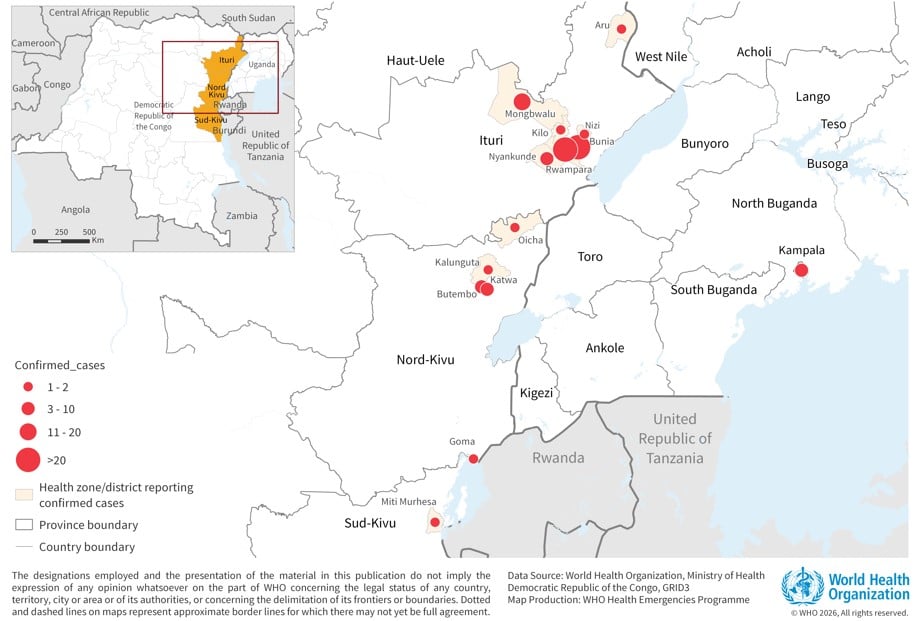
Figure 1. Distribution of suspected and confirmed cases of Bundibugyo virus disease in Democratic Republic of the Congo and Uganda, as of 29 May 2026

Distribution of suspected and confirmed cases in DRC and Uganda - Distribution of suspected and confirmed cases in DRC and Uganda

Democratic Republic of the Congo

Since the last update dated 21 May, an additional 42 confirmed cases including eight deaths and 160 suspected cases including 47 deaths have been reported from the Democratic Republic of the Congo. As of 27 May 2026, a total of 125 confirmed cases including 17 deaths (CFR 14%); and 906 suspected cases including 223 deaths have been reported from 13 health zones (HZ) in Ituri (7/36 HZ), North Kivu (5/35 HZ) and South Kivu Provinces (1/34 HZ) [SUP][1][/SUP]. Sixteen confirmed cases have been reported among health and care workers to date. Epidemiological and laboratory investigations are ongoing to reclassify all suspected cases and deaths reported in the Democratic Republic of the Congo.

The outbreak remains concentrated in Ituri Province, which accounts for 88% (110) of confirmed cases. The highest confirmed case numbers in Ituri Province are reported from Bunia (37 cases), Rwampara (33 cases), Mongbwalu (20 cases), and Nyankunde (10 cases) HZ. Of the 17 deaths among confirmed cases in the Democratic Republic of the Congo, 10 were male (nine were over 15 years old and one under 15) and seven were female (five over 15 years old and two under 15).

A total of 774 samples have been collected as of 27 May. Of these, 648 samples (84%) have been analyzed, with 125 testing positive, representing a test positivity rate (TPR) of 19.2%. This is likely an underestimation of the actual positivity rate as over 100 samples are still awaiting testing and have been sent to Kinshasa for further analysis.

As of 27 May, 2635 contacts have been listed in Ituri and North Kivu provinces.

Security incidents against health facilities, and community resistance, have recently emerged as major operational challenges in Ituri Province, with three recent incidents reported in Mongbwalu and Rwampara HZ. These create additional risks for undetected transmission, disrupt outbreak response efforts, and reinforce the need to strengthen community protection and engagement activities

Figure 2: Number of confirmed cases (n=125) and deaths (n=17) by date of reporting in the Democratic Republic of the Congo as of 27 May 2026

Number of confirmed cases and deaths in DRC - Number of confirmed cases and deaths in DRC

Source: Ministry of Health, Democratic Republic of the Congo

NB: Newly reported confirmed cases/deaths may be part of the back log of samples waiting to be tested and therefore not necessarily newly acquired infections.

Uganda

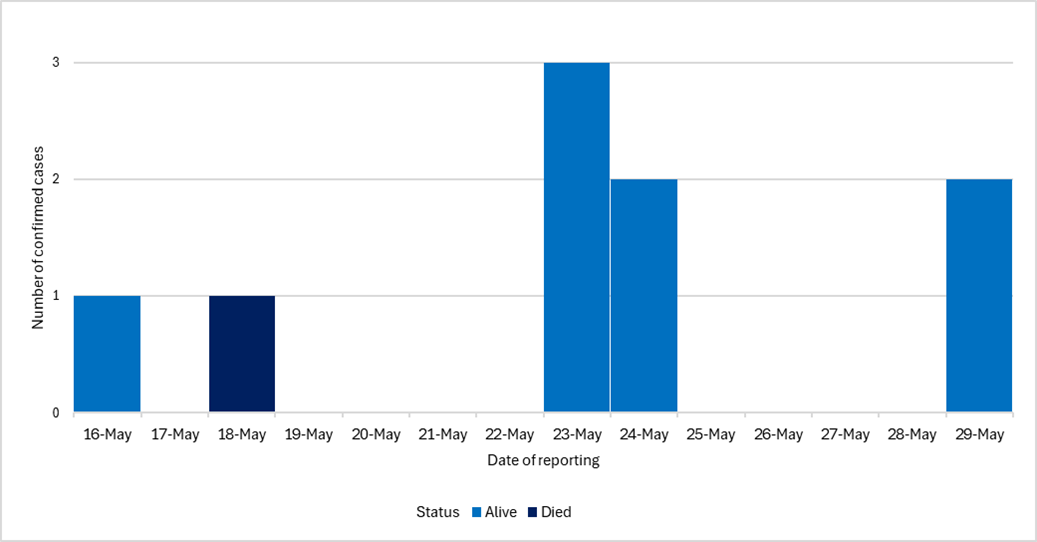
Since the last update dated 21 May, an additional seven confirmed cases have been reported from Uganda. As of 29 May 2026, a total of nine confirmed cases including one death have been reported in Kampala (n=8) and Wakiso (n=1), Uganda. Recent cases include a Ugandan driver who transported the first reported case, a Congolese health worker with linkage to the index case, a Congolese woman who travelled to Uganda for medical care, and two Ugandan health workers linked to earlier confirmed case.

As of 26 May, a total of 436 contacts linked to the cases have been identified and are under follow-up. These include close household contacts and hospital contacts where the cases were hospitalized.

Exposure risks are associated with healthcare settings and cross-border movements.

Figure 3: Number of confirmed cases (n=9) and deaths (n=1) by date of reporting in Uganda as of 29 May 2026

Number of confirmed cases and deaths in Uganda - Number of confirmed cases and deaths in Uganda

Source: Ministry of Health, Uganda


Epidemiology


Bundibugyo virus disease (BVD) is a severe and often fatal form of Ebola disease caused by the Bundibugyo virus, one of the Orthoebolavirus species. It is a zoonotic disease, with fruit bats suspected to be the natural reservoir. Human infection is thought to occur through close contact with the blood or secretions of infected wildlife, such as bats or non-human primates, and it subsequently spreads from person to person through direct contact with the blood, secretions, organs, or other bodily fluids of infected individuals or contaminated surfaces or items. Transmission is particularly amplified in health-care settings when infection prevention and control (IPC) measures are inadequate, and during unsafe burial practices involving direct contact with the deceased.

The incubation period for BVD ranges from 2 to 21 days, and individuals are not infectious until symptom onset. Early symptoms such as fever, fatigue, muscle pain, headache, and sore throat, are non-specific, which complicates clinical diagnosis and can delay detection. These symptoms then progress to gastrointestinal symptoms, organ dysfunction, and in some cases haemorrhagic manifestations. Case fatality rates in the past two BVD outbreaks, reported in Uganda and in the Democratic Republic of the Congo in 2007 and 2012, have ranged from approximately 30% to 50%.

Differentiating BVD from other endemic febrile illnesses such as malaria is challenging without laboratory confirmation using PCR or antigen/antibody-based assays. Control relies on rapid case identification, isolation and care, contact tracing, safe burials, and strong community engagement, as no approved vaccines or specific treatments currently exist for BVD.

Public health response


Health authorities in the Democratic Republic of the Congo and Uganda, in collaboration with WHO and partners, are implementing comprehensive public health measures. WHO Director-General, Dr Tedros Adhanom Ghebreyesus, traveled to the Democratic Republic of the Congo on 28 May to support the ongoing response.

For further information about public health response actions by the respective Ministry of Health, WHO, and partners, please refer to the latest situation reports published by the WHO Regional Office for Africa: Weekly External Situation Report 02, Data as of 24 May 2026 - DRC and Uganda


WHO risk assessment


On 22 May 2026, WHO assessed the risk of the outbreak of BVD to be very high at the national level in the Democratic Republic of the Congo, high at the regional level, and low at the global level. The risk assessment will be continuously reassessed in the coming days based on available and shared information.

For further information, please see the WHO Rapid Risk Assessment-Ebola disease caused by Bundibugyo virus, Democratic Republic of the Congo and Uganda v2.


WHO advice


On 19 May 2026, the Director-General of WHO convened the first meeting of the IHR Emergency Committee, which issued the temporary recommendations on 22 May 2026 to States Parties. These recommendations underscore the importance of coordinated outbreak control, enhanced cross‑border collaboration, and sustained surveillance and preparedness to prevent further regional spread and ensure an effective public health response

WHO advises against any restriction of travel to, or trade with, the Democratic Republic of the Congo or Uganda based on the currently available information. WHO continues to closely monitor and, where necessary, verify travel and trade measures in relation to this event.

​For further information on the considerations for implementing border health and international travel-related temporary recommendations, please see the relevant technical note issued on 26 May 2026

Regular Information products on the outbreak of BVD in Democratic Republic of the Congo

...

https://www.who.int/emergencies/disease-outbreak-news/item/2026-DON605
 
Quick notes - Please excuse typos


Media Advisory

Embargoed Until Friday

May 29, 2026, 1:30 p.m. EDT

Contact: CDC Media Relations


Update on Ebola Outbreak in the Democratic Republic of the Congo and Uganda


What


CDC will provide an update on its response to an Ebola outbreak in the Democratic Republic of the Congo (DRC) and Uganda.


Who


CAPT Satish K. Pillai, M.D., M.P.H., Incident Manager for CDC’s Ebola response


When


Friday, May 29, 2026, 1:30 p.m. EDT


(Call-in section redacted)


Transcript


A transcript will be available following the briefing on CDC’s website: www.cdc.gov/media.


-----------------------------------------------

Moderator: Benjamin Haynes

Presenter: Dr. Pillai


1) Rapidly evolving outbreak,
2) Working with international partners,
3) Risk to US remains low,
4) Helping nations to stop transmission at source,
5) Working on readiness for the US - Ebola screening at 4 US airports now (did not name new airport),
6) Working with domestic partners too,
7) Responding to countries and readiness activity in US,
8) Support in countries include epi work, lab work, etc., 230 CDC staff currently supporting response incl. in field,
9) Asking CDC peeps to respond to airports among qualified staff from entire agency is a long standing protocol


Questions:

ABC news:
What about the Kenya center for Americans?
CDC supports all partners...ask Dept of State

WSP radio Atlanta:
What about the Kenya center for Americans now that the court has paused operation? CDC volunteers - who are they?
Ask Dept. of State - Staffed with qualified CDC volunteers, peeps want to help, incl. new airport today.

Reuters:
What is CDC staff response to airport screening? Is hantavirus screening ceasing this weekend?
54 staff is doing airport screening. 236 staff on this response now...staff eager to respond...will follow up on hantavirus screening status...

CNN:
Volunteers? Any mandatory assignments?
Ask Sec. of Health about this, commissioned health officers + regular CDC staff

Politico:
Are US citizens being refused return if suspected Ebola?
Ask Dept. of State

Inside Health Policy:
How many CDC staff in region and their training?
CDC has ongoing staff assignments in regions. Teams are in country: 24 in DRC, 100 in Uganda - plus some deployed to region too, always getting trained...

Wall Street Journal:
Explain why suspected/confirmed Ebola Americans can not return as before & about risk to Kenya?
Exposure does not translate to actual infection - identify appropriate situations i.e. symptomatic? exposure? Complex situation.

NPR:
What is exposure to Ebola definition? Anyone who treats patients?
Look at CDC clinical web pages. Casual exposures are not necessarily exposure risk.


End​
 
Translation Google

Ebola in Ituri: Veterinarians urged to strengthen sanitary measures in slaughterhouses

May 29, 2026

Bunia, May 29, 2026 (ACP). – Veterinary agents working in the territories and city of Bunia, in Ituri province, in the Northeast of the Democratic Republic of Congo (DRC), have been called upon to strengthen sanitary measures in slaughterhouses, livestock markets and other places of sale of butchered animals, in order to prevent the spread of the Ebola virus disease, according to an official note consulted Friday by ACP.

"I have an obligation to ask you to instruct your veterinary agents in the veterinary groups and dispensaries to implement the urgent measures," read the correspondence from the head of the provincial division of fisheries and livestock, Fiston Kabasele Kyakabiri, addressed to the territorial inspectors.

According to this document, these measures are part of strengthening the provincial response to the 17th Ebola epidemic declared in Ituri.

Through this note, Mr. Kabaseke particularly stressed the permanent sanitation of slaughterhouses and slaughter areas, the cleanliness of sales areas for slaughter animals, and the systematic control of meat in markets, in order to prevent the marketing of products from animals that have not undergone veterinary inspection.

He also recommended the mandatory installation of handwashing facilities in all relevant public places, in order to strengthen prevention measures.

Furthermore, users were urged to regularly wash their hands with soap and water or use hand sanitizer before entering markets and other sales areas.

The division chief finally stressed the strict application of these health measures, recalling that community vigilance and respect for prevention protocols remain essential pillars to curb the spread of the Ebola epidemic in Ituri.

ACP/

https://acp.cd/nation/ebola-en-itur...nforcer-des-mesures-sanitaires-des-abattoirs/
 
image.png


Press Releases

Ebola Response Update – May 29, 2026 Ebola Response Update – May 29, 2026

Media Note
Office of the Spokesperson

May 29, 2026

The Department of State, in close coordination with the U.S. Centers for Disease Control and Prevention (CDC), is continuing to mount a rapid and comprehensive response to the Ebola outbreak in the Democratic Republic of the Congo (DRC) and Uganda. The United States is proud to be the largest financial contributor to the Ebola response effort. The Department of State’s assistance commitment to combat the outbreak has exceeded $162 million and is growing, enabling implementing organizations to expand the ongoing response in Africa. U.S. funding is providing critical activities to stop the outbreak at its source and ensure Ebola does not reach the United States. The Department has also provided $350 million through OCHA pooled funds to the DRC, Uganda, and South Sudan for broader humanitarian efforts in the affected region, as part of our $1.8 billion in additional funding to OCHA announced on May 14. The Department has also mobilized an additional $50 million to OCHA’s Central Emergency Response Fund to support with the immediate establishment of up to 50 Ebola response clinics.

Protecting Americans

On May 28, the United States, Mexico, and Canada issued the following statement:

“The United States, Mexico, and Canada have announced aligned public health travel measures for individuals coming from African regions at greatest risk from the Ebola virus. This coordinated approach aims to protect our citizens and the millions of visitors, fans, athletes, and tourists expected during the FIFA World Cup 2026™, while maintaining travel and commerce across our borders. The health and safety of every person in the region remains our highest priority as we welcome the world to North America.”

The Department of State issued a Worldwide Caution on May 28 with updated information on arrival restrictions and Ebola screening. The caution states that U.S. citizens and U.S. nationals who have been present in the DRC, Uganda, or South Sudan within 21 days of arrival in the United States must only enter through designated airports for enhanced screening. Travelers are advised to review the U.S. CDC information on what travelers need to know about returning to the United States from DRC, Uganda, and South Sudan for the list of designated airports.

The Department of State issued an updated health alert for U.S. citizens in Uganda on May 28 reiterating the recommendation against travel, providing information on border closures, and sharing CDC’s update to its Travel Health Notice from Level 1 to Level 2 (Practice Enhanced Precautions).

Supporting the Regional Response

With funding and support from the Department of State, governments, NGO implementers, and international organizations continue a comprehensive and coordinated response to contain the Ebola outbreak at its source to protect the American people and prevent further international spread.

On May 28, Secretary Rubio and Kenyan President William Ruto discussed the shared U.S.-Kenya commitment to respond to the Ebola outbreak. The United States intends to commit $13.5 million toward Kenya’s Ebola preparedness efforts.

The United States is proud to be the largest financial contributor to the Ebola response effort. With $162 million in assistance from the Department, key partners on the ground are expanding their ongoing response to the Ebola outbreak. These resources are scaling up the following critical response activities:

PPE Procurement and Delivery
  • In the DRC, U.S.-funded partner UNICEF has imported 100 tons of additional water, sanitation, and hygiene (WASH) and infection prevention and control supplies. The International Organization for Migration (IOM) has also deployed infection prevention and control supplies, including PPE, hand hygiene materials, chlorine and disinfectant products, infrared thermometers, and screening and triage equipment.
  • U.S.-funded implementer Samaritan’s Purse completed two of three flights to Bunia, consisting of 24 tons of PPE and equipment for a 40‑bed treatment center.
  • In Uganda, U.S.-funded partner UNICEF has delivered WASH and infection prevention and control supplies to 48 health centers across high-risk districts.
Border Screening and Surveillance
  • U.S.-funded partner IOM is supporting health screening and surveillance operations at multiple points-of-entry and points-of-control across Ituri Province (Bunia) and North Kivu (Beni and Goma) in the DRC.
  • IOM is supporting health screening and surveillance operations at major airports in the region, including N’djili International Airport and Bunia Airport in the DRC; Entebbe International Airport and Arua Airport in Uganda; Bujumbura International Airport in Burundi; and Bole International Airport in Ethiopia.
Contact Tracing and Risk Communications
  • In the DRC, U.S.-funded partner UNICEF has deployed 1,300 health workers and mobilized 100 motor bikes for use by contact tracing personnel on the ground.
  • In the DRC, U.S.-funded implementer FHI 360 engaged media, religious leaders, and community structures to strengthen prevention messaging and prevent the spread of rumors in hotspot health zones. The organization conducted training for 40 health zone supervisors on infection prevention and control measures and held coordination meetings to support safe and dignified burials.
  • In Uganda, U.S.-funded partner UNICEF has oriented district health educators in 15 high-risk districts and translated risk communications materials into 10 local languages to support prevention messaging.
Diagnostic Supplies
  • U.S-funded implementer FHI 360 delivered an initial 2,000 Ebola testing cartridges to the DRC to improve timely detection, identification, and reporting of Ebola cases
  • U.S-funded implementer FHI 360 continued to support laboratory coordination and diagnostic activities, including transportation of 310 samples from Bunia to Kinshasa.
Detection and Treatment
  • As part of the commitment to support up to 50 Ebola response clinics, U.S. assistance has enabled International Medical Corps (IMC) to establish five transit centers and a dedicated Ebola Treatment Unit to isolate and treat patients. IMC is also scaling up infection prevention and control practices at 43 health clinics to help prevent transmission, screen suspect cases, and transport patients to dedicated Ebola treatment facilities.
https://www.state.gov/releases/office-of-the-spokesperson/2026/05/ebola-response-update-may-29-2026/
 
See also post #170

image.png - Click image for larger version  Name:	image.png Views:	1 Size:	12.7 KB ID:	1036081

🚨 #EbolaRDC | Situation Report as of May 29, 2026

The response to Ebola continues in the provinces of Ituri, North Kivu, and South Kivu, with strengthened surveillance, case management, and testing capacities.

Epidemiological Situation as of May 29, 2026
• 263 cumulative confirmed cases
• 42 deaths among confirmed cases
• 2 people recovered
• 60 new suspected cases recorded
• 54 new confirmed cases during the day
• 3,200 contacts identified, including 967 followed up (30.22%)

Distribution of Confirmed Cases
• Ituri: 245 cases
• North Kivu: 15 cases
• South Kivu: 3 cases

Case Management
• 95 patients currently in isolation in various treatment facilities.
• 6 deaths reported in treatment facilities during the day.

Laboratory
• 70 samples received and analyzed on May 29.
• 54 positive results.
• Daily positivity rate: 77.1%.

Strengthening the Response
• More than 18,000 travelers screened at entry and control points.
• Gradual arrival of logistical resources to bolster field operations.
• Intensification of surveillance, awareness-raising, and contact-tracing activities.

📞 In case of symptoms or suspicion, call the toll-free number 151.​
...

image.png - Click image for larger version  Name:	image.png Views:	1 Size:	1.01 MB ID:	1036082
image.png - Click image for larger version  Name:	image.png Views:	1 Size:	748.6 KB ID:	1036083
image.png - Click image for larger version  Name:	image.png Views:	1 Size:	1.23 MB ID:	1036084

8:41 AM · May 31, 2026
 
North Kivu -

Translation Google

Beni: 5 confirmed cases of Ebola, including 2 patients who have fled

The Ebola virus disease epidemiological situation is worsening in the city of Beni. The North Kivu health bulletin of May 29, 2026, confirms three new cases in the Beni health zone. The city now has a total of five confirmed cases, including three deaths and two active cases still hospitalized.

According to the same bulletin, shared by the communication unit of the North Kivu governorate, Beni becomes the second active hotspot in the province after Katwa.

Of the five confirmed cases in Beni, two patients escaped from the Ebola Treatment Center (ETC). Provincially, five escapees have been recorded: two in Beni, one in Katwa, one in Kyondo, and one in Oicha. This escape of confirmed cases seriously complicates the work of the surveillance teams.

The province recorded four new confirmed cases in 24 hours: three in Beni and one in Oicha. The provincial total now stands at 19 confirmed cases.

The disease remains highly lethal. Twelve people have already died out of the 19 confirmed cases. No recoveries have yet been reported in North Kivu. Six active cases are currently being treated in the province's Ebola Treatment Centers (ETCs).

The Katwa health zone remains the most affected with seven confirmed cases, five deaths, two active cases, and one escapee. One patient is currently being treated at Ngothe Hospital.

In Oicha, the new case brings the total to two confirmed cases, including one death and one escapee. Butembo has recorded two deaths out of two confirmed cases. Goma has one active case being treated at HPNK. Kyondo and Kalunguta each have one confirmed case.

The teams are continuing to trace the chains of transmission. In total, 552 contacts have been recorded, but only 364 were seen this Friday, representing a follow-up rate of 66%.

The province also reported 116 suspected cases and 93 suspected deaths during the day. Twenty-three samples were sent to the laboratory.

The seven affected health zones out of 34, as well as 12 affected health areas out of 677, confirm the spread of the epidemic.

Health authorities are calling on the population of Beni to cooperate. Any suspected case must be reported, and those who are ill are urged to accept treatment in order to break the chain of transmission.

https://kivumorningpost.com/2026/05/31/beni-5-cas-confirmes-debola-dont-2-patients-en-fuite/
 
The INSP presents the first recovered patients in the presence of the WHO Director-General
b3b7ce41-a572-49e4-86c8-8230c0aedbc7.jpeg

31May Bunia, May 31, 2026. The Ministry of Public Health, Hygiene and Social Welfare, through the National Institute of Public Health (INSP), organized a ceremony this Sunday in Bunia to present the five patients who have recovered from Ebola Virus Disease (EVD), marking a significant step in the response to the 17th outbreak currently underway in Ituri Province.

The ceremony was presided over by the Director General of the INSP, Dr. Mwamba Kazadi Dieudonné, in the presence of the Director-General of the World Health Organization (WHO), Dr. Tedros Adhanom Ghebreyesus, who is currently on an assessment and response support mission in the epicenter of the outbreak. Also participating The presentation of recovered patients is an encouraging sign for the response. It demonstrates the effectiveness of the interventions implemented in the field, including early case detection, specialized medical care, rigorous contact tracing, and strong community involvement in epidemic prevention and control efforts. In his remarks, the Director General of the National Institute of Public Health (INSP) commended the professionalism and dedication of the response teams deployed in Ituri. He also expressed his gratitude to the technical and financial partners for their ongoing support, as well as to the local population for their collaboration in implementing public health measures. “ These recoveries are a source of hope and demonstrate that Ebola Virus Disease can be defeated through rapid intervention and collective mobilization. However, we must continue our efforts and maintain maximum vigilance until the complete interruption of virus transmission,” emphasized the Director General of the INSP. The presence of the WHO Director-General at this ceremony reflects the World Health Organization’s ongoing commitment to supporting the Congolese government in the fight against the epidemic and strengthening the coordination of response efforts on the ground. Through the INSP, the Ministry of Public Health, Hygiene, and Social Welfare reaffirms its determination to protect the health of the population and calls on all citizens to continue adhering to preventive measures, to promptly report any suspected cases, and to support the efforts undertaken to end this epidemic .

The response continues with intensity in order to consolidate the gains made and to achieve the ultimate goal: to definitively interrupt the transmission of Ebola Virus Disease in the Democratic Republic of Congo.
ac684bc6-7db4-40f9-bafc-60ab87400b79-1200x800.jpeg


https://insp.cd/linsp-presente-les-...ris-en-presence-du-directeur-general-de-loms/
 
Translation Google

Ebola in Ituri: a church suspends its activities after three deaths

June 1, 2026

Bunia, June 1, 2026 (ACP) - All activities of the "La Louange" church in Bunia, capital of Ituri province, the epicenter of the Ebola epidemic in the Northeast of the Democratic Republic of Congo (DRC), have been suspended until further notice, as part of Ebola prevention measures, after three deaths of its members, according to a statement consulted Monday by ACP.

"Given the critical moment we are going through within our community during this Ebola virus disease epidemic, and following the death of some servants of God, all activities organized in our cells are suspended until further notice," read the statement signed by Reverend Jacques Lika, head of this church for the ecclesiastical province of Ituri.

This suspension follows the recording of three Ebola-related deaths within this religious community.
The measure "specifically concerns morning prayer meetings, choir rehearsals, Sunday services, and other activities organized within the various branches of this Christian community," the statement indicated, calling on the faithful "to continue praying at home while awaiting the resumption of church activities."

The leaders of the cells in this church have been instructed to carry out systematic disinfection of the places of worship under their responsibility, in order to reduce the risk of spreading the disease.

The head of this Christian community also urged his followers to strictly observe the recommendations of the health authorities and to maintain prayer at home while awaiting the resumption of activities within the churches.

This decision comes amid strengthened Ebola response measures in Ituri, where health authorities and their partners are continuing awareness campaigns, epidemiological surveillance and prevention efforts to contain the spread of the epidemic.

ACP/

https://acp.cd/province/ebola-en-ituri-une-eglise-suspend-ses-activites-apres-trois-cas-de-deces/
 
Back
Top