

 Tweet
Tweet
17 September 2024
https://doi.org/10.3389/fimmu.2024.1444643
Chao Niu1,2† Tingting Liang1† Yongchong Chen1 Shan Zhu1,3 Lei Zhou1 Naifei Chen1 Lei Qian1 Yufeng Wang1,4 Min Li1* Xin Zhou1,2,4* Jiuwei Cui1,4*
Introduction: Cytokine release syndrome (CRS) is one of the leading causes of mortality in patients with COVID-19 caused by the SARS-CoV-2 coronavirus. However, the mechanism of CRS induced by SARS-CoV-2 is vague.
Methods: Using spike protein combined with IL-2, IFN-γ, and TNF-α to stimulate human peripheral blood mononuclear cells (PBMCs) to secrete CRS-related cytokines, the content of cytokines in the supernatant was detected, and the effects of NK, T, and monocytes were analyzed.
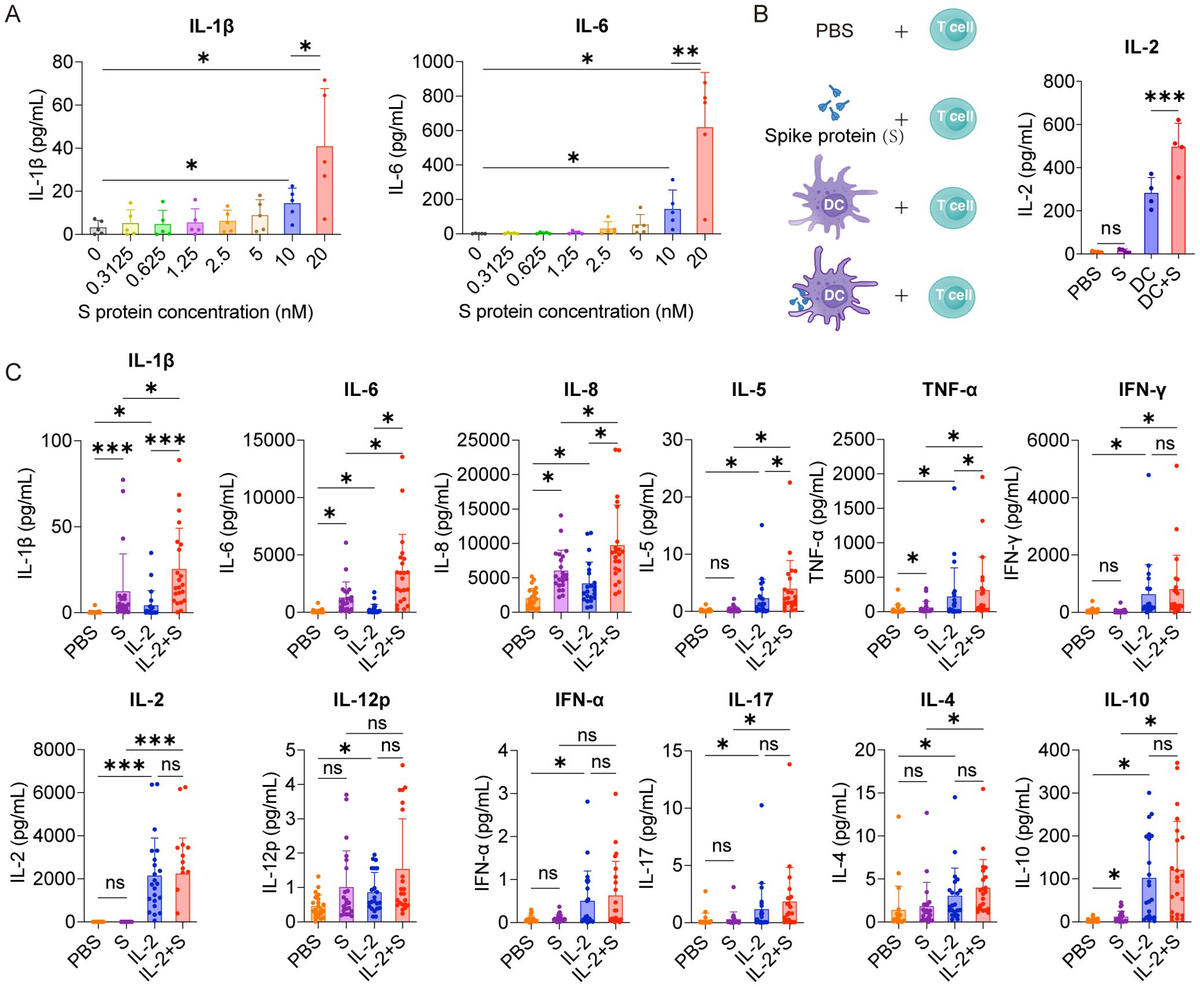
Results: This study shows that dendritic cells loaded with spike protein of SARS-CoV-2 stimulate T cells to release much more interleukin-2 (IL-2,) which subsequently cooperates with spike protein to facilitate PBMCs to release IL-1β, IL-6, and IL-8. These effects are achieved via IL-2 stimulation of NK cells to release tumor necrosis factor-α (TNF-α) and interferon-γ (IFN-γ), as well as T cells to release IFN-γ Mechanistically, IFN-γ and TNF-α enhance the transcription of CD40, and the interaction of CD40 and its ligand stabilizes the membrane expression of toll-like receptor 4 (TLR4) that serves as a receptor of spike protein on the surface of monocytes. As a result, there is a constant interaction between spike protein and TLR4, leading to continuous activation of nuclear factor-κ-gene binding (NF-κB). Furthermore, TNF-α also activates NF-κB signaling in monocytes, which further cooperates with IFN-γ and spike protein to modulate NF-κB–dependent transcription of CRS-related inflammatory cytokines.
Discussion: Targeting TNF-α/IFN-γ in combination with TLR4 may represent a promising therapeutic approach for alleviating CRS in individuals with COVID-19
https://doi.org/10.3389/fimmu.2024.1444643
Chao Niu1,2† Tingting Liang1† Yongchong Chen1 Shan Zhu1,3 Lei Zhou1 Naifei Chen1 Lei Qian1 Yufeng Wang1,4 Min Li1* Xin Zhou1,2,4* Jiuwei Cui1,4*
Introduction: Cytokine release syndrome (CRS) is one of the leading causes of mortality in patients with COVID-19 caused by the SARS-CoV-2 coronavirus. However, the mechanism of CRS induced by SARS-CoV-2 is vague.
Methods: Using spike protein combined with IL-2, IFN-γ, and TNF-α to stimulate human peripheral blood mononuclear cells (PBMCs) to secrete CRS-related cytokines, the content of cytokines in the supernatant was detected, and the effects of NK, T, and monocytes were analyzed.
Results: This study shows that dendritic cells loaded with spike protein of SARS-CoV-2 stimulate T cells to release much more interleukin-2 (IL-2,) which subsequently cooperates with spike protein to facilitate PBMCs to release IL-1β, IL-6, and IL-8. These effects are achieved via IL-2 stimulation of NK cells to release tumor necrosis factor-α (TNF-α) and interferon-γ (IFN-γ), as well as T cells to release IFN-γ Mechanistically, IFN-γ and TNF-α enhance the transcription of CD40, and the interaction of CD40 and its ligand stabilizes the membrane expression of toll-like receptor 4 (TLR4) that serves as a receptor of spike protein on the surface of monocytes. As a result, there is a constant interaction between spike protein and TLR4, leading to continuous activation of nuclear factor-κ-gene binding (NF-κB). Furthermore, TNF-α also activates NF-κB signaling in monocytes, which further cooperates with IFN-γ and spike protein to modulate NF-κB–dependent transcription of CRS-related inflammatory cytokines.
Discussion: Targeting TNF-α/IFN-γ in combination with TLR4 may represent a promising therapeutic approach for alleviating CRS in individuals with COVID-19