
 Tweet
Tweet
New research by Shi Zhengli and others: Wuhan's cat population is infected with new coronavirus, which may be transmitted by humans
04-04 12:02
Current research generally believes that the new coronavirus may originate from bats. How the new coronavirus spreads from bats to humans also requires direct contact between humans and intermediate host animals. However, it is unclear which animals are intermediate hosts of the new coronavirus. Recently, some scientific research teams are starting from which daily animals are susceptible to the new coronavirus to answer these questions, which is also critical to the prevention and control of the epidemic.
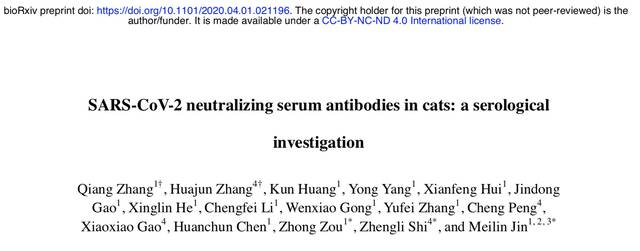
On April 3, local time, the research team of the State Key Laboratory of Agricultural Microbiology at Huazhong Agricultural University and the Wuhan Institute of Virology, Chinese Academy of Sciences jointly published a new study on the preprint platform bioRxiv, "SARS-CoV-2 neutralizing serum antibodies in cats: a serological investigation ".
They found through cat serum survey: Serum ELISA detection of 102 cats collected after the outbreak of the new crown epidemic in Wuhan showed that serum from 15 cats (14.7%) was positive for the receptor binding domain (RBD) of the new crown virus.
Among the positive samples, 11 had New Corona virus neutralizing antibodies. Among them, 3 cats with new crown patients had the highest neutralizing titers, indicating that the high neutralizing titers may be due to the close contact between the cat and the new crown patients. To.
 https://m.sohu.com/a/385457135_26061...6379169OEq3XIC
04-04 12:02
Current research generally believes that the new coronavirus may originate from bats. How the new coronavirus spreads from bats to humans also requires direct contact between humans and intermediate host animals. However, it is unclear which animals are intermediate hosts of the new coronavirus. Recently, some scientific research teams are starting from which daily animals are susceptible to the new coronavirus to answer these questions, which is also critical to the prevention and control of the epidemic.
On April 3, local time, the research team of the State Key Laboratory of Agricultural Microbiology at Huazhong Agricultural University and the Wuhan Institute of Virology, Chinese Academy of Sciences jointly published a new study on the preprint platform bioRxiv, "SARS-CoV-2 neutralizing serum antibodies in cats: a serological investigation ".
They found through cat serum survey: Serum ELISA detection of 102 cats collected after the outbreak of the new crown epidemic in Wuhan showed that serum from 15 cats (14.7%) was positive for the receptor binding domain (RBD) of the new crown virus.
Among the positive samples, 11 had New Corona virus neutralizing antibodies. Among them, 3 cats with new crown patients had the highest neutralizing titers, indicating that the high neutralizing titers may be due to the close contact between the cat and the new crown patients. To.
https://m.sohu.com/a/385457135_26061...6379169OEq3XIC

Comment