
 Tweet
Tweet
FluTrackers takes no position about any medicines, vaccines, devices, etc. If you have any medical questions consult your medical practitioner.
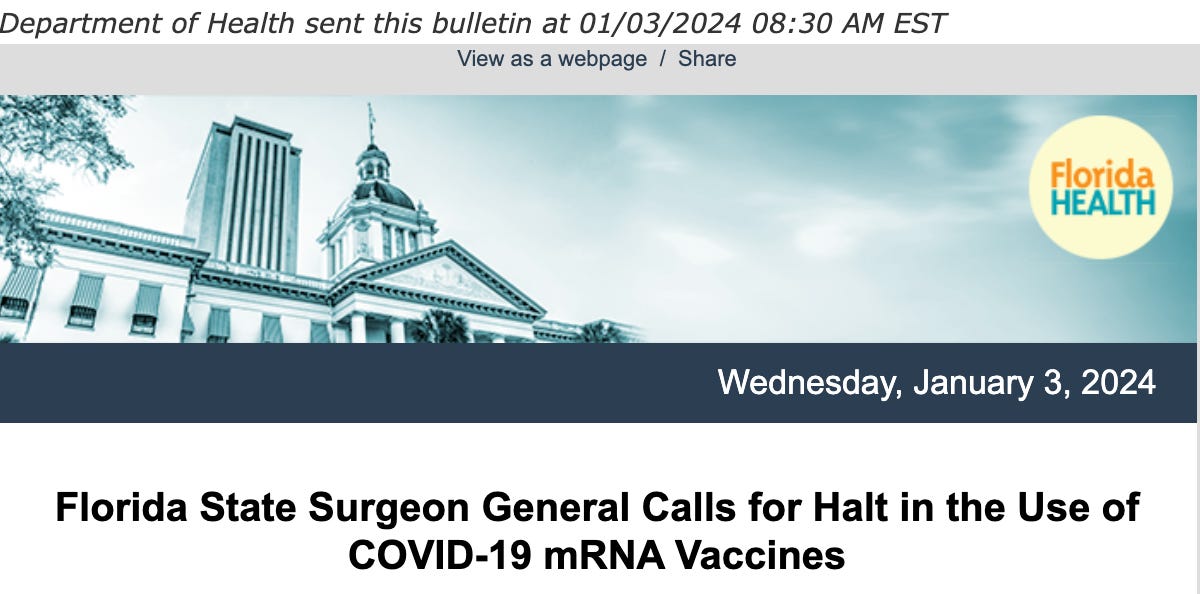
Florida State Surgeon General Calls for Halt in the Use of COVID-19 Mrna Vaccines
January 03, 2024
Contact:
Communications Office
NewsMedia@flhealth.gov
850-245-4111
Tallahassee, Fla. — On December 6, 2023, State Surgeon General Dr. Joseph A. Ladapo sent a letter to the United States Food and Drug Administration (FDA) Commissioner Dr. Robert M. Califf and Center for Disease Control and Prevention (CDC) Director Dr. Mandy Cohen regarding questions pertaining to the safety assessments and the discovery of billions of DNA fragments per dose of the Pfizer and Moderna COVID-19 mRNA vaccines.
The Surgeon General outlined concerns regarding nucleic acid contaminants in the approved Pfizer and Moderna COVID-19 mRNA vaccines, particularly in the presence of lipid nanoparticle complexes, and Simian Virus 40 (SV40) promoter/enhancer DNA. Lipid nanoparticles are an efficient vehicle for delivery of the mRNA in the COVID-19 vaccines into human cells and may therefore be an equally efficient vehicle for delivering contaminant DNA into human cells. The presence of SV40 promoter/enhancer DNA may also pose a unique and heightened risk of DNA integration into human cells.
In 2007, the FDA published guidance on regulatory limits for DNA vaccines in theGuidance for Industry: Considerations for Plasmid DNA Vaccines for Infectious Disease Indications (Guidance for Industry). In this Guidance for Industry, the FDA outlines important considerations for vaccines that use novel methods of delivery regarding DNA integration, specifically:
On December 14, 2023, the FDA provided a written response providing no evidence that DNA integration assessments have been conducted to address risks outlined by theFDA themselves in 2007. Based on the FDA’s recognition of unique risks posed by DNA integration, the efficacy of the COVID-19 mRNA vaccine’s lipid nanoparticle delivery system, and the presence of DNA fragments in these vaccines, it is essential to human health to assess the risks of contaminant DNA integration into human DNA. The FDA has provided no evidence that these risks have been assessed to ensure safety. As such, Florida State Surgeon General Dr. Joseph A. Ladapo has released the following statement:
“The FDA’s response does not provide data or evidence that the DNA integration assessments they recommended themselves have been performed. Instead, they pointed to genotoxicity studies – which are inadequate assessments for DNA integration risk. In addition, they obfuscated the difference between the SV40 promoter/enhancer and SV40 proteins, two elements that are distinct.
DNA integration poses a unique and elevated risk to human health and to the integrity of the human genome, including the risk that DNA integrated into sperm or egg gametes could be passed onto offspring of mRNA COVID-19 vaccine recipients. If the risks of DNA integration have not been assessed for mRNA COVID-19 vaccines, these vaccines are not appropriate for use in human beings.
Providers concerned about patient health risks associated with COVID-19 should prioritize patient access to non-mRNA COVID-19 vaccines and treatment. It is my hope that, in regard to COVID-19, the FDA will one day seriously consider its regulatory responsibility to protect human health, including the integrity of the human genome.”
In the spirit of transparency and scientific integrity, State Surgeon General Dr. Joseph A. Ladapo will continue to assess research surrounding these risks and provide updates to Floridians.
About the Florida Department of Health
The department, nationally accredited by thePublic Health Accreditation Board, works to protect, promote and improve the health of all people in Florida through integrated state, county and community efforts.
Follow us on Twitter at@HealthyFla and on Facebook. For more information about the Florida Department of Health please visit www.FloridaHealth.gov.
https://www.floridahealth.gov/newsro...ccines.pr.html
Florida State Surgeon General Calls for Halt in the Use of COVID-19 Mrna Vaccines
January 03, 2024
Contact:
Communications Office
NewsMedia@flhealth.gov
850-245-4111
Tallahassee, Fla. — On December 6, 2023, State Surgeon General Dr. Joseph A. Ladapo sent a letter to the United States Food and Drug Administration (FDA) Commissioner Dr. Robert M. Califf and Center for Disease Control and Prevention (CDC) Director Dr. Mandy Cohen regarding questions pertaining to the safety assessments and the
discovery of billions of DNA fragments per dose of the Pfizer and Moderna COVID-19 mRNA vaccines.The Surgeon General outlined concerns regarding nucleic acid contaminants in the approved Pfizer and Moderna COVID-19 mRNA vaccines, particularly in the presence of lipid nanoparticle complexes, and Simian Virus 40 (SV40) promoter/enhancer DNA. Lipid nanoparticles are an efficient vehicle for delivery of the mRNA in the COVID-19 vaccines into human cells and may therefore be an equally efficient vehicle for delivering contaminant DNA into human cells. The presence of SV40 promoter/enhancer DNA may also pose a unique and heightened risk of DNA integration into human cells.
In 2007, the FDA published guidance on regulatory limits for DNA vaccines in the
Guidance for Industry: Considerations for Plasmid DNA Vaccines for Infectious Disease Indications (Guidance for Industry). In this Guidance for Industry, the FDA outlines important considerations for vaccines that use novel methods of delivery regarding DNA integration, specifically:- DNA integration could theoretically impact a human’s oncogenes – the genes which can transform a healthy cell into a cancerous cell.
- DNA integration may result in chromosomal instability.
- The Guidance for Industry discusses biodistribution of DNA vaccines and how such integration could affect unintended parts of the body including blood, heart, brain, liver, kidney, bone marrow, ovaries/testes, lung, draining lymph nodes, spleen, the site of administration and subcutis at injection site.
On December 14, 2023, the FDA provided a written response providing no evidence that DNA integration assessments have been conducted to address risks outlined by the
FDA themselves in 2007. Based on the FDA’s recognition of unique risks posed by DNA integration, the efficacy of the COVID-19 mRNA vaccine’s lipid nanoparticle delivery system, and the presence of DNA fragments in these vaccines, it is essential to human health to assess the risks of contaminant DNA integration into human DNA. The FDA has provided no evidence that these risks have been assessed to ensure safety. As such, Florida State Surgeon General Dr. Joseph A. Ladapo has released the following statement:“The FDA’s response does not provide data or evidence that the DNA integration assessments they recommended themselves have been performed. Instead, they pointed to genotoxicity studies – which are inadequate assessments for DNA integration risk. In addition, they obfuscated the difference between the SV40 promoter/enhancer and SV40 proteins, two elements that are distinct.
DNA integration poses a unique and elevated risk to human health and to the integrity of the human genome, including the risk that DNA integrated into sperm or egg gametes could be passed onto offspring of mRNA COVID-19 vaccine recipients. If the risks of DNA integration have not been assessed for mRNA COVID-19 vaccines, these vaccines are not appropriate for use in human beings.
Providers concerned about patient health risks associated with COVID-19 should prioritize patient access to non-mRNA COVID-19 vaccines and treatment. It is my hope that, in regard to COVID-19, the FDA will one day seriously consider its regulatory responsibility to protect human health, including the integrity of the human genome.”
In the spirit of transparency and scientific integrity, State Surgeon General Dr. Joseph A. Ladapo will continue to assess research surrounding these risks and provide updates to Floridians.
About the Florida Department of Health
The department, nationally accredited by the
Public Health Accreditation Board, works to protect, promote and improve the health of all people in Florida through integrated state, county and community efforts.Follow us on Twitter at
@HealthyFla and on Facebook. For more information about the Florida Department of Health please visit www.FloridaHealth.gov.https://www.floridahealth.gov/newsro...ccines.pr.html

Comment