

Pathfinder
Editor, Senior Moderator
Could a seasonal flu shot help protect against bird flu? International study points to a surprising possibility
New international research led by National Taiwan University, in collaboration with USF Health, suggests that part of the answer may already exist.
In a study published April 15 in Emerging Microbes & Infections, researchers found that seasonal influenza vaccines in routine global use may significantly reduce the risk of death from H5N1 infection. The results are based on a systematic review and analysis of ferret studies, widely considered the gold standard animal model for human influenza.
The findings highlight an important implication for pandemic preparedness, suggesting that readily available tools may offer protection while the world races to develop more targeted solutions.
The Taiwan-US research team analyzed nearly two decades of experimental data from 35 controlled studies involving almost 1,800 ferrets. Seasonal flu vaccines that included a specific component, neuraminidase N1, reduced H5N1-related mortality by approximately 73 percent in vaccinated animals compared with unvaccinated animals.
That level of protection was comparable to some H5N1-specific vaccines that failed to generate strong immune responses and was only modestly lower than those that did.
In contrast, seasonal vaccines lacking the N1 component showed little to no protective effect, underscoring how specific elements of existing vaccines may play an outsized role in defending against emerging threats.
“This work suggests that we may be underestimating the broader protective value of seasonal influenza vaccines,” said Chi-Tai Fang, MD, PhD, professor of infectious diseases epidemiology at National Taiwan University and National Taiwan University Hospital and senior author of the study. “While they are not designed to target H5N1, certain components appear to activate immune responses that can reduce the severity of infection. In a real-world setting, that kind of partial protection could translate into lives saved while more specific vaccines are being developed and distributed.”
For Sten Vermund, MD, PhD, dean of the USF Health College of Public Health, chief medical officer of the Global Virus Network and a co-author, the findings highlight an important opportunity for pandemic preparedness.
“In a pandemic scenario, timing is everything,” Dr. Vermund said. “We often face a critical gap between the emergence of a new virus and the availability of a targeted vaccine. Our findings suggest that seasonal flu vaccination, something already widely available, could help reduce severe outcomes during that window. That is a meaningful advantage when every week matters.”
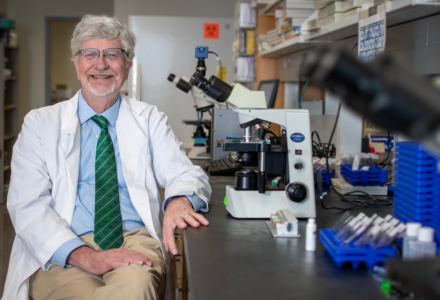
Sten Vermund, MD, PhD, dean of the USF Health College of Public Health
The study also revealed something unexpected. The seasonal vaccines did not produce detectable antibodies against H5N1 using standard tests. Instead, the protection appears to come from more complex immune mechanisms likely involving cross-reactive cellular responses that are not captured by traditional measures of immunity, suggesting protection may exist even when it is not detectable through standard laboratory markers.
These findings arrive at a critical moment, as H5N1 continues to spread among mammals while limited amounts of vaccine are available globally. This leaves health systems vulnerable in the early stages of an outbreak. While not a substitute for targeted vaccines, extensive adoption of seasonal flu vaccines could buy time by reducing deaths, easing strain on health systems and slowing the impact of a rapidly spreading virus.
The researchers caution that the findings are based on animal models and must be validated in humans, but they also point to an important next step in understanding how existing immunity built through routine vaccination may shape responses to emerging infectious diseases.
The study also reflects USF Health’s role in advancing global infectious disease research and pandemic preparedness through international collaboration, including its partnership with the Global Virus Network, headquartered at USF Health.
https://www.usf.edu/health/news/202...y deadly avian influenza,not be ready in time.
- Nora Samaranayake
- April 28, 2026
- College of Public Health, Research
New international research led by National Taiwan University, in collaboration with USF Health, suggests that part of the answer may already exist.
In a study published April 15 in Emerging Microbes & Infections, researchers found that seasonal influenza vaccines in routine global use may significantly reduce the risk of death from H5N1 infection. The results are based on a systematic review and analysis of ferret studies, widely considered the gold standard animal model for human influenza.
The findings highlight an important implication for pandemic preparedness, suggesting that readily available tools may offer protection while the world races to develop more targeted solutions.
The Taiwan-US research team analyzed nearly two decades of experimental data from 35 controlled studies involving almost 1,800 ferrets. Seasonal flu vaccines that included a specific component, neuraminidase N1, reduced H5N1-related mortality by approximately 73 percent in vaccinated animals compared with unvaccinated animals.
That level of protection was comparable to some H5N1-specific vaccines that failed to generate strong immune responses and was only modestly lower than those that did.
In contrast, seasonal vaccines lacking the N1 component showed little to no protective effect, underscoring how specific elements of existing vaccines may play an outsized role in defending against emerging threats.
“This work suggests that we may be underestimating the broader protective value of seasonal influenza vaccines,” said Chi-Tai Fang, MD, PhD, professor of infectious diseases epidemiology at National Taiwan University and National Taiwan University Hospital and senior author of the study. “While they are not designed to target H5N1, certain components appear to activate immune responses that can reduce the severity of infection. In a real-world setting, that kind of partial protection could translate into lives saved while more specific vaccines are being developed and distributed.”
For Sten Vermund, MD, PhD, dean of the USF Health College of Public Health, chief medical officer of the Global Virus Network and a co-author, the findings highlight an important opportunity for pandemic preparedness.
“In a pandemic scenario, timing is everything,” Dr. Vermund said. “We often face a critical gap between the emergence of a new virus and the availability of a targeted vaccine. Our findings suggest that seasonal flu vaccination, something already widely available, could help reduce severe outcomes during that window. That is a meaningful advantage when every week matters.”
Sten Vermund, MD, PhD, dean of the USF Health College of Public Health
The study also revealed something unexpected. The seasonal vaccines did not produce detectable antibodies against H5N1 using standard tests. Instead, the protection appears to come from more complex immune mechanisms likely involving cross-reactive cellular responses that are not captured by traditional measures of immunity, suggesting protection may exist even when it is not detectable through standard laboratory markers.
These findings arrive at a critical moment, as H5N1 continues to spread among mammals while limited amounts of vaccine are available globally. This leaves health systems vulnerable in the early stages of an outbreak. While not a substitute for targeted vaccines, extensive adoption of seasonal flu vaccines could buy time by reducing deaths, easing strain on health systems and slowing the impact of a rapidly spreading virus.
The researchers caution that the findings are based on animal models and must be validated in humans, but they also point to an important next step in understanding how existing immunity built through routine vaccination may shape responses to emerging infectious diseases.
The study also reflects USF Health’s role in advancing global infectious disease research and pandemic preparedness through international collaboration, including its partnership with the Global Virus Network, headquartered at USF Health.
https://www.usf.edu/health/news/202...y deadly avian influenza,not be ready in time.

