Announcement

Collapse
No announcement yet.

What no one wants to discuss: Pandemic threat of Ebola

Collapse
X
 
  • Filter
  • Time
  • Show
Clear All
new posts

  • What no one wants to discuss: Pandemic threat of Ebola

    From Maryn McKenna today in Wired:

    "They (Sandman/Lanard) conclude with some recommendations on how to talk about Ebola going forward so that people don?t freeze in panic, and what is at risk in public trust if no one undertakes the difficult task of beginning that conversation."

    The biggest danger of Ebola is letting it spread unchecked in Africa. If we decide to detain people coming from Africa, it could deter health care workers from going there to treat the epidemic.


    "Those are the four reasons we have thought of that could explain the lack of headlines about this calamitous prospect. The people out there talking about Ebola:

    don?t think it?s likely enough to be worth talking about;
    don?t think there?s anything to be done about it anyway;
    don?t think the public can take it; or
    can?t bear to keep the horrific prospect in focus.

    We have some sympathy for the fourth possible explanation. In fact, that?s our second failure of imagination: We too are having a hard time focusing our minds on the pandemic scenario."


  • #2
    Re: What no one wants to discuss: Pandemic threat of Ebola

    That's an excellent article, gets one thinking about it. I sincerely hope that the authorities have people behind the scenes worrying about this, even if they are not worrying about it publicly. I'm not confident that is happening, however. It seems Ebola has been consistently underestimated by the political powers right from the start.

    I'm definitely a combination of 4 and 2. If it gets that big, there really won't be anything we can do about it aside from closing the borders and focusing on our own.

    I suspect that is why it's not talked about right now, because people, including HCWs who would be on the front lines in the US, would be demanding that happen sooner rather than later. If more than a few hospitals have Ebola patients, especially if they are unexpected (not HCWs or soldiers who've been in West Africa) or domestically acquired cases, then Katy bar the door.

    There will be a period of initial panic and economic hardship, and then, I believe, people will adjust to a grim new reality. People can adjust to nearly anything, for a while. Then, it will get better, perhaps even be eliminated if a vaccine is found, and life will go on.

    Comment


    • #3
      Re: What no one wants to discuss: Pandemic threat of Ebola

      I'm in charge of information monitoring and emergency preparedness for my household, and when asked what we do if this scenario plays out, all I could do was shrug.

      Beyond common sense things like avoid obviously sick people, wash a lot, don't touch public surfaces...

      It doesn't help that my partner is essential personnel at a law enforcement facility which also houses a health center.

      Comment


      • #4
        Re: What no one wants to discuss: Pandemic threat of Ebola

        Well we could look at the history, Spanish Flu in particular, to see how people respond. The bug may change it's name but humans don't change their stripes. I wonder if there is any detail on HCW and how they responded during that pandemic. If so, there's our answer.

        I am not all concerned about the spread. What scares me is more the ecomonic damage if this thing gets loose in India or China, predominately if it's the slums. What would this do to trading and commerce? The markets, can you see the markets having a cow? I don't see people around me concerned at all but turn on the media and it's a circus. The media could go a long way to making this a reasonable approach but they seem to want to stir up a panic, creates more viewers I guess.

        Comment


        • #5
          Re: What no one wants to discuss: Pandemic threat of Ebola

          can you blame them for not checking the actual numbers ?
          With all the exponential headlines around.

          And the success stories from Kailahun,Kenema,Telimele,Lofa,...
          are usually not found in the MSM.
          I'm interested in expert panflu damage estimates
          my current links: http://bit.ly/hFI7H ILI-charts: http://bit.ly/CcRgT

          Comment


          • #6
            Re: What no one wants to discuss: Pandemic threat of Ebola

            Originally posted by Dallas View Post
            What would this do to trading and commerce? The markets, can you see the markets having a cow?
            The awful part is that there are people trading all angles of this, poised to make money whichever way the markets go. It's the smaller companies, people's pensions, supply chains, commodities that will take hits while big money hunkers down & rides it out.

            Comment


            • #7
              Re: What no one wants to discuss: Pandemic threat of Ebola

              Once of the links provided had a link to an extended fictional diary of what a flu pandemic might look like, written by Canada Sue and I read all the available parts - only about half are. I found it to be quite a sobering read and wish I could read the entire thing.

              My normal level of emergency preparedness is for what I might need in the event of a bad winter storm with no power for several days to at most a week but earlier this summer I did start to increase stores because I thought this year might be a bad one for flu and I might want/need to shelter in place for somewhat longer.

              The more I read the more I realized that it is nearly impossible to imagine just what a pandemic of any disease might be like over the long term and to try and determine what is a reasonable level of personal preparedness for myself, my pets and maybe a few friends.

              As I read the article that mentioned sparks of Ebola landing in other countries I could not help but remember that October morning in 1991 when fire began to get out of control up in the Oakland/Berkeley hills. I lived down in the flats but when up to the home of friends and evacuated their dog, the cat and the baby as they remained behind to pack as much critical stuff in their vehicles as was reasonable before the mandatory evacuation orders came about. It was several days before they learned that they still had a home to return to but one of my co-workers died trying to save his place and several others did lose their homes. Although that event was very small in scale compared to a global catastrophe it did take a psychological toll on the entire community.

              If we see a best case scenario and Ebola is stopped in its tracks in a few months and does not spread much will we see the world decide that much more attention to global public health is needed and nations take action both with their own borders and around the planet or will there be a return to complacency in short order and no real change.

              Comment


              • #8
                Re: What no one wants to discuss: Pandemic threat of Ebola

                Canada Sue, now there is a name I haven't heard in a while. Has anyone heard from her? I'd love to hear what she is up to!
                "We are in this breathing space before it happens. We do not know how long that breathing space is going to be. But, if we are not all organizing ourselves to get ready and to take action to prepare for a pandemic, then we are squandering an opportunity for our human security"- Dr. David Nabarro

                Comment


                • #9
                  Re: What no one wants to discuss: Pandemic threat of Ebola

                  I pm-ed her at tbm http://thisbluemarble.com
                  maybe she'll write about ebola ...
                  I'm interested in expert panflu damage estimates
                  my current links: http://bit.ly/hFI7H ILI-charts: http://bit.ly/CcRgT

                  Comment


                  • #10
                    Re: What no one wants to discuss: Pandemic threat of Ebola

                    Originally posted by Sollydog View Post
                    If we see a best case scenario and Ebola is stopped in its tracks in a few months and does not spread much will we see the world decide that much more attention to global public health is needed and nations take action both with their own borders and around the planet or will there be a return to complacency in short order and no real change.
                    Your question is an either or choice but the answer is both.
                    We will see a shift in priorities followed by a shift back as political attention wonders elsewhere.
                    We have been here before. When H5N1 forced the world to contemplate a high CFR pandemic a lot of effort (AKA money) was put into into preparedness.
                    There are a number of parts to this story.
                    The adoption of the MDGs (2000), the formation of GOARN (2000), the adoption of the IHR(2005) followed by the 2008 financial crisis and the H1N1(2009) pandemic. The WHO has a limited budget basic budget plus voluntary targeted contributions and little discretion in how any of it is spent. It is largely at the whim of nation states whose priorities change. In 2000 the focus was on the MDG 15 year plan and then in 2005 with the new IHR there were major commitments on the part of poor states to bring their surveillance and reporting systems up to a higher standard along with a significant global response to the H5N1 threat. At this point things were going fairly well but with everyone's finances squeezed post 2008 the WHO had its bi-annual budget cut and then cut again. At the same time it was re-tasked to continue its work towards MDG targets and refocus on chronic diseases. In the squeeze other programs got gutted many of the teams put together who should be helping us now were let go and institutional memory and expertise were lost. The last budget round saw a 13% cut in the whole budget and the 'neglected African tropical disease research budget' (which includes Ebola, Marburg etc) was set to be reduced by 50%. I do not know GOARN's current budget but in 2006 (at the height of H5N1 interest) it had a direct budget from WHO of $5.5m p.a. and a small administrative staff, any thing else it needed this staff had to try and squeeze out of doners. One of the requirements of the IHR was exactly the sort of basic disease surveillance and reporting systems that would have averted this crisis but trying to build these capacities when these very poor countries were recovering from civil war and the richer nations were licking their wounds post 2008 left the job unfinished. In the US the CDC, NIH, BARDA et al all had their budgets cut, and much the same happened elsewhere, and these are the organizations that normally come to the WHO's aid when a sudden emergence occurs.
                    Assuming this can be stopped, prior to a total economic meltdown, then promises will be made, funds allocated for a while until political attention strays and then it will be back to business as usual with vast sums spent on militaries to tackle dangers from humans and not a lot on threats of non human origin.

                    Comment


                    • #11
                      Re: What no one wants to discuss: Pandemic threat of Ebola

                      One thing that may happen within the various US agencies is a return to the kind of public health that was the primary reason for their existence- fighting infectious disease. I doubt very much that their budgets will be increased, but it's likely that their focus will be refined a bit. As the nations health threats have changed from communicable disease to ones more related to lifestyle, the focus has widened quite a bit, and the cost/benefit ratio has really exploded (much like most of the rest of medicine, actually). The low-cost, high-yield interventions have been done- long ago.

                      This leads to some spending on some unconventional research and programs, which the NIH got hammered over this past few weeks after the director said there would have been an Ebola vaccine were it not for budget cuts. It's not for me to say whether these expenditures were worthwhile, but it is definitely true that the incremental gains in American health are harder to achieve than they used to be, so there is the temptation to fund anything that has a shot a improving our lot. That will probably change going forward.

                      Comment


                      • #12
                        Re: What no one wants to discuss: Pandemic threat of Ebola

                        But it is the communicable deseases that are on the rise. Vaccination down, whooping cough, etc is on the rise.

                        Comment


                        • #13
                          Re: What no one wants to discuss: Pandemic threat of Ebola

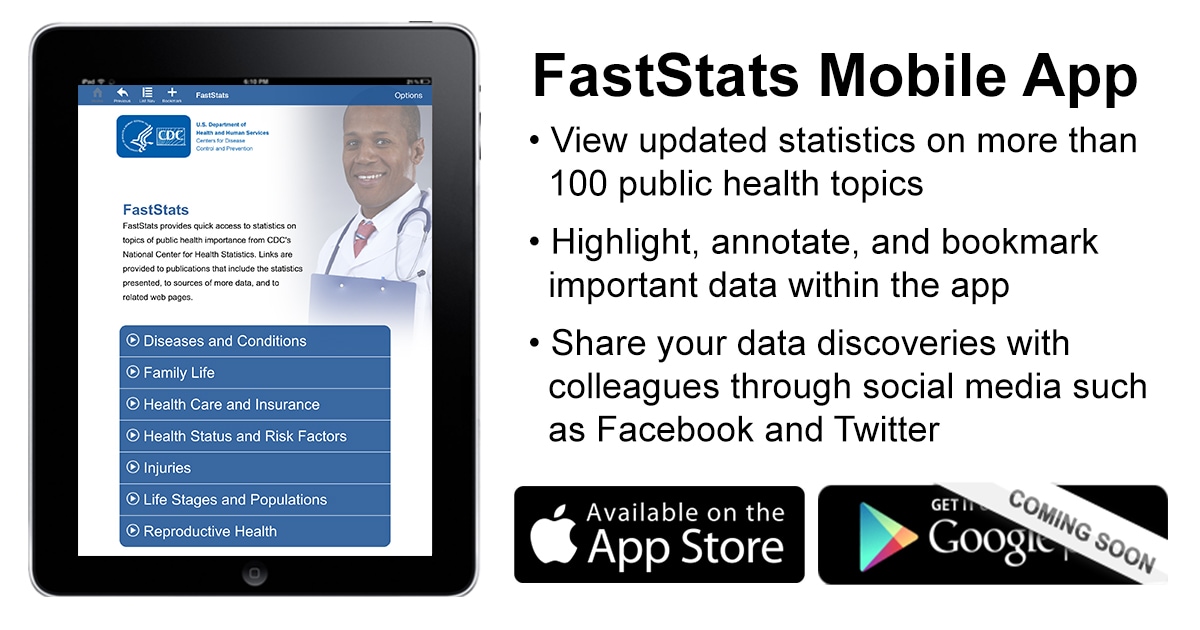
                          FastStats is an official application from the Centers for Disease Control and Prevention’s (CDC) National Center for Health Statistics (NCHS) and puts access to topic-specific statistics at your fingertips.

                          Leading Causes of Death

                          Data are for the U.S. and are final 2010 data; For the most recent preliminary data see Deaths: Preliminary Data for 2011 [PDF - 1.7 MB]
                          Number of deaths for leading causes of death

                          • Heart disease: 596,577
                          • Cancer: 576,691
                          • Chronic lower respiratory diseases: 142,943
                          • Stroke (cerebrovascular diseases): 128,932
                          • Accidents (unintentional injuries): 126,438
                          • Alzheimer's disease: 84,974
                          • Diabetes: 73,831
                          • Influenza and Pneumonia: 53,826
                          • Nephritis, nephrotic syndrome, and nephrosis: 45,591
                          • Intentional self-harm (suicide): 39,518

                          Source: Deaths: Final Data for 2011, table 10 [PDF - 1.5 MB]
                          _____________________________________________

                          Ask Congress to Investigate COVID Origins and Government Response to Pandemic.

                          i love myself. the quietest. simplest. most powerful. revolution ever. ---- nayyirah waheed

                          "...there’s an obvious contest that’s happening between different sectors of the colonial ruling class in this country. And they would, if they could, lump us into their beef, their struggle." ---- Omali Yeshitela, African People’s Socialist Party

                          (My posts are not intended as advice or professional assessments of any kind.)
                          Never forget Excalibur.

                          Comment


                          • #14
                            Re: What no one wants to discuss: Pandemic threat of Ebola

                            Not to say the US & other developed nations don't have serious public health issues to address, but the much bigger problem looming on the horizon is Ebola, and inadequate medical care in developing nations. Developed nations haven't figured out how to make aid effective and improve their own healthcare inadequacies let alone address global inadequacies with some exceptions, polio eradication comes to mind. We will all be impacted. We've had lots of time to learn this lesson from past infectious disease outbreaks but it hasn't translated into adequate funding or effective global public health policies.

                            Cases are ~30K in the three most affected countries, doubling every two or three or four weeks, global response to outbreak is still inadequate and the R0 is still ~2. That spells global pandemic to me.

                            Most developed nations, I think many of us here agree, can manage isolated imported cases of disease without epidemics. Most of the rest of the world will not be able to prevent epidemics since their healthcare infrastructures are weak and international agencies and NGO's to assist are stretched thin. We are approaching a tipping point where Ebola will be exported into developing nations which cannot contain it. How can it not spread outside of W. Africa with hundreds of thousands of infected within a few months?

                            Developed nations no longer have much of a manufacturing base thanks to the global economy and are big importers of medicine and other critical supplies (~40% of generic drugs manufactured in India, PPE manufactured in Malaysia) If people in those countries are sick or dying from a disease with CFR of 70%, it will be humanitarian crisis there and economic crisis for the rest of us.

                            Comment


                            • #15
                              Re: What no one wants to discuss: Pandemic threat of Ebola

                              Conflict is the problem. It destroys health care infrastructure.

                              http://thetimes-tribune.com/news/loc...970s-1.1773179
                              Local was on frontlines of Ebola in the 1970s
                              LUKE RANKER, STAFF REPORTS
                              Published: October 18, 2014

                              Nearly half a century ago, one local doctor was on the front lines of Ebola treatment.

                              Between 1969 and 1970, Stephen Pancoast, M.D., an infectious disease specialist on the staff at Regional Hospital of Scranton and Moses Taylor Hospital, treated patients at the United Methodist Missionary Hospital in Ganta, Liberia. One disease, West African hemorrhagic fever syndrome, would later be identified as related to the Ebola virus.

                              ...

                              Dr. Pancoast said it would be hard to compare treating Ebola in West Africa now to the methods used in the late 1960s and early 1970s. The main difference isn?t the advances in medicine or a better understanding of the disease, but the stark difference in the quality of health care available in Africa. When he was there, hospitals were not much different than in the United States.

                              ?It was a much more medically advanced place then,? he said.

                              But conditions in Liberia have deteriorated. Decades of war across the region have destroyed much of the infrastructure that was there. Dr. Pancoast doubts his hospital is still standing.
                              Developed countries need to keep that in mind as they shape their own foreign policy.

                              http://www.ijmonitor.org/2009/07/tay...rom-us-prison/
                              _____________________________________________

                              Ask Congress to Investigate COVID Origins and Government Response to Pandemic.

                              i love myself. the quietest. simplest. most powerful. revolution ever. ---- nayyirah waheed

                              "...there’s an obvious contest that’s happening between different sectors of the colonial ruling class in this country. And they would, if they could, lump us into their beef, their struggle." ---- Omali Yeshitela, African People’s Socialist Party

                              (My posts are not intended as advice or professional assessments of any kind.)
                              Never forget Excalibur.

                              Comment

                              Working...
                              X