Announcement

Collapse
No announcement yet.

Discussion - Ebola outbreaks 2026 (DRC & Uganda)

Collapse
X
 
  • Filter
  • Time
  • Show
Clear All
new posts

  • #31
    Originally posted by Toaster2 View Post
    For discussion purposes only : If Ebola spreads through bodily fluids, why is it not (considered) to be airborne ? Does anyone know ? Are the levels in the nose and upper respiratory tract much lower compared to influenza or covid ? That would be a good explanation, but I can not really think of other reasons.

    In a 2014 post, virologist Vincent Racaniello wrote:

    “We do not know why, in humans or non-human primates, Ebola virus does not transmit by respiratory aerosols. The virus might not reach sufficiently high titers in the respiratory tract, or be stable in respiratory secretions, to be efficiently transmitted by this route. There are many other possibilities. A careful study of Ebola virus titers in the human respiratory tract, and in respiratory secretions, would be valuable. However during Ebola virus outbreaks the main concern is to save people, not conduct experiments.”

    As the West African epidemic of Ebola virus grows, so does misinformation about the virus, particularly how it is transmitted from person to person. Ebola v ...

    ----------------------------------------------------------
    CDC - Ebola and Bundibugyo Virus Frequently Asked Questions
    ...
    Does Ebola spread person-to-person?

    Yes. People can get Ebola disease​ through contact with the body fluids of an infected sick or dead person. A person is only contagious once they begin showing symptoms of the disease. You cannot get Ebola from simply being near someone or passing them in public spaces because it doesn't spread through the air.
    ...
    Get information to FAQs about Ebola disease and the spring 2026 outbreak in DRC and Uganda.

    Comment


    • #32
      US, Mexico, Canada Announce Ebola-Related Travel Measures Ahead of World Cup


      Thursday, 28 May 2026 11:28 AM EDT


      The ‌United States, Mexico, and Canada on Thursday announced aligned public health travel measures for people coming from African regions at the greatest risk from Ebola, they said in a joint statement, as they aim to protect citizens and ‌visitors during the World Cup.

      "The health and safety ​of every person in the region remains our highest priority as we welcome the world to North America," they ⁠said in the statement, which did not detail the ​aligned measures.

      The World Health Organization on Sunday, May 17, declared an Ebola outbreak ⁠in the Democratic Republic of Congo a Public Health Emergency of International Concern and said there was a high risk it could spread to neighboring countries.
      ​…..

      CSI:WORLD http://swineflumagazine.blogspot.com/

      treyfish2004@yahoo.com

      Comment


      • #33
        < Congo's Ebola outbreak is spiraling, with health workers struggling to contain the virus

        May 28, 20264:47 AM ET

        (Audio)

        Transcript:
        ...
        LIVINGSTONE: Congo announced an outbreak on May 15, by which point Ebola had likely been spreading in Ituri for many weeks, if not months. And the bustling city of Bunia, home to nearly 1 million people, is close to the epicenter, a remote gold mining town called Mongbwalu.

        ESTHER STERK: The situation is currently very concerning with active transmission ongoing everywhere around here in Mongbwalu.

        LIVINGSTONE: Dr. Esther Sterk is a tropical disease specialist for Doctors Without Borders in Mongbwalu.

        STERK: Every day, there are many community deaths and suspected patients arriving at the hospital, which probably only is a small proportion of all cases at the moment. And one of the big challenges is the lack of diagnostics capacity, where often it takes many, many days before the laboratory results come out.
        ...
        RICHARD LOKUDU: (Speaking French).

        LIVINGSTONE: "Local resistance to the Ebola response has been fierce," he says. Some parts of town have become no-go zones. Tracking contacts is almost impossible.

        LOKUDU: (Speaking French).

        LIVINGSTONE: "People in the community here are dying every day," he says, "but often out of view of health workers."

        ...
        https://www.npr.org/transcripts/nx-s1-5834940

        Comment


        • #34
          Kenya court suspends US plan for Ebola quarantine facility for Americans


          By EVELYNE MUSAMBI,Associated PressMay 29, 2026​

          NAIROBI, Kenya (AP) — A court in Kenya on Friday suspended a U.S. plan to establish a quarantine facility for Americans exposed to a rare type of Ebola virus spreading in northeastern Congo, following a backlash by medical workers and activists.

          more.... https://www.ctinsider.com/news/world...e-22282007.php

          Comment


          • #35
            WHO
            Experts convened by WHO advise on candidate treatments and vaccines for Ebola disease caused by Bundibugyo virus
            28 May 2026 News release Geneva


            In response to the current outbreak of Ebola disease caused by Bundibugyo virus occurring in the Democratic Republic of the Congo, with cases also reported in Uganda, WHO convened several of its expert and advisory groups. These groups assessed potential vaccines and therapeutics for both prevention and treatment of Bundibugyo virus disease (BVD). The WHO advisory groups recommended that all the products identified and considered be used exclusively within clinical trials to generate robust data and ensure safe, ethical, and effective research.

            WHO convened a series of meetings with the WHO R&D Blueprint technical advisory groups on candidate vaccines and therapeutics for BVD.

            In parallel, WHO also convened the Strategic Advisory Group of Experts on Immunization (SAGE) and its Ebola vaccine working group to advise on the potential role of licensed Ebola vaccines during BVD outbreaks.

            Key recommendations

            There are currently no licensed therapeutics or vaccines specifically approved for the prevention and treatment of BVD. Nevertheless, WHO advisory groups considered several candidate products that are promising enough to warrant prioritization for evaluation in clinical trials. WHO is now working closely with the governments of the Democratic Republic of the Congo and Uganda to facilitate the implementation of research evaluation of these products.

            For treatment of cases:
            • For treatment, the independent experts recommended prioritizing three candidate therapeutics for evaluation in research (i.e. clinical trials) among confirmed BVD cases: the monoclonal antibodies MBP134 and Maftivimab®, as well as the antiviral remdesivir.
            • Combination therapy using a monoclonal antibody and remdesivir is also recommended for evaluation.

            For prevention of cases:
            • For post-exposure prophylaxis among contacts of confirmed and probable cases, the oral antiviral obeldesivir was determined to be a priority candidate, although experts noted that this approach depends on effective contact tracing, which remains operationally challenging in some of the affected areas of the Democratic Republic of the Congo. Research on post-exposure prophylaxis involves giving tablets of obeldesivir to contacts of cases to evaluate whether this prevents them from developing Ebola disease.
            • The most promising candidate vaccine was determined by the experts to be the single-dose rVSV Bundibugyo vaccine (being developed by the International AIDS Vaccine Initiative or IAVI). The development of this single-dose vaccine candidate will likely require 7–9 months before it is ready to be assessed through a clinical trial for its ability to prevent BDV.
            • Another candidate vaccine, ChAdOx1 Bundibugyo (being developed by Oxford University/Serum Institute of India) could potentially become available within 2–3 months for efficacy assessment through a clinical trial. However, additional animal data are still required to support and confirm further prioritization. Experts noted that a single-dose vaccine approach of this candidate could be suitable for contacts of Ebola cases, whereas a two-dose strategy might be considered for high-risk but unexposed populations such as health-care workers and frontline responders.
            • The convened experts also reviewed the potential role of Ervebo, the only licensed Ebola vaccine. It is approved for use during outbreaks caused by the most common Ebola virus in Africa, from the Orthoebolavirus family. Ervebo is not licensed for prevention of BVD and evidence on cross-protection to other Ebola virus species remains limited and inconclusive. WHO recommends that Ervebo should not be used outside carefully designed research settings, to allow for its performance against BDV to be assessed.
            Ensuring ethical and safe clinical trials

            WHO, the governments of the Democratic Republic of the Congo and Uganda, the Africa Centres for Disease Control and Prevention (Africa CDC), the ANRS Emerging infectious diseases (French National Agency for Research on AIDS and Viral Hepatitis), and other scientific partners are working together to develop and implement appropriate protocols to assess the safety and efficacy of the prioritized therapeutics through clinical field trials.

            WHO calls for accelerated access to essential supplies, stronger community protection, engagement and trust, and coordinated investment in the research, development and evaluation of BVD countermeasures.

            All research must adhere to the highest ethical standards, under the leadership of the national health authorities and in close consultation with affected communities.

            In the meantime, our priority is to stop transmission with tools that we have used for decades of Ebola responses, which include disease surveillance, rapid testing and diagnosis, contact tracing, isolation and care for patients, infection prevention and control, community engagement, and safe and dignified burials. Background


            The WHO R&D Blueprint is a global initiative that allows the rapid activation of research and development activities during epidemics. Its aim is to fast-track the availability of proven effective tests, vaccines, and medicines that can be used to save lives and avert large-scale crises.

            SAGE is the principal advisory group to WHO for vaccines and immunization. It is charged with advising WHO on overall global policies and strategies, ranging from vaccines and technology, research and development, to delivery of immunization and its linkages with other health interventions.

            continued: https://www.who.int/news/item/28-05-...ndibugyo-virus


            Comment


            • #36
              Related to posts #25 and #34, shared by Shiloh and Sharon

              It seems there has been no formal confirmation or statement from the U.S. State Department or Secretary Rubio about any quarantine facility plan in Kenya. The Kenyan government has also not issued any clear public official statement confirming a plan. The court case in Kenya appears to be based on media reports. not official government announcements.


              Kenyan court suspends US Ebola quarantine facility plan
              ...
              When the legal challenge was issued, it was unclear where the facility was to be located, or whether the Kenyan government had formally approved the plan.

              Nairobi has publicly acknowledged discussions with Washington over support for Ebola preparedness efforts, but has not directly addressed the reports about a quarantine facility.

              “The secretive, unilateral establishment of an Ebola quarantine facility raises grave constitutional concerns regarding the rights to life, health, fair administrative action, public participation, and parliamentary oversight,” the Katiba Institute said in a statement.

              US Secretary of State Marco Rubio said Washington intended to commit $13.5m towards Kenya’s Ebola preparedness efforts, though he did not publicly confirm details of the proposed quarantine arrangement.
              ...
              The plan to send Ebola-exposed US nationals to Kenya, which has no known cases of the virus, has provoked a backlash.

              -------------------------------------------------------------------
              REPUBLIC OF KENYA
              IN THE HIGH COURT OF KENYA IN NAIROBI
              HCCHRPET/E/2026
              ...
              . Credible media reports indicate constitutional recklessness by the
              Executive in advancing arrangements with grave public health, sovereignty,
              and constitutional implications without demonstrable compliance with the
              Constitution. The reports further indicate advanced Kenya-US discussions
              on establishing in Kenya a quarantine facility for American citizens
              exposed to Ebola and other highly infectious diseases, with the
              Government confirming readiness to proceed, effectively positioning
              Kenya as an offshore quarantine site for foreign states.
              ...


              --------------------------------------------------------------------​

              U.S. Department of State
              1d ·
              SECRETARY RUBIO on EBOLA: We’ve got good efforts in place and Americans should feel assured that the President and his administration are doing everything we can do to protect them.


              -----------------------------------------------------------------------------------------

              Click image for larger version  Name:	image.png Views:	2 Size:	68.9 KB ID:	1035971
              Click image for larger version  Name:	image.png Views:	2 Size:	77.2 KB ID:	1035970

              ----------------------------------------------------------------------------------
              Click image for larger version  Name:	image.png Views:	2 Size:	13.5 KB ID:	1035974
              Click image for larger version  Name:	image.png Views:	2 Size:	1.19 MB ID:	1035972Click image for larger version  Name:	image.png Views:	2 Size:	300.5 KB ID:	1035973​​​
              8:37 AM · May 27, 2026

              Comment


              • #37
                Google "Ebola" right now:

                Not case counts.
                Not the outbreak in DRC…

                Top story: Kenyan court blocks US Ebola quarantine plan.


                Screenshot:

                Click image for larger version

Name:	image.png
Views:	225
Size:	223.4 KB
ID:	1035992​​

                Comment


                • sharon sanders
                  sharon sanders commented
                  Editing a comment
                  These media are all driven by clicks so they bring politics into most of their stories. I did an interview about the start of COVID-19 with the Washington Post. My input was in the top half of the story. The 2nd half was a slam against the admin which was authored by the Washington Post. That's my experience. If you interview with a group you have no idea how they will take your unbiased reporting and place it to fit their narrative.

              • #38
                Translation Google

                DR Congo: In Mongbwalu, the epicenter of the epidemic, “there is no capacity to deal with Ebola”

                The epicenter of the epidemic, the city of Mongbwalu, in Ituri (eastern DRC), is the one that concentrates the most suspected and declared cases of Ebola, and serious concerns: lack of isolation structures, unsafe burials and 36 patients who have fled… The response is slow to get underway, report our Observers.

                Published on:29/05/2026 - 17:10
                Modified on:29/05/2026 - 17:18
                By : Corentin BAINIER
                /The Observers

                “Of the approximately twenty suspected cases who escaped, none have returned,” notes Héritier Masudi, a physician at Mongbwalu Hospital. On Sunday, May 24, worshippers stormed the hospital in an attempt to recover the body of a Catholic leader who had died from Ebola. They set fire to an isolation tent provided by Doctors Without Borders. The violence caused 18 patients to flee and disperse among the local population. As of May 29, the hospital had a total of 36 suspected cases who had reportedly fled—some unwilling to wait for test results, which take a long time to obtain.

                As the hospital director worried on RFI , this incident increases the risk of the virus spreading in this city of 130,000 inhabitants, where the seventeenth Ebola epidemic in the DRC since 1976 began. According to the count from the Mongbwalu hospital that we were able to consult, on May 29, 39 deaths had been recorded since the start of the epidemic, including 10 confirmed cases of Ebola, and 84 suspected cases had been counted.

                “It is the relatives who go to the cemetery to hold the funeral.”

                But the risk of spread also stems from the persistent difficulty in enforcing preventative measures: people with symptoms may refuse to go to the hospital because they and their relatives do not believe in the reality of the disease, explains Gloire Mumbesa, journalist in charge of the Tuungane community radio station in Mongbwalu:

                “Sick people stay at home, and when they die, it is the relatives who go to the cemetery for the burial, and there you have people side by side without protection putting the coffin underground.”

                A person who has died from Ebola remains contagious if there is contact with the body, a common practice in funeral rituals in the region, in which it is customary to touch or kiss the deceased.

                When contacted by our newsroom, the International Committee of the Red Cross confirmed that its volunteers oversee “dignified and safe” burials, without being able to provide figures. These burials, subject to a precise procedure , aim, according to the NGO, to “find the right balance between biomedical safety and cultural and religious needs” and take into account “the dignity of the deceased and their status as a human being.”

                The process includes, in particular, the disinfection of coffins and bodies when cases are reported to them.

                Next comes the placing of the body in the coffin, before the relatives are accompanied to the cemetery.

                “Unknown individuals are posting disinformation messages”

                Our Observer also explains that the distrust of a segment of the population is fueled by rumors:

                “On WhatsApp groups, there’s still a lot of misinformation: ‘this disease was manufactured,’ ‘aid workers brought the disease with them,’ ‘aid workers removed the private parts of the deceased’…

                These are the kinds of messages circulating in the community. I have at least six alerts like this, from unknown people posting these messages. To me, these are people who just want to sow discord and confuse the population.”

                A message circulating in a local WhatsApp group, a copy of which we obtained, claims that the Ebola strain circulating in Ituri is less dangerous than that of North Kivu, another province affected by the epidemic, a claim for which there is no scientific evidence. The message includes the following :

                "The Ebola outbreak in Ituri is different from that in North Kivu. There, even all the birds were dying. But in Ituri, there are no recorded cases involving birds or wild animals; there are only people who become slightly ill and as soon as they go to the hospital, they die immediately. As for animals, what kind of antiviral protection is there against Ebola?"

                The lack of resources is everywhere. The city has only one ambulance, which must be disinfected after each transport of a suspected case.

                The construction of a treatment center has been delayed.

                During the violence of May 24, an isolation tent set up by Doctors Without Borders in front of the hospital was burned down – the same thing had happened two days earlier in Rwampara , another locality in Ituri affected by the epidemic. In Mongbwalu, suspected cases who had not fled were readmitted to the hospital, explains attending physician Héritier Masudi:

                “On Wednesday, we had a total of ten suspected cases, five that we can say are stable and five are serious. We were able to separate the two groups. The serious cases are in individual rooms, the stable ones are in the same room. We removed two beds from the middle to be able to space them out a little.”

                The attack on the hospital delayed the construction of a Doctors Without Borders (MSF) treatment center by 36 hours. When contacted by our newsroom, Trish Newport, MSF's emergency program manager, explained that the NGO decided to take the time for consultation.

                “It’s not just about explaining to people what Ebola is, but also about making sure we understand their concerns. If you take two days to do that, you’ll save time in the future because, hopefully, your center won’t be attacked. We paused our work so we could talk with different representatives. Their main concern is why things aren’t moving faster, why there aren’t enough resources to ensure safe and dignified burials. They also ask why we’ve never been to Mongbwalu before, but we expected that.”

                But education alone is insufficient to address the logistical challenges faced by those involved in the response in Mongbwalu. Tests must be sent to Bunia, the provincial capital of Ituri, located 75 kilometers away, and to certify a patient as negative, two tests spaced 48 hours apart are required. “Sometimes we don’t even receive the result of the first test” after sending the sample, laments Trish Newport, due to a lack of sufficient testing capacity. Under these conditions, suspected cases decide to leave the hospital, tired of waiting and without knowing if they are positive.

                “Mongbwalu has remained isolated for several years”

                Miel Khagulalo is an activist and human rights defender in Mongbwalu. He points out that the security situation in Ituri , where armed groups have been clashing and committing massacres for years, is also a contributing factor:

                “Mongbwalu has no capacity to deal with the epidemic. I think this is because the town has remained isolated for years; it was only in 2026 that the road between Bunia and Mongbwalu was built. Today it takes three hours to get to Bunia, whereas before it could take a week... The insecurity linked to the activities of armed groups prevented significant investment. There are no banks or microfinance institutions.”

                Trish Newport of MSF concedes:

                “This is the most concerning Ebola outbreak we have ever seen. And if we are not even able to distinguish who has Ebola and who does not, how are we going to be able to control it? And how are we going to be able to gain the public's trust?”

                The NGO is expected to send more staff in the coming days to better manage the burials, as well as equipment, including ambulances. The treatment center should be operational early next week. All stakeholders are also calling for increased public awareness campaigns, undoubtedly still the most effective way to control the epidemic.

                Épicentre de l’épidémie, la ville de Mongbwalu, en Ituri (est de la de RD Congo), est celle qui concentre le plus de cas suspects et déclarés d’Ebola, et de sérieuses inquiétudes : manque de structures…


                Comment


                • #39
                  Click image for larger version

Name:	image.png
Views:	171
Size:	25.4 KB
ID:	1036022

                  7:43 AM · May 30, 2026

                  Click image for larger version

Name:	image.png
Views:	173
Size:	43.5 KB
ID:	1036023
                  ...
                  Click image for larger version

Name:	image.png
Views:	172
Size:	24.1 KB
ID:	1036024​​

                  Comment


                  • #40
                    What I Saw Inside an Ebola Ward

                    Our chief Africa correspondent, Declan Walsh, walked inside an Ebola ward where both adults and children were being treated, and where someone had recently died of the disease amid a spiraling outbreak in the region. This is what he saw.

                    By Declan Walsh, Estelle Caswell, Thomas Vollkommer and Arlette Bashizi
                    May 30, 2026


                    Our chief Africa correspondent, Declan Walsh, walked inside an Ebola ward where both adults and children were being treated, and where someone had recently died of the disease amid a spiraling outbreak in the region. This is what he saw.

                    Comment


                    • #41
                      Translation Google

                      Ebola response: the end of the epidemic is hoped for within six months

                      By the Editorial Staff
                      May 31, 2026

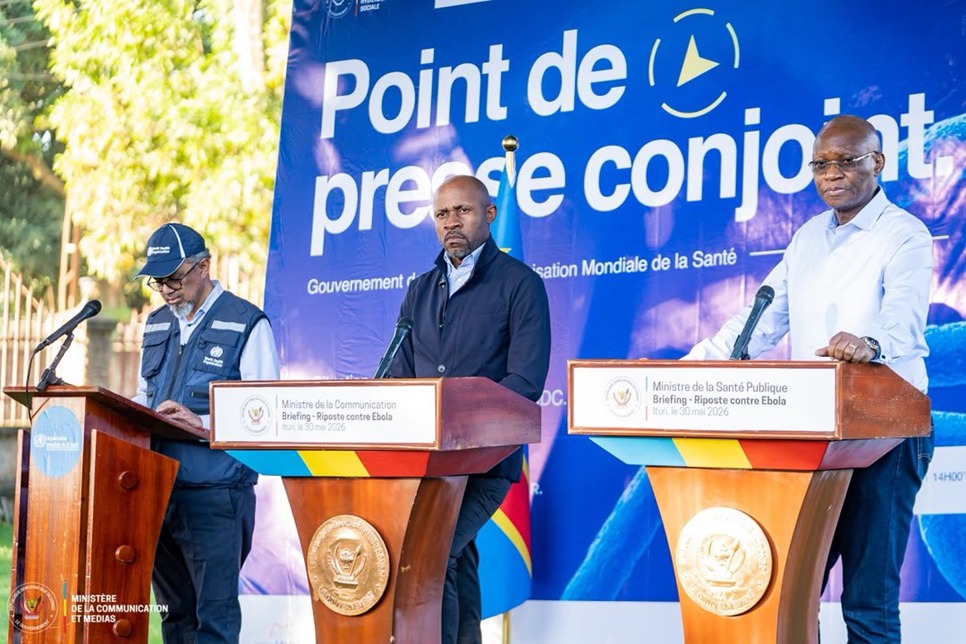
                      Faced with the 17th Ebola outbreak in Ituri and two other northeastern provinces of the DRC, the government is displaying cautious optimism. During a visit to Bunia alongside the Secretary-General of the World Health Organization (WHO) and the Minister of Communication and Media, Health Minister Roger Kamba estimated that the disease could be contained within four to six months thanks to a strengthened response, community engagement, and the support of international partners. Authorities are relying on a strategy aimed at containing the spread of the virus in the areas already affected in order to prevent its spread to other regions of the country.


                      Bunia, the epicenter of the 17th Ebola outbreak in the Democratic Republic of Congo, hosted a joint press conference on Saturday bringing together the Minister of Health, Roger Kamba, the Secretary-General of the World Health Organization (WHO), and the Minister of Communication and Media. During this meeting, health authorities reaffirmed their commitment to ending the outbreak through intensified response operations on the ground.

                      “Our goal is to control this epidemic and end it within four to six months. The best scenario is to manage to contain it in the three affected provinces,” said Roger Kamba.

                      According to the minister, several operational scenarios have been developed to adapt the health response to the evolving situation. The most favorable scenario involves limiting the spread of the virus to the provinces already affected to prevent its transmission to other regions of the country.

                      "The most favorable course of action is to contain the spread of the virus in the three provinces currently affected in order to prevent its extension to other parts of the country," he said.

                      A strengthened response with the support of the WHO

                      Congolese health authorities are confident about the evolution of the situation, while acknowledging the scale of the challenges ahead. Roger Kamba welcomed the support of the WHO and the international community, whose technical, logistical, and financial assistance is contributing to strengthening the response capacity.

                      The government intends to intensify epidemiological surveillance, early detection, patient care, and community awareness campaigns. These actions are considered essential to interrupting the chains of virus transmission.

                      On the ground, specialized teams are continuing investigations, identifying suspected cases, monitoring contacts, and deploying preventive measures in affected areas.

                      Community engagement at the heart of the strategy

                      For public health experts, the success of the response also depends on public support. The Director General of the National Institute of Biomedical Research (INRB), Professor Jean-Jacques Muyembe, emphasized the importance of community engagement in the fight against this new epidemic.

                      The epidemiologist believes that community involvement, already crucial during previous Ebola outbreaks, remains a key factor in improving early case detection, health surveillance, and risk communication.

                      Strengthening the network of community health workers is therefore among the priorities identified by health authorities and their partners.

                      Preventive measures remain in place

                      The World Health Organization recommends strict adherence to preventive measures to limit the risk of infection. These include regularly washing hands with soap and water or, failing that, using alcohol-based hand sanitizers.

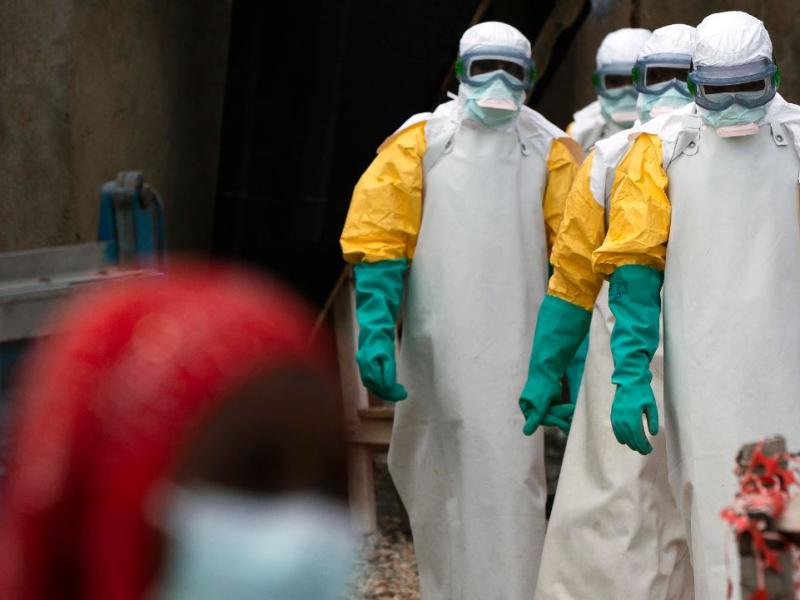
                      Healthcare workers and relatives of patients are urged to wear appropriate protective equipment, including gloves, masks, goggles, and protective clothing. The WHO also recommends avoiding all direct contact with the bodies of the deceased, with burials to be handled by specialized teams.

                      The DRC remains one of the countries most affected by Ebola epidemics since the virus was discovered in 1976 in Yambuku, in what is now Mongala province. This first epidemic recorded 318 cases and 280 deaths.

                      More recently, the Ebola Zaire outbreak between 2018 and 2020 in the Mangina, Beni, and Butembo regions caused more than 2,200 deaths. According to scientists at the INRB (National Institute of Biomedical Research), the strain currently circulating is genetically distinct from the previous Bundibugyo epidemics recorded in 2007 and 2012 and appears to have originated directly from an animal reservoir.

                      Info27

                      Face à la 17ᵉ épidémie d’Ebola qui sévit en Ituri et dans deux autres provinces du nord-est de la RDC, le gouvernement affiche un optimisme prudent. En déplacement à Bunia aux côtés du Secrétaire général de l’Organisation mondiale de la Santé (OMS) et du ministre de la Communication et Médias,...

                      Comment


                      • #42
                        Click image for larger version  Name:	image.png Views:	1 Size:	150.3 KB ID:	1036100
                        Screenshot
                        Audio in French:

                        6:24 PM · May 31, 2026
                        -----------------------------------------------------------------------------------------------------------
                        Translation Google

                        ​Ebola in the DRC: Muyembe estimates that the epidemic will not exceed 1,000 confirmed cases

                        Monday, June 1, 2026 - 09:15

                        Professor Jean-Jacques Muyembe sought to reassure on Sunday during the live Space organized by journalist Stanis Bujakera Tshiamala, stating that the ongoing Ebola epidemic in the DRC remains "a normal epidemic, like any other", with a "relatively low" mortality rate and a number of cases that falls within the trajectory of previous epidemics.

                        The Director General of the INRB specified that of the 900 suspected cases recorded since the beginning of the epidemic, approximately 290 have been confirmed in the laboratory, the only figures on which, according to him, the analysis should be based.

                        Cases that have not been tested but show epidemiological links with confirmed cases are classified as probable cases. "When we talk about Ebola, we are talking about confirmed cases, not suspected cases," he insisted.

                        Based on this assessment, Professor Muyembe estimated that the epidemic would not exceed one thousand confirmed cases. "We might reach three hundred, four hundred cases, but not one thousand," he stated, adding that a retrospective analysis could reveal that the epidemic began earlier than the officially recorded date, which would further qualify its apparent progression. Regarding the duration of the epidemic, "I'm not a prophet, but seeing what's happening on the ground, I think that if the surveillance pillar is strengthened, contact tracing is implemented so that we know exactly how this disease is transmitted, and confirmed cases are isolated, along with those who are sick and those who are suspected of having the disease. With the experience we have, we can contain this epidemic within two or three months."

                        Le professeur Jean-Jacques Muyembe s'est voulu rassurant dimanche lors du live Space organisé par le journaliste Stanis Bujakera Tshiamala, estimant que l'épidémie d'Ebola en cours en RDC reste « une ép

                        ---------------------------------------------------------------------------------
                        Ebola in the DRC: Muyembe demands that only laboratory-confirmed cases be counted.

                        Monday, June 1, 2026 - 1:34 PM

                        Professor Jean-Jacques Muyembe called on Sunday for strict methodological rigor in monitoring the Ebola epidemic, during Stanis Bujakera Tshiamala's live Space.

                        The Director General of the INRB insisted on the need to count only laboratory-confirmed cases, to the detriment of suspected cases which, according to him, risk "inflating the figures for nothing" and unnecessarily mobilizing teams on cases that may be related to malaria or typhoid fever.

                        With laboratories now deployed in the field, every suspected case must be sampled and confirmed without delay.

                        "It's the laboratory that will tell us: this is a confirmed case. And then it's over," he concluded.

                        He also argued for the establishment of a reliable epidemic curve, the only tool that makes it possible to precisely date the start of the epidemic and to track its actual evolution.​

                        Le professeur Jean-Jacques Muyembe a appelé dimanche à une rigueur méthodologique stricte dans le suivi de l'épidémie d'Ebola, lors du live Space de Stanis Bujakera Tshiamala.

                        Comment


                        • #43
                          Ebola disease outbreak in the Democratic Republic of the Congo and Uganda


                          As of 1 June 2026, the Ebola disease outbreak caused by Bundibugyo virus continues to affect the Democratic Republic of the Congo (DRC) and Uganda.

                          On 31 May, the DRC Ministry of Health published updated figures reporting a total of 282 confirmed cases, including 42 confirmed related deaths and 220 suspected cases that are under investigation. Ituri is the most affected province, with 264 confirmed cases from 14 health zones; 15 confirmed cases have been reported in North Kivu and three in South Kivu. Data are continuously reviewed and harmonised as cases are being laboratory confirmed.

                          Uganda has reported nine confirmed cases, including one death; at least three of these cases were linked to travel from DRC.

                          Although information remains limited, we assess the likelihood of infection for people living in the EU/EEA as very low. ECDC continues to monitor the situation closely and will update its assessment as new information becomes available.

                          A weekly update on this outbreak is available in the weekly communicable disease threats report

                          Areas affected by the ongoing Ebola disease outbreak

                          Click image for larger version

Name:	Screenshot 2026-06-01 at 2.22.06 PM.png
Views:	0
Size:	608.0 KB
ID:	1036131

                          ...https://www.ecdc.europa.eu/en/ebola-...ngo-and-uganda

                          Comment

                          Working...
                          X