Check out the FAQ,Terms of Service & Disclaimers by clicking the
link. Please register
to be able to post. By viewing this site you are agreeing to our Terms of Service and Acknowledge our Disclaimers.
FluTrackers.com Inc. does not provide medical advice. Information on this web site is collected from various internet resources, and the FluTrackers board of directors makes no warranty to the safety, efficacy, correctness or completeness of the information posted on this site by any author or poster.
The information collated here is for instructional and/or discussion purposes only and is NOT intended to diagnose or treat any disease, illness, or other medical condition. Every individual reader or poster should seek advice from their personal physician/healthcare practitioner before considering or using any interventions that are discussed on this website.
By continuing to access this website you agree to consult your personal physican before using any interventions posted on this website, and you agree to hold harmless FluTrackers.com Inc., the board of directors, the members, and all authors and posters for any effects from use of any medication, supplement, vitamin or other substance, device, intervention, etc. mentioned in posts on this website, or other internet venues referenced in posts on this website.
We are not asking for any donations. Do not donate to any entity who says they are raising funds for us.
Announcement
Collapse
No announcement yet.
First detection of Zika virus in neotropical primates in Brazil: a possible new reservoir.
Samples from sera and oral swabs from fifteen marmosets (Callithrix jacchus) and nine capuchin-monkeys (Sapajus libidinosus) captured in Ceara State in Brazil were tested for Zika virus. Samples were positive by Real time PCR and sequencing of the amplified product from a capuchin monkey showed 100% similarity to other ZIKV from South America. This is the first report on ZIKV detection among Neotropical primates.
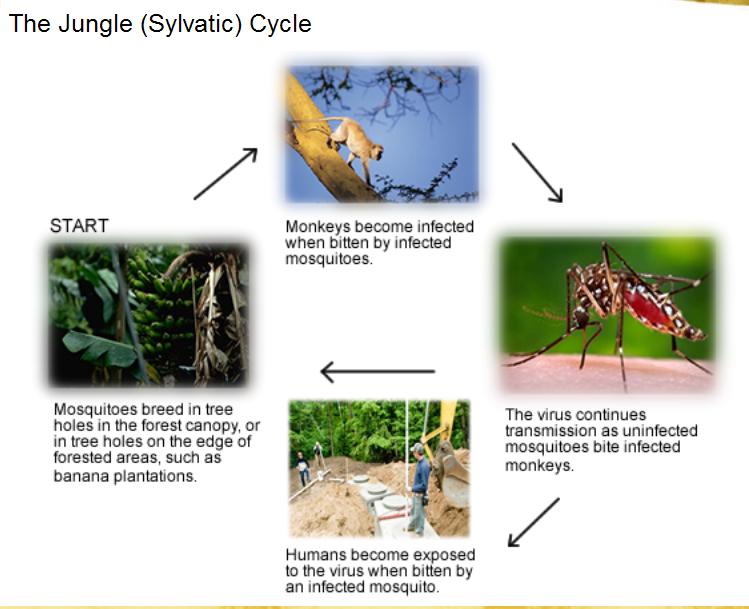
In Africa, where Zika originated, it was first isolated in a captive, sentinel rhesus monkey, which was being used for routine Yellow Fever surveillance. Like many arboviruses, the Zika and Yellow fever virus are often maintained in non-human animal reservoirs, like monkeys.
This cycle - where mosquitoes infect and carry the virus from non-human hosts, is called the Slyvatic (Jungle) cycle.
Arboviruses can also have an urban cycle, where no non-human host is required. We've seen this with Dengue, Chikungunya, and Zika in the Americas. It usually requires a fairly dense population of susceptible human hosts in order to sustain an outbreak.
In South and Central America, Yellow Fever has a Sylvatic cycle (Howler Monkeys), but so far it has been unknown whether Zika would find a suitable jungle reservoir host.
Today (h/t Greg Folkerson Twitter), we have a brief paper that suggests Zika may be finding a home in South American non-human primates.
Samples from sera and oral swabs from fifteen marmosets (Callithrix jacchus) and nine capuchin-monkeys (Sapajus libidinosus) captured in Ceara State in Brazil were tested for Zika virus. Samples were positive by Real time PCR and sequencing of the amplified product from a capuchin monkey showed 100% similarity to other ZIKV from South America. This is the first report on ZIKV detection among Neotropical primates.
From the full text:
We tested samples from sera and oral swabs from fifteen marmosets (Callithrix jacchus) and nine capuchin-monkeys (Sapajus libidinosus) captured (SISbio license 45196-3) from July to November of 2015 in Cear? State, an epidemic area for ZIKV.
Preliminary detection of these samples indicated 29% of positivity (7/24) by Real time PCR2 (Cycle Threshold Ct average 31,64 to 37,78). We found four positive samples from marmosets and three positive samples from capuchin monkeys.
Monkeys of Cear? have 1 diagnostic zika outside Africa
USP research was conducted with monkeys captured in North Board, Quixer?, St. Benedict and Guaraciaba do Norte
Monkeys infected zika virus were diagnosed for the first time outside Africa, by researchers at the University of S?o Paulo (USP). The animals were located in different regions of Cear?, between July and November 2015.
The discovery was made by a group of researchers from Cear? and S?o Paulo, in a partnership between the Pasteur Institute in S?o Paulo, the Institute of Biomedical Sciences, University of S?o Paulo (USP) and the Secretariat of Health of Cear? (SESA). The involvement of Sesa occurred through the Vector Control Center (Nuvet) and the regional coordinators of Health (Cres).
Preliminary results were published in the journal bioRxiv. The discovery shows that the disease may be more difficult to control than previously thought.
Tested positive for the virus zika four marmosets (soins) and three capuchin monkeys captured were caught in the Northern Board municipalities Quixer?, St. Benedict and Guaraciaba do Norte, between July and November 2015. They were diagnosed by PCR technique real time to detect the presence of virus in the animal's body.
Had been captured, in total, 15 soins nine capuchin monkeys, all in areas with zika notification and occurrence of microcephaly. Seven of them tested positive for zika. The animals tested have domestic habits or live close to humans.
Scientists captured marmosets and capuchin monkeys to study on anger, but just identifying the zika the samples.
Researchers must return to camp next month for tests in more monkeys and recapture some animals tested.
Splits
Scientists consider that animals have been infected by the virus transmitted by the mosquito Aedes aegypti from humans. The concern is the possibility that the virus be transmitted by wild animals to humans. The transmission chain, in this case, would be similar to that experienced with yellow fever.
Point of view
It is not out of malice, but for lack of information. In the last two years, unsuspecting visitors Coco Park started feeding soins (Calitrix jaccus). The story is already so habitual that, on Sundays, some bands come to the edge of the forest waiting for food. It is easy to see that the track Azeitoneiras and track the main park entrance. There are risks in this attitude that is becoming usual to human and marmosets. The newest concern is the finding of researchers at USP on the infection of monkeys by zika in Cear?. Probably infected animals caught the disease because of the proximity to people. For having born in disturbed forests, they were feeding people or have custom of eating and drinking in residential areas. It's fun to feed the soins, but it can be risky for man and beast. Small primates, in addition to diseases that can spread - and anger - and getting other humans, can get used to and stop, of course, get in the forest. The Coco, even in an advanced state of atropiza??o also takes care of various species. The management of the park, after alerted, put plates guiding the ban. But it does not help much. Worth a campaign without panic, but incisive as warnings not inhibited.

 Tweet
Tweet




Comment