Announcement

Collapse
No announcement yet.

France - Covid-19 2025

Collapse
X
 
  • Filter
  • Time
  • Show
Clear All
new posts

  • France - Covid-19 2025

    Translation Google

    "An epidemic resurgence": more than 26,000 new cases of Covid-19 in September, a variant identified

    by Emma ALLAMAND
    Published on September 24, 2025 at 10:49 a.m.

    Source: The Morning Show

    Autumn is synonymous with a resurgence of viruses.

    At the beginning of September, more than 26,000 new cases of Covid-19 were recorded, according to Public Health France.

    A new wave of Covid-19 has been detected. And with it, a new variant. While virus activity remains low, cases are increasing day by day. "We're at about ten cases per day, with a positivity rate on the tests we're carrying out that's almost 20% ," noted Dr. Jean-Luc Dinet, general practitioner and president of SOS Médecin Sens, on LCI, Wednesday, September 24. "We noticed that the children who tested positive were not very symptomatic. And now, for the past week, we've had young adults arriving, so the 20-40 age group, with much more severe symptoms, which are really flu-like symptoms," he explained.

    Video (in French):

    [VIDÉO] L'automne est synonyme de recrudescence des virus. Début septembre, plus de 26.000 nouveaux cas de Covid-19 ont été recensés, selon Santé publique France. - "Une reprise épidémique" : plus de 26.000 nouveaux cas de Covid-19 en septembre, un variant identifié (Santé et bien être).

    ---------------------------------------------------
    “A new variant that evades the immune system”: should we expect a rebound in the Covid epidemic this fall?

    According to Public Health France, suspected cases of Covid increased by 37% among adults during the week of September 15 to 21, 2025.

    Guillaume Dosda
    published on 09/24/2025 at 4:00 p.m.

    Does the start of autumn mean a return of the Covid-19 epidemic in France? According to figures from Public Health France , suspected coronavirus infections continue to rise among adults, with a 37% increase (i.e., 375 emergency room visits and hospitalizations) for the week of September 15 to 21, 2025. The previous week, the increase was already 29%.

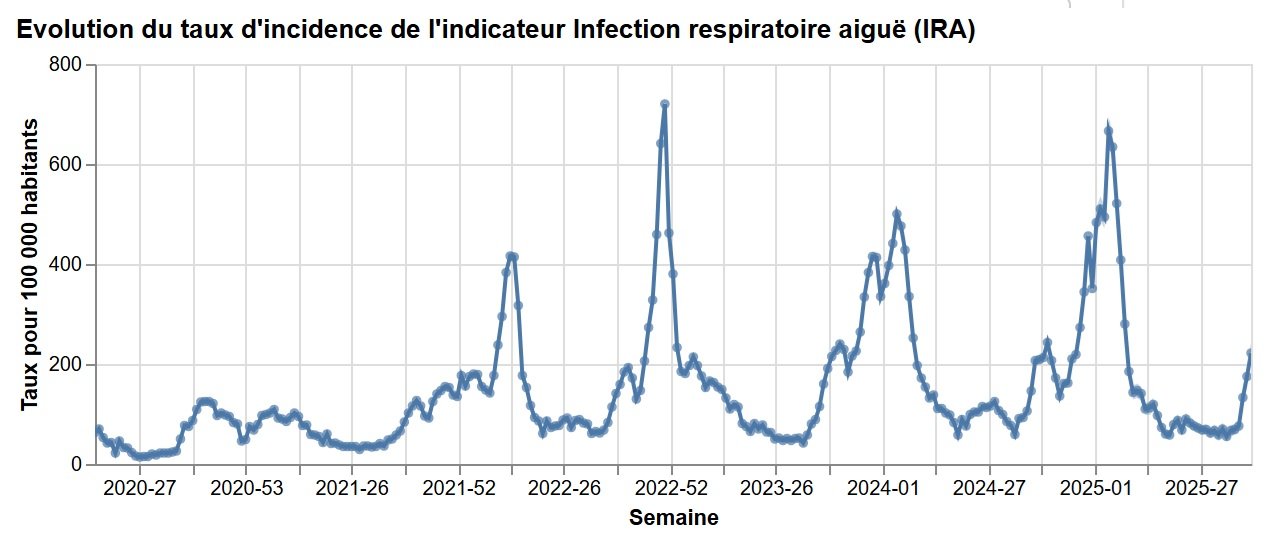
    Furthermore, according to data from the Sentinelles network , the epidemiological surveillance and research platform in general medicine, the incidence rate of Covid-19 cases seen in general medicine consultations for an acute respiratory infection was estimated at 48 cases per 100,000 inhabitants in France.

    This new wave of Covid-19 would arrive with a new variant "that escapes the immune system ," Benjamin Davido, epidemiologist at the Raymond-Poincaré Hospital in Garches, told TF1 Info . Officially called "XFG" or "Stratus," it is also nicknamed "Frankenstein" because it is the result of the hybridization of several strains of the virus.

    As such, a vaccination campaign against influenza and Covid-19 must take place between October 14 and January 31 , 2026. The first orders for Covid-19 vaccines have been open since Monday, September 22 on the Public Health France portal.



  • #2
    Translation Google

    “Covid always starts again in September”: what you need to know about the epidemic’s resurgence


    Positivity rates, circulation in wastewater, visits to emergency rooms... The epidemic has largely started to rise again, while a vaccination campaign is due to begin on October 14.

    By Nicolas Berrod
    September 26 , 2025 at 3:05 p.m.

    The trend is clear: upward! For at least two months, all Covid indicators have been climbing. The increase is now clear, according to the latest data from Public Health France, published this Wednesday.

    In city laboratories, more than one in four tests is now positive. And in emergency rooms, more than 2,000 patients were treated for suspected Covid last week, compared to around 500 in the height of summer. Here's what you need to know.

    Why is the epidemic starting again?

    SARS-CoV-2 circulates year-round , including in the summer when other respiratory viruses (influenza, respiratory syncytial virus, etc.) are at a standstill. And at times, as our immunity wanes and the virus becomes increasingly easy to infect us, the epidemic flares up again. This pattern has remained unchanged for the past five years, although the frequency and intensity of the waves have changed.

    "Since 2020, the virus has been stubborn and always starts up again in September. This often coincides with the start of the school year, perhaps because there are more contacts," says epidemiologist Dominique Costagliola, emeritus research director at Inserm. "We would have been surprised if it were the opposite, that is, if there was no epidemic resurgence, because we have in no way eradicated SARS-CoV-2," pointed out epidemiologist Antoine Flahault, director of the Geneva Institute of Global Health, at the beginning of September .

    Are the symptoms different from previous times?

    The arrival of the Omicron variant at the end of 2021 changed the symptoms experienced in the event of Covid infection: less often loss of taste and smell, but more cough, sore throat, and runny nose. Since then, as hundreds and hundreds of new "cousins" within this large Omicron family have appeared, it is difficult to say whether the clinical signs of infection have evolved further.

    "Very few people are reliably diagnosed positive using a PCR test, so we don't have good data to compare symptoms and their severity over time," points out Dominique Costagliola. One thing is certain: thanks to our immunity, due to vaccinations but also to past infections, severe forms are much less numerous than at the very beginning.

    Should we get (re)vaccinated?

    As every year since 2022, a vaccination campaign against Covid and the flu is due to begin from mid-October ( October 14th to be precise this year ) for vulnerable people. Both injections are offered at the same time, one in each arm, for practical reasons. Except that the Covid peak could be well past by then!

    Since the beginning of September, the Ministry of Health has been telling us that it could bring forward the launch to the beginning of October "if Public Health France were to detect significant transmission of SARS-CoV-2 at the end of September." We are there, but there are no plans to accelerate it, despite the figures provided by this same agency.

    Comment


    • #3
      Translation Google

      "Frankenstein" Variant, Cases on the Rise... Should We Expect a Major Covid-19 Epidemic This Fall?

      Florent Bascoul
      Today at 6:08 AM

      An increasing number of patients are presenting to hospitals or doctors with suspected Covid-19 infections. While a resurgence of the epidemic is noticeable, experts are not alarmed but are advocating prevention.

      Covid -19 is rearing its ugly head again. Several indicators show that the virus has been spreading increasingly in France since the end of the summer.

      For example, the Sentinelles network , which relies on 1,300 private doctors, noted an incidence rate of 48 cases per 100,000 inhabitants during the week of September 15 to 21. "Subject to future consolidation of the data, this rate is increasing for the second consecutive week and is at a moderate level of activity," the network specifies.

      A similar trend is observed in hospitals. According to data cross-referenced by Public Health France , the number of adult admissions for suspected Covid-19 increased by 37% during the same week.

      Finally, samples sent to laboratories for testing are returning positive in more than 20% of cases. "We have seen a doubling of the figures since July, and this is also reflected in other assessment tools such as wastewater monitoring," notes Professor Olivier Schwartz , director of the Virus and Immunity Unit at the Pasteur Institute.

      "Will it be a more or less pronounced wave? It's difficult to say at the moment. We can see that this is the case in many countries like the United States, where they experienced a wave earlier this summer, with up to 600,000 new cases diagnosed per day. The peak has been reached since the numbers have dropped. It's less pronounced than last year," adds the virologist.

      "Rapid" growth of the so-called "Frankenstein" variant

      One of the difficulties in anticipating the intensity of the epidemic resurgence lies in the circulation of new variants such as "XFG", which quickly gained popularity with its nickname "Frankenstein" . It inherited this nickname because scientists observed that it was a hybridization of the omicron variant.

      "It is characterized by a relative decrease in its sensitivity to neutralization by antibodies, and as the number of antibodies decreases in people who have been infected or vaccinated, the virus will be able to continue to spread, it does not disappear," illustrates Olivier Schwartz.

      According to the World Health Organization (WHO), "XFG is growing rapidly compared to co-circulating variants globally." It notably spread in Asia in April and May, with a rapid increase from 2.5% of strains to 11%. In Canada and Europe, the variant is also progressing. "We are at just over 25% of the presence of this variant today."

      Expert assessments were conducted in June 2025 in Southeast Asia, where it was discovered. "The report stated that there was no clear signal of severity observed, no more deaths, no more critical forms. They decided that ultimately, monitoring would be carried out closely but assessed the overall risk as low," our health consultant and doctor, Aurel Guedj, explained on BFMTV this Monday.

      For the Pasteur Institute professor, there is no cause for concern, but we must remain vigilant. "For the moment, there is nothing alarming, but we must remain vigilant."

      Un nombre croissant de patients se présente à l'hôpital ou chez leur médecin pour des suspicions d'infections au Covid-19. Si une reprise épidémique est perceptible, les experts ne s'alarment pas mais prônent la prévention.

      Comment


      • #4
        Translation Google

        The Pasteur Institute

        The Research Journal

        Covid-19: Should we be worried as the Frankenstein variant circulates?

        News
        03.10.2025

        Epidemiological news


        While the SARS-CoV-2 virus is still circulating, epidemic waves are still possible in France and around the world, less intense but persistent. In September 2025, the Frankenstein variant, a less virulent sub-variant of Omicron, will be circulating. Where are we with Covid-19 in France? Interview with Olivier Schwartz, head of the Virus and Immunity Unit at the Pasteur Institute.

        According to Public Health France , suspected cases of Covid increased by 37% among adults during the week of September 15 to 21, 2025 in metropolitan France, slightly decreasing among children, and circulation remains low in French Guiana and the Antilles . The circulation of SARS-CoV-2 is therefore increasing, but remains at reasonable levels. Above all, the XFG variant in circulation is described as more contagious but no more dangerous than its predecessors: it is also called "Frankenstein" because it results from the hybridization of two sub-variants of the Omicron virus.

        SARS-CoV-2 therefore continues to circulate, driven by the regular emergence of new variants resulting from mutations that allow it to partially evade our immunity. Vaccination and the application of barrier measures remain essential, particularly for those at risk, while careful global surveillance remains essential to prevent the emergence and spread of new variants of concern.
        Olivier Schwartz, head of the Virus and Immunity Unit at the Pasteur Institute, discusses with us the questions raised by the increase in suspected cases of Covid.


        Olivier Schwartz (photo credit: Pasteur Institute)

        #1. Why does Covid-19 continue to appear in waves, each year at roughly the same time? Will Covid-19 become a strictly seasonal illness, like the flu?

        Olivier Schwartz: SARS-CoV-2 is still circulating, with seasonal resurgences similar to those of the flu. The virus's current characteristic is that it maintains a "background circulation" throughout the year, unlike the more strictly winter flu. As long as partial immunity remains in the population, risk situations will be concentrated among the most vulnerable.

        There is, however, a decrease in the number of cases and severe forms in general, notably thanks to acquired immunity due to vaccination coverage and past infections.


        This graph shows the evolution in France of the weekly rate of confirmed cases of Covid-19 per 100,000 inhabitants during the surveillance period. ( Source: Sentinelles )

        Several factors explain this persistence:
        • The virus mutates continuously, allowing it to partially escape immunity;
        • Antibody levels decline over time, both after infection and vaccination;
        • Winter conditions favor transmission (external temperatures, humidity, closed windows).
        #2. How do SARS-CoV-2 mutations work? How do these new variants appear?

        OS: Like all RNA viruses, SARS-CoV-2 mutates regularly. Most mutations are ineffective or hinder the virus, but a few give it an "advantage," allowing it to spread. The mutations that will give rise to what are called "variants" occur in particular in the Spike protein (the main target of vaccines and neutralizing antibodies). These variants are characterized by a better ability to infect our cells and bypass our immune defenses.

        The most likely scenario is that of "endemicity," with what is also called "low-level" circulation, sometimes with small waves. But the emergence of a new, very different variant that is less susceptible to herd immunity cannot be completely ruled out.

        The majority of mutations appear as the virus circulates, but more virulent variants could emerge particularly in fragile or immunocompromised individuals (for example, elderly patients, or those with serious illnesses, or those infected with HIV and not receiving treatment), in whom the virus persists longer and has time to mutate. This dynamic explains the importance of closely monitoring these fragile individuals, particularly in developing countries. In the United States, the reduction in funds allocated to the treatment and fight against HIV-AIDS will cause an increase in the number of people infected with HIV and could therefore increase the risk of the emergence of new variants. (read the article in Le Monde - HIV: hundreds of specialists alert the United States to the "catastrophic" effect of budget cuts ).

        As for the new variants currently circulating, including the one called Frankenstein, they are relatively close genetically. But the Frankenstein moniker seems exaggerated. There is no evidence so far to suggest that this virus is more dangerous than previous variants.


        #3. Are vaccines still effective?

        OS: Today, most infections are less severe, especially in younger people or those without significant risk factors, and vaccination or previous infections contribute significantly. However, immunity declines over time, even if protection against severe forms remains significant. Hence the importance – as with the flu – of regularly updating vaccine compositions and targeting the most vulnerable people (over 65, people with comorbidities or immunocompromised people, etc.) for annual boosters. Vaccines adapted to variants are available every year.

        #4 What are the recommendations for dealing with Covid-19?

        OS: To weaken the chain of transmission of the virus, as with any respiratory infection, it is necessary to follow the recommendations of the health authorities, in particular:
        • Isolate yourself as much as possible if you are infected or sick;
        • People with risk factors are urged to be (re)vaccinated;
        • Ventilate your home, workplace or collective space regularly;
        • Maintain barrier gestures, particularly in the event of a positive test and/or symptoms: regular hand washing, wearing a mask in enclosed spaces
        • Follow the vaccination recommendations of health authorities.
        ...
        Alors que le virus SARS-CoV-2 circule toujours, des vagues épidémiques sont encore possibles en France et partout dans le monde, moins intenses mais persistantes. En septembre 2025, c’est le variant Frankenstein qui circule, un sous-variant d’Omicron, peu virulent. Où en sommes-nous avec le Covid-19 en France ? Entretien avec Olivier Schwartz, responsable de l’unité Virus et immunité, à l’Institut Pasteur.


        Comment


        • #5
          Translation Google

          Covid is not circulating enough to advance vaccination, health authorities say

          By AFP on 07.10.2025 at 5:33 p.m.
          .
          The resurgence of Covid-19 cases, which has been noticeable in France for several weeks, is not significant enough to bring forward the launch of the vaccination campaign scheduled for mid-October, health authorities said on Tuesday, calling for people to avoid "panic" in the face of a new variant.

          "There's nothing abnormal, we're actually lower than what we saw at the same time last year," explained Caroline Semaille, Director General of Public Health France, during a video conference dedicated to measures to combat autumn-winter respiratory epidemics such as the flu, Covid, and bronchiolitis.

          For several weeks, Covid has been showing signs of resurgence in France, with an increase in consultations and a growing presence of the virus in wastewater. But the data does not appear to indicate a surge.

          "In wastewater, things are starting to stabilize," reported Ms. Semaille, noting, however, that we are starting to "see a little more visits to the emergency room and possibly hospitalizations." A new weekly report will be released this Wednesday.

          The vaccination campaign against this disease will begin as planned on October 14, to be coupled with the one against the flu, the health authorities believing that there is no urgency to accelerate the fight against Covid.

          "We did not have the epidemiological arguments to change the launch date of October 14," assured Didier Lepelletier, Director General of Health, responsible for vaccination campaigns.

          Mr. Lepelletier also urged not to worry about the emergence since this summer of a variant, dubbed XFG and the latest avatar of the great Omicron family. Sometimes nicknamed "Frankenstein," particularly on social media, it appears potentially more contagious but not more dangerous at this stage.

          "Don't panic, the available vaccine is effective against this strain (and) there will be no immune escape linked to this particular strain," said the Director General of Health.

          Representatives from Public Health France and the Ministry of Health have, above all, strongly encouraged people to get vaccinated against both Covid and the flu, which was particularly virulent last season with more than 17,000 estimated deaths.

          Around 19 million people are considered at risk of developing severe forms of these two respiratory diseases, particularly those over 65, many chronically ill people, and pregnant women, and are eligible for a free flu vaccine. The Covid vaccine is fully reimbursed for all French citizens.

          Comment

          Working...
          X