
 Tweet
Tweet
Mystery in Japan as dangerous streptococcal infections soar to record levels
Health officials racing to identify cause of rise in streptococcal toxic shock syndrome, which has a 30% fatality rate
Justin McCurry in Tokyo
Thu 14 Mar 2024 21.05 EDT
...
The number of cases in 2024 is expected to exceed last year’s record numbers, while concern is growing that the harshest and potentially deadly form of group A streptococcal disease – streptococcal toxic shock syndrome (STSS) – will continue to spread, after the presence of highly virulent and infectious strains were confirmed in Japan.
The National Institute of Infectious Diseases (NIID) said: “There are still many unknown factors regarding the mechanisms behind fulminant (severe and sudden) forms of streptococcus, and we are not at the stage where we can explain them.”
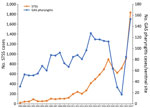
Provisional figures released by the NIID recorded 941 cases of STSS were reported last year. In the first two months of 2024, 378 cases have already been recorded, with infections identified in all but two of Japan’s 47 prefectures.
While older people are considered at greater risk, the group A strain is leading to more deaths among patients under 50, according to NIID. Of the 65 people under 50 who were diagnosed with STSS between July and December in 2023, about a third, or 21, died, the Asahi Shimbun newspaper reported..
...
Ken Kikuchi, a professor of infectious diseases at Tokyo Women’s Medical University, says he is “very concerned” about the dramatic rise this year in the number of patients with severe invasive streptococcal infections.
He believes the reclassification of Covid-19 was the most important factor behind the increase in streptococcus pyogenes infections. This, he added, had led more people to abandon basic measures to prevent infections, such as regular hand disinfection.
“In my opinion, over 50% Japanese people have been infected by Sars-CoV-2 [the virus that causes Covid-19],” Kikuchi tells the Guardian. “People’s immunological status after recovering from Covid-19 might alter their susceptibility to some microorganisms. We need to clarify the infection cycle of severe invasive streptococcal pyogenes diseases and get them under control immediately.”
...
Health officials racing to identify cause of rise in streptococcal toxic shock syndrome, which has a 30% fatality rate
Justin McCurry in Tokyo
Thu 14 Mar 2024 21.05 EDT
...
The number of cases in 2024 is expected to exceed last year’s record numbers, while concern is growing that the harshest and potentially deadly form of group A streptococcal disease – streptococcal toxic shock syndrome (STSS) – will continue to spread, after the presence of highly virulent and infectious strains were confirmed in Japan.
The National Institute of Infectious Diseases (NIID) said: “There are still many unknown factors regarding the mechanisms behind fulminant (severe and sudden) forms of streptococcus, and we are not at the stage where we can explain them.”
Provisional figures released by the NIID recorded 941 cases of STSS were reported last year. In the first two months of 2024, 378 cases have already been recorded, with infections identified in all but two of Japan’s 47 prefectures.
While older people are considered at greater risk, the group A strain is leading to more deaths among patients under 50, according to NIID. Of the 65 people under 50 who were diagnosed with STSS between July and December in 2023, about a third, or 21, died, the Asahi Shimbun newspaper reported..
...
Ken Kikuchi, a professor of infectious diseases at Tokyo Women’s Medical University, says he is “very concerned” about the dramatic rise this year in the number of patients with severe invasive streptococcal infections.
He believes the reclassification of Covid-19 was the most important factor behind the increase in streptococcus pyogenes infections. This, he added, had led more people to abandon basic measures to prevent infections, such as regular hand disinfection.
“In my opinion, over 50% Japanese people have been infected by Sars-CoV-2 [the virus that causes Covid-19],” Kikuchi tells the Guardian. “People’s immunological status after recovering from Covid-19 might alter their susceptibility to some microorganisms. We need to clarify the infection cycle of severe invasive streptococcal pyogenes diseases and get them under control immediately.”
...








Comment