
 Tweet
Tweet
Epidemiological Alert: Oropouche in the Region of the Americas, 2 February 2024
Format Situation Report Sources
Posted 3 Feb 2024 Originally published 2 Feb 2024 Origin View original
In recent months, there has been an increase in the detection of cases of Oropouche fever in certain areas of the Region of the Americas. In addition, there is a heightened prevalence of dengue circulation reported in several countries in the region. In response to this, the Pan American Health Organization / World Health Organization (PAHO/WHO) shares with Member States recommendations for the differential diagnosis of the Oropouche virus and recommends strengthening vector control and personal protection measures for the population most at risk.
Background in the Region of the Americas
In the Americas, numerous outbreaks of Oropouche virus disease (OROV) have been reported in rural and urban communities in Brazil, Ecuador, French Guiana, Panama, Peru, and Trinidad and Tobago (1). In most of these outbreaks, people of both sexes and of all ages were affected. In populations with previous contact with the virus, children and young people were most affected (1).
The circulation of the Oropouche virus is suspected to include both epidemic and jungle cycles. In the jungle cycle, primates, sloths, and perhaps birds are vertebrate hosts, although no definitive arthropod vector has been identified. In the urban epidemic cycle, humans are the amplifying host and OROV is transmitted mainly through the bite of the Culicoides paraensis mosquito that is present in the region, as well as Culex quinquefasciatus, which can also be a vector (1,2,3).
Outbreaks of Oropouche virus in the last ten years have taken place mainly in the Amazon region.
Current situation
In Brazil, on 6 January 2024, the Health Surveillance Foundation (FVS as per its acronym in Portuguese) of the state of Amazonas published an epidemiological alert regarding the detection of cases of Oropouche virus (OROV) disease in this state. The alert reported that between December 2023 and 4 January 2024, the Central Public Health Laboratory of Amazonas (Lacen-AM as per its acronym in Portuguese) analyzed 675 samples, confirming OROV virus infection by molecular detection (PCR) in 199 (29.5%). Of this total, 94.9% (189) correspond to the municipality of Manaus, 2.5% (5) to the municipality of Presidente Figueiredo, 1% (2) to Maués, 1% (2) to Tefé and 0.5% (1) to Manacapuru (4).
Between 2023 and 2024, in the state of Amazonas, 1,066 human cases with detectable results in the RT-qPCR for Oropouche virus were registered. Of these, 699 samples were from Manaus, 88 from Maués, 69 from Iranduba, 36 from Manacapuru, 32 from Presidente Figueredo, 29 from Parintins, 22 from Carauari, 21 from Itacoatiara, 17 from Rio Preto da Eva, 09 from Careiro, 08 of Borba and Coari, 06 of Novo Airão and Tefé. There is record of transmission in the municipalities of Alvares, Autazes, Barreirinha, Benjamin Constant, Beruri, Boa Vista do Ramos, Caapiranga, Canutama, Cordeiro da Várzea, Itamarati, Lábrea, Nova Olinda do Norte, Novo Aripuanã, São Paulo de Olivença, Tabatinga, and Tapauá (5).
In addition, cases of OROV reported in the states of Acre and Roraima are under investigation.
In Colombia, through a study published on 8 December 2022, conducted by the National University of Colombia, 87 cases of Oropouche virus disease occurred between 2019 and 2021 in four cities in the country: Cúcuta (3 cases), Cali (3 cases), Leticia (43 cases) and Villavicencio (38 cases) which were identified through retrospective laboratory analysis of samples from cases of acute febrile illness. The cases were confirmed using different serological, molecular and metagenomic sequencing techniques at the One Health Genomic Laboratory of the National University of Colombia Medellín Campus and their results were corroborated by the National Reference Laboratory of the National Institute of Health in 2023. Regarding the characterization of the cases, 35.6% (n=31) correspond to the 18-29 age group, 52% (n=45) are men, and 91.2% (n=80) of the cases correspond to samples collected in 2021 (6.7).
In Peru, from 2016 to 2022, 94 cases of Oropouche were reported in 6 departments of the country: Madre de Dios, Cusco, San Martín, Cajamarca, Loreto and Ayacucho. In 2022, 8 cases were reported. Of the total accumulated cases, 45% occurred in 2016, the year with the highest cumulative incidence rate of 0.14 cases per 100,000 population, with outbreaks reported in Madre de Dios, Cusco and Ayacucho (8).
Format Situation Report Sources
Posted 3 Feb 2024 Originally published 2 Feb 2024 Origin View original
 Download Report(PDF | 420.83 KB)
In recent months, there has been an increase in the detection of cases of Oropouche fever in certain areas of the Region of the Americas. In addition, there is a heightened prevalence of dengue circulation reported in several countries in the region. In response to this, the Pan American Health Organization / World Health Organization (PAHO/WHO) shares with Member States recommendations for the differential diagnosis of the Oropouche virus and recommends strengthening vector control and personal protection measures for the population most at risk.
Background in the Region of the Americas
In the Americas, numerous outbreaks of Oropouche virus disease (OROV) have been reported in rural and urban communities in Brazil, Ecuador, French Guiana, Panama, Peru, and Trinidad and Tobago (1). In most of these outbreaks, people of both sexes and of all ages were affected. In populations with previous contact with the virus, children and young people were most affected (1).
The circulation of the Oropouche virus is suspected to include both epidemic and jungle cycles. In the jungle cycle, primates, sloths, and perhaps birds are vertebrate hosts, although no definitive arthropod vector has been identified. In the urban epidemic cycle, humans are the amplifying host and OROV is transmitted mainly through the bite of the Culicoides paraensis mosquito that is present in the region, as well as Culex quinquefasciatus, which can also be a vector (1,2,3).
Outbreaks of Oropouche virus in the last ten years have taken place mainly in the Amazon region.
Current situation
In Brazil, on 6 January 2024, the Health Surveillance Foundation (FVS as per its acronym in Portuguese) of the state of Amazonas published an epidemiological alert regarding the detection of cases of Oropouche virus (OROV) disease in this state. The alert reported that between December 2023 and 4 January 2024, the Central Public Health Laboratory of Amazonas (Lacen-AM as per its acronym in Portuguese) analyzed 675 samples, confirming OROV virus infection by molecular detection (PCR) in 199 (29.5%). Of this total, 94.9% (189) correspond to the municipality of Manaus, 2.5% (5) to the municipality of Presidente Figueiredo, 1% (2) to Maués, 1% (2) to Tefé and 0.5% (1) to Manacapuru (4).
Between 2023 and 2024, in the state of Amazonas, 1,066 human cases with detectable results in the RT-qPCR for Oropouche virus were registered. Of these, 699 samples were from Manaus, 88 from Maués, 69 from Iranduba, 36 from Manacapuru, 32 from Presidente Figueredo, 29 from Parintins, 22 from Carauari, 21 from Itacoatiara, 17 from Rio Preto da Eva, 09 from Careiro, 08 of Borba and Coari, 06 of Novo Airão and Tefé. There is record of transmission in the municipalities of Alvares, Autazes, Barreirinha, Benjamin Constant, Beruri, Boa Vista do Ramos, Caapiranga, Canutama, Cordeiro da Várzea, Itamarati, Lábrea, Nova Olinda do Norte, Novo Aripuanã, São Paulo de Olivença, Tabatinga, and Tapauá (5).
In addition, cases of OROV reported in the states of Acre and Roraima are under investigation.
In Colombia, through a study published on 8 December 2022, conducted by the National University of Colombia, 87 cases of Oropouche virus disease occurred between 2019 and 2021 in four cities in the country: Cúcuta (3 cases), Cali (3 cases), Leticia (43 cases) and Villavicencio (38 cases) which were identified through retrospective laboratory analysis of samples from cases of acute febrile illness. The cases were confirmed using different serological, molecular and metagenomic sequencing techniques at the One Health Genomic Laboratory of the National University of Colombia Medellín Campus and their results were corroborated by the National Reference Laboratory of the National Institute of Health in 2023. Regarding the characterization of the cases, 35.6% (n=31) correspond to the 18-29 age group, 52% (n=45) are men, and 91.2% (n=80) of the cases correspond to samples collected in 2021 (6.7).
In Peru, from 2016 to 2022, 94 cases of Oropouche were reported in 6 departments of the country: Madre de Dios, Cusco, San Martín, Cajamarca, Loreto and Ayacucho. In 2022, 8 cases were reported. Of the total accumulated cases, 45% occurred in 2016, the year with the highest cumulative incidence rate of 0.14 cases per 100,000 population, with outbreaks reported in Madre de Dios, Cusco and Ayacucho (8).

:quality(80)/outremer%2F2019%2F10%2F03%2F5d95b4831555e_dengue_1.jpg)





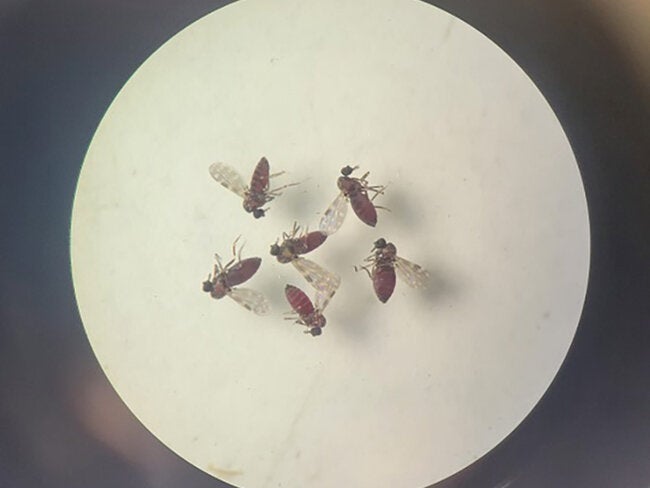
 Culicoides paraenses. (Photos: Bruna Lais Sena do Nascimento, Laboratório de Entomologia Médica/SEARB/IEC.)
 Culicoides paraensis (smaller one in the photo) and Culex quinquefasciatus (larger one in the photo)
 Culicoides paraenses.




Comment