
 Tweet
Tweet
Salmonella
New! Learn more about Salmonella:
Salmonellosis is an infection with bacteria called Salmonella. Most persons infected with Salmonella develop diarrhea, fever, and abdominal cramps 12 to 72 hours after infection. The illness usually lasts 4 to 7 days, and most persons recover without treatment. However, in some persons, the diarrhea may be so severe that the patient needs to be hospitalized. More ?
General Information
Salmonella Outbreaks
More
Report a Foodborne Illness
Reports and Publications
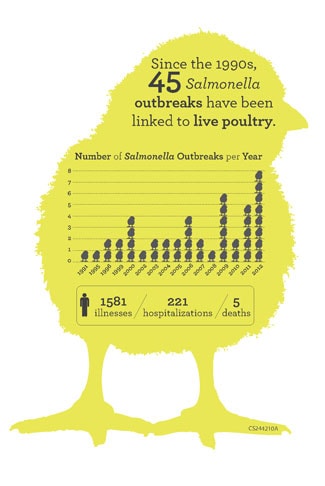
Click image to go to printable version [PDF - 551 KB]
Contact Us:

New! Learn more about Salmonella:
- Stay safe in the lab! What You Work With Can Make You Sick [PDF - 1 page]
- Digital Press Kit: Multistate Outbreaks of Human Salmonella Infections Linked to Small Turtles
- Food Safety and Raw Milk
- Salmonella is a Sneaky Germ: Seven Tips for Safer Eating
Salmonellosis is an infection with bacteria called Salmonella. Most persons infected with Salmonella develop diarrhea, fever, and abdominal cramps 12 to 72 hours after infection. The illness usually lasts 4 to 7 days, and most persons recover without treatment. However, in some persons, the diarrhea may be so severe that the patient needs to be hospitalized. More ?
General Information
- What is Salmonellosis?
- Diagnosis and Treatment
- Technical Information
- Prevention
- Additional Information
Salmonella Outbreaks
- Multistate Outbreak of Salmonella Montevideo and Salmonella Mbandaka Infections Linked to Tahini Sesame Paste
- Multistate Outbreaks of Human Salmonella Infections Linked to Small Turtles
- Multistate Outbreak of Human Salmonella Typhimurium Infections Linked to Live Poultry
More
Report a Foodborne Illness
Reports and Publications
Click image to go to printable version
[PDF - 551 KB] Contact Us:
- Centers for Disease Control and Prevention
1600 Clifton Rd
Atlanta, GA 30333 - 800-CDC-INFO
(800-232-4636)
TTY: (888) 232-6348 - Contact CDC?INFO
- Page last reviewed: May 22, 2013
- Page last updated: June 27, 2013
- Content source: Centers for Disease Control and Prevention
National Center for Emerging and Zoonotic Infectious Diseases (NCEZID)
Division of Foodborne, Waterborne, and Environmental Diseases (DFWED)

 Salmonella can contaminate more than poultry and eggs. It sneaks its way into many foods? ground beef, pork, tomatoes, sprouts?even peanut butter. Learn what you can do to make your food safer to eat.
 Salmonella is a bacteria and a common cause of foodborne illness, sometimes called "food poisoning." In the past few years, large outbreaks of illness caused by Salmonella-contaminated eggs and peanut products have made the headlines. Although many other foodborne illnesses have declined in the past 15 years, Salmonella infections have not declined at all. A new
  Salmonella illness can sometimes be serious. In most cases, illness lasts 4?7 days, and most people recover without antibiotic treatment. But, in rare cases, people may become seriously ill. Compared with other foodborne germs, Salmonella is the deadliest. It also causes more hospitalizations as well.
 You can get Salmonella from perfectly normal-looking eggs.
 You can keep you and your family safer by remembering to:

Comment