Announcement

Collapse
No announcement yet.

Pakistan: 2022 Dengue

Collapse
X
 
  • Filter
  • Time
  • Show
Clear All
new posts

  • #16
    Source: https://english.news.cn/20221005/c84...9405ea7/c.html

    Rise in dengue fever cases continues in Pakistan
    Source: Xinhua
    Editor: huaxia
    2022-10-05 14:02:17

    ISLAMABAD, Oct. 5 (Xinhua) -- The rise in dengue fever cases continued in Pakistan amid an outbreak due to floods triggered by heavy monsoon rains in the South Asian country.

    In the last 24 hours, 385 more people were diagnosed with the disease in the northwestern Khyber Pakhtunkhwa province, the provincial health department reported on Tuesday night. The number of active cases in the province currently stands at 2,314 and the total number of cases this year has reached 9,921.

    The southern Sindh province reported 336 new infections, said the provincial health department on Tuesday evening. The worst-hit area was Karachi, the provincial capital, which reported 264 new cases.

    The total number of cases this year in the province has reached 11,142...
    Comment


    • #17
      Source: https://www.who.int/emergencies/dise...em/2022-DON414


      Dengue - Pakistan

      13 October 2022


      Situation at a glance
      Between 1 January and 27 September 2022, a total of 25 932 confirmed dengue cases and 62 deaths (CFR 0.25%) were reported in Pakistan, with 74% of these cases reported in the month of September alone. The current surge in cases follows unprecedented flooding that began in mid-June 2022. With the current flood crisis affecting the national health system capacity and the growing humanitarian situation, there is a high risk of serious health impacts from dengue fever and other concurrent disease outbreaks. High population movement between Pakistan and bordering countries (in particular, Afghanistan and the Islamic Republic of Iran) means that the international transmission of dengue fever cannot be ruled out.
      Description of the outbreak
      Dengue fever is endemic to Pakistan, which experiences year-round transmission with seasonal peaks. However, triggered by the worst flooding in the country’s history that began in mid-June, the number of reported dengue cases is significantly higher in 2022 (between January and September) as compared to the same period during the four previous years.
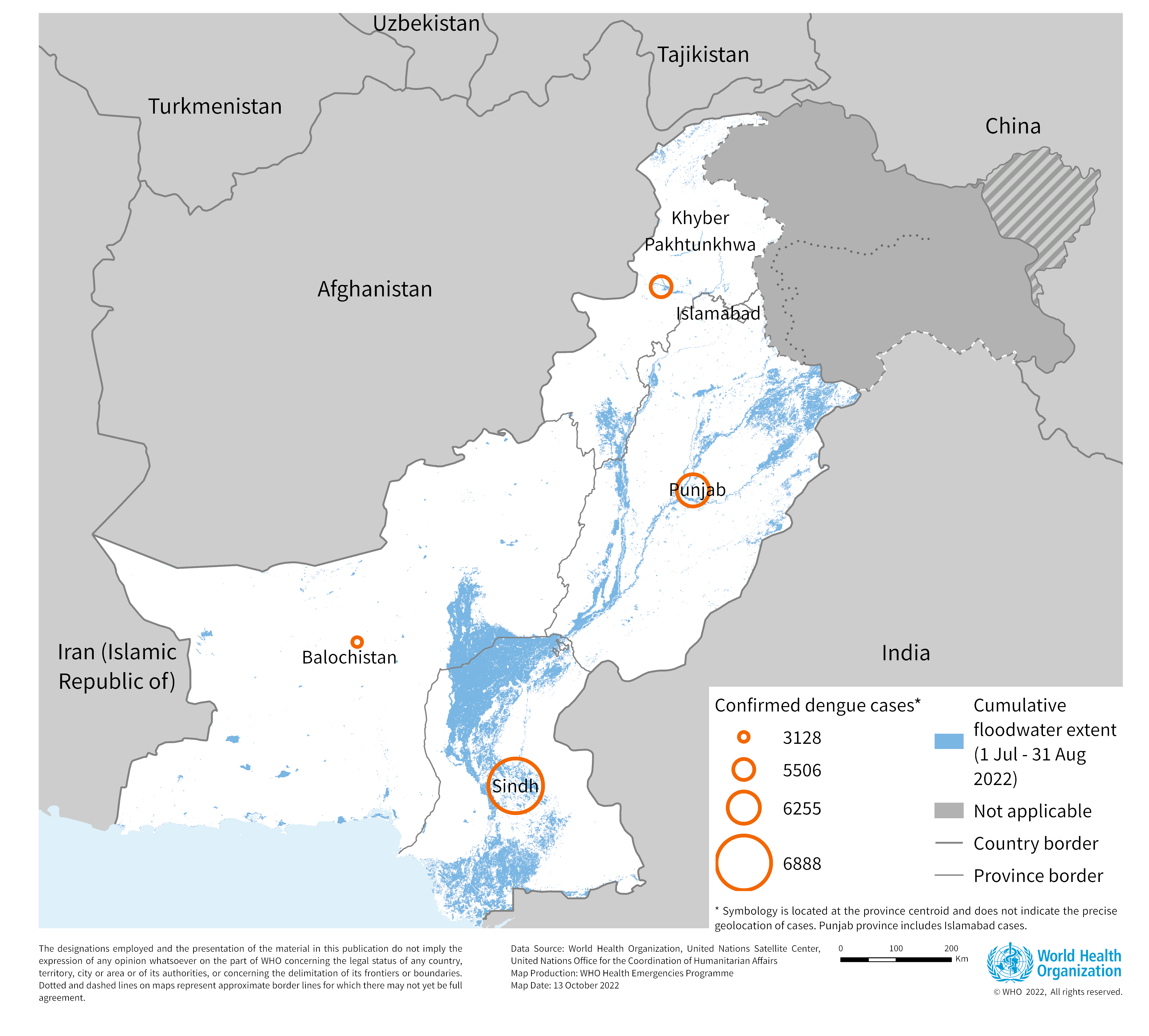
      Between 1 January to 27 September 2022, according to the National Institute of Health-Islamabad, a cumulative total of 25 932 confirmed dengue cases and 62 deaths have been reported nationally. Three-quarters (74%) of these cases were reported during the month of September alone. As of 22 September, the distribution of cases by province was available for 83% (n=21 777) of the total cases, of which 32% (n=6888) were reported from Sindh, 29% (n=6255) from Punjab (including the Islamabad Capital Territory), 25% (n=5506) from Khyber Pakhtunkhwa, and 14% (n=3128) from Balochistan (Figure 1).
      Figure 1. Distribution of confirmed dengue cases in Pakistan by province, 1 January to 22 September 2022.Epidemiology of dengue
      Dengue is a viral infection transmitted by mosquitoes caused by four types of dengue virus (DENV 1, DENV 2, DENV 3, DENV 4). Infection with one serotype provides long-term immunity to the homologous serotype, but not to other serotypes; sequential infections put people at greater risk of severe dengue. DENV can cause an acute flu-like illness, many DENV infections produce only mild illness; over 80% of cases are asymptomatic.
      There is no specific treatment for dengue, however, timely detection of cases, identifying any warning signs of severe dengue infection, and appropriate case management are key elements of care to prevent patient death and can lower fatality rates of severe infection to below 1%.
      Dengue fever is endemic in Pakistan, with seasonal outbreaks and the circulation of the four serotypes in different areas of the country. Aedes aegypti and Aedes albopictus are widely adapted vectors for urban and peri-urban environments. As dengue is recurrent in the country, the population may be at risk of re-infection and therefore, serious complications may occur if not managed promptly and correctly.
      Public health response

      The Ministry of Health, in collaboration with the Global Fund, is conducting vector surveillance and control activities as a part of Integrated Vector Management, including:
      • Technical weekly committee meetings chaired by the Ministry of Health.
      • Activation of ‘dengue counters’ in all health facilities; designated areas in emergency departments allocated for receiving suspected dengue cases.
      • Enhancement of vector surveillance activities in Lahore and other districts.
      • Provision of additional teams to support vector surveillance activities including the daily situation analysis.
      The WHO is providing support including:
      • Coordination at multiple high-level meetings for health authorities including visits and meetings of the WHO representative.
      • Strengthening of laboratory and hospital-based disease surveillance across all provinces in the country has been initiated.
      • Training of selected health care providers from all provinces in the country is being held on case management of dengue fever.
      • Training on vector surveillance and vector control including source reduction during house visits is underway.
      • Provision of 230 000 rapid diagnostic tests (RDTs) for dengue and other diseases, including malaria, acute watery diarrhoea, chikungunya, hepatitis A and E.

      WHO risk assessment

      Pakistan is experiencing an abnormal monsoon rainfall and unprecedented floods. One-third of the country and an estimated 33 million people have been impacted in 84 calamity declared districts. More than 2 million houses have been destroyed and an estimated 1460 health facilities have also reportedly been damaged. Some 7.9 million people are reportedly displaced, 12 900 people injured, and 1600 people have died. Heavy rains and floods have left millions of people without access to healthcare and medical treatment.
      With the current flood crisis affecting the national health system capacity, there is a high risk of serious health impacts from dengue fever. Currently, there is a need for improved vector surveillance, enhanced laboratory capacity for better detection, sensitization of health care providers on case management (including warning signs of severe dengue) and improved surveillance of acute febrile illness to better define disease burden and seasonality patterns.
      Vector-borne epidemics – including dengue – after flooding is a well-known phenomenon, as the stagnant water provides favorable habitats for mosquitoes to breed. The lag time is usually around 3-4 weeks before the occurrence of dengue cases.
      Ongoing disease outbreaks in Pakistan, including acute watery diarrhoea, dengue, malaria, measles, polio, and COVID-19 are being further aggravated, particularly in internally displaced persons and refugee camps and where water and sanitation facilities have been damaged.
      Dengue fever is the most rapidly spreading mosquito-borne virus infection in the world. There is high population movement between Pakistan—in particular, Khyber Pakhtunkhwa province— and bordering countries, especially the Islamic Republic of Iran and Afghanistan. Khyber Pakhtunkhwa province is also home to 1 200 000 Afghani refugees, of which 800 000 live in districts officially notified as calamity hit by floods. The transmission of dengue fever from Pakistan to border countries cannot be ruled out.

      WHO advice

      The proximity of mosquito vector breeding sites to human habitation is a significant risk factor for dengue virus infection. There is no specific treatment for dengue infection, but early detection and access to appropriate healthcare reduce mortality. Furthermore, the prevention and control of dengue depend on effective vector surveillance and control.
      WHO promotes the strategic approach known as Integrated Vector Management (IVM) to control mosquito activity and population, including Aedes spp. (the vector of dengue).
      IVM activities should be enhanced to remove potential breeding sites, reduce vector populations, and minimize individual exposure. This should involve vector control strategies for larvae and adults (i.e. environmental management and source reduction, and chemical control measures), as well as strategies for protecting people and households. Vector control activities should focus on all areas where there is human-vector contact (place of residence, workplaces, schools and hospitals).
      Vector control activities can include covering, draining and cleaning household water storage containers on a weekly basis. In addition, this may include chlorination of drinking water and application of suitable larvicides/insecticides for water storage in outdoor containers.
      Where indoor biting occurs, application of mosquito repellent lotion or sprays on the skin, use of household insecticide aerosol products, mosquito coils, or other insecticide vaporizers are recommended. Household fixtures such as window and door screens and air conditioning can also reduce bites. Since Aedes spp mosquitoes (the primary vector for transmission) are day biters with peak activity at dawn and dusk, personal protective measures such as the use of clothing to minimize skin exposure are recommended. During outdoor activities, mosquito repellents may be applied to exposed skin or to clothing. Insecticide-treated nets offer good protection to people who sleep outside or during the day (e.g. infants, people confined to bed, and night workers) and at night to prevent mosquito bites.
      In addition, vector and human case surveillance should continue to be enhanced in all affected areas and across the country. Key public health messages on reducing the risk of dengue transmission among the population are expected to continue to be provided.
      WHO does not recommend any general travel or trade restrictions to Pakistan based on the information available for this event.

      Further information

      References:
      Citable reference: World Health Organization (13 October 2022). Disease Outbreak News; Dengue - Pakistan. Available at: https://www.who.int/emergencies/dise...em/2022-DON414


      Comment


      • #18
        Source: https://arynews.tv/no-let-up-in-deng...es-in-karachi/

        October 23, 2022
        Web Desk
        No let up in dengue fever cases in Karachi

        KARACHI: Karachi continues to see a rise in the number of dengue cases as another 160 cases were reported in the city during the past 24 hours, ARY News reported on Wednesday.

        According to Sindh Health Department, as many as 160 cases of dengue fever were reported in the metropolis in the past 24 hours, taking the monthly tally to over 3000.

        Among these cases, 30 belong to District East, 52 in Central, Korangi 27 cases, 17 in South, 17 in West, 11 in Malir and eight in Kemari District.

        Meanwhile, 53 patients lost their lives due to mosquito-borne disease in 2022. Out of the total number of deaths, 47 belong to Karachi only...

        Comment


        • #19
          Source: https://english.news.cn/20221025/97d...061deaf/c.html

          Pakistan reports 4 more deaths from dengue fever
          Source: Xinhua
          Editor: huaxia
          2022-10-25 15:51:00

          ISLAMABAD, Oct. 25 (Xinhua) -- Pakistan continues to witness a rise in dengue fever cases as four more deaths were reported from the disease in the South Asian country.

          The eastern Punjab province recorded two deaths while the northwestern Khyber Pakhtunkhwa (KP) and the southern Sindh province reported one death each, the provincial health departments said on Monday evening.

          Punjab reported 210 new cases. Punjab's capital Lahore reported 74 new patients, followed by Rawalpindi and Multan cities with 41 cases each. The total number of dengue cases in Punjab this year has gone up to 13,184.

          In KP, 223 more people were diagnosed with the mosquito-borne disease, the provincial health department said on Monday evening. The number of active cases in the province currently stands at 1,369 while the total number of cases this year has reached 16,847...

          Comment


          • #20
            Source: https://english.news.cn/20221028/a8b...e5b6fc3/c.html

            Dengue fever cases continue to rise in Pakistan
            Source: Xinhua
            Editor: huaxia
            2022-10-28 15:14:15

            ISLAMABAD, Oct. 28 (Xinhua) -- The number of dengue fever cases has continued to rise in Pakistan amid an outbreak due to floods triggered by heavy monsoon rains.

            In the last 24 hours, 340 more people were diagnosed with the mosquito-borne disease in the northwestern Khyber Pakhtunkhwa province, the provincial health department reported on Thursday night. The number of active cases in the province currently stands at 1,544 and the total number of cases so far this year has reached 17,883.

            The southern Sindh province reported 219 new infections, said the provincial health department on Thursday evening. The worst-hit area was Karachi, the provincial capital, which reported 140 new cases. With the new cases, the October figure to date for the province has risen to 8,036, bringing the local total to 18,190 this year...

            Comment


            • #21
              Source: https://english.news.cn/20221105/f8f...3358bdc/c.html

              Pakistan reports 4 new deaths from dengue fever
              Source: Xinhua
              Editor: huaxia
              2022-11-05 17:52:16

              ISLAMABAD, Nov. 5 (Xinhua) -- Pakistan continued to witness an increase in dengue fever cases as four more deaths were reported as a result of the disease in the last 24 hours in the South Asian country.

              All the deaths were reported from the eastern Punjab province, the provincial health department said on Friday, adding that three of them were recorded in the provincial capital Lahore while one from Rawalpindi.

              In total, Punjab reported 225 new cases in the past 24 hours. Lahore recorded 91 new cases, followed by Rawalpindi with 41 cases. The total number of dengue cases in the province this year has now gone up to 15,778.

              In northwestern Khyber Pakhtunkhwa province, 279 more people were diagnosed with the mosquito-borne disease, the provincial health department said on Friday evening. The number of active cases in the province currently stands at 1,587, while the total number of cases this year has reached 19,720...

              Comment


              • #22
                Source: https://www.app.com.pk/domestic/rawa...es-4735-cases/

                Rawalpindi’s dengue tally reaches 4,735 cases
                Fri, 25 Nov 2022, 3:27 PM

                RAWALPINDI, Nov 25 (APP): The total tally of dengue in Rawalpindi had reached 4,735 cases, with the arrival of four more patients during the last 24 hours.

                District Coordinator Epidemics Prevention and Control (DCEPC), Dr Sajjad Mehmood Friday said that 31 patients had been admitted to three allied hospitals of the city, including 14 to the Benazir Bhutto Hospital (BBH), 13 to the District Headquarters Hospital and four to the Holy Family Hospital (HFH)...

                Comment


                • #23
                  Source: https://english.news.cn/20221127/117...c046c1c/c.html

                  20 deaths reported from dengue in parts of Pakistan in 3 weeks
                  Source: Xinhua
                  Editor: huaxia
                  2022-11-27 17:48:30

                  ISLAMABAD, Nov. 27 (Xinhua) -- At least 20 people were killed from dengue fever in different parts of Pakistan over the last three weeks as the number of cases keeps on increasing in the country, the local health departments reported.

                  During this period, around 15 deaths were reported from the eastern Punjab province while the southern Sindh and northwestern Khyber Pakhtunkhwa provinces recorded three and two deaths, respectively, according to the latest figures released by the authorities on Saturday.

                  In the last 24 hours, four people died from the disease in Punjab, bringing to 45 the total death toll this year in the province, the provincial health department said on Saturday. The total number of dengue cases in the province this year has now gone up to 18,487...

                  Comment


                  • #24
                    Source: https://tribune.com.pk/story/2389019...rise-in-punjab

                    Dengue fatalities rise in Punjab
                    Number of patients hospitalised goes down from 1,067 to 355 in a month
                    Adnan Lodhi December 02, 2022

                    LAHORE:

                    Dengue fever claimed more lives in Punjab during November as compared to the total death toll of the previous 10 months despite a drastic decrease in the number of patients.

                    Official data shows that 27 people died due to dengue fever across the province during the past month, raising the death toll during the ongoing year to 45.

                    However, there were also indications of an improvement in the overall situation as the number of new cases of the disease dropped to 3,768 in November from 8,500 in October.

                    The situation in the hospitals also improved substantially as 355 patients were undergoing treatment after admission to the facilities in the province on Wednesday as compared to 1,067 at the end of the previous month.

                    Of the total 355 patients, as many as 178 are admitted to hospitals in Punjab. The disease has cost the province 35 lives during the past two months...

                    Comment


                    • #25
                      Source: https://arynews.tv/pakistan-sees-762...-ongoing-year/

                      Pakistan registers 76,210 dengue cases, 136 deaths during ongoing year
                      December 6, 2022
                      Jahangir Khan

                      ISLAMABAD: Pakistan has registered as many as 76,210 dengue virus cases during the ongoing year, ARY News reported on Tuesday, quoting sources within National Institute of Health.

                      According to a detailed report prepared by the National Institute of Health (NIH), as many as 76,210 dengue virus cases with 136 deaths were reported countrywide from January 1 to December 5, 2022.

                      Sindh remains the highly infected province with 22,495 cases and 61 deaths of the mosquito-borne disease.

                      In Khyber Pakhtunkhwa, 22,799 dengue virus cases with 18 deaths followed by Punjab with 18,797 cases and 45 deaths.

                      Islamabad reported 5,392 cases of dengue virus and six deaths. Balochistan and Azad Jammu and Kashmir reported 5,283 and 1,444 dengue cases, respectively...

                      Comment

                      Working...
                      X