Announcement

Collapse
No announcement yet.

NOAA Observations Indicate a Small Portion of Light Oil Sheen Has Entered the Loop Current

Collapse
X
 
  • Filter
  • Time
  • Show
Clear All
new posts

  • NOAA Observations Indicate a Small Portion of Light Oil Sheen Has Entered the Loop Current

    Scientist: Oil spill could hit Loop Current within 24 hours

    TBO.com
    Published: May 3, 2010
    Updated: 28 min. ago

    TAMPA - A University of Miami scientist says the Gulf oil spill could get into what's called the Loop Current within a day, eventually carrying oil south along the Florida coast and into the Florida Keys.

    But the risk to Florida's pristine, white west coast beaches continues to be low from the growing and menacing blob of oil in the Gulf of Mexico.


    ...

    Read more at:
    http://www2.tbo.com/content/2010/may...news-breaking/

  • #2
    Re: Scientist: Oil spill could hit Loop Current within 24 hours

    Does anyone have a map of the loop current?

    Comment


    • #3
      Re: Scientist: Oil spill could hit Loop Current within 24 hours

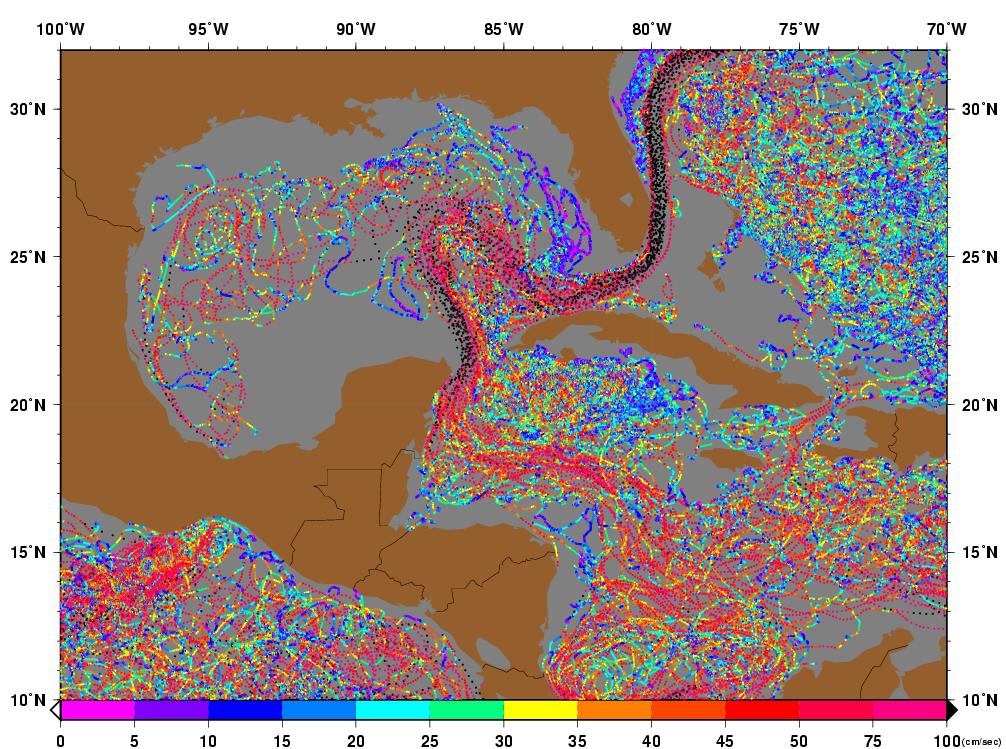
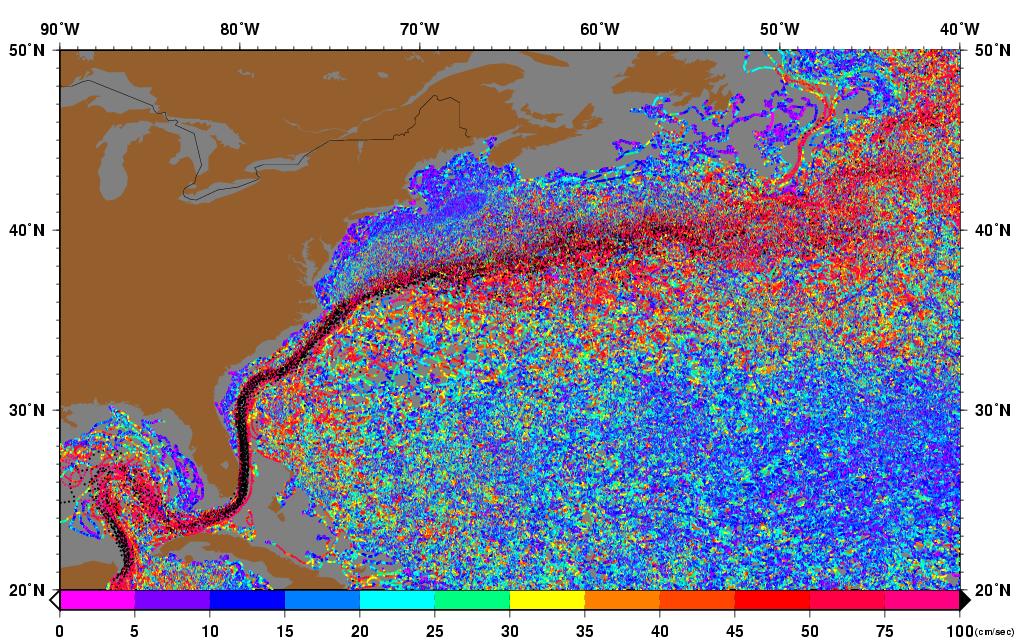
      Loop Current is an ocean current that transports warm Caribbean water through the Yucatan Channel between Cuba and Mexico. The current flows northward into the Gulf of Mexico, then loops southeastward through the Florida Keys (where it is called the Florida Current), and into the Bahamas. Here, the waters of the Loop Current flow northward along the U.S. coast and become the Gulf Stream. With current speeds of about 0.8 m/s, the Loop Current is one of the fastest currents in the Atlantic Ocean. The current is about 200-300 km (125-190 miles) wide, and 800 meters (2600 feet) deep, and is present in the Gulf of Mexico about 95% of the time. During summer and fall, the Loop Current provides a deep (80-150 meter) layer of vary warm water that can provide a huge energy source for any lucky hurricanes that might cross over.


      Figure 1. The Loop Current flow northwards into the Gulf of Mexico. Every 6-11 months, a bulge in the current cuts off into a clockwise-rotating eddy that then drifts slowly west-southwestward towards Texas. Image credit: NOAA.
      The Loop Current commonly bulges out in the northern Gulf of Mexico and sometimes will shed a clockwise rotating ring of warm water that separates from the main current (Figure 1). This ring of warm water slowly drifts west-southwestward towards Texas or Mexico at about 3-5 km per day. This feature is called a "Loop Current Ring", "Loop Current Eddy", or "Warm Core Ring", and can provide a key source of energy to fuel rapid intensification of hurricanes that cross the Gulf, in addition to the Loop Current itself. The Loop Current pulsates in a quasi-regular fashion and sheds rings every 6 to 11 months. When a Loop Current Eddy breaks off in the Gulf of Mexico at the height of hurricane season, it can lead to a dangerous situation where a vast reservoir of energy is available to any hurricane that might cross over. This occurred in 2005, when a Loop Current Eddy separated in July, just before Hurricane Katrina passed over and "bombed" into a Category 5 hurricane. The eddy remained in the Gulf and slowly drifted westward during September. Hurricane Rita passed over the same Loop Current Eddy three weeks after Katrina, and also explosively deepened to a Category 5 storm.
      So, a key question each hurricane season is: when will the next Loop Current Eddy break off, creating a ready-made high-octane energy source for any hurricane that might pass by? A good way to answer this question is to study the behavior of the Loop Current over the past year. This can be viewed at Navy Research Lab's web site, including a large movie (51 Mb) of the past year's currents. This movie has arrows showing the direction of the current, plus a color coding that represents the height of the sea surface above mean level. The higher the height, the warmer the water (since warm water expands and thus raises the sea level where it is at).
      We've also saved a copy of this animation covering the period October 2005-October 2006. One can see at the beginning of the animation the Loop Current Eddy that fueled Katrina and Rita sitting in the Gulf of Mexico south of Louisiana. This eddy moves slowly west-southwest to a point off the Texas coast by November, where it gradually dissipates. A small Loop Current Eddy breaks off eight months later in March, and a large one just four months later, in July. The July 2006 eddy gets temporarily re-absorbed in September, then breaks free again by October.
      The Navy web site offers a 1-month forecast of the Loop Current in the Gulf of Mexico. However, according to an interesting February 2004 article published by offshore-engineer.com, reliable forecasts of these currents and eddies are not available yet. Keep in mind that currents are driven by winds, and wind forecasts are not reliable out more than about 10 days. For more information: A 1998 paper published in the Journal of Physical Ocenaography titled, Loop Current Eddy Paths in the Western Gulf of Mexico provides some technical information on Loop Eddies. Horizon Marine, Inc. tracks and forecasts Loop Eddies and provides a pay service for this. Louisiana State University has a nice series of images showing the passages of Ivan, Katrina and Rita over Loop Current Eddies.
      http://www.wunderground.com/hurricane/loopcurrent.asp
      CSI:WORLD http://swineflumagazine.blogspot.com/

      treyfish2004@yahoo.com

      Comment


      • #4
        Re: Scientist: Oil spill could hit Loop Current within 24 hours

        Loop Current

        From Wikipedia, the free encyclopedia


        Jump to: navigation, search
        <!-- start content -->This article is about the oceanic phenomenon. For the electrical signaling schemes, see Current loop.

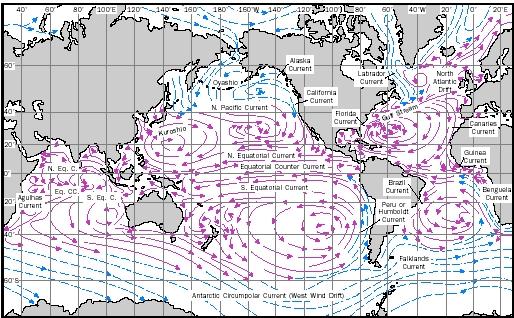
        Gulf Stream currents (1943 map).


        Part of the Gulf Stream, the Loop Current is a warm ocean current in the Gulf of Mexico that flows northward between Cuba and the Yucat?n peninsula, moves north into the Gulf of Mexico, loops west and south before exiting to the east through the Florida Straits.
        A related feature is an area of warm water called an "Eddy" or "Loop Current ring" that separates from the Loop Current, somewhat randomly. These rings then drift to the west at speeds of about 5 cm/s (0.18 km/h or 0.11 mph) and bump into the coast of Texas or Mexico.
        Around 1970, it was believed that the Loop Current exhibited an annual cycle in which the Loop feature extended farther to the north during the summer. Further study over the past few decades, however, has shown that the extension to the north (and the shedding of eddies) does not have a significant annual cycle.
        The Loop Current and its eddies may be detected by measuring sea surface level. Sea surface level of both the Eddies and the Loop on September 21, 2005 was up to 60 cm (24 in) higher than surrounding water, indicating a deep area of warm water beneath them.<SUP id=cite_ref-0 class=reference>[1]</SUP> On that day, Hurricane Rita passed over the Loop current and intensified into a Category 5 storm with the help of the warm water.

        Hurricane Katrina encountering the Gulf Loop Current and Eddy Vortex.http://en.wikipedia.org/wiki/Loop_Current
        CSI:WORLD http://swineflumagazine.blogspot.com/

        treyfish2004@yahoo.com

        Comment


        • #5
          Re: Scientist: Oil spill could hit Loop Current within 24 hours


          Loop Current


          Gulf Stream


          <TABLE cellSpacing=0 cellPadding=0 width=666 align=center border=0 hspace="0" vspace="5"><TBODY><TR><TD vAlign=bottom align=middle>


          </TD><TD vAlign=bottom align=middle>
          </TD></TR></TBODY></TABLE>

          Comment


          • #6
            Re: Scientist: Oil spill could hit Loop Current within 24 hours

            #1: "Weisberg and Shay agree that once the oil enters the Loop Current, it continue east into the Gulf Stream likely will end up in the Keys and ."


            preserving the well, and polute the whole Central Atlantic ocean Gulf Stream areas ...


            Attached Files

            Comment


            • #7
              Re: Scientist: Oil spill could hit Loop Current within 24 hours

              NEW ORLEANS, May 5, 2010

              Oil Spill Close to Shore, Satellite Images Show

              Images Shows Spill Drifting toward South; Current Could Carry Oil toward Florida, Keys

              Excerpt:

              Two satellite images taken Wednesday morning indicate oil has reached the Mississippi Delta and the Chandeleur Islands off the coast of Louisiana.
              It's not clear whether the oil is on shore, but it's very close, said Hans Graber, director of the University of Miami's satellite sensing facility.

              U.S. Coast Guard Lt. James McKnight said crews remained at the Chandeleurs on Wednesday after officials got a report of oil coming ashore, but they have not located it.

              "They're sitting there, basically, waiting for the first signs of any kind of a sheen to touch the islands," he said.

              Graber said the images also show oil drifting south, toward the Loop Current, which scientists say could carry it toward Florida and the Florida Keys. The northern edge of the current may have already picked up some oil.

              .../

              Comment


              • #8
                Re: Scientist: Oil spill could hit Loop Current within 24 hours

                Gulf currents carry fate of coasts

                <script type="text/javascript">var collab_title = 'Gulf currents carry fate of coasts';</script><!-- /HEADLINE --><!-- MAIN PHOTO -->


                <!-- /MAIN PHOTO --><!-- BYLINE -->
                By Kate Spinner
                Published: Thursday, May 6, 2010 at 1:00 a.m.
                Last Modified: Wednesday, May 5, 2010 at 11:25 p.m.
                ( page all of 4 )
                <!-- /PUBDATE -->

                SARASOTA COUNTY - As a growing oil slick looms in the Gulf of Mexico, the health of Florida's coastline depends on the weather and the currents.

                The oil will reach land somewhere. It's a matter of where and when
                scientists say, with strong winds and powerful ocean currents determining the destination.

                "It's not going to go away anytime soon. It's going to persist out there until it comes to land somewhere," said Ian MacDonald, an oceanography professor at Florida State University who also studies natural oil seepage.

                Most scientists agree that currents will probably sweep some or most of the slick to the Atlantic, shielding Southwest Florida from the brunt of the calamity.

                But that forecast could change, in the unlikely event that strong winds push the slick farther east.

                snip

                ....

                More at:

                Comment


                • #9
                  Re: Scientist: Oil spill could hit Loop Current within 24 hours

                  USF Scientist: Oil Spill Now Three Times Size of Lake Okeechobee

                  <SMALL itxtvisited="1">May 6, 2010 By Vickie Chachere</SMALL>

                  Excerpt:

                  Hu?s work is one part of the multi-layered effort to track the effort through USF?s Ocean Circulation Group, which has created a series of complex models over the course of the past two weeks to follow the flow of oil.

                  Led by Physical Oceanographer Robert Weisberg, the research has been instrumental in showing both the public and policy makers what will happen should the oil reach the Loop Current, which circulates in the gulf and then flows around the Florida Keys and up the Atlantic coast.

                  Click the ?play? button on this model to see how Weisberg?s analysis shows the currents would move oil spilled in the north central gulf. And this model shows projections for the Deep Horizon spill.

                  <!-- additional info -->Provided by University of South Florida

                  Comment


                  • #10
                    Scientist: Oil may be entering Gulf Loop current

                    Scientist: Oil may be entering Gulf Loop current, could reach Palm Beach County

                    By Adam Playford The Palm Beach Post
                    May 16, 2010
                    Oil may be on its way.

                    New satellite images show oil starting to enter the Gulf Loop current, which would pull it through the Florida Keys, into the Gulf Stream and up to Palm Beach County, according to a scientist tracking the oil spewing into the gulf.

                    The new images, taken Saturday by NASA's Jet Propulsion Laboratory, "clearly [show] that the oil is being pulled into the Loop current," according to a release from Mitch Roffer, an oceanographer who runs Roffer's Ocean Fishing Forecasting Service and has been providing daily updates on the spill's movement.

                    "We still don't know how long it's going to take to get around to the Keys and then the east coast of Florida - it just remains to be seen," Roffer said Saturday.

                    That process, which is difficult to predict, would take at least a week, and possibly several, scientists say.

                    snip

                    Comment


                    • #11
                      Re: Scientist: Oil may be entering Gulf Loop current

                      Trajectory Forecast

                      Estimate for: 1800 CDT, Tuesday, 5/18/10
                      Date Prepared: 2100 CDT, Saturday, 5/15/10


                      Comment


                      • #12
                        Re: Scientist: Oil may be entering Gulf Loop current

                        Worry that Gulf oil spreading into major current

                        By JEFFREY COLLINS and JASON DEAREN, Associated Press Writers Jeffrey Collins And Jason Dearen, Associated Press Writers ? <ABBR class=recenttimedate title=2010-05-17T04:38:11-0700>40 mins ago</ABBR>

                        Excerpts:

                        "A researcher told The Associated Press that computer models show the oil may have already seeped into a powerful water stream known as the loop current, which could propel it into the Atlantic Ocean. A boat is being sent later this week to collect samples and learn more.

                        "This can't be passed off as 'it's not going to be a problem,'" said William Hogarth, dean of the University of South Florida's College of Marine Science. "This is a very sensitive area. We are concerned with what happens in the Florida Keys."

                        ---------------------------

                        "Hogarth said a computer model shows oil has already entered the loop current, while a second shows the oil is 3 miles from it ? still dangerously close. The models are based on weather, ocean current and spill data from the U.S. Navy and the National Oceanic and Atmospheric Administration, among other sources.

                        Hogarth said it's still too early to know what specific amounts of oil will make it to Florida, or what damage it might do to the sensitive Keys or beaches on Florida's Atlantic coast. He said claims by BP that the oil would be less damaging to the Keys after traveling over hundreds of miles from the spill site were not mollifying.

                        Damage is already done, with the only remaining question being how much more is to come, said Paul Montagna, from the Harte Research Institute for Gulf of Mexico Studies at Texas A&M University.

                        "Obviously the quicker they plug this the better, but they are already having a tremendous effect on the environment," he said. "In the end, we have to figure out how much is actually pouring into the Gulf."

                        Full text at:

                        Comment


                        • #13
                          Re: Scientist: Oil may be entering Gulf Loop current

                          <TABLE class=full cellSpacing=0 cellPadding=0><TBODY><TR><TD class=full>Dr. Jeff Masters' WunderBlog


                          </TD><TD></TD></TR></TBODY></TABLE>
                          Last Updated: 7:47 PM GMT on May 17, 2010 ? Last Comment: 8:52 PM GMT on May 17, 2010
                          <TABLE class=full cellSpacing=0 cellPadding=0><TBODY><TR class=vaT><TD class=full><TABLE class=blueTop cellSpacing=0 cellPadding=0><TBODY><TR><TD class=hLeft></TD><TD class=hCenter>Oil enters the Loop Current and is headed to the Florida Keys</TD><TD class=hRight></TD></TR><TR><TD class=sLeft></TD><TD class=sCenter></TD><TD class=sRight></TD></TR></TBODY></TABLE><TABLE class=full cellSpacing=0 cellPadding=0><TBODY><TR><TD class=full>Posted by: JeffMasters, 7:38 PM GMT on May 17, 2010</TD></TR></TBODY></TABLE>
                          Satellite imagery today from NASA's MODIS instrument confirms that a substantial tongue of oil has moved southeast from the Deepwater Horizon oil spill and entered the Gulf of Mexico's Loop Current. The Loop Current is an ocean current that transports warm Caribbean water through the Yucatan Channel between Cuba and Mexico. The current flows northward into the Gulf of Mexico, then loops southeastward just south of the Florida Keys (where it is called the Florida Current), and then along the west side of the western Bahamas. Here, the waters of the Loop Current flow northward along the U.S. coast and become the Gulf Stream. Once oil gets into the Loop Current, the 1 - 2 mph speed of the current should allow the oil to travel the 500 miles to the Florida Keys in 10 - 20 days. Portions of the Loop Current flow at speed up to 4 mph, so the transport could be just 4 - 5 days. It now appears likely that the first Florida beaches to see oil from the spill will be in the Lower Florida Keys, not in the Panhandle.


                          Figure 1. Satellite image of the oil spill taken at 12:40 EDT Monday May 17, 2010. The location of the Loop Current is superimposed. Image credit: University of Wisconsin and NASA.

                          <B><BIG>Why is oil getting into the Loop Current?</B></BIG>
                          The winds over the oil spill location are offshore out of the northwest today, and offshore winds will continue intermittently through Wednesday, which should allow a substantial amount of oil to enter the Loop Current. The major reason oil is moving southwards is because of the instability of the currents in the Gulf of Mexico. The Loop Current is not a stable feature, and tends to surge northwards and southwards in a chaotic fashion, and in response to changes in the prevailing winds. Over the past week, chaotic behavior of the Loop Current and a clockwise-rotating eddy just to its north, just south of the oil spill location, have combined to bring a current of southward-moving surface water to the oil spill location. As strong on-shore winds from the southeast slackened this past weekend, oil has been drawn southward into the Loop Current. The latest NOAA trajectory forecasts failed to anticipate the movement of the oil into the Loop Current. The latest surface current forecasts from NOAA's HYCOM model show that oil could continue pouring into the Loop Current for most of the rest of the week. It is highly uncertain how diluted the oil might get on its voyage to northwestern Cuba and the Florida Keys this week, but the possibility for a major ecological disaster in the fragile Keys ecosystem cannot be ruled out. Southeast to east winds of 10 - 15 knots are expected to develop late this week and extend into early next week, which may be strong enough to impose a surface current that will shut off the flow of oil into the Loop Current by Friday or Saturday.


                          Figure 2. Forecast made at 8pm EDT Sunday May 16, 2010, of the Gulf of Mexico currents by NOAA's HYCOM model. A persistent southward flowing surface current is predicted to occur this week between the oil spill location (red dot) and the Loop Current. Image credit: NOAA.

                          <B><BIG>Likely areas of impact</B></BIG>
                          Based on a study of 194 floating probes released into the Northeast Gulf of Mexico during a 1-year study in the 1990s (Figure 3), the west coast of Florida from Tampa Bay southwards to the Everglades is at minimal risk of receiving oil from surface currents. There is a "forbidden zone" off the southwest Florida coast where the shape of the coast, bottom configuration, and prevailing winds all act to create upwelling and surface currents that tend to take water away from the coast. This study implies that the greatest risk of land impacts by surface oil caught in the Loop Current is along the ocean side of the Florida Keys, and along the coast of Southeast Florida from Miami to West Palm Beach. Eddies breaking away from the Gulf Stream would also likely bring oil to northwest Cuba, the western Bahamas, and the U.S. East Coast as far north as Cape Hatteras, North Carolina, though at lesser concentrations. Southwest Florida cannot rest entirely, though--the "forbidden zone" is only true for surface waters, and there is onshore flow below the surface. Since recent ship measurements have detected substantial plumes of oil beneath the surface, southwest Florida might be at risk if one of these plumes gets entrained into the Loop Current. These subsurface plumes were also detected by current probes launched into the oil spill on May 8 by one of NOAA's hurricane hunter aircraft, according to one scientist I spoke to at last week's AMS hurricane conference. There are plans for the Hurricane Hunters to go out again tomorrow and drop more probes into the spill to attempt to get a better handle on where the oil is and where the currents are taking it.


                          </TD></TR></TBODY></TABLE>
                          .../

                          Full text at:

                          Comment


                          • #14
                            Re: Scientist: Oil may be entering Gulf Loop current

                            UPDATE 1-US Coast Guard prepares for oil in south Florida


                            Mon May 17, 2010 5:24pm EDT


                            Oil getting closer to "Loop Current"

                            * Authorities preparing for impact on southern Florida
                            * Offshore drilling chief to step down (Adds details, quotes)
                            By Tom Doggett and Ayesha Rascoe
                            WASHINGTON, May 17 (Reuters) - The U.S. Coast Guard is preparing for the possibility that tar balls from the massive Gulf Coast oil spill might be swept up in a current and reach the southern Florida coast, a top official said on Monday.
                            Rear Admiral Peter Neffenger, deputy national incident commander with the Coast Guard, said in testimony before a Senate committee that the government was closely watching whether the oil would be swept up into the "loop current" that moves around Florida.
                            "Currently it shows to be somewhere in the neighborhood of 40-50 miles (65-80 km) from the southern edge of the spill," Neffenger said of the current that could sweep the oil down to the Florida Keys and even up the U.S. East Coast.
                            "We are watching that carefully and as a result of that we are preparing for potential impact on the southern Florida coast and impacts around the southern Florida coast," he told the Senate Homeland Security and Governmental Affairs Committee at a hearing on the oil spill.
                            He said the oil would likely be in the form of tar balls that are a "little easier to manage" when they come ashore.
                            "This is not to say this is a good thing," he said. "I think it will be a more manageable piece than what we're currently looking at in the Gulf."
                            CURRENT PROTECTED LIKE COASTLINE
                            Homeland Security Secretary Janet Napolitano also said the government was monitoring the loop current very closely and were treating it as if it were a coastline.

                            snip


                            http://www.reuters.com/article/idUSN1710251220100517
                            CSI:WORLD http://swineflumagazine.blogspot.com/

                            treyfish2004@yahoo.com

                            Comment


                            • #15
                              Re: Scientist: Oil may be entering Gulf Loop current

                              May 18, 2010, 8:10 am <!-- date updated --><!-- <abbr class="updated" title="2010-05-18T08:37:52+00:00">— Updated: 8:37 am</abbr> --><!-- Title -->
                              The Oil and the Loop Current


                              <!-- Byline --><ADDRESS class="byline author vcard">By JOHN COLLINS RUDOLF</ADDRESS><!-- The Content -->Institute for Optical Oceanography, College of Marine Science, University of South Florida The oil spill in the Gulf of Mexico as observed from space on Monday.

                              An article today in The Times examines the prospect that oil from the gulf spill could reach the so-called loop current, which could carry it into the Florida Keys and the Atlantic Ocean.
                              Satellite images shed light on the trajectory of the oil and the current.

                              The one above shows the oil spill as observed from space by the NASA satellites Terra and Aqua on Monday. Using an array of sensors, these satellites detect the spectral reflection of the ocean, allowing a wide variety of observations on things like water temperature and surface features like the oil spill.

                              The oil spill is pictured in outline, revealing a long tail of oil being dragged away from the site of the Deepwater Horizon oil rig by ocean currents.

                              Responsible for the current is a giant eddy, also known as a cyclone, about 150 miles wide from east to west. It has spun off the much larger loop current, a powerful and unpredictable ocean feature that transports warm water in a clockwise motion from the Yucat?n Peninsula into the northern Gulf of Mexico, then south to the Florida Keys and out into the Atlantic.

                              The thickness of the oil in the tail is unknown. Federal officials have characterized it as a light sheen, while some independent scientists believe it to be considerably thicker. That the tail of oil is easily visible from space is one indication that it may be thicker than a light sheen.

                              ?It?s highly visible in our imagery,? said Nan Walker, an oceanographer with the Earth Scan Laboratory at Louisiana State University, where a separate analysis of the satellite images is being done. ?It?s unmistakable. And oil spills, to my mind, aren?t usually that easy to track.?

                              The next two images show the ocean temperature in the gulf, with an outline of the oil spill overlaid. The dark red bulb directly below the oil spill is the loop current; above it is the cooler and less distinct cyclone.

                              The first image shows the oil spill, upper left, in relation to the loop current on May 6-7.
                              Institute for Optical Oceanography, College of Marine Science, University of South Florida

                              The following image shows the oil spill on Monday, with a long tongue of oil snaking out to sea.
                              (All three images were created by Chuanmin Hu of the Institute for Optical Oceanography at the University of South Florida.)
                              Institute for Optical Oceanography, College of Marine Science, University of South Florida

                              Satellite images indicate that oil could reach the Gulf Current, flowing north along the Atlantic coast.

                              Comment

                              Working...
                              X