Announcement

Collapse
No announcement yet.

France - Outbreak of lumpy skin disease in cattle 2025

Collapse
X
 
  • Filter
  • Time
  • Show
Clear All
new posts

  • #16
    Translation Google


    Pascal Xicluna/agriculture.gouv.fr

    August 12, 2025 Info +

    Lumpy skin disease of cattle (LSD): update and frequently asked questions

    LSD was detected in France for the first time on June 29, 2025, in Savoie. This viral disease, which is highly detrimental to the health of cattle (potentially leading to death), leads to significant production losses in infected livestock. LSD is not transmissible to humans, neither through contact with infected cattle, nor through the consumption of products from contaminated cattle, nor through the bites of vector insects.

    Update on the situation in France

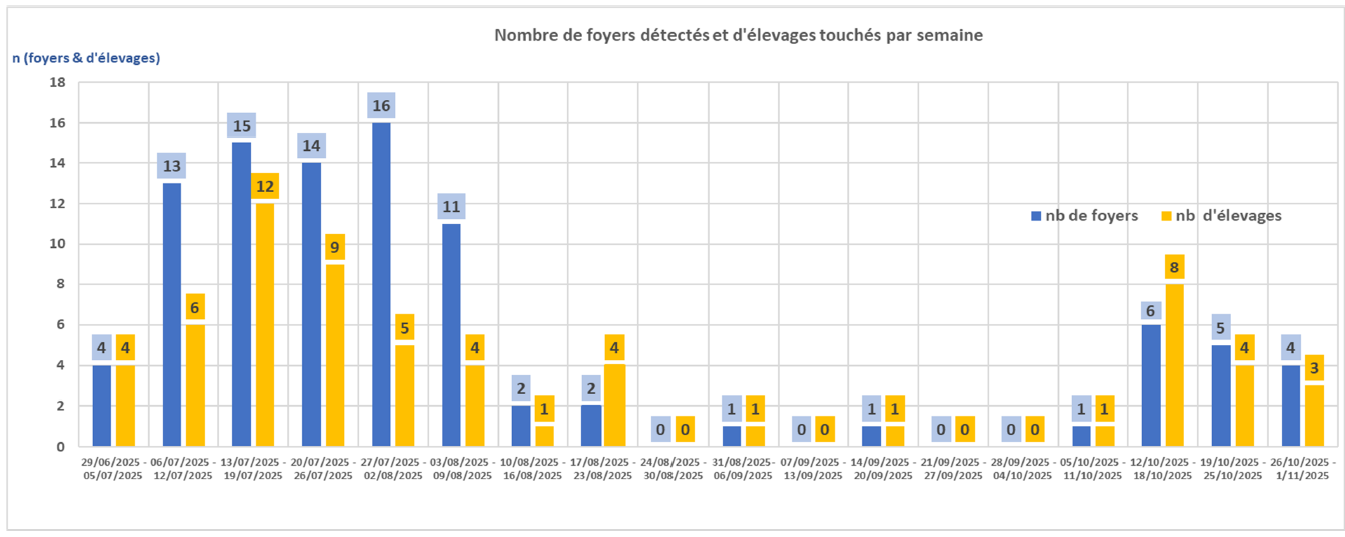
    As of August 11, 2025, 74 outbreaks have been detected in France, spread across two departments: Savoie (31 outbreaks spread across the municipalities of Entrelacs and Hauteluce), Haute-Savoie (43 outbreaks spread across the municipalities of Rumilly, Massingy, Marigny-Saint-Marcel, Faverges-Seythenex, Saint-Ferréol, Les Combes-Seythenex, Boussy, Val-de-Chaise, Moye). These outbreaks concern 39 farms.
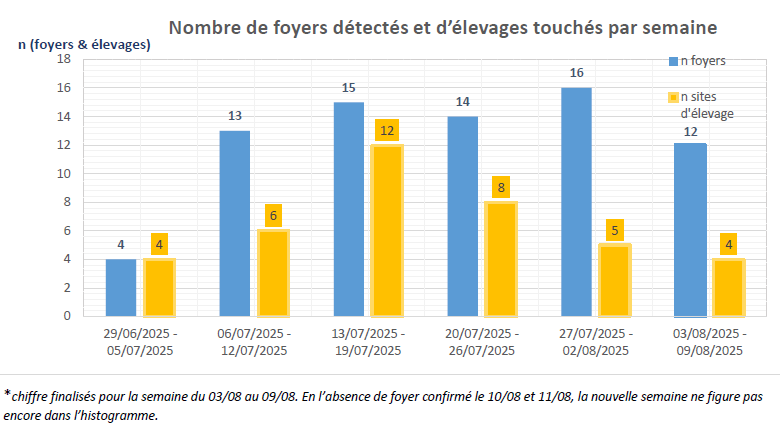
    See image description DNC - Graph of the number of outbreaks detected and affected farms per week

    Control measures include prohibiting the movement of cattle within regulated zones , depopulation of cattle present in declared outbreaks, and vaccination. For more information on zoning and depopulation measures, see section 5. "Management measures" .

    Vaccination projects, carried out by veterinarians with the support of breeders, began on July 18. The vaccination strategy concerns all cattle, regardless of age, located in the so-called "regulated" zone, which extends over a 50-kilometer radius around the outbreaks, or approximately 250,000 cattle. To date, this zone includes the majority of the territory of the two affected departments, Savoie and Haute-Savoie, as well as part of Ain and Isère. Vaccination of cattle in this zone is mandatory and fully covered by the State.

    The vaccination deployment strategy is twofold:
    • from a line located 20 kilometers from the outbreaks, the vaccination campaign is carried out towards the heart of the regulated zone to limit the spread of the disease from the outbreaks and towards the outside of the regulated zone for a barrier effect.
    • vaccination around the homes.
    The objective of this massive and rapid vaccination campaign, in addition to depopulation measures and movement restrictions, is the complete and rapid eradication of the disease.

    ...
    La DNC a été détectée en France, pour la première fois, le 29 juin 2025 en Savoie. Cette maladie virale fortement préjudiciable à la santé des bovins (allant potentiellement jusqu’au décès) conduit à des pertes de production importantes du cheptel infecté. La DNC n’est pas transmissible à l’Homme, ni par contact avec des bovins infectés, ni par la consommation de produits issus de bovins contaminés, ni par piqûres d’insectes vecteurs.


    Comment


    • #17
      France - Lumpy skin disease virus (Inf. with) - Follow up report 17
      ...
      REPORT DATE
      2025/08/22
      ...
      EPIDEMIOLOGICAL COMMENTS

      The epidemiological investigation on the first outbreak is still ongoing. At this stage, the origin of the infection has not been determined. As of 21/08/2025: 76 outbreaks have been confirmed among 41 different livestock farmers. Only 12 municipalities are affected.
      ...
      Click image for larger version

Name:	image.png
Views:	456
Size:	20.9 KB
ID:	1018198
      ...
      NEW OUTBREAKS

      ob_163254 - DNC20250245 - Chambéry
      ...

      Comment


      • #18
        France - Lumpy skin disease virus (Inf. with) - Follow up report 18
        ...
        REPORT DATE
        2025/08/25
        ...
        EPIDEMIOLOGICAL COMMENTS

        The epidemiological investigation on the first outbreak is still ongoing. At this stage, the origin of the infection has not been determined As of 25/08/2025: 77 outbreaks have been confirmed among 42 different livestock farmers. Only 13 municipalities are affected.
        ...
        Click image for larger version

Name:	image.png
Views:	483
Size:	20.7 KB
ID:	1018295
        ...
        NEW OUTBREAKS

        ob_163361 - DNC20250250 - Belley
        ...

        Comment


        • #19
          A new outbreak of lumpy skin disease declared in Ain, five cows slaughtered

          Anabelle Gallotti
          Published onSunday, September 7, 2025 at 6:55 AM
          Updated onSunday, September 7, 2025 at 8:40 AM

          A second outbreak of dermatosis was detected in Ain on Saturday, September 6. It involved five unvaccinated animals that were slaughtered the same day. The previous outbreak in Ain dates back to August 23.

          Lumpy skin disease, a disease that has been affecting cows in our region since the beginning of summer, continues to circulate. It is a disease transmitted by certain insects only. It only affects cattle and is not transmissible to humans or other animals. It has been wreaking havoc since the beginning of summer in Savoie, Haute-Savoie, and to a lesser extent in Ain and Isère.

          Second outbreak detected in Ain

          On Saturday, September 6, a new outbreak of LSD was confirmed in the Ain department " in a batch of five unvaccinated animals ," according to the Ministry of Agriculture. The animals on this farm were slaughtered on the same day (September 6). This is the second case of LSD in this department since the start of the crisis. The previous outbreak, in Grand Colombier, was detected on August 23, after a continuous two-week period without any new outbreaks in France (it involved 80 cattle, editor's note).

          The eradication goal has not yet been achieved

          These sick cows, after a fortnight without new contamination, show that the virus is still locally present in our territory and that " the health situation is not yet completely stabilized . " Vaccination coverage is nevertheless high: more than 90% according to government services. But if we observe "a significant slowdown in the weekly number of outbreaks, the eradication objective has not yet been achieved ." The Ministry of Agriculture indicates in a press release that extreme vigilance remains essential "to avoid compromising the results of recent weeks."
          ...
          Un deuxième foyer de dermatose a été détecté dans l’Ain, samedi 6 septembre. Il concernait cinq animaux non vaccinés qui ont été abattus le jour même. Le précédent foyer dans l’Ain remonte au 23 août dernier.

          ---------------------------------------------------
          September 8, 2025 Info +

          Lumpy skin disease of cattle (LSD): update and frequently asked questions
          ...
          Update on the situation in France

          As of September 8, 2025, 78 outbreaks have been detected in France, spread across three departments: Savoie (32 outbreaks spread across the municipalities of Entrelacs, Hauteluce and Chindrieux), Haute-Savoie (44 outbreaks spread across the municipalities of Rumilly, Massingy, Marigny-Saint-Marcel, Faverges-Seythenex, Saint-Ferréol, Les Combes-Seythenex, Boussy, Val-de-Chaise, Moye and Giez) and Ain (2 outbreaks spread across Culoz and Injoux-Génissiat). These outbreaks concern 46 farms.
          ...

          La DNC a été détectée en France, pour la première fois, le 29 juin 2025 en Savoie. Cette maladie virale fortement préjudiciable à la santé des bovins (allant potentiellement jusqu’au décès) conduit à des pertes de production importantes du cheptel infecté. La DNC n’est pas transmissible à l’Homme, ni par contact avec des bovins infectés, ni par la consommation de produits issus de bovins contaminés, ni par piqûres d’insectes vecteurs.

          Comment


          • #20
            New outbreak of lumpy skin disease worries cattle farmers

            By Le Figaro with AFP
            24 minutes ago

            The detection of an outbreak of lumpy skin disease (LSD) in a cattle herd in the Rhône region, a good distance from the French epicentre of this animal disease, has revived fears of a wider spread but also tensions between unions over the systematic culling of infected outbreaks.

            An outbreak of LSD was detected Thursday in a herd of dairy cows in the Rhône region, a first for this department, which had previously been free of the disease and was outside the regulated zone, the Ministry of Agriculture announced Friday. This brings to 79 the number of outbreaks detected in 47 farms since the first appearance in France at the end of June of this viral disease, which is not transmissible to humans, and which leads to significant losses in milk production and sometimes results in the death of part of the infected herd. The spread, which occurs between infected cattle or through insect bites, began in Savoie and Haute-Savoie, before affecting communes in Ain.

            According to the ministry, a vaccination campaign and drastic movement restrictions in a restricted area helped stem its spread at the end of August. However, the total and systematic culling of infected areas caused strong emotions and heightened conflict between unions over the strategy to adopt. The government and the FNSEA-JA alliance supported this drastic measure, while the Rural Coordination and the Peasant Confederation, which attempted to block the culls, regret that other methods were not considered. The new outbreak was detected in Saint-Laurent-de-Chamousset, about thirty kilometers west of Lyon. The restricted area extended across Ain, Isère, Savoie, and Haute-Savoie, and ended a few kilometers east of the city. "Depopulation (culling, editor's note) is underway and a new regulated zone has been defined ," the ministry said on Friday, for whom this new case "illustrates the importance of maintaining increased vigilance . "

            Tensions between unions

            The last outbreak detected dates back to September 6, in a herd with unvaccinated animals despite the obligation in the area, a "negligence ," according to Arnaud Rousseau, the president of the FNSEA. This resets the 45-day counter from which, without new cases, movement restrictions can be lifted. The government has already allowed, under very strict conditions, descents from summer pastures. With the cooling temperatures, it is becoming complicated to leave cows at altitude, especially when they have had to calve in these areas where it is difficult to milk them, which leads to additional losses. At the Livestock Show held from Tuesday to Thursday in Rennes, all the breeders were praying not to learn of new cases. But criticism has been rife through conferences and union actions.

            The Peasant Confederation simulated the murder of breeders on Tuesday at the ministry's stand, denouncing a "deadly" strategy that failed to take into account veterinary opinions that "diverged" from the state's strategy. Its spokesperson, Stéphane Galais, read the testimony of a breeder devastated by the slaughter of his animals: "This morning, the children had set their alarms to say goodbye to them ." On Wednesday, FNSEA president Arnaud Rousseau denounced the appearance of "Raoult professors of dermatosis ," claiming that his union and the state had relied on scientific expertise, unlike "self-proclaimed epidemiologists . "

            "1,748 animals were slaughtered in a 50 km area around the outbreaks, which includes 275,000 to 290,000 animals. We're talking about 0.6%. Behind them, of course, are men and women, and it remains dramatic. But we did it responsibly ," he said at a press conference. The affected farmers, who have access to psychological support and have already received an advance from the state to compensate for the loss of animals, are also hoping for aid for indirect losses and to rebuild their herds.

            Une campagne de vaccination et de restriction drastique des mouvements dans une zone réglementée a permis, selon le ministère, d’endiguer la diffusion de cette maladie, fin août.

            Comment


            • #21
              Translation Google


              Xavier Remongin/agriculture.gouv.fr

              September 19, 2025 Press Release

              Lumpy skin disease in cattle: new outbreak confirmed in the Rhône on September 18, a new regulated zone defined

              A new outbreak of lumpy bovine skin disease (LBD) was confirmed in the Rhône region on September 18th on a dairy farm. This farm, located outside the previously defined regulated zone, has led to the demarcation of a new regulated zone.


              This first outbreak in the Rhône is also the first in a department outside the regulated zone since the disease emerged last June in Savoie. The last outbreak was detected on September 6 in Ain.

              Depopulation of this new outbreak is underway, and a new regulated zone has been defined around it. In order to eradicate the disease as quickly as possible, surveillance measures, restrictions on animal movements, and the deployment of vaccinations have been prescribed.

              This new outbreak, in a previously unaffected area, illustrates the importance of maintaining increased vigilance regarding the health status of cattle, biosecurity measures and compliance with rules relating to animal movements, in a context where the health situation with regard to LSD is still evolving.

              The epizootic outbreak in the first regulated zone was brought under control very quickly thanks to the strategy deployed. It is absolutely essential that this strategy be continued and that all stakeholders continue to be fully committed to completely eradicating it in both regulated zones.

              Thus, in the current health context, it is essential, for the protection of the French cattle herd, to continue the control measures defined since the beginning of the emergence of LSD on the territory:
              • Early detection of outbreaks, based on: close monitoring of the health of cattle by breeders, systematic reporting to the veterinarian in the event of suggestive signs (fever, discharge, nodules) for the taking of official samples;
              • Total depopulation of cattle in the homes;
              • In regulated areas, mass vaccination, as soon as possible and compulsory; this vaccination is fully covered by the State;
              • Compliance in regulated areas with biosecurity requirements and in particular bans on the movement of cattle or strict compliance with movement conditions in the event of authorized derogation movements.
              LSD is a strictly animal, viral disease that is not transmissible to humans , neither through contact with infected cattle, nor through the feeding of products derived from these animals (meat, milk, cheese), nor through insect bites. It spreads between cattle through the movement of infected animals or via "vector" insects (horseflies and biting flies / stomoxys).

              The health strategy voted on July 16 by the Health Parliament and implemented in France is based on imperative measures to stop the spread of the virus, with the objective of completely and quickly eradicating the disease:
              • Early detection of clinically suspect cattle, including vaccinated ones;
              • Rapid analysis of all suspicions by approved local laboratories;
              • If confirmed, the total depopulation of cattle in the outbreaks will be carried out to extinguish the sources of the virus, in accordance with the obligations of European regulations;
              • The establishment of regulated zones around outbreaks, where reinforced protection and surveillance measures apply: prohibition or limitation of movements, disinfestation of means of transport and veterinary surveillance visits to farms;
              • Vaccination has been mandatory in these regulated areas since July 18.

              ...
              Un nouveau foyer de dermatose nodulaire contagieuse bovine (DNC) a été confirmé dans le Rhône, le 18 septembre, dans un élevage de vaches laitières. Cet élevage, situé en dehors de la zone réglementée définie jusqu’alors, conduit à délimiter une nouvelle zone réglementée.


              Comment


              • #22
                Translation Google


                October 12, 2025 Press Release

                Lumpy skin disease of cattle (LSD): first outbreak confirmed in the Jura on October 11, a new regulated zone defined

                An outbreak of lumpy bovine skin disease (LBD) was confirmed in the Jura region on October 11th on a 93-head cattle farm. This farm, located outside the previously defined regulated zone, has led to the demarcation of a new regulated zone where a mandatory vaccination campaign, funded by the state, will be implemented.


                This outbreak is located in the commune of Écleux in the northwest of the Jura department. This location leads to the establishment of a regulated zone with a radius of 50 kilometers around this outbreak, covering parts of the departments of Jura, Doubs, Côte-d'Or, Haute-Saône, and Saône-et-Loire. This new zone does not overlap any of the previous zones.
                This outbreak, located in a previously unaffected area, once again illustrates the importance of maintaining increased vigilance regarding the health status of cattle, implementing biosecurity measures and ensuring compliance with the rules relating to animal movements, in a context where the health situation with regard to LSD is still evolving.
                The epizootic outbreak in the first two regulated zones was successfully contained thanks to the strategy adopted and deployed. It is absolutely essential that it be continued and that all stakeholders continue to be fully committed to eradicating it completely.
                Thus, in the current health context, it is essential for the protection of the French cattle herd to continue the control measures defined since the beginning of the emergence of LSD in the territory:
                • Early detection of outbreaks, based on: close monitoring of the health of cattle by breeders, systematic reporting to the veterinarian in the event of suggestive signs (fever, discharge, nodules) for the taking of official samples;
                • Total depopulation of cattle in the homes;
                • In regulated areas, mass vaccination, as soon as possible and compulsory; this vaccination is fully covered by the State;
                • Compliance in regulated areas with biosecurity requirements and in particular bans on the movement of cattle or strict compliance with movement conditions in the event of authorized derogation movements.
                LSD is a strictly animal, viral disease that is not transmissible to humans , neither through contact with infected cattle, nor through the feeding of products derived from these animals (meat, milk, cheese), nor through insect bites. It spreads between cattle through the movement of infected animals or via "vector" insects (horseflies and biting flies / stomoxys).

                ...
                Un foyer de dermatose nodulaire contagieuse bovine (DNC) a été confirmé dans le Jura, le 11 octobre, dans un élevage de 93 bovins. Cet élevage, situé en dehors de la zone réglementée définie jusqu’alors, conduit à délimiter une nouvelle zone réglementée où une campagne de vaccination obligatoire et prise en charge par l’État, sera mise en œuvre.

                Comment


                • #23
                  Translation Google

                  Pascal Xicluna / agriculture.gouv.fr

                  October 15, 2025

                  Press Release


                  Lumpy skin disease (LSD): a new outbreak in Ain leads to the establishment of a new regulated zone


                  An outbreak of lumpy bovine skin disease (LBD) was confirmed in the Ain department on October 14th, on a herd of 180 calves. It is located in the commune of Neuville-les-Dames. The location of this outbreak has led to the demarcation of a fifth regulated zone in France. In this 50 km radius zone around the outbreak, a mandatory vaccination campaign will be implemented and funded by the State.


                  This regulated zone covers parts of the departments of Ain, Saône-et-Loire, Jura, Rhône, and Isère. Given the location of this outbreak, close to other regulated zones in place, the new regulated zone covers part of two of the previously established regulated zones.

                  Furthermore, in the Jura, two new outbreaks of DNC were detected on October 13 and 14, in the commune of Écleux, where a first outbreak had been confirmed on October 11.

                  These recent outbreaks, located in previously unaffected areas, illustrate the importance of maintaining increased vigilance regarding cattle health, implementing biosecurity measures, and ensuring compliance with animal movement rules. Controls are being put in place to verify their proper application.

                  The epizootic outbreak in the first two regulated zones was brought under control thanks to the strategy adopted and deployed. It is important that this strategy be continued and that all stakeholders continue to be fully committed to eradicating the disease.

                  Thus, in the current health context, it is essential for the protection of the French cattle herd to continue the control measures defined since the beginning of the emergence of LSD in the territory:
                  • Early detection of outbreaks, based on: close monitoring of the health of cattle by breeders, systematic reporting to the veterinarian in the event of suggestive signs (fever, discharge, nodules) for the taking of official samples;
                  • Total depopulation of cattle in the homes;
                  • In regulated areas, mass vaccination, as soon as possible and compulsory; this vaccination is fully covered by the State;
                  • Compliance in regulated areas with biosecurity requirements and in particular bans on the movement of cattle or strict compliance with movement conditions in the event of authorized derogation movements.
                  ...

                  Un foyer de dermatose nodulaire contagieuse bovine (DNC) a été confirmé dans l’Ain, le 14 octobre, dans un élevage de 180 veaux. Il se situe dans la commune de Neuville-les-Dames. La localisation de ce foyer conduit à délimiter une cinquième zone réglementée en France.

                  Comment


                  • #24
                    Translation Google

                    Dermatosis: Cattle exports suspended and animal gatherings banned


                    Marie-Coralie Fournier ,
                    Axel Canu
                    Published onFriday, October 17, 2025 at 11:03 AM
                    Updated onSaturday, October 18, 2025 at 7:03 AM


                    Agriculture Minister Annie Genevard is on an official visit to the Jura region this Friday for a crisis meeting on lumpy skin disease. She announced a 15-day suspension of cattle exports and a ban on gatherings of animals.

                    Annie Genevard is chairing a crisis meeting on lumpy skin disease this Friday from the prefecture of Lons-le-Saunier (Jura). The Minister of Agriculture arrived on site around 8 a.m., while 86 outbreaks have been confirmed in France , in three different regions. After the Alps and Ain, the Jura was affected (with three outbreaks in Ecleux ), then the Pyrénées-Orientales (also with three outbreaks). Surrounded by local elected officials, the prefects of Doubs and Jura and the presidents of the Chambers of Agriculture of these two departments, the Minister of Agriculture reaffirmed the strategy for combating this disease which affects cows: "The objective is not to control but to eradicate the disease" according to Annie Genevard.

                    Ban on gatherings of animals

                    At the end of the meeting, the Minister of Agriculture announced several measures. Festive gatherings with cattle are banned throughout France . The Haute-Saône Chamber of Agriculture and the Vesoul town hall had already decided as early as Thursday, October 16, that the Sainte-Catherine fair, scheduled to take place in Vesoul on November 25, would be held without animals.


                    Cattle exports suspended for 15 days

                    Furthermore, no cattle will leave France at the national level for 15 days. Exports are prohibited, this is the other measure announced this Friday by Annie Genevard.


                    In 2024, France exported 940,000 young cattle, cattle aged four to fifteen months intended for meat production, and 356,000 dairy calves under two months old, according to figures from the Livestock Institute.

                    These animals are mainly sent to Spain and Italy for fattening, sometimes returning to France for slaughter. These two neighboring countries have also recorded cases of lumpy skin disease, Italy a few days before the disease arrived in France in June and Spain more recently.

                    Reinforced controls

                    Animal slaughter is subject to compensation , and farmers can receive support from agricultural social security. Animal movements are prohibited within a 50-km zone around confirmed outbreaks. Checks against potential illegal movements will be carried out on busy roads, the minister specified this Friday. The operation, already underway, is now being reinforced. The fine for this violation is 750 euros. It will still be possible to move a bovine from a regulated zone to a disease-free zone under one condition: slaughter. A health pass will be issued by the State.

                    Slaughter, vaccination, animal movements prohibited

                    The fight against bovine lumpy skin disease involves three key actions :

                    Slaughter of cows in infected areas
                    Mass and compulsory vaccination in regulated areas
                    Health measures with movement restrictions

                    According to the minister, the outbreaks in the first two areas (the Alps and Ain) "were able to be quickly stopped thanks to this strategy" .

                    "Any breeder who opposes vaccination will have it imposed on him."

                    Since the discovery of an outbreak in the Jura region in Ecleux on Saturday, October 11, a new regulated zone has been established , with a vaccination campaign launched less than 24 hours after the cases were confirmed. "Vaccination is mandatory in this regulated zone. Any farmer who opposes it will have it imposed," the Minister of Agriculture reminded. For each outbreak in France, the regulated zone is set up within a 50 km radius of the affected farm. In the Jura region, for example, the entire department is affected and all cattle must therefore be vaccinated, with financial support from the State.

                    Following this crisis meeting at the Jura prefecture, the Minister of Agriculture is expected at a cattle farm in Chaussenans, near Poligny, to discuss the vaccination of cows against dermatitis.

                    https://www.francebleu.fr/infos/agri...e-jura-1340859

                    Comment


                    • #25
                      Translation Google


                      Pascal Xicluna/agriculture.gouv.fr

                      October 21, 2025 Info +

                      Lumpy skin disease of cattle (LSD): update and frequently asked questions

                      LSD was detected in France for the first time on June 29, 2025, in Savoie. This viral disease, which is highly detrimental to the health of cattle (potentially leading to death), leads to significant production losses in infected livestock. LSD is not transmissible to humans, neither through contact with infected cattle, nor through the consumption of products from contaminated cattle, nor through the bites of vector insects.
                      ...
                      Annie Genevard, Minister of Agriculture, Agri-Food and Food Sovereignty, urgently convened the National Steering Committee for Animal and Plant Health Policy (CNOPSAV) on October 17, and took the following measures to combat LSD:
                      • Ban on all “festive” gatherings (competitions, fairs, exhibitions, etc.) of cattle throughout metropolitan France;
                      • Ban, in all regions comprising a regulated zone – namely Auvergne-Rhône-Alpes, Bourgogne-Franche-Comté and Occitanie – on markets for cattle intended for breeding;
                      • Ban on all cattle leaving mainland France to prevent the virus from spreading outside France.
                      These measures will be lifted on November 5, if the health situation allows. Learn more .

                      Update on the situation in France

                      As of October 20, 2025, 88 outbreaks have been detected in France, spread across six departments: Savoie (32 outbreaks spread across the municipalities of Entrelacs, Hauteluce and Chindrieux), Haute-Savoie (44 outbreaks spread across the municipalities of Rumilly, Massingy, Marigny-Saint-Marcel, Faverges-Seythenex, Saint-Ferréol, Les Combes-Seythenex, Boussy, Val-de-Chaise, Moye and Giez), Ain (3 outbreaks spread across Culoz, Injoux-Génissiat and Neuville-les-Dames), Rhône (1 outbreak across Saint-Laurent-de-Chamousset), Jura (4 outbreaks across the municipality of Ecleux) and Pyrénées-Orientales (4 outbreaks spread across the municipalities of Oms, La Bastide, Valmanya, Baillestavy). These outbreaks concern 57 farms.

                      The control measures consist of banning the movement of cattle within regulated zones (see the representation of the zones, and the lists of municipalities concerned, on the websites of the DRAAF Auvergne-Rhône-Alpes , Bourgogne-Franche-Comté and Occitanie ) , depopulation of cattle present in declared outbreaks, and vaccination. To find out more about zoning, and depopulation measures, see section 5. "Management measures" .

                      Vaccination campaigns, carried out by veterinarians with the support of farmers, began on July 18. The vaccination strategy covers all cattle, regardless of age, located in the so-called "regulated" zone, which extends over a 50-kilometer radius around the outbreaks. Vaccination of cattle in this zone is mandatory and fully covered by the State.
                      The vaccination deployment strategy is twofold:
                      • from a line located 20 kilometers from the outbreaks, the vaccination campaign is carried out towards the heart of the regulated zone to limit the spread of the disease from the outbreaks and towards the outside of the regulated zone for a barrier effect.
                      • vaccination around the homes.
                      The objective of this massive and rapid vaccination campaign, in addition to depopulation measures and movement restrictions, is the complete and rapid eradication of the disease.

                      The National Steering Committee for Animal and Plant Health Policy (CNOPSAV) voted on August 28 in favor of preventive vaccination of all cattle farms in Corsica, in response to the threat of spread from Sardinia, which has been affected by the disease. This vaccination campaign began on September 1, for a four-month vaccination campaign.

                      ...

                      La DNC a été détectée en France, pour la première fois, le 29 juin 2025 en Savoie. Cette maladie virale fortement préjudiciable à la santé des bovins (allant potentiellement jusqu’au décès) conduit à des pertes de production importantes du cheptel infecté. La DNC n’est pas transmissible à l’Homme, ni par contact avec des bovins infectés, ni par la consommation de produits issus de bovins contaminés, ni par piqûres d’insectes vecteurs.


                      Comment


                      • #26

                        Pascal Xicluna/agriculture.gouv.fr

                        Translation Google

                        October 30, 2025 Info +

                        Lumpy skin disease of cattle (LSD): update
                        ...
                        Candida nephritis (CN) was first detected in France on June 29, 2025, in Savoie. This viral disease, which is highly detrimental to the health of cattle (potentially leading to death), results in significant production losses in infected herds. CN is not transmissible to humans, neither through contact with infected cattle, nor through the consumption of products from contaminated cattle, nor through the bites of vector insects.

                        Summary
                        News

                        The health strategy to combat DNC ​​has been successful in Savoie and Haute-Savoie, where there have been no outbreaks since the beginning of September. The recent appearance of several isolated outbreaks is concerning and likely results from animal movements, some of which are illegal.

                        This situation undermines the confidence of our European partners who are closely monitoring the evolution of the disease in France. Therefore, Annie Genevard, Minister of Agriculture, Food and Food Sovereignty, convened an emergency meeting of the National Steering Committee for Animal and Plant Health Policy (CNOPSAV) on October 17th and took the following measures:
                        • Prohibition of all "festive" gatherings (competitions, fairs, shows, etc.) of cattle throughout the metropolitan territory;
                        • Prohibition, in all regions including a regulated zone – namely Auvergne-Rhône-Alpes, Bourgogne-Franche-Comté and Occitanie – of markets for cattle intended for breeding;
                        • A ban on all cattle leaving metropolitan France to prevent the spread of the virus outside of France.
                        To learn more, read the press release from October 17th .

                        In order to preserve the economic situation of the beef industry and to support all responsible professionals who have made major efforts, Annie Genevard announced on October 30 the early resumption of beef exports from November 1 , without prejudice to the rules which remain applicable in the regulated zone.

                        To learn more, read the press release from October 30th .


                        Situation report in France

                        As of October 29, 2025, 95 outbreaks have been detected in France, spread across six departments: Savoie (32), Haute-Savoie (44), Ain (3), Rhône (1), Jura (6) and Pyrénées-Orientales (9). These outbreaks affect 63 farms. Control measures

                        For the protection of French cattle herds, it is essential to continue the control measures defined since the beginning of the emergence of CND in the territory:
                        • Early detection of outbreaks, based on: close monitoring of the health status of cattle by farmers, systematic reporting to the veterinarian in case of suggestive signs (fever, discharges, nodules) for the carrying out of official samples; regulated zones are established by prefectural decree around outbreaks (see the section "Regulated zones").
                        • Total depopulation of cattle from the homes;
                        • In regulated areas, mass vaccination is mandatory and carried out as quickly as possible; this vaccination is fully funded by the State. The vaccination strategy applies to all cattle, regardless of age.
                        • Compliance in regulated areas with biosecurity requirements and in particular the prohibitions on the movement of cattle or the strict respect of the conditions of movement in the event of an authorized derogation movement.
                        Restricted areas


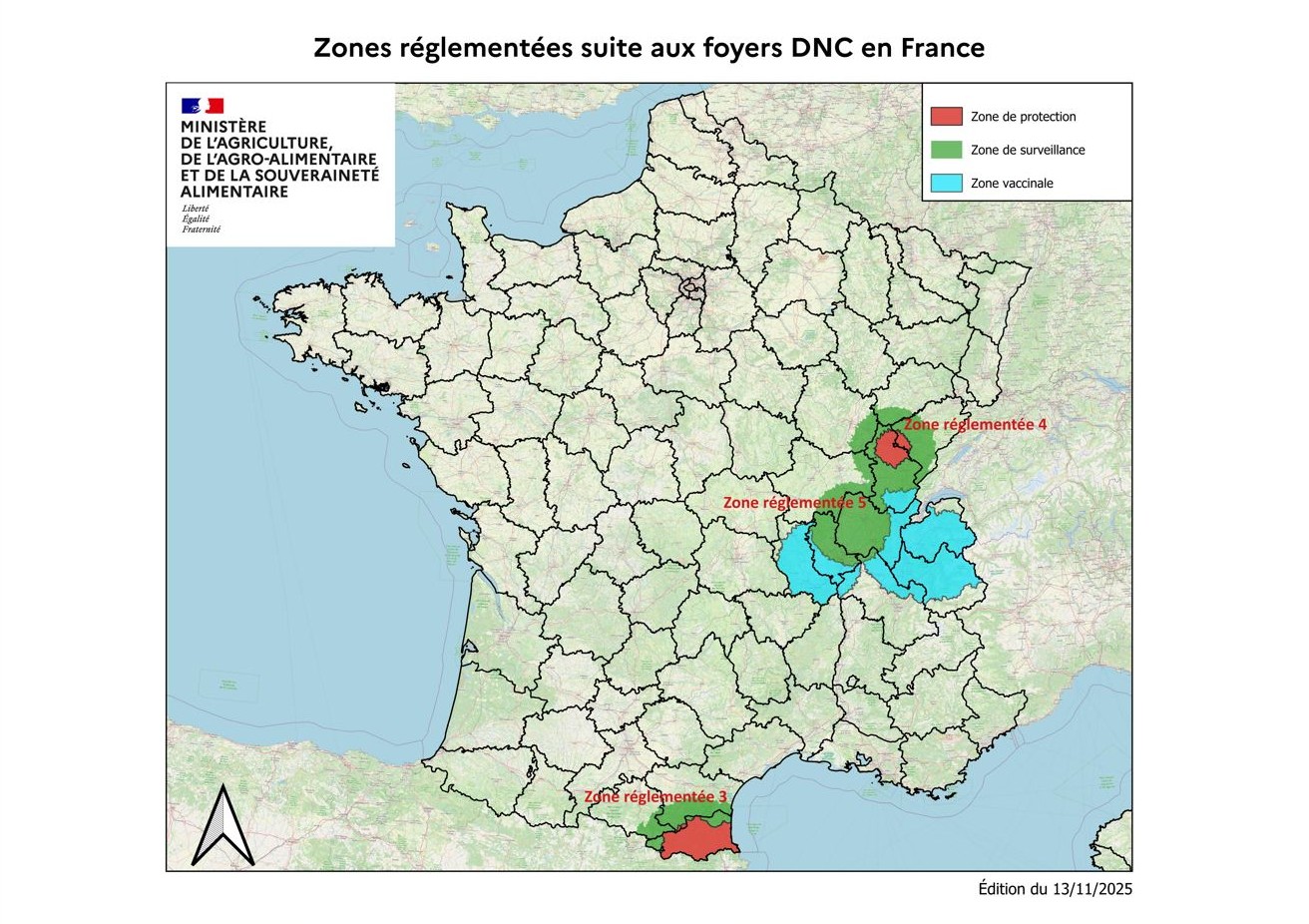
                        Regulated zones are established by prefectoral decree around each detected outbreak of non-communicable diseases (NCDs). They include:
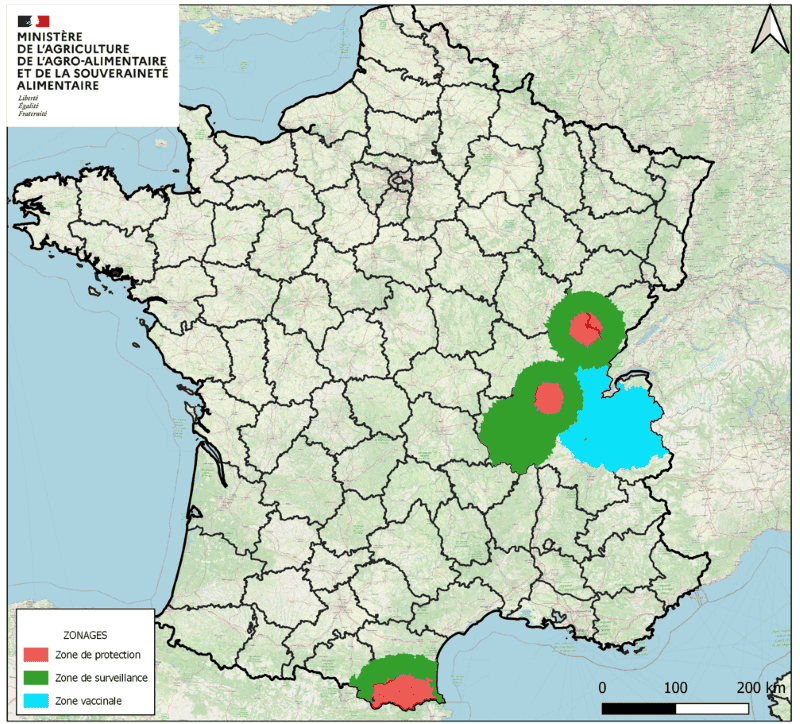
                        • a so-called "surveillance zone", within a radius of 50 kilometers around the outbreak, where preventive measures are applied (reinforced veterinary surveillance, disinsection), as well as restrictions on the movement of cattle aimed at preventing the disease from spreading to other farms by transporting cattle.
                        • A so-called "protection zone," within a 20-kilometer radius of the outbreak, is established where the same rules apply as in the surveillance zone, with even stricter measures regarding the movement of animals. If 28 days pass after the depopulation of the last infected farm, without the detection of other outbreaks, then the "protection zone" becomes a "surveillance zone."
                        Five regulated zones have been established in France:
                        1. The first regulated zone (ZR1) covered part of the departments of Jura, Isère, Ain, Savoie and Haute-Savoie, following outbreaks detected in Ain, Savoie and Haute-Savoie between June 29 and September 6. This regulated zone was lifted on October 22.
                        2. The second regulated zone (ZR2) covers part of the departments of Ain, Isère, Loire and Rhône, following the outbreak detected on September 18 in the Rhône. Within this regulated zone, the protection zone was moved to a surveillance zone (on October 20).
                        3. The third regulated zone (ZR3) was established following outbreaks detected in Spain in early October. The Spanish regulated zone initially extended to the southern part of the Pyrénées-Orientales department. With the emergence of outbreaks in Pyrénées-Orientales, this zone has expanded and, since October 15th, now covers the entire department, plus parts of Aude and Ariège.
                        4. The fourth regulated zone (ZR4) covers parts of the departments of Jura, Doubs, Côte-d'Or, Haute-Saône and Saône-et-Loire. It was established on October 11, following the confirmation of an outbreak in the town of Ecleux (Jura), where two other outbreaks were detected in the following days.
                        5. The fifth regulated zone (ZR5) was established following the detection of an outbreak in a farm in the Ain department on October 14th. This zone partially overlaps with ZR1, ZR2 and ZR4.
                        The lists of municipalities affected by these regulated zones are detailed on the websites of the DRAAF (Regional Directorates for Food, Agriculture and Forestry) of Auvergne-Rhône-Alpes , Bourgogne-Franche-Comté , and Occitanie . For more information on the zoning and population reduction measures, see section 5, "Management Measures," of our FAQ .

                        Corsica is not subject to a regulated zone. However, the National Steering Committee for Animal and Plant Health Policy (CNOPSAV) voted on August 28th in favor of preventive vaccination of all cattle farms in Corsica, in response to the threat of the disease spreading from Sardinia, which has been affected. This vaccination campaign began on September 1st and will last four months.

                        To learn more about the disease: consult our frequently asked questions .


                        La DNC a été détectée en France, pour la première fois, le 29 juin 2025 en Savoie. Cette maladie virale fortement préjudiciable à la santé des bovins (allant potentiellement jusqu’au décès) conduit à des pertes de production importantes du cheptel infecté. La DNC n’est pas transmissible à l’Homme, ni par contact avec des bovins infectés, ni par la consommation de produits issus de bovins contaminés, ni par piqûres d’insectes vecteurs.

                        Comment


                        • #27
                          Translation Google

                          Fontpédrouse
                          Bovine dermatosis: controversy after the abandonment of euthanized cow carcasses in the Canigou summer pastures

                          Baptiste Guiet
                          Published on Monday, November 3, 2025 at 7:50 PM
                          Updated onTuesday, November 4, 2025 at 7:15 AM

                          The carcasses of four cows slaughtered due to an outbreak of bovine lumpy skin disease have been abandoned for a week in the summer pastures of Fontpédrouse (Pyrénées-Orientales). This situation has outraged many farmers. The prefecture assures that it is studying solutions for their removal.

                          In the midst of the bovine lumpy skin disease crisis, the image is deeply disturbing: decomposing cow carcasses abandoned on the heights of the Carança Valley, in the heart of the Canigou massif. The four animals, three of which showed symptoms of the disease, were euthanized on Tuesday, October 28, in the middle of their summer grazing season.

                          The aim was indeed to intervene quickly, where the animals were located, in order to prevent, ultimately unsuccessfully, the spread of the virus to the rest of the alpine pasture. The cow carcasses were then left on site, in an enclosure located about a hundred meters from the Carança refuge .

                          "The two agents from the Departmental Directorate for the Protection of Populations (DDPP) present that day had absolutely no intention of having the carcasses removed," asserts Guillaume Husson, himself a livestock farmer in the Canigou massif and present during the culling operation. It was impossible, in fact, to get a truck up to the site , and the aerial option was also ruled out. "Yet, every year, we organize helicopter deliveries to supply the shepherds at high altitudes: it was unthinkable to me that the state services wouldn't proceed in the same way ," the farmer laments.

                          "We came across a group of hikers and I saw the incomprehension in their eyes."

                          A decomposing carcass left for vultures right next to a trail: the image is appalling for Guillaume Husson. "An animal dying in the high pastures happens, the birds of prey come to clean it up, it's the natural balance. But here, we have four cows dead for a week in a place frequented by tourists. I find that unacceptable. It's terrible for our image! We wanted these carcasses removed the same day. A few days ago, we came across a group of hikers and I saw the incomprehension in their eyes. It bothers me!"

                          In a letter addressed this Monday, November 3, to representatives of the Confédération paysanne 66, and which ICI Roussillon was able to consult, the prefect of Pyrénées-Orientales, Pierre Regnault de la Mothe, indicates that the prefecture "is in the process of identifying a logistical solution to proceed with the removal [of the carcasses] in the coming days, at the expense of the State services" .

                          According to the Ministry of Agriculture, a total of ten outbreaks of bovine nodular dermatosis have been identified in the Pyrénées-Orientales, where 250 animals have been slaughtered since the start of the epidemic .

                          Les carcasses de quatre vaches abattues pour cause d'épidémie de dermatose nodulaire bovine sont abandonnées depuis une semaine dans les estives de Fontpédrouse (Pyrénées-Orientales). Une situation qui scandalise de nombreux éleveurs. La préfecture assure étudier des solutions pour les évacuer.

                          Comment

                          Working...
                          X