• FluTrackers.com Inc. does not provide medical advice. Information on this web site is collected from various internet resources, and the FluTrackers board of directors makes no warranty to the safety, efficacy, correctness or completeness of the information posted on this site by any author or poster. The information collated here is for instructional and/or discussion purposes only and is NOT intended to diagnose or treat any disease, illness, or other medical condition. Every individual reader or poster should seek advice from their personal physician/healthcare practitioner before considering or using any interventions that are discussed on this website. By continuing to access this website you agree to consult your personal physican before using any interventions posted on this website, and you agree to hold harmless FluTrackers.com Inc., the board of directors, the members, and all authors and posters for any effects from use of any medication, supplement, vitamin or other substance, device, intervention, etc. mentioned in posts on this website, or other internet venues referenced in posts on this website.
  • We are not asking for any donations. Do not donate to any entity who says they are raising funds for us.

WVa: 9 counties without water, state capital shut down due to coal mining industrial chemical spill

Emily

Editor, Senior Moderator
http://www.hawaiinewsnow.com/story/24413766/chemical-spill-brings-wva-capital-to-standstill
Chemical spill shuts down much of W.Va. capital
Posted: Jan 10, 2014 1:41 AM PST Updated: Jan 10, 2014 12:19 PM PST

By JOHN RABY
Associated Press

CHARLESTON, W.Va. (AP) - Schools and restaurants closed, grocery stores sold out of bottled water, and state legislators who had just started their session canceled the day's business after a chemical spill in the Elk River in Charleston shut down much of the city and surrounding counties even as the extent of the danger remained unclear.

The federal government joined the state early Friday in declaring a disaster, and the West Virginia National Guard planned to distribute bottled drinking water to emergency services agencies in the nine affected counties. In requesting the federal declaration, which makes federal resources available to the state, state officials said about 300,000 people were affected...

http://www.wchstv.com/newsroom/eyewitness/140110_22300.shtml
OSHA Investigating Spill To Assess Worker Safety, Health Issues

Reported: Jan. 10, 2014 4:54 PM EST

CHARLESTON, W.Va. (AP) -- The Occupational Safety and Health Administration is investigating a chemical spill in Charleston to assess potential worker health and safety issues.

The agency said it began inspecting Freedom Industries' facility on Friday.

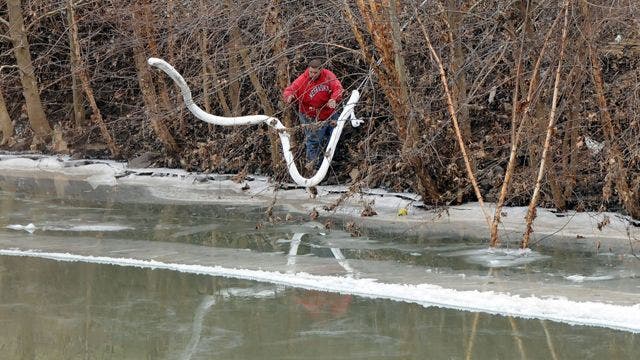
A chemical used in the coal preparation process leaked from a tank at the facility into the Elk River on Thursday...
 
Re: WVa: 9 counties without water, state capital shut down due to coal mining industrial chemical spill

Hundreds in W. Va. report exposure symptoms after crippling chemical spill

Published January 11, 2014FoxNews.com


...Hundreds of West Virginia residents are complaining of exposure symptoms after a crippling chemical spill compromised the public water supply for thousands of people and forced the closure of schools businesses, and restaurants in the state capital.
By Friday evening, 737 people had called the West Virginia Poison Center to report concerns or symptoms related to the spill, including nausea, vomiting, dizziness, diarrhea, rashes and reddened skin, state health officials told Reuters.
Dr. Elizabeth Scharman, director of the state's poison control center, said the symptoms vary "from very mild to much more bothersome.'' She told Reuters at least 70 people have been seen by an emergency room doctor, though only a handful have been admitted to hospitals.
About 300,000 people in nine counties entered their third day Saturday without being able to drink, bathe in, or wash dishes or clothes with their tap...:tiphat:http://www.foxnews.com/us/2014/01/1...r-crippling-chemical-spill/?intcmp=latestnews
 
Re: WVa: 9 counties without water, state capital shut down due to coal mining industrial chemical spill

http://triblive.com/usworld/nation/5401446-74/west-virginia-charleston#axzz2qGvhJ6QI
By USA Today

Published: Saturday, Jan. 11, 2014, 8:21 p.m.

Read more: http://triblive.com/usworld/nation/5401446-74/west-virginia-charleston#ixzz2qGwAWAde
...
The water that comes out of the taps is ?gross,? said Jane Haley, 48, in Charleston. ?It's hard to describe how bad it smells.?

Saturday was rainy, ?so I put out two coolers out and filled them up with rainwater. I heated the water up on (the) stove and used it to wash my hair,? she said.

Others were more direct.

?I was laying in bed this morning, and I heard the rain and I thought, ?Thank God!' ? said Debbie Stevens, 54.

The Charleston resident grabbed her shampoo and conditioner and went outside to stand in her pajamas under a leaky gutter that was pouring rainwater.

?I washed my hair, and then I came in and used my wet pajamas to take a horse bath,? she said.

Read more: http://triblive.com/usworld/nation/5401446-74/west-virginia-charleston#ixzz2qGw1dYfH
Follow us: @triblive on Twitter | triblive on Facebook


January 10, 2014
What is 'Crude MCHM'? Few know
By Ken Ward Jr.

http://www.register-herald.com/todaysfrontpage/x1186920902/UPDATED-5-hospitalized-lawsuits-filed-in-wake-of-chemical-spill
Friday afternoon, West Virginia National Guard Adjutant Maj. Gen. James Hoyer said the chemical had dissipated from 2 parts per million Thursday to 1.7 parts per million. Hoyer said 1 part per million is an acceptable level of Crude MCHM in water, according to the Centers for Disease Control. At .1 part per million, the odor associated with the chemical is no longer detectable, he said.


January 11, 2014
Scientists cobble together ad-hoc water limit
by Ken Ward Jr.
Staff writer
 
Re: WVa: 9 counties without water, state capital shut down due to coal mining industrial chemical spill

Media Advisory

For Immediate Release
Friday, January 17, 2014

2014 West Virginia Chemical Release

river.jpg
What is MCHM?

4-methylcyclohexanemethanol (MCHM) is a chemical used to process coal. MCHM does not explode or catch fire. As a class of organic alcohols, it has an obvious odor and is reported to smell like licorice.
What is the acceptable level of MCHM in drinking water?

There should be no MCHM in drinking water. Following a chemical release, communities may need to determine when it would be appropriate to issue an alert about the potential risks of drinking water with low levels of MCHM present. Scientists have recommended a screening level of 1 ppm (parts per million) for drinking water. A level of 1ppm or below is not likely to be associated with any adverse health effects. Additionally, the public may continue to use tap water for cooking. It is also safe to consume food which may have been prepared using tap water, as with food cooked in restaurants. Also, there is no known risk for bathing.
Due to limited availability of data, and out of an abundance of caution, pregnant women may wish to consider an alternative drinking water source until the chemical is at non-detectable levels in the water distribution system. For mothers with babies, there is no research that suggests consuming water with these low levels of MCHM poses any health risk to their baby. However, if you have any concerns, please consult your doctor.
How was the 1 ppm level calculated?

Few studies on this specialized chemical exist and most have been conducted on animals. Scientists used the limited information available about this chemical to calculate how much MCHM a person could ingest without resulting in adverse health effects. These calculations use uncertainty factors to take into account the differences between animals and people and to consider possible effects on special populations. An additional factor was applied to account for the limited availability of data. Based on the application of these uncertainty factors and the available research studies, scientists recommend a screening level of 1 part per million (1 ppm), or lower, of MCHM in drinking water.
CDC used the following calculation to establish a screening level of 1 part per million (ppm) for the MCHM spill in the Elk River:
mchm_calculation.jpg
Where:

  • DW Advisory = Drinking Water Advisory
  • NOEL = No Observed Effect Level in the experimental species (100 mg/kg/day)
  • BW = Body weight of a child (10 kg)
  • UF = Uncertainty factors that address differences between animals and humans (10X), address differences accounting for sensitive humans (10x), and account for weaknesses in the toxicological database (10X).
  • Intake = The estimated intake from drinking water of a 10 kg child (1 liter/day).
NOEL (mg/kg/d) BW (kg) UF (unitless) Intake (L/day) DW Advisory (mg/L or ppm) 100 10 1000 1 1 What studies were used in calculating the 1ppm recommendation?

Although we evaluated several studies obtained from the manufacturer of MCHM, the recommended level of 1ppm was based on one study, the Pure MCHM 28 Day Daily Oral Study. This was the only study available that provided an estimate of the dose in test animals that was not associated with any observed effects or the NOEL.
We then extrapolated downwards to come up with the recommendation for a level that we believe would not be associated with any adverse health effects. This methodology is widely accepted and commonly used in environmental public health and risk assessment.
Pure MCHM 28 Day Daily Oral Study Details - Rats received 0, 25, 100, and 400 mg/kg/day, 5 days a week, for 4 weeks. In this study, the administration of 400 mg/kg/day for 4 weeks was associated with erythropoietic, kidney, and liver effects, including increased liver weight, inflammation, and kidney tubular degeneration. The study determined that the No Observed Effect Level was 100 mg/kg/day.
Additional Information


http://emergency.cdc.gov/chemical/MCHM/westvirgina2014/index.asp
 
Re: WVa: 9 counties without water, state capital shut down due to coal mining industrial chemical spill

http://www.cnn.com/2014/01/16/us/west-virginia-contaminated-water/
How safe is West Virginia tap water, if pregnant women shouldn't drink it?
By Catherine E. Shoichet. Jean Casarez and Ashley Fantz, CNN
updated 11:00 PM EST, Thu January 16, 2014

...

The Centers for Disease Control and Prevention have said as long as the chemical is diluted enough, the water should be safe to drink.

But other experts say they aren't so sure, because studies about the chemical -- 4-methylcyclohexane methanol -- are sparse, and investigators are still looking into them.

"Due to limited availability of data, and out of an abundance of caution, you may wish to consider an alternative drinking water source for pregnant women until the chemical is at non-detectable levels in the water distribution system," CDC director Dr. Thomas Frieden said in a letter to West Virginia health officials advising them on the situation.

It's not uncommon for officials to issue different guidance for pregnant women, who are considered to be more vulnerable to illness than the general population. One reason why: even when chemicals have been studied, research into the impact on pregnant women is less common...
 
Back
Top Bottom