• FluTrackers.com Inc. does not provide medical advice. Information on this web site is collected from various internet resources, and the FluTrackers board of directors makes no warranty to the safety, efficacy, correctness or completeness of the information posted on this site by any author or poster. The information collated here is for instructional and/or discussion purposes only and is NOT intended to diagnose or treat any disease, illness, or other medical condition. Every individual reader or poster should seek advice from their personal physician/healthcare practitioner before considering or using any interventions that are discussed on this website. By continuing to access this website you agree to consult your personal physican before using any interventions posted on this website, and you agree to hold harmless FluTrackers.com Inc., the board of directors, the members, and all authors and posters for any effects from use of any medication, supplement, vitamin or other substance, device, intervention, etc. mentioned in posts on this website, or other internet venues referenced in posts on this website.
  • We are not asking for any donations. Do not donate to any entity who says they are raising funds for us.

Worldwide: 24 confirmed cases due to novel animal nCoV coronavirus - 16 fatalities - September 20, 2012 - May 2, 2013

Re: Saudi Arabia: 3 cases, 2 deaths due to novel animal coronavirus

Re: Saudi Arabia: 3 cases, 2 deaths due to novel animal coronavirus

===
The head of the country’s public health authority, Mohammed bin Hamad Al Thani, said the infected Qatari had “been treated in Qatar for two months before being transferred to London.”
http://m.gulfnews.com/news/gulf/saudi-arabia/saudi-downplays-impact-of-virus-on-haj-1.1081129
===
British Health protection officials are testing more than 30 health care workers who have come in contact with the Qatari patient.
“It’s still [in the] very early days,” said Gregory Hartl, a WHO spokesman. “At the moment, we have two sporadic cases and there are still a lot of holes to be filled in.”
He added it was unclear how the virus spreads. Coronaviruses are typically spread in the air but Hartl said scientists were considering the possibility that the patients were infected directly by animals.
http://gulfnews.com/news/world/other-world/five-more-with-sars-like-virus-1.1081384
===
“WHO is working closely with the Kingdom of Saudi Arabia, as in previous years, to support the country’s health measures for all visitors participating in the hajj pilgrimage to Makkah next month,” the World Health Organisation (WHO) said in a statement.
http://www.thenews.com.pk/Todays-News-1-134294-WHO-advising-Saudis-on-virus-ahead-of-Haj
===
"The Health Ministry has taken preventative measures to deal with the influx of over 2 million Haj pilgrims," Ziad Memish, the deputy minister for public health, told Reuters. "The measures include monitoring the entrances through land, sea and air to evaluate the people entering and obtain samples if any symptoms are apparent,"
http://www.reuters.com/article/2012/09/26/us-haj-infection-idUSBRE88P0VF20120926
===
ScienceInsider talked to Ron Fouchier, a virologist at Erasmus MC in Rotterdam, the Netherlands, who sequenced the virus's genome and concluded that the Saudi and Qatari patients most likely are infected with the same virus. Questions and answers have been edited for brevity and clarity.
http://news.sciencemag.org/scienceinsider/2012/09/ron-fouchier-on-the-new-coronavi.html
===
 
Re: Saudi Arabia: 3 cases, 2 deaths due to novel animal coronavirus

Re: Saudi Arabia: 3 cases, 2 deaths due to novel animal coronavirus

The head of the country's public health authority, Mohammed bin Hamad Al-Thani, said the infected Qatari had ?been treated in Qatar for two months before being transferred to London.?

This is not true - There are multiple media reports in this thread including a report from WHO (link) that this individual presented with symptoms on September 3, 2012. He was not treated in Qatar for two months before being transferred to the UK.
<object style="position:absolute;z-index:1000" type="application/x-dgnria" id="plugin0" height="0" width="0">

</object>
 
Re: Saudi Arabia: 3 cases, 2 deaths due to novel animal coronavirus

Re: Saudi Arabia: 3 cases, 2 deaths due to novel animal coronavirus

Tunisia Ministry of Health tells citizens not to worry about the new coronavirus. This news release refers to 4 total patients. I am not sure if this is true or not.

machine translation

The Ministry of Public Health confirms that the virus "crowns" does not represent a threat to the Tunisian pilgrims.

Thursday, September 27, 2012 - 01:02 PM
Reassured the Ministry of Public Health in a communiqu? issued her day pilgrims this year with attached monitor 4 cases infected with influenza "crowns" Saudi Asaudihmhirh that it is not to worry or concern given that these injuries are isolated cases have been diagnosed with three of them at the level clinical while signed sure one Mkhbayrh, so it has confirmed the Ministry of Public Health that the disease remained confined and were no cases of infection from human to human. and noted author himself that the World Health Organization declared the absence of contraindications to travel to holy sites and not the need for action The meeting further (such as vaccinations) and sufficiency precautions SSG transmitted diseases by breathing. This has confirmed the Ministry of Public Health that the health situation reassuring and invited pilgrims Tunisians to respect the rules of keeping physical health, for their own safety and health with the need to focus on personal hygiene and Wash hands frequently and the ministry has confirmed its commitment to pursue the epidemiological situation for providing the best health conditions for pilgrims in Miami until they return to the homeland health and wellness.


http://diyar.charlesayoub.com/index.php/article-details/150195
 
Re: Saudi Arabia: 3 cases, 2 deaths due to novel animal coronavirus

Re: Saudi Arabia: 3 cases, 2 deaths due to novel animal coronavirus

The Egyptian MOH will be giving a free N100 mask to each person who gets the vaccines required for the visa to the Hajj in Saudi Arabia.

Minister of Health spent 100 free mask each pilgrim for the prevention of the virus, "Corona"
Hossam Zayed
26-9-2012 | 18:35 230

Minister of Health
Issued Dr. Mohammad Mustafa Hamid, Minister of Health and Population, a decision regardless 100 mask for free each pilgrim went to the Office of Health to take the vaccinations required for Hajj, and that measure is important for the prevention of viruses, including influenza virus new "Corona." explained Dr. Maher Hashem sentences, Deputy Director in quarantine preventive medicine at the Ministry of Health, that the influenza virus, "Corona" does not appear in Egypt at all, and 3 cases only are popping up in Saudi Arabia since last July, and although the virus is lethal but that eating Vaccination against seasonal influenza before traveling to the Hajj Ten days and is available in all health offices of the ministry, can spare pilgrims infection, in addition to vaccinations other requested by Saudi Arabia for a visa Hajj and Umrah. it also must follow a number of Altalmyat important for the prevention of infection, including washing hands constantly with personal hygiene and change visor 3 times a day, and not to be subjected to crowded places and lack of direct exposure to sunlight.

http://gate.ahram.org.eg/NewsConten...-يصرف-١٠٠-قناع-واقٍ-مجانًا-لكل-حاج-للوقا.aspx
 
Re: Saudi Arabia: 3 cases, 2 deaths due to novel animal coronavirus

Re: Saudi Arabia: 3 cases, 2 deaths due to novel animal coronavirus

The Health Minister of Algeria accuses the pharmaceutical industry of confusing pilgrims about the new coronavirus to sell medicines and vaccines before the Hajj.


ealth Minister Abdelaziz Ziari accused
Foreign laboratories behind the launch of a virus'' Corona'' to sell the vaccine
Thursday, September 27, 2012 Algeria: Zoubir Fadel


Accused the Minister of Health and Hospital Reform, Abdelaziz Ziari, yesterday, laboratories foreign standing behind the launch of virus'' Corona'' to confuse the pilgrims and selling vaccine, adding that all medicines and masks available for 63 thousand pilgrims Algerian holy sites, starting from yesterday, with the arrival of the first Regiment of pilgrims.
reduced Ziari told Khabar, on the sidelines of the launch of the first flight of pilgrims from Houari Boumediene airport in Algiers, the risk of SARS virus'''', which is a new strain of virus'' Corona'' he said, adding that'' the World Health Organization did not inform us any information regarding this virus''. He'' is about Palmkhabr foreign seeking every autumn to launch viruses to be able to sell medicines, vaccines and make a profit'', suggesting that the current situation coincides with the Hajj season where will be present more than 3 million pilgrims in Saudi Arabia, allowing achievement of the goal of these laboratories.

more...

http://www.elkhabar.com/ar/watan/304020.html
 
Re: Saudi Arabia: 3 cases, 2 deaths due to novel animal coronavirus

Re: Saudi Arabia: 3 cases, 2 deaths due to novel animal coronavirus

Hat-tip Treyfish. An interview with the brother of the man in the ICU in London. This article suggests the man is showing some signs of improvement.

http://www.raya.com/news/pages/e931b338-d344-49a5-9977-de0a33923dfe

Health Council last to know the evolution of the case of a patient "Corona" the brother of the patient "Corona": Prince expenses Alalajthassan ensure that if citizen injured PAL "Corona"
Council did not know about the situation until after the announcement of the news from the World Health
Family transferred him to London Swiss plane
Hamad Hospital refused to move without endorsing his brother to take responsibility
? Statement of Health to transfer the patient from British Hamad Hospital is real
? Do not follow health "health" of the patient since his illness, otherwise why not Ieljoh before aggravation of his condition?
? talk about injuring my brother kidney failure is incorrect
? We turned to a private hospital after doctors failed Hamad to remedy the situation
? WHO urges doctors around the world to report any case
Books - Ibrahim Badawi:

Confirmed brother patient Qatari infected with "Corona" new, and lying now at a hospital in Britain, that if his brother is stable and gradually improving, contrary to what appeared in the news agencies, and after that began to move his eyes two days ago, also receded pneumonia testimony doctors, pointing that the state sponsored treatment expenses.

He told the flag: The lung brother was inflamed and Off 90% upon arrival at the hospital, "غيز Land St. Thomas" British past 15 days, they are beginning to recover after being placed on a respirator, pointing out that despite the situation remains critical but doctors They stabilize the heartbeat and oxygen in the blood and despite the presence of some kidney infections, but they seem to be in better condition than in the beginning of the [virus] infection.

He criticized what he described as the lack of transparency about the statement of the Supreme Council of Health announcing the transfer of the patient from Hamad Hospital, the British is the truth .. Stressing that the patient's family transferred him by helicopter Swiss at their own expense after Hamad Hospital's request for special equipment on board .. Stressing on the falsity of the statement on the follow-up of the Supreme Council of the patient for some time, but they treated him from the beginning by the worsening of the situation.

He stressed that the Supreme Council of Health did not know anything about the case of his brother only after the announcement of the news by the British Ministry of Health and the World Health Organization, and the Council was wrong in mentioning about the suffering of his brother from kidney failure two months ago .. Pointing out that the flight details sick to his brother began after returning from Umrah week where began to feel shortness of breath and cough, flu and was transferred him to a hospital Hamad Medical doctors giving him some antibiotics after measuring pressure, diabetes and heart and told him it was fine and that the problem lies in the slight increase in cholesterol .. Adding: not diagnostic well as continued suffering of my brother and we went by subsequently to a private hospital gave him an injection antibiotic severe called "Tstroyn" may have led to irritation virus strongly as resulted in a serious deterioration in his condition occurred narrow severe breathing we have quoted then to hospital Hamad again.

He continued: did not stay my brother Hospital Hamad only one night, the next day, we asked to move on our ambulance jumper for treatment in London and the hospital to communicate by helicopter from Dubai but they were not to have the necessary equipment to transport the patient was contacted by plane other Swiss by some friends and we are moving at our own expense and we have receipts to prove it.

He pointed out that immediately after the arrival of his brother to the hospital was put on a respirator to work on the rest lung, which suffered a lot during that period and two of his brothers to the hospital along with his sons accompany him now.

In a telephone conversation's flag with sister facilities to the patient in London, assured us that the state of his brother in a continuous improvement since 4 days, and pneumonia down the testimony of doctors who expressed optimism improved the situation, and they did not expect this development in light of the start of the patient to restore awareness The feeling of those around him.

He said: transfer my brother to London has the efforts of personal full, where Hamad Hospital refused to move claiming that it will not bear the travel only approved after it signed to approve moving on my own responsibility, has been ordered aircraft from Dubai, but they were not equipped and asked again through our personal relationship of Zurich, Switzerland, at our own expense.

On a reported injury brother acute kidney failure, he said that this is totally false and claims to prove securities official and vice versa, the case of his brother, significantly improved the testimony of doctors.

Dr. Mohammed Al-Hajri Director health protection and disease control transitional Supreme Council of Health said he was introduced patient dated September 8 intensive care in Hamad General Hospital before deteriorating condition were then sent the patient to London to undergo Vhsoat at the hands of the Committee of health protection (HBA) as supplied to him medical evacuation aircraft, while the World Health Organization declared the Qatari citizen diagnosed with a virus looks like severe acute respiratory syndrome "(SARS)," which he called "Corona" after returning from performing Umrah at the end of the last month of Ramadan.

In context, the World Health Organization urged yesterday in the medical field in various parts of the world to report any patient infected with severe respiratory and may have traveled to Saudi Arabia or Qatar and subjected to a new virus-like virus Severe Acute Respiratory Syndrome (SARS) .. The guidance Medical Health Organization for up to 194 member states that the medical personnel attention to anyone symptoms injury severe respiratory and possible rise in temperature accompanied by cough and require his treatment in the hospital and was in the area discovered the virus or been in contact with the case confirmed or suspected during the previous ten days.

The virus is defined as the coronary virus is linked to the roles the usual cold and belongs to the same family of virus Severe Acute Respiratory Syndrome (SARS), which appeared in China in 2002 and infected 8,000 people worldwide and caused the death of 800 before control.

The link between the virus and Saudi Arabia to raise concern, especially with the near Hajj season where millions flock to Saudi Arabia to perform the Hajj .. The World Health Organisation (WHO) said it had identified a group of laboratories that can provide experts in the coronal virus states that you need.
 
Re: Saudi Arabia: 3 cases, 2 deaths due to novel animal coronavirus

Re: Saudi Arabia: 3 cases, 2 deaths due to novel animal coronavirus

[Source: Centre for Health Protection, Hong Kong PRC SAR, full text: (LINK).]

Update on overseas human cases with novel coronavirus infection


The Centre for Health Protection (CHP) of the Department of Health today (September 27) provided an update on developments and its work following the report by the World Health Organization (WHO) on human cases with novel coronavirus infection in two patients from the Kingdom of Saudi Arabia (KSA) and Qatar.

A spokesman for the CHP said that other than the two patients reported by the WHO, another five suspected cases of novel coronavirus infection had been admitted to a hospital in Denmark. According to the information released by the hospital, all the five patients were in fact suffering from influenza B infection.

"As such, the total number of laboratory confirmed cases of novel coronavirus worldwide so far remains at two," the spokesman said.

As regards the progress of the legislative preparations to include the novel coronavirus as a notifiable infectious disease under the law, the spokesman said that the work is now in full swing and the relevant legislative amendments will be gazetted tomorrow (September 28) with immediate effect.

The spokesman pointed out that under the amendments, "Severe Respiratory Disease associated with Novel Coronavirus" will be added to the list of infectious diseases specified in Schedule 1 as a statutorily notifiable disease, and the virus to the list of infectious agents in Schedule 2 under the Prevention and Control of Disease Ordinance, Cap. 599.

With the amendments, medical practitioners are required to notify the Director of Health if they have reason to suspect the existence of this disease, and persons in charge of a laboratory are required to notify any leakage of the virus in the laboratory that may pose a public health risk. In addition, the Director may exercise his power to institute relevant border control measures for travellers having regard to the development in the affected areas.

The amendments add to Hong Kong's protection against the disease by facilitating early disease detection, preventing laboratory-acquired infection and enabling the implementation of appropriate public health measures if they are called for, depending on public health risk assessment.

"The CHP will issue letters to doctors and the medical laboratory sector to inform them of the relevant legislative amendments," the spokesman said.

"We will continue to keep a close watch on the latest developments and liaise with international health partners on the progress of further epidemiological investigations and surveillance, and the corresponding advice from the WHO," he added.


Ends/Thursday, September 27, 2012
Issued at HKT 19:36
NNNN
- ------
 
Re: Saudi Arabia: 3 cases, 2 deaths due to novel animal coronavirus

Re: Saudi Arabia: 3 cases, 2 deaths due to novel animal coronavirus

http://www.google.com/hostednews/uk...y2XfkyDpz2NRdUTBw?docId=N0434941348743771002A

'New virus' man in stable condition
(UKPA) ? 11 hours ago
A man who contracted a potentially fatal Sars-like virus is now in a stable condition.

The 49-year-old, from Qatar, is being treated in an intensive care unit at St Thomas' hospital in London after he became infected with a new type of coronavirus.

A spokesman for the hospital confirmed that the man, who is still in isolation and is connected to an artificial lung to keep him alive, has been in a stable condition for the last two days.

He is receiving extracorporeal membrane oxygenation (Ecmo) treatment, which delivers oxygen to the blood outside the body when the lungs are not able to. It also continuously pumps blood into and around the body.

The man, who was suffering from acute respiratory syndrome and renal failure, was admitted to an intensive care unit in Doha, Qatar, on September 7. He was transferred to the UK by air ambulance on September 11.

Before he became ill he had travelled to Saudi Arabia, the World Health Organisation said.

The Health Protection Agency (HPA) said the man has contracted a "new virus" which has only been identified in one other case. That patient, a 60-year-old from Saudi Arabia, died as a result of the virus.

A HPA spokeswoman said preliminary inquiries had found no contact between the two patients.

The organisation is also investigating a "small number" of cases which could be linked to the virus. One patient, who travelled to the Middle East in the last three months, was treated in the UK but has since died, the HPA said.

Coronaviruses cause most common colds but can also cause Sars (severe acute respiratory syndrome). In 2003, hundreds of people died after a Sars outbreak in Asia.
 
Re: Saudi Arabia: 3 cases, 2 deaths due to novel animal coronavirus

Re: Saudi Arabia: 3 cases, 2 deaths due to novel animal coronavirus

http://www.cidrap.umn.edu/cidrap/content/other/sars/news/sep2712corona.html

Full genome sequence of novel coronavirus expected shortly
Lisa Schnirring Staff Writer


Sep 27, 2012 (CIDRAP News) ? British health officials said today that a Rotterdam lab that first characterized the novel coronavirus linked recently to two severe illnesses hopes to publish the whole genome in the next 24 to 48 hours, and the UK's Health Protection Agency (HPA) launched guidance to help clinicians investigate and manage possible cases.

The HPA said in an update that the full genome sequence will be published by Ron Fouchier, PhD, based at Erasmus University in the Netherlands. The sequence will be based on cultured virus that has been at the lab since early July.

Yesterday the agency gave the same time frame for release of the full sequence and did not change the estimate in today's update.

The HPA had earlier released the partial sequence for the virus's polymerase gene, obtained from an infected patient undergoing treatment in London, which enabled scientists to compare it with others and determine that the new virus is related to bat coronaviruses. The HPA said it doesn't yet have a viral isolate, but clinical material from the patient is being cultured to make isolates.

Also, the HPA shared new details about molecular diagnostics for identifying the new virus. It said pan-coronavirus primers described by an international group of researchers in 2003 and in a 2008 report from Belgian researchers should both be useful. However, the clinical material the HPA has does not react with specific assays it has for OC23, 229E, NL64, or SARS. It said it welcomed offers of reagents and information from scientists who specialize in the area.

In other developments, the HPA published some clinical tools to help clinicians manage suspected and confirmed cases along with close contacts. The tools include an algorithm for investigating and managing possible cases; it describes the testing process, protective actions to take if an infection is confirmed, and the next steps to take for sample collection and data reporting.

Another algorithm walks clinicians through investigating close contacts of patients with confirmed novel coronavirus infections. For contacts who don't have clinical symptoms during the initial visit, the HPA recommends that baseline clotted blood samples be taken as soon as possible, ideally no later than 7 days after exposure. The algorithm recommends that follow-up samples be taken at least 14 days after baseline or 28 days after exposure if a sample couldn't be taken when the case-patient was asymptomatic. It says a contact form should be completed 10 days after the initial data is collected.

The HPA also issued a nine-page infection control resource for handling confirmed and suspected cases. It noted that coronaviruses are mainly transmitted by large respiratory droplets and direct or indirect contact with secretions. The agency also said the viruses can be detected in feces and urine and in some instances can be transmitted by aerosolized respiratory droplets and feces. It detailed steps to take in addition to standard precautions, such as what type of respirator and personal protective equipment (PPE) to use.

In developments elsewhere, Hong Kong's Centre for Health Protection (CHP) said today that the process to make novel coronavirus infection a notifiable disease is under way. It said a legislative amendment will be recorded tomorrow, taking effect immediately. Health practitioners will be required to notify the CHP's director of health if they suspect the disease, and labs will be required to report virus leaks that may pose a public health risk.

No new infections involving the novel coronavirus have been detected beyond the Qatari man hospitalized with a severe respiratory illness and renal failure in a London intensive care unit and a 60-year-old Saudi Arabian man who was infected with a virtually identical virus who died in June.

The identification of a new coronavirus has raised global health worries, because a then-novel one in 2003 caused the SARS epidemic that sickened 8,422 people, killing 916 of them. Health officials have said the new virus is clearly different than the one that caused SARS, and some have said that an animal source can't be excluded.
 
Re: Saudi Arabia: 3 cases, 2 deaths due to novel animal coronavirus

Re: Saudi Arabia: 3 cases, 2 deaths due to novel animal coronavirus

[Source: Eurosurveillance, full text: (LINK). Edited.]

Eurosurveillance, Volume 17, Issue 39, 27 September 2012

Rapid communications


Detection of a novel human coronavirus by real-time reverse-transcription polymerase chain reaction

V M Corman<SUP>1</SUP>, I Eckerle<SUP>1</SUP>, T Bleicker<SUP>1</SUP>, A Zaki<SUP>2</SUP>, O Landt<SUP>3</SUP>, M Eschbach-Bludau<SUP>1</SUP>, S van Boheemen<SUP>4</SUP>, R Gopal<SUP>5</SUP>, M Ballhause<SUP>3</SUP>, T M Bestebroer<SUP>4</SUP>, D Muth<SUP>1</SUP>, M A M?ller<SUP>1</SUP>, J F Drexler<SUP>1</SUP>, M Zambon<SUP>5</SUP>, A D Osterhaus<SUP>4</SUP>, R M Fouchier<SUP>4</SUP>, C Drosten ()<SUP>1</SUP>
  1. Institute of Virology, University of Bonn Medical Centre, Bonn, Germany
  2. Virology Laboratory, Dr Soliman Fakeeh Hospital, Jeddah
  3. TibMolbiol, Berlin, Germany
  4. Department of Virology and Virosciences, Erasmus Medical Centre, Rotterdam, The Netherlands
  5. Health Protection Agency (HPA), London, United Kingdom
<HR>
Citation style for this article: Corman VM, Eckerle I, Bleicker T, Zaki A, Landt O, Eschbach-Bludau M, van Boheemen S, Gopal R, Ballhause M, Bestebroer TM, Muth D, M?ller MA, Drexler JF, Zambon M, Osterhaus AD, Fouchier RM, Drosten C. Detection of a novel human coronavirus by real-time reverse-transcription polymerase chain reaction. Euro Surveill. 2012;17(39):pii=20285. Available online: http://www.eurosurveillance.org/ViewArticle.aspx?ArticleId=20285
Date of submission: 27 September 2012
<HR>
We present two real-time reverse-transcription polymerase chain reaction assays for a novel human coronavirus (CoV), targeting regions upstream of the E gene (upE) or within open reading frame (ORF)1b, respectively. Sensitivity for upE is 3.4 copies per reaction (95% confidence interval (CI): 2.5?6.9 copies) or 291 copies/mL of sample. No cross-reactivity was observed with coronaviruses OC43, NL63, 229E, SARS-CoV, nor with 92 clinical specimens containing common human respiratory viruses. We recommend using upE for screening and ORF1b for confirmation. <HR>

Introduction

Coronaviruses (CoV) are large positive-stranded RNA viruses causing mainly respiratory and enteric disease in a range of animals and in humans. Humans are known to maintain circulation of four different human coronaviruses (hCoV) at a global population level. These are part of the spectrum of agents that cause the common cold. The SARS-CoV constitutes a fifth hCoV, which was in circulation for a limited time during 2002 and 2003, when a novel virus appeared in humans and caused an outbreak affecting at least 8,000 people. Mortality was high, at ca. 10% [1]. Symptoms matched the clinical picture of acute primary viral pneumonia, termed severe acute respiratory syndrome (SARS).

During September 2012, health authorities were notified of two cases of severe hCoV infection caused by a novel virus type. Both patients had travelled, or resided, in Saudi Arabia.

Laboratories dealing with each of these unlinked cases were situated in Jeddah, Rotterdam and London, respectively.

In a collaborative activity co-ordinated by major European and national epidemic response networks we have developed diagnostic real-time reverse-transcription polymerase chain reaction (RT-PCR) assays suitable for qualitative and quantitative detection of the new agent. Here we summarise the technical evaluation and analytical performance of these assays.


Materials and Methods
Template for design of assays
A provisional genome sequence as well as an isolate of the new virus were obtained from author RM Fouchier on 24 September 2012, after public notification of the second case case, who was in the United Kingdom (UK), to be most probably infected by the same virus as the first case, yet unrelated. The sequence (GenBank accession number: JX869059 for the Rotterdam virus isolate, termed hCoV-EMC) served as the template for assay design, and the virus was used for initial validation experiments.


Clinical samples
Respiratory swab, sputum, and endotracheal aspirate material was obtained during 2010?2012 from several hospital wards of the University of Bonn Medical Centre.


Cell culture
Vero cells were infected with a the cell culture isolate (unpublished data) at two different doses (multiplicities of infection (MOI) of ca. 0.1 and ca. 10 TCID50 per cell) and harvested after 0, 12, 24, and 36 hours for RT-PCR analysis.


RNA extraction
RNA was extracted from the samples as described earlier [2] by using a viral RNA mini kit (Qiagen). Sputum samples were pretreated with 2? sputum lysis buffer (10 g of N-acetylcysteine/litre, 0.9% sodium chloride) for 30 minutes in a shaking incubator. Swabs were immersed in lysis buffer.


Real-time reverse-transcription polymerase chain reaction screening assay upstream of E gene (upE assay)

A 25-μl reaction was set up containing 5 μl of RNA, 12.5 μl of 2 X reaction buffer provided with the Superscript III one step RT-PCR system with Platinum Taq Polymerase (Invitrogen; containing 0.4 mM of each dNTP and 3.2 mM Magnesium sulfate), 1 μl of reverse transcriptase/Taq mixture from the kit, 0.4 ?l of a 50 mM magnesium sulfate solution (Invitrogen ? not provided with the kit), 1 μg of non-acetylated bovine serum albumin (Sigma), 400 nM concentrations of primer upE-Fwd (GCAACGCGCGATTCAGTT) and primer upE-Rev (GCCTCTACACGGGACCCATA), as well as 200 nM of probe upE-Prb (6-carboxyfluorescein [FAM])-CTCTTCACATAATCGCCCCGAGCTCG-6-carboxy-N,N,N,N?-tetramethylrhodamine [TAMRA]). All oligonucleotides were synthesized and provided by Tib-Molbiol, Berlin. Thermal cycling involved 55?C for 20 min, followed by 95?C for 3 min and then 45 cycles of 95?C for 15 s, 58?C for 30 s.

It should be mentioned that common one-step real-time RT-PCR kits formulated for application with probes should all provide satisfactory results with default reaction mix compositions as suggested by manufacturers. In the particular case of our formulation the bovine serum albumin can be omitted if using a PCR instrument with plastic tubes. The component only serves the purpose of enabling glass capillary-based PCR cycling.


Real-time reverse-transcription polymerase chain reaction confirmatory assay (open reading frame (ORF)1b gene)
The assay had the same conditions as for the upE RT-PCR, except primer and probe sequences were ORF1b-Fwd (TTCGATGTTGAGGGTGCTCAT), primer ORF1b-Rev (TCACACCAGTTGAAAATCCTAATTG), and probe ORF1b-Prb (6-carboxyfluorescein [FAM])- CCCGTAATGCATGTGGCACCAATGT-6-carboxy-N,N,N,N?-tetramethylrhodamine [TAMRA]). This target gene did not overlap with those of known pan-CoV assays [3-5].


In-vitro transcribed RNA controls

PCR fragments covering the target regions of both assays, and some additional flanking nucleotides (?peri-amplicon fragments?), were generated using primers CTTCTCATGGTATGGTCCCTGT and AAGCCATACACACCAAGAGTGT for the upE assay, and CGAGTGATGAGCTTTGCGTGA and CCTTATGCATAAGAGGCACGAG for the ORF1b assay. Products were ligated into pCR 4 plasmid vectors and cloned in Escherichia coli by means of a pCR 4-TOPO TA cloning reagent set (Invitrogen). Plasmids were examined for correct orientation of inserts by PCR, purified, and re-amplified with plasmid-specific primers from the reagent set to reduce the plasmid background in subsequent in vitro transcription.

Products were transcribed into RNA with the MegaScript T7 in vitro transcription reagent set (Ambion). After DNase I digestion, RNA transcripts were purified with Qiagen RNeasy columns and quantified photometrically. All transcript dilutions were carried out in nuclease-free water containing 10 ?g/mL carrier RNA (Qiagen).


Determination of analytical sensitivities of real-time reverse-transcription polymerase chain reaction methods
Series of eight parallel reactions per concentration step were prepared and tested by the respective RT-PCR to determine concentration-dependent hit rates. Hit rates were subjected to probit regression analysis in StatgraphicsPlus software (version 5.0; Statistical Graphics Corp.).


Specificity of the assays

Assay specificity was determined using high-titred virus stock solutions, as well as clinical samples known to contain respiratory viruses. All material stemmed from the in-house strain and sample collection of University of Bonn, Institute of Virology. Identities and virus RNA concentrations were re-confirmed by specific real-time RT-PCRs for each virus before the experiment. Measured RNA concentrations are listed below along with the recorded stock virus titres.


Results


Upon scanning of a provisional genome assembly, a region upstream of the putative E gene was identified as a particularly suitable target region for a real-time RT-PCR assay. The assay designed for this region is hereafter referred to as the upE-assay. A confirmatory test was designed in the open reading frame 1b (termed the ORF1b assay). This target gene did not overlap with those of known pan-CoV assays [3-5].

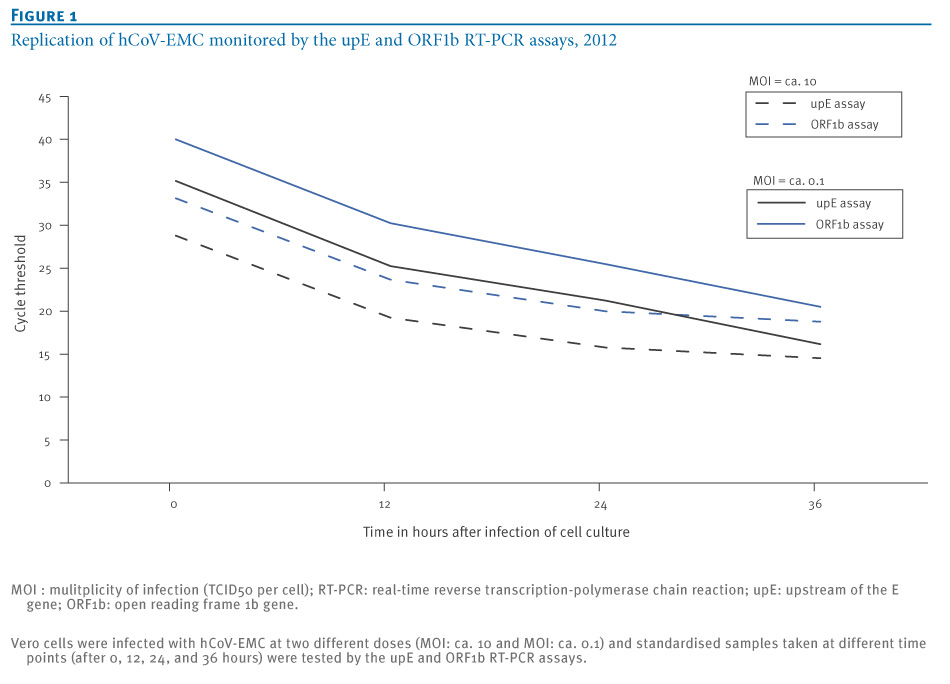
In order to obtain an estimate of the end point sensitivity of the assays, they were applied to cell culture-derived virus stock. The virus had a titre of 1.26 x 10<SUP>7 </SUP>median tissue culture infective dose (TCID50)/mL. In limiting dilution experiments, the upE and ORF1b assays detected down to 0.01 and 0.1 TCID50 per reaction, respectively. The discrepancy between assays might be due to release of subgenomic RNA after onset of cytopathogenic effect (CPE) in cell culture, including the upE target fragment. As shown in Figure 1, PCRs on these samples indicated no divergence between the assays after onset of CPE (observed at 24h onwards). However, both assays deviated from each other by constant numbers of Ct values over the full duration of incubation, including time 0 (T0) when the cells were just infected and when no subgenomic RNA could have been present. It was concluded that the higher Ct values at each time point, and the lower dilution end point for the ORF1b assay indicated that this assay had a lower sensitivity.

Figure 1. Replication of hCoV-EMC monitored by the upE and ORF1b RT-PCR assays, 2012

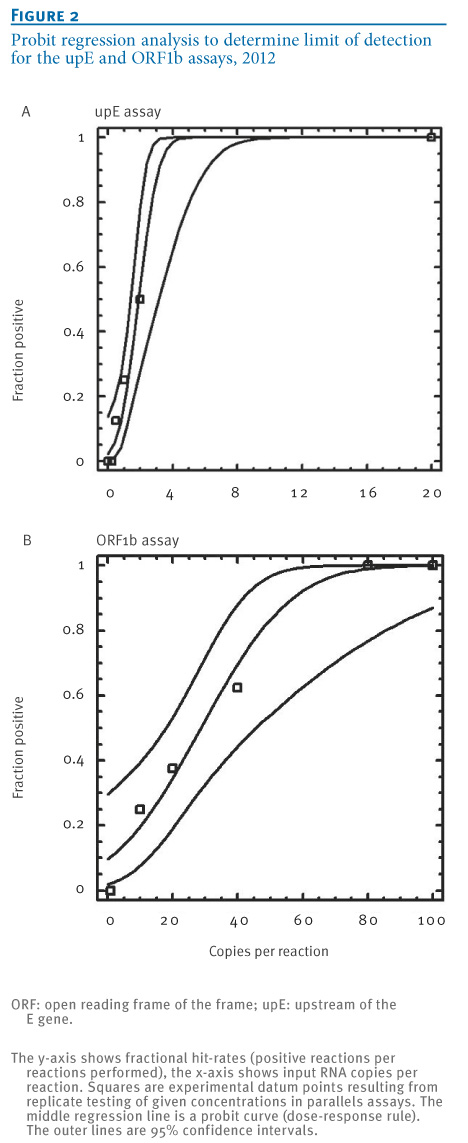
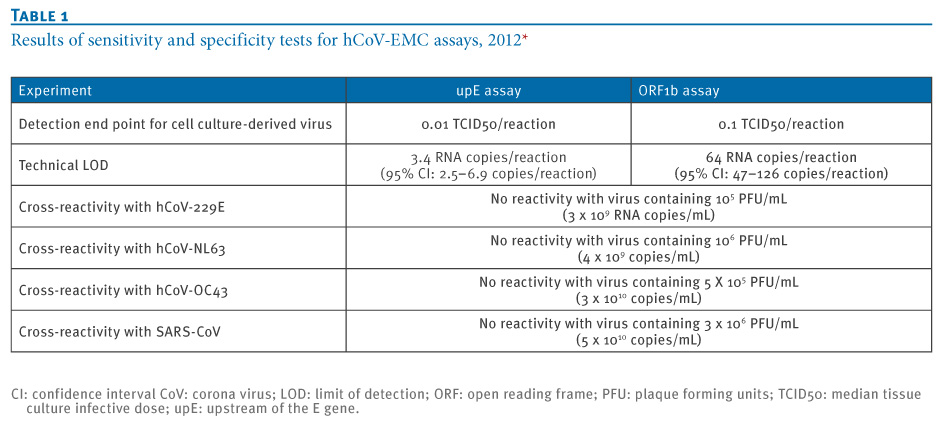
A more detailed assessment of technical sensitivity can be achieved using quantified, in-vitro transcribed RNA derived from the peri-amplicon region of each assay. These transcripts were generated and tested in serial ten-fold dilution experiments. Detection end points were two copies per reaction for the upE assay, and 10 copies per reaction for the confirmatory, ORF1b gene, assay. To obtain a statistically robust assessment of Limit Of Detection (LOD), transcripts were also tested in multiple parallel reactions in smaller dilution intervals above and below the end-point PCR limits. The results in terms of the fraction of positive reactions at each concentration were subjected to probit regression analysis and plotted as shown in Figure 2, where panel A shows the upE assay and panel B the ORF1b assay. The resulting LODs are summarised in Table 1. Based on the upE assay with a detection limit of 3.4 copies per reaction, and a cell-culture endpoint equivalent to 0.01 TCID50 per reaction, it was calculated that the RNA/infectious unit ratio of the virus stock must have been ca. 29 (100/3.4).

Figure 2. Probit regression analysis to determine limit of detection for the upE assay., 2012

Table 1. Results of sensitivity and specificity tests for hCoV-EMC assays, 2012


To exclude non-specific reactivity of oligonucleotides among each other, all formulations were tested 40 times in parallel with assays containing water and no other nucleic acids except the provided oligonucleotides. In none of these reactions was any positive signal seen. Cross-reactivity with known, heterospecific human CoVs was excluded by testing high-titred cell culture materials as summarised in Table 1. It should be noted that the unculturable hCoV-HKU1 was not included in these experiments.

To obtain a more clinically relevant figure on assay specificity, the assays were applied on 92 original clinical samples in which other respiratory viruses had already been detected during routine respiratory screening at Bonn University Medical Centre. These samples were prepared using the Qiagen Viral RNA kit, a formulation widely used to extract RNA in clinical laboratories. Of note, the tested panel included four samples containing hCoV-HKU1, which was not available as cultured virus stock. In total, none of the 92 original clinical samples as presented in Table 2, containing a wide range of respiratory viruses, gave any detection signal with either assay while positive controls were readily detected. It was concluded that the assay could be reliably applied to clinical samples.

Table 2. Known respiratory viruses in clinical samples used for testing the specificity of hCoV-EMC assays, 2012


Preliminary testing was also done on a patient hospitalised with acute infection during preparation of this report (Authors R Gopal and M Zambon, own unpublished observations). Both assays provided very clear amplification signal on various clinical samples. The upE assay again appeared more sensitive than the ORF1b assay.


Discussion

Here we provide the technical background data for RT-PCR assays developed in rapid response to the emergence of a novel human CoV (GenBank accession number: JX869059 for the Rotterdam virus isolate, termed hCoV-EMC).

Cell culture-derived virus is a useful source of reference material for the evaluation of molecular detection assays. However, detection end points determined on cell culture-derived virus are difficult to correlate to virus titre. Reasons include the discrepancy between infectious viral particles and the number of copies of viral RNA, as well as the imbalance between viral genomic and subgenomic transcripts in the particular case of CoVs. This is important for laboratories using cell-cultured virus as reference, but also in the clinical setting.

For example, SARS-CoV assays targeting structural protein genes tend to be slightly more sensitive than ORF1b-based assays when applied to clinical samples [6]. For the novel virus the ratio of RNA copies per infectious unit was ca. 29, while little imbalance seems to exist between genomic and subgenomic RNA in Vero cells up to 36 h post infection.

While we are not addressing the issue of quantitative PCR in this report, it should be mentioned that the availability of synthetic RNA standards enables immediate implementation of quantitative virus detection that is essential for case management and public health. Quantitative virus data can help assess the height and duration of virus excretion, and can also be useful as an early and robust parameter for the success of treatment [2,7,8]. Here we have used synthetic RNA to determine technical limits of detection in the style of standards applied by industry, taking inter-assay variation into account and providing statistically robust detection end points based on physically quantified target genes, which is impossible to achieve on cell-cultured virus. It is important to note that the detection limits we describe here are expressed as copies per reaction. We have chosen not to translate these numbers into other terms such as ?copies per ml of sputum?, ?copies per swab sample?, or ?copies per gram of faeces?. Such transformations vary greatly between different RNA extraction methods and clinical materials. However, we can project that the level of sensitivity, particularly for the upE assay, is very similar to those levels achieved with most advanced RT-PCR assays developed for the SARS-CoV [6,8]. For example, the Qiagen Viral RNA kit with an input volume of 140 ?l of sample and an elution volume of 60 ?l as recommended by the manufacturer involves a conversion factor of 85.7 between copies per reaction and copies per mL of sample. The upE assay should thus detect as little as ca. 291 copies per mL of sputum with 95% certainty. For solid samples such as swabs, which can be dipped into the lysis buffer, the resulting conversion factor is 12, resulting in a projected capability of the assay to detect as little as ca. 41 copies per swab with 95% certainty.
In this regard it is highly important to remember practical experiences made with SARS-CoV detection. Even with the highest levels of RT-PCR sensitivity it turned out that not all patients retrospectively shown to seroconvert could be diagnosed by RT-PCR in the acute phase of disease [6,8,9].

This has been ascribed to the fact the SARS-CoV replication occurs predominantly in the lower respiratory tract due to the anatomical localisation of its entry receptor, Angiotensin-converting enzyme 2 (ACE2). Should the novel virus use the same receptor, we might see a similar distribution of virus, and similar challenges in clinical application of molecular diagnostics. Studies of virus concentration in clinical samples are underway to address these highly critical issues.

Specificity is a very important issue in rare, highly critical virus infections for which a broad number of differential diagnoses exist. The risk associated with false positive PCR results posed a challenge in development of the assays described here.

First, real-time PCR can yield artificial signals due to technical interference of oligonucleotides involved in the assay (resembling primer dimers in which probe sequences participate). These may be observed at infrequent intervals due to the statistical nature of nonspecific random molecular interactions. We have taken care to exclude the occurrence of those signals by testing large series of water-containing assays. Second, any virus detection assay might cross-react with related viruses, and there is worldwide circulation of four different human CoVs. Viral stock solutions were tested in order to exclude cross-reactivity even on high-titred materials. In spite of the favourable outcome of this experiment, it should be mentioned that of the two assays investigated, the target gene of the ORF1b-based assay was most conserved between CoV. The genetic range of known CoV from animals is larger than those human viruses tested here. Theoretical comparisons between genomes of these viruses and our ORF1b assay suggested no risk of significant cross-reactivity (not shown). However, in absence of further investigation we tend to recommend using the upE assay for case management. This is also due to the lower sensitivity of the ORF1b assay.


The final proof of assay specificity was provided in a set of clinical samples that was assembled to realistically reflect the composition of patient groups presenting with Acute respiratory infections (ARI). Of note, also the four "common-cold coronaviruses" hCoV-NL63, -229E, -OC43, and ?HKU1 were included in this panel. Consequentially, we can say from these data that typical human CoV will not cross-react with the assay, even under adverse conditions such as those created by the additional presence of patient-derived nucleic acid and other components typical of clinical samples that may all interfere with the performance of PCR.

The open availability of proven diagnostic assays early in an epidemic is useful in order to equip and prepare public health laboratories efficiently [10,11]. However, there is a number of caveats associated with the wide and largely uncontrolled provision of such technology during the very early phase of an epidemic. In this phase public health authorities around the world have to monitor the development of case statistics in order to make projections and attain epidemic risk assessment. The notification of false positive laboratory results can be highly detrimental during this phase of the epidemic.

The authors of this paper will provide in-vitro transcribed RNA controls to health professionals (refer to Acknowledgements section) but will not be able to provide intense technical advice. Authors will follow the policy of providing only one control, namely that for the upE assay, in order to minimise opportunities for accidental laboratory contamination. If laboratories find patient samples positive by the upE assay and control, they can conduct confirmatory testing using the ORF1b assay. A positive result in this test would most likely not be due to contamination. Of note, the target gene of our ORF1b assay does not overlap with that of other, so-called ?pan-CoV? assays [3-5], excluding the possibility of contaminating our assay with high-titred controls or PCR products from these assays.

In this light we should mention that we have been working on an N gene-based assay as well, but our experience with testing clinical material strongly suggests N-gene assays should not be used for diagnostic application for the time being, i.e., as long as no direct sequence information of the N gene is available from clinical samples.

Acknowledgements
The development and provision of these assays was done by a European research project on emerging diseases detection and response, EMPERIE, contract No 223498, co-ordinated by author A.D.M.E.O. Author C.D. has received infrastructural support from the German Centre for Infection Research (DZIF) that included full funding of the position of author V.M.C. Oligonucleotides can be ordered from stock at Tib-Molbiol, Berlin (www.tib-molbiol.de). In-vitro transcribed RNA controls can be acquired from author C.D. through the European Virus Archive platform (www.european-virus-archive.com), funded by the European Commission under contract number 228292. Further information and assay updates can be retrieved at www.virology-bonn.de.

All authors acknowledge the rapid and helpful co-ordination work done by Dr Cathy Roth at WHO headquarters, Geneva.

<HR>


References
  1. Peiris JS, Yuen KY, Osterhaus AD, Stohr K. The severe acute respiratory syndrome. N Engl J Med. 2003;349(25): 2431-41.
  2. Drosten C, Gunther S, Preiser W, van der Werf S, Brodt HR, Becker S, et al. Identification of a novel coronavirus in patients with severe acute respiratory syndrome. N Engl J Med. 2003;348(20): 1967-76.
  3. Vijgen L, Moes E, Keyaerts E, Li S, Van Ranst M. A pancoronavirus RT-PCR assay for detection of all known coronaviruses. Methods Mol Biol. 2008;454: 3-12.
  4. Emery SL, Erdman DD, Bowen MD, Newton BR, Winchell JM, Meyer RF, et al. Real-time reverse transcription-polymerase chain reaction assay for SARS-associated coronavirus. Emerg Infect Dis. 2004;10(2): 311-6.
  5. de Souza Luna LK, Heiser V, Regamey N, Panning M, Drexler JF, Mulangu S, et al. Generic detection of coronaviruses and differentiation at the prototype strain level by reverse transcription-PCR and nonfluorescent low-density microarray. J Clin Microbiol. 2007;45(3): 1049-52.
  6. Drosten C, Chiu LL, Panning M, Leong HN, Preiser W, Tam JS, et al. Evaluation of advanced reverse transcription-PCR assays and an alternative PCR target region for detection of severe acute respiratory syndrome-associated coronavirus. J Clin Microbiol. 2004;42(5): 2043-7.
  7. Haagmans BL, Kuiken T, Martina BE, Fouchier RA, Rimmelzwaan GF, van Amerongen G, et al. Pegylated interferon-alpha protects type 1 pneumocytes against SARS coronavirus infection in macaques. Nat Med. 2004; 10(3): 290-3.
  8. Peiris JS, Chu CM, Cheng VC, Chan KS, Hung IF, Poon LL, et al. Clinical progression and viral load in a community outbreak of coronavirus-associated SARS pneumonia: a prospective study. Lancet. 2003;361(9371): 1767-72.
  9. Chan KH, Poon LL, Cheng VC, Guan Y, Hung IF, Kong J, et al. Detection of SARS coronavirus in patients with suspected SARS. Emerg Infect Dis. 2004;10(2): 294-9.
  10. Abbott A. SARS testing: First past the post. Nature. 2003;423(6936): 114.
  11. Drosten C, Doerr HW, Lim W, Stohr K, Niedrig M. SARS molecular detection external quality assurance. Emerg Infect Dis. 2004;10(12): 2200-3.

-
------
 
Re: Saudi Arabia: 3 cases, 2 deaths due to novel animal coronavirus

Re: Saudi Arabia: 3 cases, 2 deaths due to novel animal coronavirus

[Source: Eurosurveillance, full text: (LINK). Edited.]

Eurosurveillance, Volume 17, Issue 39, 27 September 2012

Rapid communications

Novel coronavirus associated with severe respiratory disease: Case definition and public health measures


N Danielsson ()<SUP>1</SUP>, on behalf of the ECDC Internal Response Team<SUP>2</SUP>, M Catchpole<SUP>3</SUP>
  1. European Centre for Disease Prevention and Control, Stockholm, Sweden
  2. The members of the team are listed at the end of the article
  3. Health Protection Agency, London, United Kingdom
<HR>
Citation style for this article: Danielsson N, on behalf of the ECDC Internal Response Team, Catchpole M. Novel coronavirus associated with severe respiratory disease: Case definition and public health measures . Euro Surveill. 2012;17(39):pii=20282. Available online: http://www.eurosurveillance.org/ViewArticle.aspx?ArticleId=20282
Date of submission: 27 September 2012
<HR>
Two cases of rapidly progressive acute respiratory infection in adults associated with a novel coronavirus have generated an international public health response. The two infections were acquired three months apart, probably in Saudi Arabia and Qatar. An interim case definition has been elaborated and was published on the World Health Organization website on 25 September 2012.
<HR>

Case 1

On 13 June 2012 a patient in their sixties presented with deteriorating pneumonia in Jeddah, Saudi Arabia and a seven day history of respiratory symptoms. The patient developed acute renal failure and died on 24 June 2012. A novel beta-coronavirus was isolated and sequenced at the Erasmus Medical Centre (EMC) in Rotterdam, the Netherlands [1].


Case 2

On 11 September 2012 a patient in their forties with severe respiratory symptoms was evacuated from Qatar to a United Kingdom hospital and was admitted to intensive care there on 12 September. The patient remains in hospital and has been on life support with pulmonary and renal failure. Extensive diagnostic tests for a causative agent were negative but on 21 September a pan-coronavirus RT-PCR test performed on lower respiratory samples was positive for a conserved sequence of the coronavirus polymerase gene [2]. Comparison with the nucleotide sequence at the EMC indicated a close match with the novel virus isolated from Case 1. Contacts of Case 2, many of them healthcare workers, are being actively identified, monitored and investigated for coronavirus infection. Some of them have reported mild respiratory symptoms but none have tested positive for the novel virus or developed severe disease to date [3].


Background

Coronaviruses are globally distributed and are found in humans, other mammals and birds. They are enveloped RNA viruses classified in alpha, beta and gamma genera. Up to one third of mild upper respiratory tract infections in adults are caused by human coronaviruses. The zoonotic severe acute respiratory syndrome (SARS) beta-coronavirus (SARS-CoV) caused the SARS outbreak in 2003 when over 900 people died.
[4] Human coronaviruses are transmitted through direct contact with secretions and via aerosol droplets. Infected patients also excrete virus in faeces and urine and under certain circumstances, airborne transmission can occur from aerosolised respiratory secretions and faecal material [5].
The detection of a novel coronavirus associated with severe respiratory disease and renal failure requires urgent assessment and careful management. The United Kingdom Health Protection Agency (HPA) alerted European Union (EU) Member States and other countries via the Early Warning and Response System (EWRS) and International Health Regulations (IHR) mechanisms.


Control measures

The HPA has recommended stringent control measures and developed an early case definition [6]. The European Centre for Disease Prevention and Control (ECDC) has developed a risk assessment in response to the cases [2]. A surveillance strategy has been agreed between ECDC and WHO with the first priority being to determine whether there are additional severe cases. The initial virology results and the separation in time of the only two confirmed cases suggest an infection that quite probably is of zoonotic origin and different in behaviour from SARS [5]. It is essential to rule out there being additional severe undiagnosed cases, especially since the transfer of severely ill patients in air ambulances meant that cases may be missed by conventional surveillance that is based on clinical notification by the original diagnosing physician, particularly primary care physicians. Hence the interim case definition has been developed with the aim of providing a high level of sensitivity for identifying cases ill enough to require hospital care or having pneumonia while avoiding cases with only mild symptoms [7].


Case definition

The case definition applies the established link that both cases stayed in the Arabian Peninsula but makes it conditional of hospitalisation or pneumonia, which means that cases with a link to an affected area but only mild symptoms do not require investigation. The affected area is currently defined as Saudi Arabia and Qatar but can be expanded as needed.

Human coronaviruses have a short incubation period of 3 to 4 days. The longest incubation period observed during the SARS outbreak was 12 days. However, this was an outlier and a pragmatic incubation period of up to 10 days has been adopted for the case definition. The case definition should be used by clinicians for deciding which patients require investigation for possible novel coronavirus infection and which patients should be reported to national authorities. An interim case definition was published on the WHO website on 25 September [8]. It is expected to be amended once more epidemiological and diagnostic information becomes available and clinicians and public health managers should stay updated with the latest version on the website.

EU Member States have been requested to report patients meeting the case definition to ECDC through the EWRS and countries should continue to report probable or confirmed cases through the IHR contacts at WHO regional offices as mandated by the IHR. There is currently no rapid diagnostic test that easily confirms infection with this novel virus. Virus detection and serological testing is being developed by the HPA, the EMC and the University of Bonn, Germany and this was facilitated through close collaboration including the provision of preliminary sequences and a virus isolate between those institutions [9].


Infection control advice

The HPA has developed specific infection control advice for suspected or confirmed novel coronavirus cases. The guidelines take a strict precautionary approach, whereby patients are isolated in negative-pressure single rooms or, if this is not possible then a single room with en-suite facilities.

Full personal protective equipment (PPE), including gowns, gloves and FFP3 masks are worn by staff and others having direct contact with the patient [6].


Conclusions

This situation is still evolving and there are many unknowns to consider in hypothesis generation and control measures. There is strong evidence that a novel virus caused the severe disease in the two patients. Based on this assumption it can be concluded that the virus poses an as yet poorly defined level of threat to people?s health. There may have been other cases in the past that were missed and serological testing of stored sera and other specimens from such cases will be important. Serological testing will also determine whether the two cases represent the most severe end of a spectrum of clinical presentations which also includes mild and asymptomatic infections or if they are isolated events. To date, the long period between occurrence of the two cases and the lack of secondary cases among contacts suggest the disease is poorly communicable in humans. Our assessment, based on the limited information currently available, is that the risk of wide spread transmission resulting in severe disease is low. However, the emergence of a novel coronavirus requires a thorough assessment which is currently being coordinated at international level.


The ECDC internal response team

Katrin Leitmeyer, Pete Kinross, Herve Zeller, Niklas Danielsson, Pasi Penttinen, Rene Snacken, Anna-Pelagia Magiorakos, Amanda Ozin, Romit Jain, Eve Robinson, Lara Payne Hellstrom, Angus Nicoll, Josep Jansa and Denis Coulombier.


<HR>

References
  1. ProMED-mail. Novel coronavirus - Saudi Arabia: human isolate Archive Number: 20120920.1302733 20 September 2012 21:51:30 CEST. Available from: http://www.promedmail.org/direct.php?id=20120920.1302733
  2. European Centre for Disease Prvention and Control (ECDC). Rapid Risk Assessment . Severe respiratory disease associated with a novel coronavirus. Stockholm: ECDC; 2012. [Accessed 26 Sep 2012]. Available from: http://ecdc.europa.eu/en/publications/Publications/RRA-Novel-coronavirus-final20120924.pdf
  3. Health Protection Agency (HPA). HPA Press release. Acute respiratory illness associated with a new virus identified in the UK. London:HPA; 2012. [Accessed 25 Sept 2012]. Available from: http://www.hpa.org.uk/NewsCentre/NationalPressReleases/2012PressReleases/120923acuterespiratoryillnessidentified/
  4. World Health Organization (WHO). WHO final summary SARS, 15 August 2003:Summary table of SARS cases by country, 1 November 2002 - 7 August 2003. Geneva: WHO; 2003. Available from: http://www.who.int/csr/sars/country/country2003_08_15.pdf
  5. World Health Organization (WHO). Consensus document on the epidemiology of severe acute respiratory syndrome (SARS) 2003. Geneva: WHO; 2003. Available from: http://www.who.int/csr/resources/publications/CDS_CSR_ARO_2004_2.pdf
  6. Health Protection Agency (HPA). Infection control advice: Suspected or Confirmed Novel Coronavirus Cases. London:HPA; 2012. [Accessed 25 Sep 2012]. http://www.hpa.org.uk/webc/HPAwebFile/HPAweb_C/1317136232722
  7. World Health Organization (WHO). WHO Case-finding interim case definition. Geneva: WHO; 2012. [Accessed 26 Sep 2012]. Available from: http://www.who.int/csr/disease/coronavirus_infections/en/index.html
  8. World Health Organization (WHO). Case definition for case finding severe respiratory disease associated with novel coronavirus. Geneva: WHO; 2012. Available from: http://www.who.int/csr/disease/coronavirus_infections/en/index.html
  9. Health Protection Agency (HPA). Partial genetic sequence information for scientists about the Novel Coronavirus 2012. London: HPA; 2012. [Accessed 25 Sep 2012]. Available from: http://www.hpa.org.uk/Topics/InfectiousDiseases/InfectionsAZ/RespiratoryViruses/NovelCoronavirus/respPartialgeneticsequenceofnovelcoronavirus/
-
------
 
Re: Saudi Arabia: 3 cases, 2 deaths due to novel animal coronavirus

Re: Saudi Arabia: 3 cases, 2 deaths due to novel animal coronavirus

[Source: Eurosurveillance, full text: (LINK).]

Eurosurveillance, Volume 17, Issue 39, 27 September 2012

Miscellaneous

Note from the editors: A new virus bringing back memories from the past


Eurosurveillance editorial team ()<SUP>1</SUP>
  1. European Centre for Disease Prevention and Control (ECDC), Stockholm, Sweden
<HR>
Citation style for this article: Eurosurveillance editorial team. Note from the editors: A new virus bringing back memories from the past. Euro Surveill. 2012;17(39):pii=20284. Available online: http://www.eurosurveillance.org/ViewArticle.aspx?ArticleId=20284
Date of submission:
<HR>
In recent days, public health experts and healthcare workers around the world are alert following the discovery of a new human coronavirus causing severe respiratory illness. Two cases, both with connection to Saudi Arabia, were communicated through ProMED on 20 and 23 September respectively [1,2].

Many health professionals still have vivid memories of the alert that followed the death of an American businessman in a hospital in Hanoi, Vietnam, in early 2003 after having travelled to China, and the following outbreak of severe acute respiratory syndrome (SARS). This triggered worldwide alarm and containment measures. During the outbreak, there was excellent collaboration between global players and institutions, on various levels (i.e. public health institutions, laboratories and hospitals) and new ways of communicating proved to be highly value for the exchange of information. The last case of SARS occurred in China in May 2004: thereafter the virus seemed to have disappeared and has not resurfaced since.

The public health world is currently looking closely into the two recent cases of coronovirus infection. Similar to SARS, the two patients had/have symptoms of severe respiratory illness and the virus comes from the same family, Coronaviridae. However, there are some marked differences. The virus is not the same: laboratory analyses have proven that the new virus is not a SARS-like virus. Furthermore, the two confirmed cases occurred with a gap of three months between them and there is no evidence of a direct epidemiological link.

Much remains unknown at the moment and information that would allow us to make a final judgment about the disease is missing. Two rapid communications in this issue give a timely account of the recommended public health measures and assays to detect the virus. On the basis of the limited evidence currently available, the risk for person-to-person transmission, as assessed by the European Centre for Disease Prevention and Control (ECDC) in a rapid risk assessment, is considered low [3]. Eurosurveillance will continue to provide more information as it becomes available.

<HR>

References
  1. ProMED-mail. Novel coronavirus - Saudi Arabia: human isolate. Archive Number: 20120920.1302733. 20 Sep 2012. Available from: http://www.promedmail.org/?p=2400:1000
  2. ProMED-mail. Novel coronavirus - Saudi Arabia (03): UK HPA, WHO, Qatar. Archive Number: 20120923.1305982. 23 Sept 2012. Available from: http://www.promedmail.org/?p=2400:1000
  3. European Centre for Disease Prevention and Control (ECDC). Severe respiratory disease associated with a novel coronavirus, 24 September 2012. Rapid risk assessment. Stockholm: ECDC; 2012. Available from: http://www.ecdc.europa.eu/en/publications/Publications/RRA-Novel-coronavirus-final20120924.pdf
-
------
 
Re: Saudi Arabia: 3 cases, 2 deaths due to novel animal coronavirus

Re: Saudi Arabia: 3 cases, 2 deaths due to novel animal coronavirus

http://www.cbsnews.com/8301-501367_162-57522080/animals-suspected-in-spread-of-new-virus/

Animals suspected in spread of new virus

LONDON — Britain's Health Protection Agency has published an early genetic sequence of the new respiratory virus related to SARS that shows it is most closely linked to bat viruses, and scientists say camels, sheep or goats might end up being implicated too.

So far, there are no signs the virus will be as deadly as SARS, or severe acute respiratory syndrome, which killed hundreds of people, mostly in Asia, in a 2003 global outbreak.

Global health officials say they haven't found evidence the virus can spread between people and suspect two victims from the Middle East may have caught it from animals.

"It's a logical possibility to consider any animals present in the region in large numbers," said Ralph Baric, a coronavirus expert at the University of North Carolina at Chapel Hill. "Biologists now need to go into the area and take samples from any animals they can get their hands on, including camels and goats," he said. Baric said it was crucial to find out how widespread the virus is in animals and what kind of contact might be risky for people.

Baric suggested bats might be spreading the virus directly to humans since the two confirmed infections happened months apart. "If there was an established transmission pattern from other animals, we probably would have seen a lot more cases," he said.

The World Health Organization said it is considering the possibility the new coronavirus sickened humans after direct contact with animals. The agency is now working with experts in the Middle East to figure out how the two confirmed cases got infected but could not share details until the investigation was finished.

One patient was a Saudi Arabian man who died several months ago while the other is a Qatari national who traveled to Saudi Arabia before falling ill and is currently in critical but stable condition in a London hospital.

Earlier this week, WHO issued a global alert asking doctors to be on guard for any potential cases of the new respiratory virus, which also causes kidney failure.

Saudi officials have already warned that next month's annual Muslim Hajj pilgrimage, which brings millions to Saudi Arabia from all around the world, could allow the virus to spread. As a precautionary measure, they are advising pilgrims to keep their hands clean and wear masks in crowded places.

[snip]
 
Re: Saudi Arabia: 3 cases, 2 deaths due to novel animal coronavirus

Re: Saudi Arabia: 3 cases, 2 deaths due to novel animal coronavirus

http://au.news.yahoo.com/world/a/-/world/14991066/new-mystery-virus-not-easily-spread-who/

New mystery virus not easily spread: WHO
September 28, 2012, 7:50 pm

GENEVA (AFP) - A new mysterious respiratory virus that has killed at least one person and left another in critical condition does not appear very contagious, the World Health Organisation said Friday.

"From the information available thus far, it appears that the novel coronavirus cannot be easily transmitted from person to person," the WHO said in a statement.

WHO spokesman Gregory Hartl told reporters in Geneva that rapid progress was being made in characterising the disease and developing diagnostic tests, which would be made available as quickly as possible.

The origin of the new virus was still unknown, he said.

[snip]
 
Re: Saudi Arabia: 3 cases, 2 deaths due to novel animal coronavirus

Re: Saudi Arabia: 3 cases, 2 deaths due to novel animal coronavirus

[Source: World Health Organization, full page: (LINK). Edited.]

Novel coronavirus infection - update


28 September 2012


As of 28 September 2012, no additional confirmed cases due to infection with the novel coronavirus have been reported to WHO.

WHO is working closely with the national authorities of the involved countries (Qatar, Saudi Arabia, United Kingdom) and international partners in order to better understand the public health risk from the novel coronavirus.

From the information available thus far, it appears that the novel coronavirus cannot be easily transmitted from person-to-person.

Given the severity of the two laboratory confirmed cases, WHO is continuing to monitor the situation in order to provide the appropriate response, expertise and support to its Member States.

Rapid progress has been made in the characterization of the novel coronavirus, and in the development of sensitive and specific diagnostic assays. WHO is collaborating with partner laboratories to make these available as quickly as possible. It is anticipated that the first batch of reagents, together with information and testing algorithms, will be available for urgent testing within the coming days.

Tests for novel coronavirus infection of patients under investigation - based on the case definition issued by WHO ? are currently available by some partner laboratories. National Health Authorities can contact these laboratories through WHO.

WHO continues to inform its Member States through the designated National Focal Points under the International Health Regulations (2005).
No travel or trade restrictions have been recommended by WHO for Saudi Arabia or Qatar with respect to the novel coronavirus infections.
- ------
 
Re: Saudi Arabia: 3 cases, 2 deaths due to novel animal coronavirus

Re: Saudi Arabia: 3 cases, 2 deaths due to novel animal coronavirus

Published Date: 2012-09-28 10:48:09
Subject: PRO/AH/EDR> Novel coronavirus - Saudi Arabia (07): Eurosurveillance reports
Archive Number: 20120928.1313337

NOVEL CORONAVIRUS - SAUDI ARABIA (07): EUROSURVEILLANCE REPORTS
***************************************************************
A ProMED-mail post
http://www.promedmail.org
ProMED-mail is a program of the
International Society for Infectious Diseases
http://www.isid.org

[reports already in this thread]

[One of the most important conclusions reached in the discussions above is that current assessments are based on limited information currently available and there is the need to gather more information on the epidemiology of this novel coronavirus. As with prior outbreaks associated with newly identified organisms, initial reports of cases tend to be more severe clinical presentations -- with SARS in 2002/2003 the early reports were of many fatalities associated with identified cases. Similarly, the early reports of the 2009 influenza pandemic related to influenza A/H1N1 pdm09 virus were those of high numbers of deaths in previously healthy young individuals.

If one looks at the final epidemic curve for the SARS epidemic (available at http://www.who.int/csr/sars/epicurve/epiindex/en/index1.html) one is reminded that while the early reports of an outbreak of severe respiratory disease in Guangdong province, China, came to the attention of the international public health community in the 2nd week of February 2003, retrospective case finding during the course of the epidemic revealed individual cases had occurred with onset of illness beginning during the period of 22 Nov 2002 and continued to occur at a low level until January 2003.

Hence, caution is necessary before coming to definitive conclusions about this novel coronavirus until more information is known. - Mod.MPP]
 
Re: Saudi Arabia: 3 cases, 2 deaths due to novel animal coronavirus

Re: Saudi Arabia: 3 cases, 2 deaths due to novel animal coronavirus

This is worth keeping an eye on. We need to rule out the possibility that large numbers of milder cases are being missed.

http://www.cidrap.umn.edu/cidrap/content/other/sars/news/sep2812corona.html

[snip]

Currently, the second patient, the 49-year-old man from Qatar, is on life support with pulmonary and renal failure. His contacts, which include healthcare workers, are being closely monitored for hCoV-EMC infection. Though some have reported mild respiratory symptoms, none has tested positive for the disease or shown any severe symptoms.
 
Re: Saudi Arabia: 3 cases, 2 deaths due to novel animal coronavirus

Re: Saudi Arabia: 3 cases, 2 deaths due to novel animal coronavirus

[Source: World Health Organization, full page: (LINK). Edited.]

Novel coronavirus infection - update - revised interim case definition

29 September 2012


WHO has continued to monitor the situation. No additional confirmed cases have been reported and there is no evidence so far of person to person transmission of the novel coronavirus.

In order to ensure an appropriate and effective identification and investigation of patients who may be infected with the virus, without overburdening health care systems with unnecessary testing, a revised interim case definition has been issued by WHO (see related links to right of this page).

It should be noted that this case definition was developed based on data from two confirmed cases and as such some degree of clinical judgment is required where individual cases are concerned.

WHO has been cooperating closely with the laboratories which were responsible for the confirmation of the presence of the novel coronavirus in the two confirmed cases. These laboratories have been working on the development of diagnostic reagents and protocols which can be provided to laboratories that are not in a position to develop their own, and these are now available. WHO is now seeking to broaden the number of laboratories that will be able to assist Member States with the detection or confirmation of this novel virus.

WHO has received offers of support from a number of major public health institutions around the world to assist with testing, should the need arise. The complete nucleic acid sequence of the virus has been uploaded to Genbank and the testing protocol, utilizing real-time PCR, has been published.

WHO does not advise special screening at points of entry with regard to this event nor does it recommend that any travel or trade restrictions are applied.


WHO continues to inform its Member States through the designated National Focal Points under the International Health Regulations (2005).
-
------
 
Re: Saudi Arabia: 3 cases, 2 deaths due to novel animal coronavirus

Re: Saudi Arabia: 3 cases, 2 deaths due to novel animal coronavirus

[Source: World Health Organization, full page: (LINK). Edited.]

Revised interim case definition ? novel coronavirus

Interim case definition as of 29 September 2012


Case finding and classification scheme for Severe Acute Respiratory Infections associated with novel coronavirus infection:

The following scheme is recommended for identifying cases that should be tested for infection with the novel coronavirus recently described. The goals of this scheme are to ensure a systematic approach to appropriate identification and investigation of patients who may be infected with the virus without overburdening health care systems with unnecessary testing. It should be noted that this information was developed based on data from two confirmed cases and as such some degree of clinical judgment is required where individual cases are concerned.


Patients to be investigated (referred to as ?Patient Under Investigation?):
  • A person with an acute respiratory infection, which may include fever (≥ 38?C , 100.4?F) and cough; AND
  • suspicion of pulmonary parenchymal disease (e.g. pneumonia or Acute Respiratory Distress Syndrome (ARDS)) based on clinical or radiological evidence of consolidation; AND
  • travel to or residence in an area where infection with novel coronavirus has recently been reported or where transmission could have occurred;* AND
  • not already explained by any other infection or aetiology, including all clinically indicated tests for community-acquired pneumonia according to local management guidelines.

Management of Patients Under Investigation:

Patients falling into this category should undergo routinely available laboratory tests as clinically indicated according to local management guidelines for Community-Acquired Pneumonia to determine the presence of other potential primary aetiologies of pneumonia. Examples of other aetiologies might include streptococcus pneumoniae, hemophilus influenza type B, legionella pneumophila, other recognized primary bacterial pneumonias, influenza, and respiratory syncytial virus. It is not necessary to wait for all test results for other pathogens to be available before testing for novel coronavirus. In addition, patients with a clear history and clinical presentation consistent with chemical pneumonitis or smoke inhalation should not be considered as a patient under investigation.

If the respiratory disease is unexplained, appropriate clinical specimens should be sent for laboratory investigation. Rapid progress has been made in the characterization of the novel coronavirus, and in the development of sensitive and specific diagnostic assays. WHO is collaborating with partner laboratories to make these available as quickly as possible. It is anticipated that the first batch of reagents, together with information and testing algorithms, will be available for urgent testing within the coming days.

Until then, WHO is able to provide contact information of laboratories willing and able to test for the presence of the novel coronavirus. For further details, national authorities should contact their respective International Health Regulations Contact Point at their WHO Regional Office.

Appropriate infection control measures should be instituted while the patient is under investigation. Should Member States require further guidance on Infection Prevention and Control, please refer to WHO interim guidelines on Infection prevention and control of epidemic- and pandemic-prone acute respiratory diseases in health care (WHO/CDS/EPR/2007.6).

Infection prevention and control of epidemic- and pandemic-prone acute respiratory diseases in health care


Management of case contacts

Any person who has had close contact** with a probable or confirmed case while the probable or confirmed case was ill should be carefully monitored for the appearance of respiratory symptoms. If symptoms develop with the first 10 days following the contact, the individual should be considered a ?Patient Under Investigation? regardless of the severity of illness and investigated accordingly.

If laboratory data, including histopathological examination of fatal cases, cannot be obtained because the patient has died before specimens are taken, clinical specimens cannot otherwise be obtained, or appropriate laboratory testing for other pathogens is not available, then the patient may meet criteria for ?Probable Case? as defined below.


Case definitions for reporting

Probable Case
  • A person fitting the definition above of a ?Patient Under Investigation? with clinical, radiological, or histopathological evidence of pulmonary parenchyma disease (e.g. pneumonia or ARDS) but no possibility of laboratory confirmation either because the patient or samples are not available or there is no testing available for other respiratory infections, AND
  • close contact** with a laboratory confirmed case, AND
  • not already explained by any other infection or aetiology, including all clinically indicated tests for community-acquired pneumonia according to local management guidelines.

Confirmed Case

A person with laboratory confirmation of infection with the novel coronavirus.


Reporting:

WHO requests that probable and confirmed cases be reported within 24 hours of being classified as such, through the regional focal point for International Health Regulations at the appropriate WHO Regional Office.


(*) Currently, these areas would include only Qatar and Saudi Arabia (as of 29 September 2012).

(**) Close contact includes:
  • anyone who provided care for the patient including a health care worker or family member, or had other similarly close physical contact;
  • anyone who stayed at the same place (e.g. lived with, visited) as a probable or confirmed case while the case was symptomatic.
-
------
 
Back
Top Bottom