• FluTrackers.com Inc. does not provide medical advice. Information on this web site is collected from various internet resources, and the FluTrackers board of directors makes no warranty to the safety, efficacy, correctness or completeness of the information posted on this site by any author or poster. The information collated here is for instructional and/or discussion purposes only and is NOT intended to diagnose or treat any disease, illness, or other medical condition. Every individual reader or poster should seek advice from their personal physician/healthcare practitioner before considering or using any interventions that are discussed on this website. By continuing to access this website you agree to consult your personal physican before using any interventions posted on this website, and you agree to hold harmless FluTrackers.com Inc., the board of directors, the members, and all authors and posters for any effects from use of any medication, supplement, vitamin or other substance, device, intervention, etc. mentioned in posts on this website, or other internet venues referenced in posts on this website.
  • We are not asking for any donations. Do not donate to any entity who says they are raising funds for us.

Will Nurses Work During a Pandemic?

Re: Will Nurses Work During a Pandemic?

I saw on the news tonight that 80% of our drugs are imported from China. Probably an equal amount of other supplies, like tubing, syringes, and so on. So, the question of whether employees show up at hospitals may be irrelevant, since the hospitals won't have much of anything to offer if Asia is hit hard and the imports stop. Those countries that produce medical supplies will need it themselves.

As a nurse myself, I'm storing as much PPE as I can. I'll use it at home and in my neighborhood, but I won't be going anywhere near a hospital.
 
Re: Will Nurses Work During a Pandemic?

Limited ppe
Some nurses will work
What other strategies could help?[/quote]

Nothing will help if it will be an CFR>>> pandemic.
The estab. knows that, and every of us, if thinking about, can see this.

One alternative variant can be a: "deployed military - vax" strategy,
where (probably) who will working at the hospital when the emergency will be declared, will remain closed in, in a quarantine settled by the various "forces".
The hospital "insiders" will be the ones who will care for the patients, also...
 
Re: Will Nurses Work During a Pandemic?

Anne what vax? LOL The only existing vax (in the US at least) has been promised to the armed forces. And, it of course is a gamble as to its effectiveness. It will take several months for any new vaccines to be made and that can only happen after the onset of the pandemic.

I found this today while working and thought I'd pop it in here. It's probably just a sales pitch, but maybe someone is trying to get a start.

SANOFI PASTEUR?S INVESTIGATIONAL H5N1 INFLUENZA VACCINE ACHIEVES HIGH IMMUNE RESPONSE AT LOW DOSAGE
- Clinical study demonstrates breakthrough dose-sparing formulation that increases stockpile capacities and expands potential production capacities to billions of doses in a pandemic situation -
Lyon (France), Sept. 18, 2007? Sanofi pasteur, the vaccines division of sanofi-aventis Group, today announced data showing that its new investigational H5N1 pandemic influenza vaccine containing a proprietary adjuvant achieved a high immune response at the lowest dose of H5N1 antigen reported to date.
The vaccine containing only 1.9 μg of antigen generated a high level of seroprotective immune response in over 70 percent of the participants in a clinical trial and, in the same clinical trial, vaccine containing 3.75 μg of antigen generated a high level of seroprotective immune response in over 80 percent of the participants.
Once fully developed, this vaccine should give sanofi pasteur the potential to provide billions of doses in a pandemic situation and greatly increases its ability to produce vaccines for stockpiling in advance of a pandemic. This would be a significant achievement for public health and a breakthrough in research and development of pre-pandemic and pandemic vaccines that is fully in line with sanofi pasteur?s early commitment to bring answers to the global threat posed by pandemic influenza.
Results are based on analysis of a clinical trial conducted in Belgium. The trial involved 266 healthy adults, 18 to 40 years of age. The vaccine tested was produced from inactivated H5N1 virus and contains a new, proprietary adjuvant aimed at stimulating the immune system to increase the response to the vaccine. Trial participants received two doses of each formulation. Four levels of antigen dose were tested, with 1.9 μg being the lowest dose.
Preliminary data also show good cross-reactivity to a more recently circulating H5N1 strain. Further assessment of the ability of this vaccine to provide cross-protection to variants of the H5N1 strains is ongoing.
Sanofi pasteur has committed, in the event of a pandemic being declared by the World Health Organization (WHO), to producing the largest possible number of doses of its most advanced pandemic influenza vaccine in the shortest possible time. In order to increase its capacity, sanofi pasteur initiated clinical trials with a novel adjuvant aimed at dramatically reducing the amount of antigen needed to elicit a protective immune response to the H5N1 strain currently identified by global health authorities and experts as a potential source for the next pandemic.
 
Re: Will Nurses Work During a Pandemic?

There are tests going on but is anyone actually manufacturing the vax? I hadn't heard of anyone actually making millions instead of thousands of doses.
 
Re: Will Nurses Work During a Pandemic?

This is my first post. I have followed your work from the very start. I am a volunteer EMT and Search and Rescue member with Disaster management responsibilities in a small county.

I find this topic very interesting and difficult. Many of us have dedicated our lives to helping others, (33 years so far). When H5N1 first started I studied it and then began to prepare my community. Public meetings as well as many county management level meetings. Many at the county level believe it will never happen.

We have a community plan, (with PPE etc.) in my community but the county has done nothing. I was talking with my locale small town doctor who is located in a neighboring county. He was telling me that he was starting to look into H5N1 and had not heard anything from his locale county, (Ever).

He researched other outbreaks and learned that the health care workers were the first to suffer losses. He said that he felt that it would not do the community any good if all the Doctors die first.

He did not tell me his plan but I think he will stay away.
 
Last edited:
Re: Will Nurses Work During a Pandemic?

Rescuer, welcome to the posting side of FluTrackers. Glad to hear from you, although the message may be bad. The problem is a serious one and people need to talk about it so that enough PPE can be ordered to ensure medical staff stays.
 
Re: Will Nurses Work During a Pandemic?

You know, it's REEEEEALLY scary to think about how things will be if we nurses don't/can't show up to work.

:(

Off topic a bit: My husband works for Louisiana's DHH (in I.T.) and they did a mass vaccination drill last week, giving out flu shots. He said they did something like 26,000 people in 6 hours over 9 locations... at his location alone (at a local university) they were doing 600 people an hour!!

We were discussing what we'd do in a pandemic situation a few months ago, and he mentioned that if we were to get sick, that it would be best to do it (like we have a choice, lol) in the beginning of the first wave, while there are still nursing staff and vents available. What do you think about that line of thought?

This all terrifies me if I think about it too much. :(
 
Re: Will Nurses Work During a Pandemic?

Welcome to FluTrackers, Rescuer.

Your local doctor is right, doctors and nurses will be no help if they are dead or afraid of dying on the job because they can not protect themselves.

A hospital's or medical facility's most valuable asset is it knowledgeable and skillful staff. If those people are dead or fear coming to work during a pandemic, all of the fancy equipment, medicines, and other medical supplies will be useless.

On any job, an employee needs the proper safety tools and equipment to protect themselves when they do their job. It is imperative that the necessary PPE and other safety supplies be stockpiled for medical personnel before a pandemic starts.
 
Re: Will Nurses Work During a Pandemic?

if we were to get sick, that it would be best to do it (like we have a choice, lol) in the beginning of the first wave, while there are still nursing staff and vents available. What do you think about that line of thought?

I don't want to scare you Cairelle, but about the only way to get that personalized care is to be the index case, the first patient to come down with an easily transmissible pandemic virus.

After the index case starts spreading the virus, it will be only be a short time before hospitals are overrun. It will be dependent on the reproductive number (R0), the attack rate (AR), the incubation period, and the severity of the infection. A pandemic virus will be a novel virus, so people will have few or no natural defenses. We have to assume that the 300+ people that have been infected with H5N1 to date are representative of the severity of infection with a novel virus.

Almost all of the human H5N1 cases that have survived to date have required intensive care for long periods of time, sometimes weeks. Even then less than 30% of infected individuals survived. I don't know about your local hospital situation, but how many vents do you have? How many are routinely available for any surge?

Do you think that your local hospital will be able to treat you with a vent for several weeks while it is being overrun by other infected people? Will the staff stay that long?

The best option is to avoid infection at all costs. If you are HCW you will need PPE to continue doing your job. And if you are a pandemic flu patient you will want your nurses and doctors protected because you will want them to continue to care for you as long as necessary. Think about it, you are being treated in a vent for several days, you start feeling better, and then the next morning the PPE in the care facility is gone. So are your nurses and the doctors that were treating you. What option would you have?
 
Re: Will Nurses Work During a Pandemic?

Thanks for the welcome.

The scary thing is that our community has supplied and I have been told by our sheriff that he has not prepared and if he needs our supplies he will come get them.

I strongly recommend that you keep you preparing information to yourself.

Many new scary things going on in disaster management at all levels.
 
Re: Will Nurses Work During a Pandemic?

Thanks for the welcome.

The scary thing is that our community has supplied and I have been told by our sheriff that he has not prepared and if he needs our supplies he will come get them.

I strongly recommend that you keep you preparing information to yourself.

Many new scary things going on in disaster management at all levels.


Surviving a pandemic, as well as rebuilding after a pandemic, is a community affair. It requires more than a few families that stockpiled food and water. While you may want to keep your family preps secret, there is a need to urge your community as a whole to prepare. No matter how much food and water you have stocked up, you will eventually run out. Once a pandemic is over, rebuilding will be necessary. But that will only happen if you trust your neighbors in your local community.

The time to build that trust is now, before the we have the start of a pandemic. With enough trusted friends and neighbors you should be able to withstand any demands to give up your preps to others during a pandemic. You and the other members of your trusted group will also be in a better position to start to rebuild once it is over.
 
Re: Will Nurses Work During a Pandemic?

CBN Report: Surgical Masks May Provide Significant Aerosol Protection


By Eric Toner, M.D., February 15, 2007


http://www.upmc-cbn.org/report_archive/2007/02_February_2007/cbnreport_02152007.html


The relative protection afforded by surgical and N-95 masks is an important issue that is prompting much debate in the process of planning for outbreaks of infectious respiratory diseases such as SARS or an influenza pandemic. In an article published recently in the American Journal of Industrial Medicine, Y. Li and colleagues from The Hong Kong Polytechnic University report the results of their study comparing the in vivo protective performance of surgical masks and N95 respirators [1]. The authors found that N95 respirators filtered out 97% of a test aerosol while surgical masks did almost as well, filtering out 95% of the aerosol.

Methods

The authors used a KCl-flourescein solution aerosol as a viral simulant. KCl is the test challenge aerosol recommended by the National Institute for Occupational Safety and Health (NIOSH), and flourescein was added as a visual marker to gauge the degree of KCl penetration. Each of 10 subjects (half men and half women) was tested wearing each kind of mask. The masks were fitted properly, and the subjects were tested at rest and while walking on a treadmill up to 6.4 km/hr (4 miles/hour). The KCl solution was sprayed on the mask twice every 10 minutes, for a total of 14 times, from a distance of 1 meter away using an atomizer.
The degree of filtration of the challenge aerosol was measured in two ways. First, the concentration of KCl in the 4 layers of the exposed N95 and the 3 layers of the exposed surgical mask was determined. Second, the degree of flourescein staining on the portion of a subject’s face covered by the mask was quantified.

Results
The estimated size of the most penetrating aerosol particles reaching the mask was 0.1-0.3µm. By each method, the N95 performed significantly better than the surgical mask, but the difference was small (2%).

Droplet vs. Aerosol
Surgical masks have long been the recommended respiratory protection for diseases transmitted by large droplets (>5µ) such as plague or meningococcal meningitis. For diseases such as TB that are transmitted by small droplet aerosols, an N95 (or better) respirator or powered air purifying respirators (PAPRs) with high efficiency particulate absorbing (HEPA) filter is recommended. It has been generally assumed that a surgical mask provided little protection from aerosols. With SARS and influenza, both droplet and aerosol transmission may occur, although the relative importance of each is debated.

During the SARS epidemic, in most circumstances, surgical masks were effective in protecting healthcare workers (HCW) from infection. In a case-control study of five hospitals in Hong Kong affected by SARS, W. H. Seto and colleagues found that consistent use of surgical masks was associated with a significant reduction in risk of infection. In fact, of 51 HCW with documented SARS exposure while wearing a surgical mask, none became infected. In contrast, 13 of 198 exposed HCWs (6.5%) who did not wear a surgical mask or N95 were infected. [2]
Similar results were found in Toronto during the SARS outbreak, where consistent use of surgical masks reduced the risk of infection by 50% among 32 critical care nurses who entered the room of a SARS patient. Consistent use of an N95 resulted in an 80% risk reduction. [3]
The experience with the SARS epidemic clearly demonstrated a relationship between the risk of infection to HCWs and certain aerosol-generating medical procedures. The highest risk was associated with endotracheal intubation, airway suctioning, and non-invasive positive pressure ventilation [4]. In these settings, the highest degree of respiratory protection possible is warranted.

Finite Supply of N95s

It has been argued that since influenza transmission occurs through both aerosols and large droplets [5], all personnel with direct patient contact should wear N95s or PAPRs. However, there are several problems with this approach: N95s cost approximately 10 times as much as surgical masks; they are much less comfortable to wear, especially for prolonged periods of time, which could result in under-utilization; and there is a finite national (and global) supply of N95s. The Strategic National Stockpile (SNS) has 105 million N95s on hand or on order [6]. Added to the stocks maintained by hospitals and distributors, this supply may be enough to provide an N95 for all HCWs in direct contact with flu patients during a relatively mild pandemic. This supply is probably not enough for all in a severe pandemic, in which case use of N95s would have to be restricted to those at greatest risk.

The HHS guidelines

On October 17, 2006, the U.S. Department of Health and Human Services (HHS) released new interim guidelines for the use of surgical masks and respirators in an influenza pandemic. [7] These new interim guidelines are meant to augment and supersede previous recommendations located in Part 2 of the HHS Pandemic Influenza Plan (www.hhs.gov/pandemicflu/plan/). This plan was released in November 2005 and may be updated or amended as new epidemiologic information becomes available.
Specifically, HHS now recommends that a properly fit-tested, NIOSH-certified N-95(or higher) respirator should be worn in lieu of surgical masks when:
  1. Participating in procedures that have a high likelihood of generating aerosolized particles (e.g., endotracheal intubation, nebulizer treatments, cardiopulmonary resuscitation, and bronchoscopy) performed on a patient with confirmed or suspected pandemic influenza.
  2. Providing direct care to patients with confirmed or suspected pneumonia due to pandemic influenza.
Furthermore, HHS says that the use of an N95 is prudent in the direct care of all other patients with confirmed or suspected pandemic influenza if there is a sufficient supply.

With an insufficient supply of N95s, the guidelines recommend prioritization for use in high risk, aerosol generating situations. In addition, in the event of a shortage, other NIOSH-certified N, R, or P- class respirators or powered air purifying respirators (PAPRs) may be considered; however, re-usable respirators, such as PAPRs, must be decontaminated after each use. The guidelines reinforce that proper training in the use, removal, and disposal of respirators as well as the medical contraindications to respirator use is critical.

In the event that no respirators are available, the guidance points out that surgical masks will provide benefits against droplet exposure and should be worn by all HCW having direct contact with confirmed or suspected pandemic influenza patients.

Summary

The current study, supported by the clinical observations from the SARS epidemic, provides evidence that a surgical mask may provide significant protection from aerosols as well as droplets. In high risk settings, N95 respirators or PAPRs should be used if available. However, if N95s are not available, as might be expected in a severe pandemic, use of a surgical mask along with other routine barriers (gown, gloves, and goggles) may afford significant protection from infection, especially in low risk settings. Since surgical masks vary considerably in design, further study is needed to evaluate the aerosol filtering efficiency of various masks. The Institute of Medicine is hosting a meeting entitled “Workshop on Personal Protective Equipment for Healthcare Workers in the Event of Pandemic influenza: Next Steps and Research Agenda” on Feb. 22, 2007 in Washington, D.C. to explore these issues [http://www.iom.edu/CMS/3740/39644/39679.aspx].

References

[1] Li Y, Wong<sup> </sup> T, Chung J , et al. In vivo protective performance of N95 respirator and surgical facemask, Am J Industrial Med 2006:49:1056 –1065.
[2] Seto W, Tsang D, Yung R, et al. Effectiveness of precautions against droplets and contact in prevention of nosocomial transmission of severe acute respiratory syndrome (SARS). Lancet 2003;361:1519-1520.
[3] Loeb M, Mcgeer A, Henry B, et al. Emerg Infect Dis. 2004;10:251-255. Available online at http://www.cdc.gov/ncidod/eid/vol10no2/03-0838.htm. Accessed February 8, 2007.
[4] Fowler R, Guest C, Lapinsky S, et al. Transmission of Severe Acute Respiratory Syndrome during intubation and mechanical ventilation. Am J Respir Crit Care Med 2004;169:1198-1202. Available online at http://171.66.122.149/cgi/content/abstract/169/11/1198. Accessed February 8, 2007.
[5] Tellier R. Review of aerosol transmission of influenza A virus. Emerg Infect Dis. 2006;12: Nov. Available from http://www.cdc.gov/ncidod/EID/vol12no11/06-0426.htm. Accessed February 15, 2007.
[6]DHHS. Pandemic Planning Update III, A Report from Secretary Michael O. Leavitt November 13, 2006. Available online at http://[URL="http://www.pandemicflu.gov/plan/pdf/panflureport3.pdf"]www.pandemicflu.gov/plan/pdf/panflureport3.pdf[/url] . Accessed February 8, 2007.
[7] Interim Guidance on Planning for the Use of Surgical Masks and Respirators in Health Care Settings during an Influenza Pandemic. Available at http://www.pandemicflu.gov/plan/healthcare/maskguidancehc.html. Accessed on October 19, 2006.

 
Re: Will Nurses Work During a Pandemic?

......health care workers were the first to suffer losses. He said that he felt that it would not do the community any good if all the Doctors die first.

He did not tell me his plan but I think he will stay away.

Welcome rescuer. :) Your input is appreciated.

I think a lot depends on the eventual infectivity & CFR of any pandemic influenza.

Unfortunately, given what we know now, it could be very bad.

One has to ask......if EMTs, etc. will risk their lives and especially if there is a high probability that they will contract & die from H5N1 in the process of performing their duties, and if folks seeking the help of a hospital are already to sick to be saved (which may well be true), is it the best use of resources to follow the prepandemic customary procedures?

I believe that the rule of thumb in times of insufficient resources, is to put the resources with those who stand the best chance of living. Following that same logic, I would assume it would follow that it's imperative to save resources from certain death, so they will be available when their efforts will be needed to safely give others a chance of living.

Hopefully various health organizations have prepared instructional videos (for TV broadcast), etc. to show folks how to care for their sick family members at home. A good use of resources might be for doctors, nurses, and EMTs to supply this information by telephone.

.
 
Re: Will Nurses Work During a Pandemic?

Masks matter, read on a (aproved for public release) pdf research report from Edgewood 2004:
DRAGER_biological_masks_Test_Report_DefendAIR.pdf- attachment
_____
and
From an FluWiki writer, gs Tue Dec 05, 2006 :

<TABLE width="100%"><TBODY><TR><TD>[SIZE=+1]masks[/SIZE] </TD></TR><TR><TD>by: gs
Tue Dec 05, 2006 at 10:40:23 AM EST

</TD></TR><TR><TD>it's annoying, that we still have no results on the efficiacy of mask-filters.
N95 is recommended, better -maybe- N99 or N100
but this is apparantly not tested.
Some sources say, that good surgical masks are as effective as N95s.
Flu-viruses are 0.1microns large, but only
0.3 microns are tested even for Hepa-filters.
Still masks are probably somehow efficient
as was demonstrated with SARS.
Lots of different masks and filters are being offered and I was searching for microscope pictures of the material instead of tests
as done by NIOSH with sodium-chloride particles or such.
This was invain, I couldn't find microscope pictures. I'd like to see how a N95 differs from a surgical mask or a paper mask or a Hepa mask.
So, can you please put your masks under the microscope and post your pictures here ?
Here is what I found about the classes:
(EN 779):
G1 Am <65

G2 65<AM<80< p>
G3 80<AM<90< p>
G4 90<AM< p>
F5 40<EM<60< p>
F6 60<EM<80< p>
F7 80<EM<90< p>
F8 90<EM<95< p>
F9 95<EM< p> (EN 1822)
H10 E(0.3micron)>95 , E(MPPS)>85
H11 98,95
H12 99.99 , 99.5
H13 99.997 , 99.95
H14 99.999 , 99.995
U15 E(0.12 micron) >99.9995 , E(MPPS) >99.9995
U16 >99.99995 , 99.99995
U17 99.999995 , 99.999995
N95 : >95%
N99 : >99%
N100 , P100 ("Hepa"?): >99.97%
(EN 149)
FFP1 : >80%
FFP2 : >94%
FFP3 : > 99%
Am%=average degree of separation
Em%=average efficacy level
E%=average fractional degree of separation
MPPS=most penetrating particle size I assume the FFPx and Nx - classes are also for MPPS ? (translated from a German webpage, US-sources
and norms appreciated)
_____

and
Masks May Not Help Against Super-Flu
[FONT=Verdana,Sans-serif]<TABLE cellSpacing=0 cellPadding=0 width="100%" border=0><TBODY><TR><TD bgColor=#cbcbcd><TABLE cellSpacing=0 cellPadding=0 width="100%" border=0><TBODY><TR><TD height=2></TD></TR></TBODY></TABLE></TD></TR></TBODY></TABLE>[FONT=Verdana,Sans-Serif]Email this Story[/FONT]
Copyright 2007
May 4, 6:46 PM (ET)

By LAURAN NEERGAARD
<TABLE cellSpacing=0 cellPadding=1 width=210 align=right border=0><TBODY><TR><TD align=middle><TABLE borderColor=#cbcbcd cellSpacing=0 cellPadding=1 width=150 border=1><TBODY><TR><TD><TABLE cellSpacing=0 cellPadding=0 border=0><TBODY><TR align=middle><TD></TD></TR><TR><TD>[FONT=Verdana,Sans-serif](AP) University of Michigan freshman Alicja Sobilo wears a surgical mask at work as part of a study as...[/FONT]
[FONT=Verdana,Sans-serif]Full Image[/FONT]
</TD></TR></TBODY></TABLE></TD></TR></TBODY></TABLE></TD></TR></TD></TR></TBODY></TABLE><STYLE>p {margin:12px 0px 0px 0px;}</STYLE>
WASHINGTON (AP) - If a super-flu strikes, face masks may not protect you. Even so, the government says people should consider wearing them in certain situations, just in case.
The consumer advice issued Thursday reflects the fact that the science behind it is unclear. Whether widespread use of masks will help, or harm, during the next worldwide flu outbreak is a question that researchers are studying furiously.
But it's a question the public keeps asking as the government makes preparations for the next flu pandemic. So the Centers for Disease Control and Prevention came up with preliminary guidelines.
"We don't want people wearing them willy-nilly," said Dr. Michael Bell, a CDC infection-control expert. "The overall recommendation really is to avoid exposure."
<TABLE cellSpacing=2 cellPadding=0 align=left border=0><TBODY><TR vAlign=top><TD align=middle><SCRIPT language=javascript>if ((typeof tag300_2) == 'function') {tag300_2();} </SCRIPT></TD></TR></TBODY></TABLE>When that's not possible, the guidelines say to consider wearing a simple surgical mask if:
_You're healthy and can't avoid going to a crowded place.
_You're sick and think you may have close contact with the healthy, such as a family member checking on you.
_You live with someone who's sick and thus might be in the early stages of infection, but still need to go out.
Consider wearing a more expensive, better-filtering mask called an N95 respirator if you're well but must take care of a sick person, they conclude.
But remember the mask doesn't take the place of basic precautions, including hand washing and avoiding contact with people who have respiratory infections, said Dr. Julie Gerberding, CDC director.
"We are concerned people will think the mask is the magic bullet. It can have a role in personal protection but they are not the only thing," Gerberding told a news conference in Atlanta.
Influenza pandemics can strike when the easy-to-mutate flu virus shifts to a strain that people never have experienced. Scientists cannot predict when the next pandemic will arrive, although concern is rising that the Asian bird flu might trigger one if it starts spreading easily from person to person.
It would take months to brew a vaccine, so the hunt is on for simple infection-control measures that communities could use in the meantime.
Topping that list: Avoid crowds, and avoid close contact with the sick unless you must care for someone, the CDC has long stressed. Flu spreads most easily to those within 6 feet of an infected person. And flu tends to be most contagious before people realize they're truly sick, when the very first coughing and sneezing begins and they're still likely to be out and about.
Why aren't masks a no-brainer to add to the list? They can help trap virus-laden droplets flying through the air with a cough or sneeze. But it's unclear whether large droplets or far tinier, so-called aerosolized particles are the bigger risk from flu.
Simple surgical masks only filter the larger droplets. But better-filtering respirators aren't for everyone. They must be fitted to the user's face, don't fit over beards, and many people find them hard to breathe in. Most people don't know how to use them properly, Gerberding said.
Plus, the CDC has wrestled with whether masks would create a false sense of security. Perhaps someone who should have stayed home would don an ill-fitting mask and hop on the subway instead.
Nor does flu only spread through the air. Say someone covers a sneeze with his or her hand, then touches a doorknob or subway pole. If you touch that spot next and then put germy hands on your nose or mouth, you've been exposed. (Hint: Public health experts now recommend sneezing into your elbow instead.)
It's harder to absent-mindedly rub your nose while wearing a mask. Conversely, faces get pretty sweaty under masks. Reach under to wipe that sweat, and users may transfer germs caught on the outside of the mask straight to the nose, Bell cautioned.
The CDC has long recommended that health workers who care for the sick during a pandemic be given masks, and the government is stockpiling for that purpose - amid dire warnings that supplies would quickly disappear once a pandemic struck.
Thursday's guidelines are the first for the general public, and likely will change later in the year as long-awaited results from mask research emerges. Meanwhile, there's no need for personal stockpiles, Bell said, although "if an individual feels more comfortable having a few at home, that's not unreasonable."
"When the CDC says 'consider,' the average citizen is going to respond by saying, 'I really ought to do this,'" said Jeff Levi of the advocacy group Trust for America's Health.
That will mean shortages, he said, calling for the government to increase stockpiles.
---
Associated Press Writer Dorie Turner in Atlanta contributed to this report.
--- On the Net: Pandemic flu information: http://www.pandemicflu.gov
______

[/FONT]
</TD></TR></TBODY></TABLE>
and
Masks
Category: Infectious disease ? Influenza ? Outbreak ? Public health
Posted on: March 8, 2006 10:55 AM
Not the Batman kind--the influenza kind.
I received a questionnaire yesterday from ABC news. Apparently, they're doing a story on pandemic influenza preparation. Included were questions like, "What would you recommend to those individuals who are trying to obtain antiviral medications for their own personal preparedness? When should they start taking them?" and "What would you recommend to individuals who are trying to obtain face masks for their own personal preparedness? When should they start wearing them?", as well as questions about food and water stockpiling and going to work/school. (More below...)
I made it clear that I think antiviral stockpiling is a bad idea, but the mask question is a bit trickier.
<TABLE cellSpacing=0 cellPadding=0 align=right vspace="0" hspace="0"><TBODY><TR><TD style="BORDER-RIGHT: #d4d0c8; PADDING-RIGHT: 3.75pt; BORDER-TOP: #d4d0c8; PADDING-LEFT: 3.75pt; PADDING-BOTTOM: 3.75pt; BORDER-LEFT: #d4d0c8; PADDING-TOP: 3.75pt; BORDER-BOTTOM: #d4d0c8; BACKGROUND-COLOR: transparent" vAlign=top align=left><?xml:namespace prefix = o ns = "urn:schemas-microsoft-com:office:office" /><o:wrapblock><?xml:namespace prefix = v ns = "urn:schemas-microsoft-com:vml" /><v:shapetype id=_x0000_t75 stroked="f" filled="f" path="m@4@5l@4@11@9@11@9@5xe" o:preferrelative="t" o:spt="75" coordsize="21600,21600"><v:stroke joinstyle="miter"></v:stroke><v:formulas><v:f eqn="if lineDrawn pixelLineWidth 0"></v:f><v:f eqn="sum @0 1 0"></v:f><v:f eqn="sum 0 0 @1"></v:f><v:f eqn="prod @2 1 2"></v:f><v:f eqn="prod @3 21600 pixelWidth"></v:f><v:f eqn="prod @3 21600 pixelHeight"></v:f><v:f eqn="sum @0 0 1"></v:f><v:f eqn="prod @6 1 2"></v:f><v:f eqn="prod @7 21600 pixelWidth"></v:f><v:f eqn="sum @8 21600 0"></v:f><v:f eqn="prod @7 21600 pixelHeight"></v:f><v:f eqn="sum @10 21600 0"></v:f></v:formulas><v:path o:connecttype="rect" gradientshapeok="t" o:extrusionok="f"></v:path><o:lock aspectratio="t" v:ext="edit"></o:lock></v:shapetype><v:shape id=_x0000_s1026 style="MARGIN-TOP: 0px; Z-INDEX: 1; MARGIN-LEFT: 0px; WIDTH: 223.65pt; POSITION: absolute; HEIGHT: 123pt; mso-position-horizontal: absolute; mso-position-horizontal-relative: text; mso-position-vertical: absolute; mso-position-vertical-relative: text" o:allowincell="f" type="#_x0000_t75"><v:imagedata o:href="http://www.stanford.edu/group/virus/uda/images/flumask.jpg" src="file:///C:\DOCUME~1\ADMINI~1.DIG\LOCALS~1\Temp\msohtml1\01\clip_image001.jpg"></v:imagedata><?xml:namespace prefix = w ns = "urn:schemas-microsoft-com:office:word" /><w:wrap type="topAndBottom"></w:wrap></v:shape></o:wrapblock>
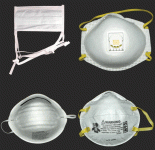

</TD></TR></TBODY></TABLE>
Of course, images of people in masks are what many of us think about when images of 1918 come to mind. Unfortunately, there's no good evidence that they helped reduce the spread of the virus--for every city with mask laws that seemed to have a milder epidemic, there's another one where disease was as severe as areas that had no such law. Similarly, there have been many published studies supporting the idea that the most popular type of masks used in healthcare outbreak situations--the N95 mask--helps to protect healthcare workers, but would that extend to the general public?
The thing is, influenza virus isn't only contracted via inhalation. The masks--if fitted and used properly--can probably decrease this risk. But influenza can enter the body in other ways, such as rubbing your eyes with contaminated fingers. Do masks provide a false sense of security, causing people to be more lax in other ways (such as face-touching, or handwashing?) This is my worry, and this is why I don't universally recommend masks. (Revere at Effect Measure says much the same, with ample additional information). Of course, as noted,
Suffice it to say nothing said here or by CDC or anywhere else is likely to stop people from wearing N95 face masks or stop vendors form selling them on the basis they will protect you and your family from influenza. Whether they will or won't, whether they can be reused or not, whether they will have other untoward side effects (interference with hearing, vision or breathing) remains to be seen.
And this is what concerns me: people who are scared and think, "hey, it can't hurt," and get lulled into that false complacency. This is addressed in this article (dealing more with a bioterrorist event than a natural pandemic, but the sentiment holds:
Even in a biological attack, the masks have major shortcomings. Like fit.
"Does it have a nose piece like a metal clip you can bend over your nose? That's a better model because the big kicker here is getting a good fit," Utgoff says.
Bad fits are deadly. Contaminated air breathed from around the unfiltered edges instead of through the N95-rated material undermines the purpose of a mask.
And, got a beard? "Shave it," says Breysse, who recommends duct-taping the mask to your face to make a good fit.
"For you to take a respirator and put it on without any training or fitting probably wouldn't give you the protection you are expecting," says Ron Herring, general manager of the Safety Products Division at Pittsburgh-based MSA.
Another huge shortcoming is that you don't know when to wear a mask. There are no reliable early warning signs that a biological agent has been released. No big air-raid warning horn goes off. News reports will be after the fact. "So here I am, I've got a mask, and I don't know when to use it," Utgoff says.
Obviously you may know when pandemic influenza is in your geographic area, so it's not quite as random as a biological warfare attack, but what then? Do you wear it all the time? Only around people you know are infected, or in public? Will that be enough to protect you?
Another problem is that the single-use masks don't last. "They are disposable because they deteriorate with sweat and wear and age," Breysse says.
And this is something Revere addresses as well--we don't really know how many uses a disposable N95 is good for. Best bet would be to throw it away and get a new one each time, but that certainly gets expensive after awhile. Recall that a regular influenza season can last 6 months from beginning to end, and for a pandemic, all bets are off.
Like Revere, I don't own any masks. My husband couldn't wear one now as it is due to facial hair, and I too am not convinced that they'll work in the community. Should H5N1 or another pandemic virus surface here, perhaps I'll get one on the chance that I need to visit someone I know is ill, but I don't see myself wearing them out on a daily basis (especially duct-taped!). I'm already a hermit, and that quality would likely be amplified in the event of a pandemic.
(Image from here.)
Send this entry to: Del.icio.usSpurlMa.gnoliaDigg
TrackBacks
TrackBack URL for this entry: http://scienceblogs.com/cgi-bin/MT/mt-tb.cgi/2543
<o:p></o:p>
Comments
I liken this situation to what we find in automobiles. Cars are much safer now than they were in the past thanks to strict regulations, airbags, seatbelts, ABS systems, better road maintenance, etc. Granted there are some drivers who overestimate their safety and get lulled into a false sense of security. The end result is people still driving recklessly, distracted, drunk, sleepy, etc., and people still dying in car wrecks. But on the whole, I think the safety precautions are for the better.
The same would hold I believe in the case of a potential epidemic. Certainly there will be those who overestimate the protection masks offer, and some will pay the price. But thanks to education and good habit forming, I think they would be a net positive.
Hopefully we never have to be put in such a position.
Oh, and I read in NewScientist today that a bacterium called Microbispora apparently survived the Columbia disaster at temps exceeding 175degC. I'm not sure I'm convinced. Since that wasn't one of the bacteria sealed it may have contaminated the sample after it touched down. It's easy enough to check...take some Microbispora and cook it to see what happens. I think thermophiles have been found in temps as high as 115degC.
Posted by: Dave S. | March 8, 2006 12:58 PM
I've seen it suggested that masks provide very little protection from airborne, but what they do do is keep people from unconsciously touching their mouth and nose with their fingers -- a much more common route of infection. Made sense to me.
Posted by: tavella | March 8, 2006 01:07 PM
I'm not sure about even protection from that. Have you ever watched people without much training wear a mask like that? They just push it up to itch their nose, etc.
Posted by: Tara | March 8, 2006 01:33 PM
I think encouraging people to wear masks in the event of a flu epidemic or pandemic would just create hysteria, raise stress levels ( a factor known to negatively affect immune systems) cause panic behaviour and generally make matters worse.
Posted by: Dale | March 8, 2006 01:36 PM
One Mask may do the job its call Nanomask

The NanoMask is the first face mask in the world to utilize nanotechnology enhanced
filter media to effectively isolate and destroy viral and bacterial contaminants. Nanoparticles enhance
the intrinsic filtration efficiency of the media by acting as a destructive absorbent to kill virus and
bacteria that come in contact with the filtration system.
http://www.emergencyfiltration.com/Products/NanoMask.htm
Posted by: pom!! | March 8, 2006 08:29 PM
That NanoMask add just has me imagining tiny robots crawling around on a piece of filter paper, tiny lasers zapping incoming germs. My imagination frequently reverts to cartoon-mode, so of course the laser beams are visible and red, and the germs look suitably ugly (nasty brown colours, lots of flagella, etc).
I also like the advertising copy:
One Mask may do the job its call Nanomask
Um, shouldn't there be a few more letters in there? Like an "e" and a "d" at the end of the penultimate word? I suspect a comma may be useful, as well.
Posted by: The Brummell | March 8, 2006 09:30 PM
Tara C. Smith is an Assistant Professor of Epidemiology in the College of Public Health at the University of Iowa. She is also the deputy director of the university's Center for Emerging Infectious Diseases. Her research involves a number of pathogens at the animal-human nexus. Additionally, she is the founder of Iowa Citizens for Science and also writes for The Panda's Thumb. Please note the views expressed on this site are Dr. Smith's alone and may not be representative of the groups mentioned above.
 

Attachments

Re: Will Nurses Work During a Pandemic?

it's annoying, that we still have no results on the efficiacy of mask-filters.
N95 is recommended, better -maybe- N99 or N100
but this is apparantly not tested.
.[/FONT]

?? Is the production of N99 and N100 masks starting to exceed the production of the N95? To whom are the N99 and N100 masks shipped? And in what amount??
:magnify:
 
Re: Will Nurses Work During a Pandemic?

Hi Jonesie.

The sentence ("anoy...") are from "gs" (2006.).

Is the production of N99 and N100 masks starting to exceed the production of the N95?
I don't know, but versus the N100, the N95 give you an 5% probability to leakage in the same time period, and is probably only for money costs, and breathing difficulties for asthma/lung/cardiac patients that N95 are used.

To whom are the N99 and N100 masks shipped? And in what amount?
To whom are buying, for now. If an pand. start, will be no masks to buy.
The amount is individual shielding purposes at the individual level, I suppose.

If looking the "gs" question:
"I'd like to see how a N95 differs from a surgical mask or a paper mask or a Hepa mask."

- a ordinary thick surgical masks can't shield viruses, only droplets
- a ordinary paper mask is used for dust particles

N100 have also a problem with it's sealing, because it can't press anaugh on the skin to be sure hermetical if you are working, sweating.

This can be resolved only with a rubber/glass masks with a filter for bio-particles (only chemical is not adequate), or a respirator.

For a micron-particulates question, some answers can be seen from the posted pdf doc: masks_Test_Report_DRAEGER_DefendAIR.pdf
at page 13, Table 3. Draeger DefendAir PF Results.

_______________________________________________________________

Positive air-pressure respirator (costly):
_______________________________________________________________

<TABLE class=Container_mar4 cellSpacing=0 cellPadding=0 width="100%" border=0><TBODY><TR><TD class=LY04-ContainerT vAlign=center><TABLE cellSpacing=0 cellPadding=0 width="100%" border=0><TBODY><TR><TD class=LY04-ContainerTitleTD vAlign=top>Who needs a high purity respirator? </TD><TD class=LY04-ContainerActionsTD vAlign=top></TD></TR></TBODY></TABLE></TD><TD class=LY04-ContainerTR vAlign=top>
forum
</TD></TR><TR><TD class=LY04-ContainerML vAlign=top></TD><TD class=LY04-ContainerM vAlign=top><TABLE cellSpacing=0 cellPadding=0 width="100%" border=0><TBODY><TR><TD class=LY04-ContainerContent id=dnn_ctr375_ContentPane vAlign=top align=left><!-- Start_Module_375 -->
Essential workers and heads-of-household who must protect themselves from being infected by airborne viruses such as the H5N1 avian influenza in the event of, or the threat of a pandemic.
Employees in jobs associated with unpleasant or dangerous air quality (auto repair, garbage, gasoline, insulation, mold, paint, sheetrock, solvents, or animal/human sewage);
Do-it-yourself (DIY) enthusiasts and hobbyists
Asthmatics and those who suffer from significant airborne allergies and respiratory maladies
The elderly and those who are highly susceptible to the ordinary flu or other airborne diseases.
<!-- End_Module_375 -->

</TD></TR></TBODY></TABLE></TD><TD class=LY04-ContainerMR vAlign=top></TD></TR><TR><TD class=LY04-ContainerBL vAlign=top>
forum
</TD><TD class=LY04-ContainerB vAlign=top>
forum
</TD><TD class=LY04-ContainerBR vAlign=top>
forum
</TD></TR></TBODY></TABLE>
<LINK href="04-Container.css" type=text/css rel=stylesheet><TABLE class=Container_mar4 cellSpacing=0 cellPadding=0 width="100%" border=0><TBODY><TR><TD class=LY04-ContainerTL vAlign=top>
forum
</TD><TD class=LY04-ContainerT vAlign=center><TABLE cellSpacing=0 cellPadding=0 width="100%" border=0><TBODY><TR><TD class=LY04-ContainerTitleTD vAlign=top>Respirator features: </TD><TD class=LY04-ContainerActionsTD vAlign=top></TD></TR></TBODY></TABLE></TD><TD class=LY04-ContainerTR vAlign=top>
forum
</TD></TR><TR><TD class=LY04-ContainerML vAlign=top></TD><TD class=LY04-ContainerM vAlign=top><TABLE cellSpacing=0 cellPadding=0 width="100%" border=0><TBODY><TR><TD class=LY04-ContainerContent id=dnn_ctr376_ContentPane vAlign=top align=left><!-- Start_Module_376 -->Ultra low particle filtration
  • Comfortable for long term wear
  • Lightweight and compact
  • Easy to wear back pack
  • Positive air pressure
  • On-demand air
  • 4 hour lithium battery life
  • Disposable, replaceable filters
    Same protection as the most expensive Hazmat suit:
  • Outside air is continuously drawn into a base unit worn on a beltpack
  • The air passes through an ultra-low penetration (ULPA) disposable filters
  • The filters will remove particles and viruses at <100 nanometers, (well inside the range of avian flu and pollen)
  • You breath the cleanest air possible with today?s technology
_____________________________________________________________

</TD></TR></TBODY></TABLE></TD></TR></TBODY></TABLE>
 

Attachments

Re: Will Nurses Work During a Pandemic?

It is not bird flu, but Ebola is dangerous and fatal enough. The current outbreak of Ebola in Uganda may have infected as many as 84 people with 18 confirmed dead including HCWs.

See this thread: New Ebola Strain in Uganda Spreading - Death toll rising

Below is an article from Uganda where HCWs are going on strike to hold out for hazard pay for working with Ebola patients. Hat-tip to Niman.

Bundibugyo Nurses Strike

The Monitor (Kampala)
NEWS
4 December 2007
Posted to the web 4 December 2007
By Tabu Butagira, Joseph Mugisha, and Emmanuel Gyezaho
Kampala/Bundibugyo
HEALTH workers handling Ebola patients in Bundibugyo temporarily abandoned duty yesterday morning over delayed payment of their risk allowances and only resumed work after local leaders cleared the overdue bills in the afternoon.
Citing eight of their colleagues who have since contracted the disease while on duty, one health worker said their condition of work was precarious and it was "inhumane" for government officials to hold back "our" little pay.
"For us, no payment of our risk allowance, no work from today onwards," one of the disgruntled nurses said.
Bundibudyo MP Jane Alisemera sounded alarm bells yesterday in Parliament urging the government to "urgently find financial resources" because "volunteers are withdrawing due to none payments."
"They cannot continue working because they are operating under dangerous circumstances."
Bundibugyo RDC, Samuel Kazinga who heads the local Ebola taskforce in the district, downplayed the morning hitch that sparked a wave of panic among district officials, saying the complainants only "demanded" their pay.
"It is one thing to demand and another to strike but we have now paid part of the money they were demanding," said Mr Kazinga, who had earlier attributed the pay to bureaucratic delays in processing payment.
Daily Monitor has learnt that officials of the district Ebola Taskforce were paying doctors a daily risk allowance of Sh30, 000 while nursing officers and other support staff were getting Sh20, 000 and Sh10, 000 respectively.
In Kampala, Unicef Country representative Keith McKenzie told a government-organised news conference that the NGO had sent Sh230 million directly to Bundibugyo District to support the Ebola fight, "including payment for health workers. Latest statistics show that Ebola has killed 19 people out of 74 cumulative infections.
The latest victim has been identified as Mighten Muliwaviyo, the chairman of the business community in Bundibugyo town council who died on Monday night, amid reports of new infections in Kasese, Kabarole and Mbarara District.
By last evening, a man identified as Mr Johnson Baluku, who showed symptoms akin to that of Ebola, was reported to have been admitted at Bwera Hospital in Kasese while three alert cases were registered in Kabarole District.
The minister is expected to table the "emergency funds" budget to his colleagues during the Cabinet sitting today.
The junior minister had indicated that the Sh6b would be used for among other things; meeting recurrent operational costs, buying medical supplies and protective gears as well as paying risk allowance for health workers handling Ebola patients.
Unicef has through the central government separately given protective materials, medical equipments and supplies worth Sh861m to tackle the epidemic.

http://allafrica.com/stories/printab...712041123.html
 
Re: Will Nurses Work During a Pandemic?

It would be easy to think that hospital workers fleeing an outbreak were like soldiers disserting in the face of combat. But it's hard to know how much information and personal protection hospital staff are given in these settings for them to carefully weigh up the risks -- not only to them, but also their families.
I know doctors who are certain they would not want to be at the frontlines of a pandemic -- not just because of the risk of infection to them, but more importantly, what the disease could do to their infant children.
Perhaps some of these hospital workers in Uganda are the main bread-winners for their families, and their support is critical for the survival of others.
These are some of the issues that public health authorities need to think through carefully in planning what level of service will be provided in a pandemic situation.
 
Back
Top