

AlaskaDenise
In Memoriam
http://earthquake.usgs.gov/eqcenter/eqarchives/poster/2009/20090130.phpFor reasons that are not well understood at this time, earthquakes in the intraplate class give rise to extremely sparse aftershock sequences. Often they have no aftershocks at all. This contrasts with large shallow crustal earthquake that can have hundreds or even thousands of aftershocks.
http://en.wikipedia.org/wiki/Intraplate_earthquakesAn intraplate earthquake is an earthquake that occurs in the interior of a tectonic plate, whereas an interplate earthquake is one that occurs at a plate boundary.
Intraplate earthquakes are rare compared to earthquakes at plate boundaries. Nonetheless, very large intraplate earthquakes can inflict heavy damage. Notable examples of damaging intraplate earthquake are the 1811-1812 earthquakes in New Madrid, Missouri, and the 1886 earthquake in Charleston, South Carolina
Remember how the Padang, Indonesia quakes was just off the coast? It was in a shallow area next to Sumatra (forearc basin), not in the trench as was the one that caused the big tsunami (red dot on purple trench area of drawing below). If you look about 1/3 down the page in the article below, you'll see a diagram of the Indonesian Islands, and a shallow quake just beside Sumatra is an intraplate earthquake.
See: http://whatonearth.olehnielsen.dk/Tectonics.asp
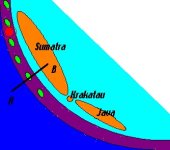
Latest earthquake was at the very edge of Sumatra - the island, NOT the trench.
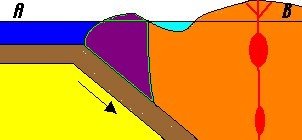
It occured in the little shelf (filled with light blue water), but shallow enough to be part of the upper island.
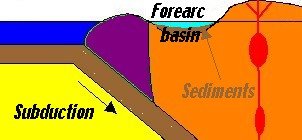
It occured in the area just below the brown area labeled sediments.
I hope our resident geophysicist (?Wotan) can add further clarity to this situation.
.