

Commonground
Senior Moderator
Note: The reporting date of human infections included in this weekly update is based on the Event Information Site
(EIS) posting date, rather than the date of initial notification received through the International Health Regulations
(2005) (IHR).
Human infection with avian influenza A(H5) viruses
Human infection with avian influenza A(H5N1) virus
From 17 to 23 April 2026, no new case of human infection with avian influenza A(H5N1) virus was reported
to WHO in the Western Pacific Region. The last case was reported from Oddar Mean Chey Province,
Cambodia, with symptom onset on 28 March 2026.
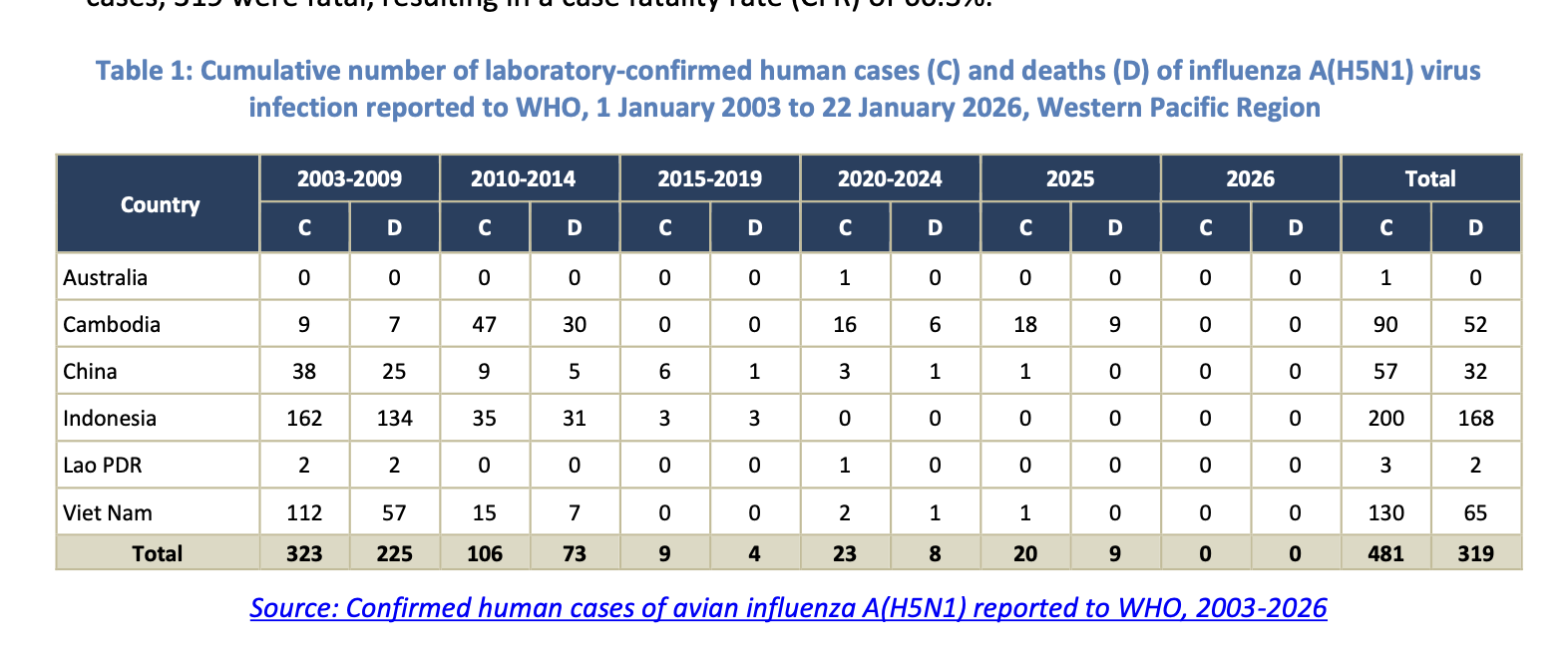
From 1 January 2003 to 22 January 2026, a total of 481 cases of human infection with avian influenza
A(H5N1) virus have been reported from six countries within the Western Pacific Region (Table 1). Of these
cases, 319 were fatal, resulting in a case fatality rate (CFR) of 66.3%.
Table 1: Cumulative number of laboratory-confirmed human cases (C) and deaths (D) of influenza A(H5N1) virus
infection reported to WHO, 1 January 2003 to 22 January 2026, Western Pacific Region.
Globally, from 1 January 2003 to 22 January 2026, 993 cases of human infection with avian influenza
A(H5N1) virus were reported from 25 countries. Of these 993 cases, 477 were fatal (CFR of 48.0%).
Human infection with avian influenza A(H5N6) virus
From 17 to 23 April 2026, no new cases of human infection with avian influenza A(H5N6) virus were
reported to WHO in the Western Pacific Region. Since 2014, a total of 93 laboratory-confirmed cases of
human infection with influenza A(H5N6) virus including 57 deaths (CFR 61.3%) have been reported to WHO
in the Western Pacific Region. The last case was reported from Anhui Province, China, with an onset date
of 17 June 2024.
Human infection with avian influenza A(H5) virus, unsubtyped virus
From 17 to 23 April 2026, no new cases of human infection with avian influenza A(H5) virus were reported
to WHO in the Western Pacific Region. The last case was reported from Long An Province, Viet Nam, with
an onset date of 9 November 2024.
Public health risk assessment for human infection with avian influenza A(H5) viruses
Whenever avian influenza viruses are circulating in poultry, there is a risk for sporadic infection and small
clusters of human cases due to exposure to infected poultry or contaminated environments. Therefore,
sporadic human cases are not unexpected.
No sustained human-to-human transmission has been identified associated with the recent reported
human infections with avian influenza A(H5). Available evidence suggests that influenza A(H5) viruses
circulating have not acquired the ability to efficiently transmit between people; therefore, sustained
human-to-human transmission is thus currently considered unlikely.
The zoonotic threat remains elevated due to the spread of viruses among birds. However, the overall
pandemic risk associated with A(H5) is considered to have not significantly changed in comparison to
previous years. WHO recommends that Member States remain vigilant and consider mitigation steps to
reduce human exposure to potentially infected birds to reduce the risk of additional zoonotic infection.
For information on risk assessments on Avian Influenza, see:
Updated joint FAO/WHO/WOAH public health assessment of recent influenza A(H5) virus events in
animals and people published on 29 September 2025.
Human infection with avian influenza A(H3N8) virus
From 17 to 23 April 2026, no new cases of human infection with avian influenza A(H3N8) virus were
reported to WHO in the Western Pacific Region. The last case was reported from China with an onset date
of 22 February 2023. To date, a total of three laboratory-confirmed cases of human infection with
influenza A(H3N8) virus with one death have been reported to WHO in the Western Pacific Region.
Human infection with avian influenza A(H7N4) virus
From 17 to 23 April 2026, no new cases of human infection with avian influenza A(H7N4) virus were
reported to WHO in the Western Pacific Region. To date, only one laboratory-confirmed case of human
infection with influenza A(H7N4) virus has been reported to WHO. This case was reported from China on
14 February 2018.
Human infection with avian influenza A(H7N9) virus
From 17 to 23 April 2026, no new cases of human infection with avian influenza A(H7N9) virus were
reported to WHO in the Western Pacific Region. To date, a total of 1 568 laboratory-confirmed human
infections with avian influenza A(H7N9) virus, including 616 fatal cases (CFR: 39.3%), have been reported
to WHO since early 2013. The last case reported to WHO in the Western Pacific Region was in 2019.
Human infection with avian influenza A(H9N2) virus
From 17 to 23 April 2026, no new cases of human infection with avian influenza A(H9N2) virus were
reported to WHO in the Western Pacific Region. The last case was reported from Jiangxi Province, China,
with symptom onset on 20 March 2026.
Since December 2015, a total of 162 cases of human infection with avian influenza A(H9N2), including two
deaths (both with underlying conditions), have been reported to WHO in the Western Pacific Region. Of
these, 159 were reported from China, two were from Cambodia, and one was from Viet Nam.
Human infection with avian influenza A(H10N3) virus
From 17 to 23 April 2026, no new cases of human infection with avian influenza A(H10N3) virus were
reported to WHO in the Western Pacific Region. The last case was reported from Guangdong Province,
China, with an onset date of 29 December 2025. To date, seven cases of human infection with avian
influenza A(H10N3) have been reported globally.
Most previously reported human infections with avian influenza viruses were due to exposure to infected
poultry or contaminated environments. Since avian influenza viruses, including avian influenza A(H10N3)
viruses, continue to be detected in poultry populations, further sporadic human cases could be detected
in the future. Currently, available epidemiologic information suggests that the avian influenza A(H10N3)
virus has not acquired the ability for sustained human-to-human transmission, thus the likelihood of
spread among humans is low.
Human infection with avian influenza A(H10N5) virus
From 17 to 23 April 2026, no new cases of human infection with avian influenza A(H10N5) were reported
to WHO in the Western Pacific Region. To date, one case of avian influenza A(H10N5) virus has been
reported from Zhejiang Province, China, with an onset date of 30 November 2023.
Avian influenza A(H10) subtype viruses are known to be distributed in domestic and wild bird species
worldwide. They are classified as low pathogenic and occasionally infect mammals (e.g., pigs). Human
infection with avian influenza A(H10N5) is unusual; however, given the sporadic nature of human infection
with H10Nx, this is not an unexpected event. There is no evidence of sustained human-to-human
transmission of influenza A(H10Nx). Human infections of avian influenza need to be monitored and
assessed for any indications of changes in transmissibility and virulence.
Animal infection with avian influenza virus
From 17 to 23 April 2026, no new cases of highly pathogenic avian influenza (HPAI) in animals were
reported to the World Organisation for Animal Health (WOAH) in the Western Pacific Region. For more
information on animal infection with avian influenza viruses with potential public health impact, visit:
• WOAH web page: Weekly disease information and Latest report on Avian Influenza
• Emergency Prevention System for Transboundary Animal and Plant Pests and Diseases (EMPRES)
• FAO Global Animal Disease Information System (EMPRES-i)
Avian Influenza Weekly
Other Updates:
Continued: https://cdn.who.int/media/docs/defa..._20260424.pdf?sfvrsn=aa12851a_1&download=true
(EIS) posting date, rather than the date of initial notification received through the International Health Regulations
(2005) (IHR).
Human infection with avian influenza A(H5) viruses
Human infection with avian influenza A(H5N1) virus
From 17 to 23 April 2026, no new case of human infection with avian influenza A(H5N1) virus was reported
to WHO in the Western Pacific Region. The last case was reported from Oddar Mean Chey Province,
Cambodia, with symptom onset on 28 March 2026.
From 1 January 2003 to 22 January 2026, a total of 481 cases of human infection with avian influenza
A(H5N1) virus have been reported from six countries within the Western Pacific Region (Table 1). Of these
cases, 319 were fatal, resulting in a case fatality rate (CFR) of 66.3%.
Table 1: Cumulative number of laboratory-confirmed human cases (C) and deaths (D) of influenza A(H5N1) virus
infection reported to WHO, 1 January 2003 to 22 January 2026, Western Pacific Region.
Globally, from 1 January 2003 to 22 January 2026, 993 cases of human infection with avian influenza
A(H5N1) virus were reported from 25 countries. Of these 993 cases, 477 were fatal (CFR of 48.0%).
Human infection with avian influenza A(H5N6) virus
From 17 to 23 April 2026, no new cases of human infection with avian influenza A(H5N6) virus were
reported to WHO in the Western Pacific Region. Since 2014, a total of 93 laboratory-confirmed cases of
human infection with influenza A(H5N6) virus including 57 deaths (CFR 61.3%) have been reported to WHO
in the Western Pacific Region. The last case was reported from Anhui Province, China, with an onset date
of 17 June 2024.
Human infection with avian influenza A(H5) virus, unsubtyped virus
From 17 to 23 April 2026, no new cases of human infection with avian influenza A(H5) virus were reported
to WHO in the Western Pacific Region. The last case was reported from Long An Province, Viet Nam, with
an onset date of 9 November 2024.
Public health risk assessment for human infection with avian influenza A(H5) viruses
Whenever avian influenza viruses are circulating in poultry, there is a risk for sporadic infection and small
clusters of human cases due to exposure to infected poultry or contaminated environments. Therefore,
sporadic human cases are not unexpected.
No sustained human-to-human transmission has been identified associated with the recent reported
human infections with avian influenza A(H5). Available evidence suggests that influenza A(H5) viruses
circulating have not acquired the ability to efficiently transmit between people; therefore, sustained
human-to-human transmission is thus currently considered unlikely.
The zoonotic threat remains elevated due to the spread of viruses among birds. However, the overall
pandemic risk associated with A(H5) is considered to have not significantly changed in comparison to
previous years. WHO recommends that Member States remain vigilant and consider mitigation steps to
reduce human exposure to potentially infected birds to reduce the risk of additional zoonotic infection.
For information on risk assessments on Avian Influenza, see:
Updated joint FAO/WHO/WOAH public health assessment of recent influenza A(H5) virus events in
animals and people published on 29 September 2025.
Human infection with avian influenza A(H3N8) virus
From 17 to 23 April 2026, no new cases of human infection with avian influenza A(H3N8) virus were
reported to WHO in the Western Pacific Region. The last case was reported from China with an onset date
of 22 February 2023. To date, a total of three laboratory-confirmed cases of human infection with
influenza A(H3N8) virus with one death have been reported to WHO in the Western Pacific Region.
Human infection with avian influenza A(H7N4) virus
From 17 to 23 April 2026, no new cases of human infection with avian influenza A(H7N4) virus were
reported to WHO in the Western Pacific Region. To date, only one laboratory-confirmed case of human
infection with influenza A(H7N4) virus has been reported to WHO. This case was reported from China on
14 February 2018.
Human infection with avian influenza A(H7N9) virus
From 17 to 23 April 2026, no new cases of human infection with avian influenza A(H7N9) virus were
reported to WHO in the Western Pacific Region. To date, a total of 1 568 laboratory-confirmed human
infections with avian influenza A(H7N9) virus, including 616 fatal cases (CFR: 39.3%), have been reported
to WHO since early 2013. The last case reported to WHO in the Western Pacific Region was in 2019.
Human infection with avian influenza A(H9N2) virus
From 17 to 23 April 2026, no new cases of human infection with avian influenza A(H9N2) virus were
reported to WHO in the Western Pacific Region. The last case was reported from Jiangxi Province, China,
with symptom onset on 20 March 2026.
Since December 2015, a total of 162 cases of human infection with avian influenza A(H9N2), including two
deaths (both with underlying conditions), have been reported to WHO in the Western Pacific Region. Of
these, 159 were reported from China, two were from Cambodia, and one was from Viet Nam.
Human infection with avian influenza A(H10N3) virus
From 17 to 23 April 2026, no new cases of human infection with avian influenza A(H10N3) virus were
reported to WHO in the Western Pacific Region. The last case was reported from Guangdong Province,
China, with an onset date of 29 December 2025. To date, seven cases of human infection with avian
influenza A(H10N3) have been reported globally.
Most previously reported human infections with avian influenza viruses were due to exposure to infected
poultry or contaminated environments. Since avian influenza viruses, including avian influenza A(H10N3)
viruses, continue to be detected in poultry populations, further sporadic human cases could be detected
in the future. Currently, available epidemiologic information suggests that the avian influenza A(H10N3)
virus has not acquired the ability for sustained human-to-human transmission, thus the likelihood of
spread among humans is low.
Human infection with avian influenza A(H10N5) virus
From 17 to 23 April 2026, no new cases of human infection with avian influenza A(H10N5) were reported
to WHO in the Western Pacific Region. To date, one case of avian influenza A(H10N5) virus has been
reported from Zhejiang Province, China, with an onset date of 30 November 2023.
Avian influenza A(H10) subtype viruses are known to be distributed in domestic and wild bird species
worldwide. They are classified as low pathogenic and occasionally infect mammals (e.g., pigs). Human
infection with avian influenza A(H10N5) is unusual; however, given the sporadic nature of human infection
with H10Nx, this is not an unexpected event. There is no evidence of sustained human-to-human
transmission of influenza A(H10Nx). Human infections of avian influenza need to be monitored and
assessed for any indications of changes in transmissibility and virulence.
Animal infection with avian influenza virus
From 17 to 23 April 2026, no new cases of highly pathogenic avian influenza (HPAI) in animals were
reported to the World Organisation for Animal Health (WOAH) in the Western Pacific Region. For more
information on animal infection with avian influenza viruses with potential public health impact, visit:
• WOAH web page: Weekly disease information and Latest report on Avian Influenza
• Emergency Prevention System for Transboundary Animal and Plant Pests and Diseases (EMPRES)
• FAO Global Animal Disease Information System (EMPRES-i)
Avian Influenza Weekly
Other Updates:
Continued: https://cdn.who.int/media/docs/defa..._20260424.pdf?sfvrsn=aa12851a_1&download=true