• FluTrackers.com Inc. does not provide medical advice. Information on this web site is collected from various internet resources, and the FluTrackers board of directors makes no warranty to the safety, efficacy, correctness or completeness of the information posted on this site by any author or poster. The information collated here is for instructional and/or discussion purposes only and is NOT intended to diagnose or treat any disease, illness, or other medical condition. Every individual reader or poster should seek advice from their personal physician/healthcare practitioner before considering or using any interventions that are discussed on this website. By continuing to access this website you agree to consult your personal physican before using any interventions posted on this website, and you agree to hold harmless FluTrackers.com Inc., the board of directors, the members, and all authors and posters for any effects from use of any medication, supplement, vitamin or other substance, device, intervention, etc. mentioned in posts on this website, or other internet venues referenced in posts on this website.
  • We are not asking for any donations. Do not donate to any entity who says they are raising funds for us.

We are actually surprised not to have seen outbreaks already

Gert van der Hoek

In Memoriam - Editor, Senior Moderator
snip from IRIN article:

Africa doesn?t have the huge poultry populations that Asia has, Domenech said. Also risks of contamination between wild birds and poultry might be lower in Africa because there is less contact than in Asia.

However, the illegal trade in poultry and exotic birds could be a cause of outbreaks in Africa, he said. Also many Africans live with chickens in their backyards, making contamination between animals and humans more likely, Domenech said.

Furthermore, most African countries do not have the capacity to respond to outbreaks and thus when one occurs it may become difficult to contain.

Domenech also said that surveillance of wild birds in Africa is more difficult because they have natural predators such as vultures. ?Many wild birds might have died from the disease without anyone knowing,? he said.

?We are actually surprised not to have seen outbreaks already in areas with many migratory birds such as in deltas of the Senegal and Niger rivers and in East Africa?s Rift Valley,? Domenech said.

Joseph Domenech, chief veterinary officer for the Food and Agriculture Organisation (FAO) and a specialist on avian flu.

http://www.irinnews.org/report.asp?ReportID=56663&SelectRegion=Africa
 
Re: We are actually surprised not to have seen outbreaks already

I would like to comment on the statement that contamination between wild birds and poultry is less common in Africa. My home in Freetown, the capital of Sierra Leone is just half a mile from a 4000 acre RAMSAR protected wetland area that hosts a large number of migratory birds every year. It is a tiny stretch of the roughly 250 miles of coastline that is all coastal wetland which forms an important feed stop for hundreds of thousands of birds of the East Atlantic Flyway. Some migratory birds actually nest in the trees around my house and along the many creeks that run down the mountains through the city, etc. Terns from as far away as Canada, escort joggers along the several mile stretch of beach on the other side of Aberdeen Creek ( the RAMSAR SITE) . Some birds prey on the chicks of poultry wandering around the backyards, as most Sierra Leoneans are either back yard poultry farmers -- or next door neighbours of one. No single day passes when any Sierra Leonean -- rural or urban is not exposed to a domestic chicken or its excreta. Freetown has a population probably in excess of a million people, living closely with backyard poultry, under the East Atlantic migratory bird flyway and as a result, probably has the highest risk of an uncontainable outbreak in the country. Most of West Africa's coastal cities are probably in a similar position.

The Conservation Society of Sierra Leone, a homegrown NGO that does annual surveys of birds confirms that migratory birds move North and South at the same time coming from as far away as S. Africa. This means that there is a mixing movement of birds all along the African litoral that can cross-transfer anything brought south from Canada, Europe, or Asia, in the three north south flyways that cover Africa. Interestingly, last year while our Avian Influenza Task Force was considering the danger posed by the coastal migratory birds, we saw the outbreak and spread from Nigeria creeping along the inland wetlands associated with the Niger river ( which starts in Northern Sierra Leone). The huge inland delta of the Niger just north of Sierra Leone in Mali is thus also a potential mixing bowl for migratory birds from different flyways. Of course the Niger river is also a major commercial thouroughfare and spread could also take place through poultry trade.


A quick comment on the vultures. At a recent biodiversity workshop held in Sierra Leone and funded by the Critical Ecosystems Partnership Fund, one of the delegates presented a poster on the decline of vultures in the West Africa region and pointed out that this was an indication of the environmental degradation. Apparently, vultures are an indicator species as they survive on the carcasses of wildlife and have large area surveillance capability. Interestingly, this has consequences for humans also as congregations of vultures are used by local livestock farmers to locate births and deaths of their animals. I am not sure how vultures consuming carcasses of dead birds could mask an outbreak since they are likely to succumb themselves. On the other hand, they may be useful as part of a surveillance network if monitored.


Dutchy said:
snip from IRIN article:

Africa doesn?t have the huge poultry populations that Asia has, Domenech said. Also risks of contamination between wild birds and poultry might be lower in Africa because there is less contact than in Asia.

However, the illegal trade in poultry and exotic birds could be a cause of outbreaks in Africa, he said. Also many Africans live with chickens in their backyards, making contamination between animals and humans more likely, Domenech said.

Furthermore, most African countries do not have the capacity to respond to outbreaks and thus when one occurs it may become difficult to contain.

Domenech also said that surveillance of wild birds in Africa is more difficult because they have natural predators such as vultures. ?Many wild birds might have died from the disease without anyone knowing,? he said.

?We are actually surprised not to have seen outbreaks already in areas with many migratory birds such as in deltas of the Senegal and Niger rivers and in East Africa?s Rift Valley,? Domenech said.

Joseph Domenech, chief veterinary officer for the Food and Agriculture Organisation (FAO) and a specialist on avian flu.

http://www.irinnews.org/report.asp?ReportID=56663&SelectRegion=Africa
 
Re: We are actually surprised not to have seen outbreaks already

Thank you for your informative "boots on the ground" post, Cozodapo.

Welcome to the FT forum. :)

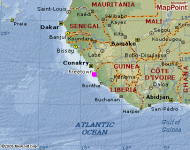
For people not familiar with Freetown's location - it's the violet dot in the center of the map below.....
Freetown2, Sierra Leone.GIF

.
 
Last edited:
Back
Top