• FluTrackers.com Inc. does not provide medical advice. Information on this web site is collected from various internet resources, and the FluTrackers board of directors makes no warranty to the safety, efficacy, correctness or completeness of the information posted on this site by any author or poster. The information collated here is for instructional and/or discussion purposes only and is NOT intended to diagnose or treat any disease, illness, or other medical condition. Every individual reader or poster should seek advice from their personal physician/healthcare practitioner before considering or using any interventions that are discussed on this website. By continuing to access this website you agree to consult your personal physican before using any interventions posted on this website, and you agree to hold harmless FluTrackers.com Inc., the board of directors, the members, and all authors and posters for any effects from use of any medication, supplement, vitamin or other substance, device, intervention, etc. mentioned in posts on this website, or other internet venues referenced in posts on this website.
  • We are not asking for any donations. Do not donate to any entity who says they are raising funds for us.

Watch the humidity, flu likes it dry

mixin

Well-known member
WASHINGTON - Grandma may have been right about keeping a teakettle warming on the stove in winter to moisten the air.

Studies of seasonal influenza have long found indications that flu spreads better in dry air.

Now, new research being published Tuesday in Proceedings of the National Academy of Science, indicates that the key is the absolute humidity ? which measures the amount of water present in the air, regardless of temperature ? not the more commonly reported relative humidity.

Relative humidity varies depending on air temperature; absolute humidity doesn't.

"The correlations were surprisingly strong. When absolute humidity is low, influenza virus survival is prolonged and transmission rates go up," said Jeffrey Shaman, an Oregon State University atmospheric scientist who specializes in ties between climate and disease transmission

Full story: http://www.msnbc.msn.com/id/29106092
 
Re: Watch the humidity, flu likes it dry

Here's a little more about relative/absolute humidity. I wonder why this first sentence is true? I would think flu virus would live longer in moist conditions.

In 2007, researchers reported that the flu virus is more stable and stays in the air longer when air is cold and dry.

I wonder if the moisture has a pH level that negatively affects the virus?

---------------------------------------------------------------------

2. What made you wonder if absolute humidity was more important in flu transmission and survival than relative humidity?

All the laboratory studies I have seen examine how influenza survival and transmission vary with changing relative humidity conditions; none of them examine the effect of absolute humidity. Relative humidity is a physically meaningful variable, and for some organisms it can be biologically significant; however, relative humidity does not provide a fixed measure of atmospheric water vapor content. Absolute humidity is the actual atmospheric water vapor content which for some disease systems can have greater biological significance than relative humidity.

3. Can you describe your results?

We re-examined the data from those laboratory investigations of influenza virus survival and transmission and looked for a connection with absolute humidity. During our investigation, we found that both the survival and transmission of influenza virus increase markedly in lower absolute humidity conditions. While relative humidity only explains a small amount of this variability of influenza virus survival and transmission (36 percent and 12 percent, respectively), absolute humidity accounts for much more (90 percent and 50 percent, respectively).

Additionally, in temperate regions both outdoor and indoor absolute humidity are at a minimum during winter months, conditions that favor influenza survival and transmission. The same is not true for relative humidity, which is at a maximum outdoors during winter. These findings indicate that absolute humidity provides a single, coherent and more physically sound explanation for observed changes in the survival, transmission and seasonality of influenza.

4. Would that mean that flu rates would be higher in dry, temperate climates than in "humid," temperate climates? Is temperature less of a factor than humidity?

The results indicate that the influenza virus, once expelled from a host into the environment, would survive longer in drier air conditions. As a result, transmission proceeds more efficiently. However, humid conditions certainly don?t preclude transmission ? they just seem to work against it.

Temperate regions of the world, such as the U.S., have seasonal absolute humidity cycles. The air in New York City on a typical summer day has four times as much water vapor as the air on a typical winter day. That large humidity difference greatly favors outbreaks during winter, when humidity levels are lowest and influenza survival is greatest. Even in South Florida, there is a large seasonal absolute humidity cycle that favors wintertime influenza transmission.

We have also examined the effect of temperature on influenza survival and transmission. Our analyses indicate that temperature does not exert the same level of control as absolute humidity. Like relative humidity, the effect of temperature is much more marginal.

Interview conducted and condensed by Karen Barrow.
http://www.nytimes.com/2009/03/03/health/03questions.html?_r=3&partner=MYWAY&ei=5065

 
Re: Watch the humidity, flu likes it dry

relative humidity is directly proportional to absolute humidity

the connection is still unclear:

http://www.flutrackers.com/forum/showpost.php?p=105139

no transmission at 5°C and 20% relative humidity
much transmission at 5°C and 35% relative humidity

no transmission at 20°C and 80% relative humidity
much transmission at 20°C and 20% humidity

no transmission at 30°C

flu in the tropes is assumed to transmit by droplets or contact, not aerosole
 
Re: Watch the humidity, flu likes it dry

I thought your chart was interesting and tried to copy it over into this thread; but it didn't copy well. Thanks for putting it into words.

Why do you think there was no transmission at 20% RH?

Also, when it states 30% relative humidity, what would the absolute humidity be? Higher or lower?
 
Re: Watch the humidity, flu likes it dry

click on "quote", then you can copy it:


Code:
temperature in degree Celsius
   |           |           |
  |05          20          30
--|-----------------------------------
20|.           .xxxxxxx
35|.xxxxxxxx   .xxxxxxxx   .
50|.xxxxxxx    .xx
65|.xxxx       .xxxxxx
80|.xxxx       .
--|-----------------------------------
|
|_relative humidity in %

x: one infected guinea pig (out of 8)


zero infected Guinea Pigs (out of 8) at 5°C and 20% RH
I think all results are for RH, no consideration of AH


there was another study by Palese et.al. with Guinea Pigs, where they
conclude that flu transmits in the Tropes by contact and not aerosoles (AFAIR)
 
Re: Watch the humidity, flu likes it dry

Note: China is experiencing an unprecedented drought and dry season.

I know this is an old post but I wanted to thank you... it was a correlation that had completely escaped me prior to reading it.

The drought is true for Australia as well, and, although they have no known H5N1, they have had two influenza seasons more severe than that suffered in Western Europe or North America.

Interesting pandemic implications.
 
Re: Watch the humidity, flu likes it dry

make a statistics to compare seasonal flu in different years and countries
with weather conditions i.e. temperature and humidity !

The data is available. Has it been done ?
If it had been done and positive, then we probably would have heard about it.
If it had been done and negative, then we less likely had heard about it (IMO)

I did some partial examination before (France) and found no
significant connection.
 
Re: Watch the humidity, flu likes it dry

I do hope you are not looking at *me* to produce those statistics ;) . Not my "thing" at all, nor do I want it to be. But, I was momentarily intrigued at the thought of digging up 1918 data (such as it is) and comparing it to global weather patterns of the day (if available).
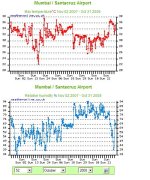
 
Re: Watch the humidity, flu likes it dry

attachment.php


http://www.wunderground.com/history...tml?req_city=NA&req_state=NA&req_statename=NA
 

Attachments

  • weamum.jpg
    weamum.jpg
    81.1 KB · Views: 0
Re: Watch the humidity, flu likes it dry

1918 1st wave was _in summer_

2nd wave in Sept.,October

The summer wave is assumed to have been the pandemic strain of H1N1, however, AFAIK that is not an indisputable fact. Not that I necessarily doubt it... in fact, I am one who believes 1918 was not the first appearance of H1N1 in the human population, but it just seems "sloppy" to so confidently assume the summer presentation was the same virus as the one from the fall.
 
Re: Watch the humidity, flu likes it dry

(1917-18-19,) What were the unusual weather conditions, if any, to account for this most serious bacterial attack upon the human race ? For instance, a medical writer in Spain states: ?After the subsidence of the epidemic of influenza in Spain last spring, the summer was extremely dry, the drought being worse than even the oldest inhabitants could remember, and the epidemic flared up again seemed to yield to the extreme hot weather, suddenly spread throughout the whole of Spain.?

Another writer, from the Philippines, states that ?The disease raged in the islands for about six weeks, when a typhoon with torrential rain followed by strong winds swept away the last vestige of the disease.?

Another writer states ?The epidemic appeared after a very hot season had suddenly been succeeded by a very cold one and that perhaps the weather precipitated a large amount of other respiratory infections such as always become relevent at this season (autumn).?

http://www.flutrackers.com/forum/showthread.php?t=72160
 
Re: Watch the humidity, flu likes it dry

http://query.nytimes.com/mem/archive-free/pdf?_r=1&res=9B02E0DE113BEE3ABC4B53DFB6678383609EDE

drought during July and August in USA


Summer 1918 was rainy and cool in Germany
Spring 1918 was dry


http://www.scribd.com/doc/2450197/Weather-Controls-Over-the-Fighting-During-the-Summer-of-1918

June was hot and dusty in France
rain,mud earlier (April,May ?)

rain in Flanders, August-November
Febr.-March , dry and mild
heavy rain storm, June 9-10
followed by fine weather...


nothing really unusual, apparantly.
Still 1st wave
 
Re: Watch the humidity, flu likes it dry

I wonder if, after periods of severe/extended drought in the summer,
the soil pulls the moisture out of the autumn and winter air?
 
Re: Watch the humidity, flu likes it dry

I wonder if, after periods of severe/extended drought in the summer,
the soil pulls the moisture out of the autumn and winter air?

The concept would make sense if weather was static and self-contained. Because weather patterns would continue to "feed in" moisture the small amount wicked out of the air by dry soil wouldn't seem to be "meaningful", or maybe it would be not rapid enough to overcome continually arriving humidity.

If that makes sense :oem I'm not a weather expert either. However, I do believe that heat/humidity (or lack thereof) is a piece of the influenza puzzle... just don't know which piece or how big it is.
 
Re: Watch the humidity, flu likes it dry

typically 2 flu seasons (waves) per year in the Tropes
(Nicaragua,Okinawa,Hongkong,...)

Hong Kong:
attachment.php


and almost no signs that human flu survives for longer times without replicating
 

Attachments

Back
Top