
• FluTrackers.com Inc. does not provide medical advice. Information on this web site is collected from various internet resources, and the FluTrackers board of directors makes no warranty to the safety, efficacy, correctness or completeness of the information posted on this site by any author or poster. The information collated here is for instructional and/or discussion purposes only and is NOT intended to diagnose or treat any disease, illness, or other medical condition. Every individual reader or poster should seek advice from their personal physician/healthcare practitioner before considering or using any interventions that are discussed on this website. By continuing to access this website you agree to consult your personal physican before using any interventions posted on this website, and you agree to hold harmless FluTrackers.com Inc., the board of directors, the members, and all authors and posters for any effects from use of any medication, supplement, vitamin or other substance, device, intervention, etc. mentioned in posts on this website, or other internet venues referenced in posts on this website.
  • We are not asking for any donations. Do not donate to any entity who says they are raising funds for us.

Wales: Bird flu symptom cases rise to 17

Anne

Senior Moderator
British authorities identify 4 human cases of bird flu

<!-- /kicker & headline --><!-- subhead --><!-- /subhead --><!-- byline -->
dot_h.gif

The Associated Press
Published: May 25, 2007
at_narrow_bot.gif


<!-- /article tools - narrow (used with span photos) --><!-- copy -->LONDON: Four people have tested positive for a mild strain of bird flu, British authorities said Friday.
The cases ? which are not the feared H5N1 strain, but the less dangerous H7N2 subtype ? were reported after poultry died at a small farm in north Wales. Tests were performed on nine people associated with the farm, and the Health Protection Agency said in a news release that four people had tested positive for the H7N2 strain of the virus.
Three of the nine were hospitalized, but have since been discharged, the agency said.
The H7 subtype of bird flu is believed to be less virulent than H5, but it has in the past caused human cases, and was responsible for a large outbreak in the Netherlands. In that outbreak in 2003, there were 89 mild cases of H7N7, and one person died.
Most of the cases in the Netherlands were conjunctivitis, a mild eye infection.
<!-- sidebar --><!-- today in links -->Today in Europe <!-- /170 x 60 ad -->
<!-- /sidebar -->"The mortality rate of H7 viruses is not on the order of H5N1," said Dr. Michael Perdue, a World Health Organization bird flu expert. Experts estimate that nearly half or more of all people who contract H5N1 die.
While H7 viruses tend to cause milder illnesses in humans, they still have the potential to ignite a global flu outbreak and should be watched.
"A low pathogenic H7 virus might not be picked up as easily as a highly pathogenic virus," said Perdue, explaining that the mild symptoms of a H7 case might be mistaken for ordinary flu, causing experts to lose valuable time tracking an emerging pandemic.
Like all flu viruses, H7 evolves constantly. Other bird flu subtypes have also caused illnesses in humans. Surveillance in Europe for all bird flu viruses has greatly increased in recent years.
While global health experts have been focused on H5N1 as the strain most likely to cause the next flu pandemic, it is also possible that another subtype, such as H7, could ultimately be responsible. "I'd hate to predict anything with bird flu," said Perdue.
The farm came to the attention of British authorities after a number of chickens died.
Dr. Christianne Glossop, the chief veterinary officer for Wales, said in a statement that they had tested positive for H7N2.
A one-kilometer (1.6-mile) exclusion zone was put in place around the farm, and the remaining chickens have been slaughtered.


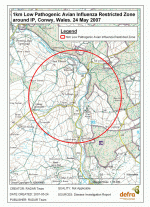
 
Re: Human H7N2 infection in North Wales

Re: Human H7N2 infection in North Wales

Statement on avian flu cases at Corwen smallholding

Thursday, 24 May 2007


An H7 flu virus has been identified in birds on one smallholding near Corwen, Conwy.

Two people living on the farm have symptoms compatible with conjunctivitis and a flu?like illness.

The National Public Health Service for Wales has arranged for blood tests to check the cause of their viral infection. Both are receiving treatment. Neither of them is in hospital.

In almost all cases of human H7 infection to date, the virus has only caused a mild disease.

H7 avian flu remains largely a disease of birds. Almost all human H7 infections documented so far have been associated with close contact with dead or dying poultry. In any case, it is very difficult for human beings to catch flu from birds.

There has to be very close and continued contact for this to happen and this contact in an enclosed space. The H7 virus also does not transmit easily from person to person.

Dr Marion Lyons, Consultant in Communicable Disease Control for the National Public Health Service for Wales, said:-
?As a precaution, we are identifying all those who have been in very close contact with the birds in the last seven days so that we can offer them an anti viral medicine called tamiflu. This can help in reducing symptoms. We are also contacting all those people who have been in close contact with those people living on the smallholding since they fell ill a week ago.?

?The National Public Health Service for Wales has been kept informed by Animal Health and is monitoring the situation closely. We are following guidelines and plans in place for such cases of avian flu.?

A Q&A information sheet prepared by the NPHS is available to download from the link: Q&A Avian Influenza in North Wales

Situation updates are also available from the Welsh Assembly Government website at: http://new.wales.gov.uk/news/presreleasearchive/1469510/?lang=en

A map detailing the Avian Influenza Restricted Zone declared in accordance with Article 55 of the Avian Influenza and Influenza of Avian Origin in Mammals (Wales) (No.2) Order 2006 is also given on the Welsh Assembly website at: ttp://new.wales.gov.uk/topics/environmentcountryside/ahw/disease_surveillance_control/avianflu/avianfludeclaration/?lang=en

More information about avian influenza is also available from the Department of the Environment, Food and Rural Affairs (Defra) website at: http://www.defra.gov.uk/animalh/diseases/notifiable/disease/ai/index.htm

Source: National Public Health Service for Wales (NPHS)

http://www.wales.nhs.uk/sites3/news.cfm?orgid=719&contentid=6786
 
Re: Human H7N2 infection in North Wales

Re: Human H7N2 infection in North Wales

Four People Test Positive For Bird Flu

Updated: 21:24, Friday May 25, 2007
Four people have tested positive for for bird flu after an outbreak of the virus on a farm in north Wales.

The Health Protection Agency (HPA) carried out tests on specimens from nine people associated with the incident - seven from Wales and two from north west England.


1342722.jpg
Chickens were slaughtered

Of the four positive results, two were from Wales and two were from north west England.
The remaining five were negative, the HPA said.
Dr Christianne Glossop, Chief Veterinary Officer for Wales, previously said it was not the most dangerous H5N1 strain but H7N2 low pathogenic avian influenza.

http://news.sky.com/skynews/article/0,,30100-1267580,00.html
 
Re: Human H7N2 infection in North Wales

Re: Human H7N2 infection in North Wales

Credits to Rick at P4P

British authorities identify human cases of bird flu
Strain is mild, not the feared H5N1

Friday, May 25, 2007

AP

"The cases — which are not the feared H5N1 strain, but the less dangerous H7N2 subtype — were reported after poultry died at a small farm in north Wales. Tests were performed on nine people associated with the farm, and the Health Protection Agency said in a news release that four people had tested positive for the H7N2 strain of the virus.

"The Welsh health authorities said that in all but one of the four human cases the virus had spread from poultry. The other case may have been transmitted from person to person."

http://www.delmarvanow.com/apps/pbcs.dll/article?AID=/20070525/NEWS01/70525037/1002
 
Re: Human H7N2 infection in North Wales

Re: Human H7N2 infection in North Wales

British authorities identify human cases of bird flu
Strain is mild, not the feared H5N1
By The Associated Press

<TABLE cellSpacing=0 cellPadding=0 width="100%" border=0><TBODY><TR><TD vAlign=top><!-- ARTICLE BODYTEXT --><!--ARTICLE TEXT-->
LONDON (AP) ? Four people have tested positive for a mild strain of bird flu, British authorities said Friday. The cases ? which are not the feared H5N1 strain, but the less dangerous H7N2 subtype ? were reported after poultry died at a small farm in north Wales. Tests were performed on nine people associated with the farm, and the Health Protection Agency said in a news release that four people had tested positive for the H7N2 strain of the virus.
</TD></TR></TBODY></TABLE>

Three of the nine were hospitalized, but have since been discharged, the agency said.

The Welsh health authorities said that in all but one of the four human cases the virus had spread from poultry. The other case may have been transmitted from person to person.

?Although the number of people involved is very small, we could be dealing with some spread of the H7 flu virus within the household setting,? said Dr. Marion Lyons, a communicable disease specialist with the Welsh health service. ?We are treating this possibility very seriously.?

Officials are now following up all close contacts of the people who were ill as a precaution.

The H7 subtype of bird flu is believed to be less virulent than H5, but it has in the past caused human cases, and was responsible for a large outbreak in the Netherlands. In that outbreak in 2003, there were 89 mild cases of H7N7, and one person died.

Most of the cases in the Netherlands were conjunctivitis, a mild eye infection.

?The mortality rate of H7 viruses is not on the order of H5N1,? said Dr. Michael Perdue, a World Health Organization bird flu expert. Experts estimate that nearly half or more of all people who contract H5N1 die.

While H7 viruses tend to cause milder illnesses in humans, they still have the potential to ignite a global flu outbreak and should be watched.

?A low pathogenic H7 virus might not be picked up as easily as a highly pathogenic virus,? said Perdue, explaining that the mild symptoms of H7 infection might be mistaken for ordinary flu, causing experts to lose valuable time tracking an emerging pandemic.

Like all flu viruses, H7 evolves constantly. Other bird flu subtypes have also caused illnesses in humans. Surveillance in Europe for all bird flu viruses has greatly increased in recent years.

While global health experts have been focused on H5N1 as the strain most likely to cause the next flu pandemic, it is also possible that another subtype, such as H7, could ultimately be responsible. ?I?d hate to predict anything with bird flu,? said Perdue.

The farm came to the attention of British authorities after a number of chickens died.

Dr. Christianne Glossop, the chief veterinary officer for Wales, said in a statement that the chickens had tested positive for H7N2.

A 1.6-mile exclusion zone was put in place around the farm, and the remaining chickens have been slaughtered.

http://www.delmarvanow.com/apps/pbcs.dll/article?AID=/20070525/NEWS01/70525037/1002
 
Re: Human H7N2 infection in North Wales

Re: Human H7N2 infection in North Wales

A 1.6-mile exclusion zone was put in place around the farm, and the remaining chickens have been slaughtered.

This is a case of erroneous conversion from metric to english distance measures. The map shows a 1 km exclusion zone around the farm which is .62 english miles. Had the exclusion zone been 1 mi, the zone would have been 1.6 km.


http://new.wales.gov.uk/topics/envi...control/avianflu/avianfludeclaration/?lang=en


Clipboard01.gif
 
Re: Human H7N2 infection in North Wales

Re: Human H7N2 infection in North Wales

Although the media reports leave out many details, I suspect the breakdown of the 11 positives as 3 B2H and 8 H2H. Initial reports described 4 positives, which included 2 from northwest England who had contact with poultry, and 2 from Wales. It seems likely that one of teh two from Wales had contact, while the second was a family member.

Now there are seven more positives, which are likley to be family members or contacts of the two above.

H7 is efficiently transmitted H2H. It seems that the 8 H2H came from a VERY small number of tested (probably 18). Thus, 8/18 contacts have symptoms and have been H7N2 confirmed.
 
Re: Human H7N2 infection in North Wales

Re: Human H7N2 infection in North Wales

11 ill as bird flu tests continue
Officials investigating two possible cases of bird flu in north Wales have traced 26 people who may have been in contact with the disease.

Eleven of these people have shown flu-like symptoms, but none has been seriously ill.
Officials said there was not a "significant risk" to public health.
One mild form of bird flu has been confirmed at a smallholding in Conwy, and tests should reveal if there is a second case on a Llyn Peninsula farm.
The National Public Health Service for Wales defined possible contacts of bird flu as people who had been in contact with affected premises, or have either handled or come very close to known infected poultry.

<TABLE><TBODY><TR><TD width=5></TD><TD class=fact><!--Smva-->Cases of spread to people remain very unusual and are usually associated with very close contact with birds
<!--Emva--><!--Smva-->Marion Lyons, National Public Health Service for Wales <!--Emva--></TD></TR></TBODY></TABLE>

It also included those who had had close contact with another person who has or is suspected as having bird flu.
Four people - two from Wales and two from north-west England - have been found to have contracted bird flu following the outbreak at Corwen.
A further four are being treated as having had the disease.
The latest figures come as officials examine two properties.

The confirmed case involved a smallholding at Llanfihangel Glyn Myfyr, near Cerrigydrudion, Conwy.

Owners Tony Williams and Barbara Cowling, who have tested negative for the virus, called in a vet after their Rhode Island Red chickens began to die.


They bought the chickens at Chelford Market at Macclesfield, Cheshire, some 70 miles (112 km) away, on 7 May.
Police at scene
A total of 30 chickens from the smallholding have now been slaughtered after 15 birds died. Officials have stressed that the disease found at the Conwy farm was the H7N2 strain of bird flu, not the more virulent H5N1.
The second possible case emerged on Saturday about 35 miles (56 km) away, at a farm on the outskirts of Efailnewydd, near Pwllheli. It has also been linked to the market.
Police are at the scene but Welsh Assembly Government officials said the farm would not be closed off unless test results found the presence of avian flu.
Marion Lyons, of the National Public Health Service for Wales, said: "We do not believe there is a significant risk to public health in Wales.
"Bird flu is still primarily a disease of birds. Cases of spread to people remain very unusual and are usually associated with very close contact with birds.
"We are contacting every individual who has been in close contact with the people who are cases so people who are not contacted by us should not worry.
"People we have identified as contacts are being offered medication to reduce the severity of any impact from the infection. We are continuing to investigate and identify potential contacts today."
A helpline has been set up to offer information about bird flu. The number is 0845 600 3678, and it is open from 0700 - 2000 BST daily.
The Department for Environment, Food and Rural Affairs (Defra) wants to hear from anyone - who has not already been contacted - who purchased from or supplied to Chelford Market, Cheshire, on Monday, 7 May, or any poultry keeper who visited the market on that day whose birds have subsequently become ill.
They are asked to contact their local animal health office or the Defra helpline 08459 335577. Lines are open between 0900 - 1700 BST seven days a week.


Story from BBC NEWS:
http://news.bbc.co.uk/go/pr/fr/-/1/hi/wales/6696035.stm
 
Re: Human H7N2 infection in North Wales

Re: Human H7N2 infection in North Wales

It sounds like the number of people infected with H7N2 could grow significantly. Media reports suggest that the three positives with poultry contact would have been exposed around May 17, when samples were collected for testing. The owners, who would have been exposed earlier, when the birds were purchased May 5, had symptoms, but tested negative. They had likely cleared the H7N2 by the time they were tested, but will test positives for antibodies to H7, which will peak in the next week or two.

Of the initial 4 positives, 3 had contact with the poultry. One was local, and likely to be the vet. Two were from northwaest England, and probably were involved with the collection of samples. The forth positive was local, and probably a contact (family member) of the other local positive (probably the vet). Thus, these two local positives likely were infected in the past 10 days.

Media reports then described 3 plus 4 more positives. The 7 additional positives appear to be local, and are likely linked to the local index case.

However, it is possible that the two owners of the farm infected contacts before they cleared the virus.

Thus, the 9 local positives included 1 linked to poultry, and 8 contacts (H2H).

the 11 positives do not include anyone at the originating market, or anyone at the second farm that is under investigation. If positive, the number of contacts at this farm, as well as links to other infected birds from the market, would markedly widen the circle of infections, based on the distance between the market and the two farms.

Moreover, many of the contacts that are PVR negative many soon be antibody positive, because it takes about 3 weeks for antibody levels to peak.

The above data show how quickly the numbers can grow, and why the official comments on lack of human transmission are both misleading and dangerous.
 
Re: Human H7N2 infection in North Wales

Re: Human H7N2 infection in North Wales

<TABLE class=newsprpt cellSpacing=0 cellPadding=0 width=661 align=center border=0><TBODY><TR><TD colSpan=3 height=30>
2007/05/27 <SCRIPT> var crtime="2007-05-27 09:10:50";if(crtime!=null && crtime!=""){document.write("

");} </SCRIPT>

</TD></TR><TR><TD align=middle colSpan=3>
<SCRIPT> var TISHITI="";if(TISHITI!=null && TISHITI!=""){document.write("

");} </SCRIPT>
  ​
Capitol Hill British health authorities confirmed on the 25th, Four people were diagnosed with the less dangerous H7N2 avian flu virus.
  ​
According to local media reports, British health authorities in North Wales, recently a small poultry farms found dead. In recognition of these dead birds infected with avian flu virus, the health sector and the farm linked to the nine people had been tested, four were found to have blood test results were positive, three were admitted for treatment and discharged a short time.
  ​
Although the H7 avian flu virus to human nature than the threat of the H5 avian influenza virus, the experts warned that H7 avian flu virus could trigger a global epidemic of influenza outbreaks, should be highly valued. Experts noted that the H7 avian flu virus infection symptoms lighter, and they are often misdiagnosed as the common cold, This is likely to lose track outbreaks of disease valuable time.:tiphat: http://64.233.179.104/translate_c?h...com/pub/wxxcm/gjss/200705/t20070527_90369.htm

<SCRIPT language=JavaScript>createPageHTML(1, 0, "t20070527_90369", "htm");</SCRIPT></TD></TR></TBODY></TABLE>
 
Re: Human H7N2 infection in North Wales

Re: Human H7N2 infection in North Wales

re:dr nimans post at 6:37,does that mean that there are possibly 36 people now infected.......?
 
Re: Human H7N2 infection in North Wales

Re: Human H7N2 infection in North Wales

Commentary

Efficient H7N2 Transmission To Bird Flu Patients in England

Recombinomics Commentary
May 25, 2007


The Welsh health authorities said that in all but one of the four human cases the virus had spread from poultry. The other case may have been transmitted from person to person.

?Although the number of people involved is very small, we could be dealing with some spread of the H7 flu virus within the household setting,? said Dr. Marion Lyons, a communicable disease specialist with the Welsh health service. ?We are treating this possibility very seriously.?

Officials are now following up all close contacts of the people who were ill as a precaution.

The above comments describe efficient human to human transmission of H7N2 in England. The H7N2 outbreak was confirmed yesterday, and four patients have already tested positive, including one case with human, but not poultry contact. The efficiency of H7N2 transmission to humans has been noted previously.

The most dramatic example was the H7N7 outbreak in the Netherlands in 2003. One person died and over 80 initially tested positive. These cases included contacts of cullers. However, a retrospective test of H7 antibodies in contacts indicated the number infected likely exceeded 1000. Many were asymptomatic, and the cases with symptoms generally had mild flu-like symptoms, and / or conjunctivitis.

The current patients also appear to have mild symptoms, because those hospitalized have been discharged. However, as noted above, the number infected is still not known.

This outbreak follows an H7N3 outbreak in England last year. A small number of human cases were identified, and the sequence of the H7 has been published. The sequence contained M230I, which is adjacent to the receptor binding domain, and is found in all human subtypes (H3N2, H1N1, and influenza B). The sequence encoding M230I in H7N3 poultry in England was subsequently found in H5N1 in poultry and one patient in Egypt. Other patients and poultry had M230I encoded by the sequence found in an Qinghai H5N1 infected eagle owl in northern Germany.

The co-circulation of H7 and Qinghai H5N1 is cause for concern because of the ability of H5N1 to acquire sequences that increase the efficiency of human to human transmission. The Gharbiya cluster involved three patients from the same family. H5N1 was isoaltyed from two, and both had M230I. Like all H5N1 patients in Egypt with M230I, the three cluster members died.

The efficient transmission of H7N2, which will also likely have M230I, is cause for concern.


.
 
Re: Human H7N2 infection in North Wales

Re: Human H7N2 infection in North Wales

Commentary

Efficient H7N2 Transmission To 11 Patients in Wales England

Recombinomics Commentary
May 27, 2007


The outbreak was confirmed at the Conwy smallholding on Thursday
Officials investigating two possible cases of bird flu in north Wales have traced 26 people who may have been in contact with the disease.
Eleven of these people have shown flu-like symptoms, but none has been seriously ill.

Owners Tony Williams and Barbara Cowling, who have tested negative for the virus, called in a vet after their Rhode Island Red chickens began to die.

They bought the chickens at Chelford Market at Macclesfield, Cheshire, some 70 miles (112 km) away, on 7 May.

The second possible case emerged on Saturday about 35 miles (56 km) away, at a farm understood to be on the outskirts of Efailnewydd, near Pwllheli. It has also been linked to the market.

The above comments detail human-to-human transmission of H7N2 in Wales, England and suggest that the tramission is efficient and the number of human cases will grow significantly.

Although the owners of the farm have tested negative, media reports indicate that earlier they had symptoms. Since their expsore may have been as early as May 7, when one of the 15 infected birds died, the owners may have cleared the H7N2 by the time they were tested, which would have been after May 17, when poultry samples were collected for testing.

It is likely that these collections led to the first four confirmed cases. Three of these four had contact with poultry. Two were from northwest England, and one was from Wales. The patient from Wales, or the owners of the farm, likely infected the fourth positive.

Humans were also likely responsible for the next seven positives, which are also in Wales. Thus, of the 11 confirmed cases, 8 were infected by people, not poultry.

These numbers demonstrate efficient human-to-human transmission, because only 26 people have been tested, and some, like the owners, may be false negatives because the PCR test was too late, while others may be false negatives because they were tested too early.

Similarly, people linked to the sellers of the poultry in Macclesfield have not been described, nor have results of the investigation of a second farm in Efailnewydd been released. Moreover, the distance of the two farms from each other, as well as the market in Macclesfield, suggest that additional farms spread over a relatively large region, may also have unreported human and poultry H7N2 infections.

H7 is efficiently transmitted human-to-human. The symptoms are typically mild and including flu-like symptoms and conjunctivitis. In the 2003 outbreak in the Netherlands, it is likely that over 1000 people were infected, based on H7 antibodies in cullers and contacts. In that outbreak there was one fatality.

Widespread infections of humans with H7 are cause for concern. H5N1 has been reported in Scotland, Denmark, Germany, Austria, and France last year (as well as many additional countries in western Europe).

H5N1 is likely to be circulating undetected in the region. H5N1 was reported in Moscow suburbs this year.

More details on the farm and market, as well as sequences from the H7N2 isolates would be useful.


.
 
Re: Human H7N2 infection in North Wales

Re: Human H7N2 infection in North Wales

.....Since their expsore may have been as early as May 7, when one of the 15 infected birds died, the owners may have cleared the H7N2 by the time they were tested, which would have been after May 17, when poultry samples were collected for testing.
So they need to test for antibodies after May 28th?

.
 
Re: Human H7N2 infection in North Wales

Re: Human H7N2 infection in North Wales

Dr Lyons said that the possibility of person-to-person contact could not be ruled out
'Dozens in contact with bird flu'
9.18, Sun May 27 2007


Up to 36 people may have been in contact with bird flu as test results from a farm in north Wales are awaited, health officials have said.

Eleven of the 36 people, all of whom are in Wales, have symptoms of flu or conjunctivitis in relation to the H7N2 strain of the virus. Results from tests on a farm in Corwen, on the Llyn Peninsula, are yet to be released.

The National Public Health Service for Wales has stressed that no one is seriously ill and the lead consultant in communicable disease control with the NPHS, Dr Marion Lyons, said: "We believe the risk to the health of the general public is low."

The case was confirmed last week after 15 Rhode Island Red chickens bought by the farm's owners at Chelford Market, Cheshire, died. A further 30 birds have now been slaughtered.

Dr Lyons said that the possibility of person-to-person contact could not be ruled out.

She said: "Person-to-person spread would be very unusual but limited spread of this type has been seen elsewhere in the past in some cases of bird flu. There is no laboratory confirmation."

The NPHS defined possible contacts of bird flu as those who had been in contact with affected premises or infected poultry. It also includes people who have had close contact with another person with confirmed or suspected bird flu.

Dr Lyons added: "Of the people with conjunctivitis or a flu-like illness, some did not have close contact with infected poultry."


http://www.itv.com/news/britain_8049f67ca17bd17946d4ad8fbc3052fc.html
 
Re: Human H7N2 infection in North Wales

Re: Human H7N2 infection in North Wales

Hopefully, this situation will provide a current high-profile illustration of the highly communicable characteristics of AI and people will take the H5N1 prep advice more seriously.

It would be interesting to see the outcome if one of these H7N2 infected people were exposed to H5N1 within less than 90 days. They might be protected like the ducks in ?HK were protected from HP H5N1 by a recent infection of H9N2.

.
 
Re: Human H7N2 infection in North Wales

Re: Human H7N2 infection in North Wales

28 May 2007

Coughlan bans import of birds from Britain

By Ray Ryan, Agribusiness Correspondent
THE Department of Agriculture has taken measures to prevent bird flu from reaching Ireland.


The move comes as vets probing an outbreak of a mild strain of the virus in Wales ordered tests at a second location.

Bird flu was confirmed among chickens at a farm in Conwy, north Wales, last Thursday but it was the low pathogenic H7N2 strain ? not the H5N1 strain which is potentially deadly to humans. Vets have now ordered samples be taken from birds at a farm on the Llyn Peninsula because of a link with a market in Chelford, England, where the chickens at the first farm were bought. Authorities in Wales said there was no significant risk to public health. They have traced 26 people who may have been in contact with the disease. Eleven of these people have shown flu-like symptoms, but none has been seriously ill.

Officials in Dublin are monitoring the situation and keeping in contact with colleagues in Cardiff and Belfast. Agriculture Minister Mary Coughlan announced an immediate ban on the import of birds from Britain, with the exception of racing pigeons and other captive poultry participating in bird gatherings and shows.

A similar measure is being introduced in the North and reflects the all-island approach that has been consistently adopted in response to any increased threat associated with avian flu.

Ms Coughlan said the ban does not apply to birds from the North. Bird owners on either side of the Border are free to have their birds participate in shows and gatherings anywhere on the island.

The decision to introduce the ban follows a meeting of the management committee of her department?s National Disease Control Centre.

Ms Coughlan said her department has a wild bird surveillance programme in place, which is targeting priority areas regarded as being at the greatest risk of the introduction of avian flu, taking account of a number of specified criteria.

She urged flock owners to continue to take appropriate biosecurity measures to protect their flocks.

Anybody who may have purchased poultry at Chelford Market in Cheshire on May 7 is asked to call the Department of Agriculture?s dedicated helpline on 1890 252283.:tiphat:
http://www.irishexaminer.com/irishe...m=ireland-qqqa=ireland-qqqid=33718-qqqx=1.asp
 
Re: Human H7N2 infection in North Wales

Re: Human H7N2 infection in North Wales

Pupils offered bird flu treatment


Children at a primary school are being offered anti-bird flu treatment as a pupil is thought to have the virus.


The year five pupil at Ysgol Henllan, Denbighshire, is linked to a smallholding near Corwen, Conwy, where a mild form of the virus was found.

Officials said nine-11-year-olds in years five and six were being offered tamiflu to protect them from infection.

Four people have tested positive for bird flu and 11 have shown flu-like symptoms, but no-one is seriously ill.

The child who is believed to have the virus is said to be responding to treatment at home.


This is an unusual step for us to take because the risk of the infection being passed from the child to other pupils is so small.

Twelve children and two teachers from the school have been identified as having been in prolonged close contact with the pupil, on days when there was a "small risk" of the child being infectious.

Only these children and staff have been offered tamiflu - an antiviral medication which reduces the severity of any impact of the infection.

The parents of each child are being contacted by staff at the National Public Health Service for Wales (NPHS).

Dr Brendan Mason from the NPHS, said: "This is an unusual step for us to take because the risk of the infection being passed from the child to other pupils is so small.

"However, this particular virus usually only affects birds and is relatively unknown in humans. Its clinical characteristics have not been fully defined.

"It is very rare to see this particular flu virus so we are taking every reasonable precaution to eliminate it from the community."

Dr Mason said the NPHS was contacting all parents by letter to invite them to meet officials at 1700 BST on Monday and Tuesday.

"From a public health perspective, the school will be safe to reopen as normal after the half term break. The risk of avian flu to the public is low."

Officials have now traced 36 people in total who may have been in contact with the disease, although only 11 of these have shown flu-like symptoms.

The confirmed case involved a smallholding at Llanfihangel Glyn Myfyr, Conwy.


An outbreak was confirmed at the Conwy smallholding on Thursday

Owners Tony Williams and Barbara Cowling, who have tested negative for the virus, called in a vet after their Rhode Island Red chickens began to die.

They bought the chickens at Chelford Market at Macclesfield, Cheshire, some 70 miles (112 km) away, on 7 May.

A total of 30 chickens from the smallholding have now been slaughtered after 15 birds died.

Officials have stressed that the disease found at the Conwy farm was the H7N2 strain of bird flu, not the more virulent H5N1.

The second possible case emerged on Saturday about 35 miles (56 km) away, at a farm on the outskirts of Efailnewydd, near Pwllheli. It has also been linked to the market.

Officials have said there is not a "significant risk" to public health. A helpline has been set up to offer information about bird flu. The number is 0845 600 3678, and it is open from 0700 - 2000 BST daily.


The Department for Environment, Food and Rural Affairs (Defra) wants to hear from anyone - who has not already been contacted - who purchased from or supplied to Chelford Market, Cheshire, on Monday, 7 May, or any poultry keeper who visited the market on that day whose birds have subsequently become ill.

They are asked to contact their local animal health office or the Defra helpline 08459 335577. Lines are open between 0900 - 1700 BST seven days a week.

http://news.bbc.co.uk/2/hi/uk_news/wales/6698183.stm
 
Back
Top Bottom