

sharon sanders
Editor-in-Chief & President
Meanwhile, Back In Vietnam . . . .
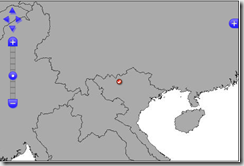
Credit FAO
# 8987
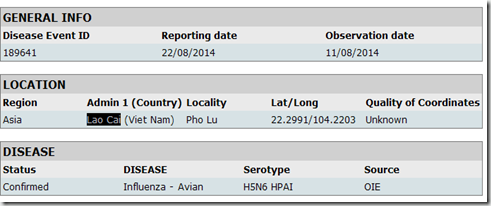
The FAO is reporting a third outbreak of the newly emerging avian H5N6 virus ? this time on a Pheasant farm in Lao Cai Province. This latest outbreak is nearly 300km distant from the closest of the two outbreaks reported last week (see Vietnam Gears Up To Detect, Fight Avian H5N6), suggesting the virus is already widely dispersed.
Like the H5N8 avian virus, which appeared in South Korean poultry last January, H5N6 is a relatively new avian threat. While low pathogenic versions of this virus have been reported in the past, it wasn?t until last spring did we see a highly pathogenic (HPAI) strain emerge ? this time in Southern China.
And in that case ? unlike H5N8 ? there was a (fatal) human infection involved (see Sichuan China: 1st Known Human Infection With H5N6 Avian Flu).
Up until last week, we?d not heard any more about this upstart virus, and there were hopes it was a flash in the pan. But over the summer two widely separated outbreaks were reported in Vietnam, and now we have a this third, more recent report.
Both of these emerging avian viruses are related to the highly pathogenic H5N1 virus, which has infected more than 600 people over the past decade, killing roughly 60% of known cases. In the case of H5N8, we know it is continuing to evolve, and now consists of multiple clades (see EID Journal: Describing 3 Distinct H5N8 Reassortants In Korea).
While we may not see another pandemic for years to come, right now we have no lack of contenders in the wild - H5N1, H7N9, H10N8, H5N6, H9N2 . . . . ? to keep our eyes on.
Posted by Michael Coston at <a class="timestamp-link" href="http://afludiary.blogspot.ca/2014/08/meanwhile-back-in-vietnam.html" rel="bookmark" title="permanent link"><abbr class="published" itemprop="datePublished" title="2014-08-22T10:06:00-04:00">10:06 AM</abbr>

Credit FAO
# 8987
The FAO is reporting a third outbreak of the newly emerging avian H5N6 virus ? this time on a Pheasant farm in Lao Cai Province. This latest outbreak is nearly 300km distant from the closest of the two outbreaks reported last week (see Vietnam Gears Up To Detect, Fight Avian H5N6), suggesting the virus is already widely dispersed.
Like the H5N8 avian virus, which appeared in South Korean poultry last January, H5N6 is a relatively new avian threat. While low pathogenic versions of this virus have been reported in the past, it wasn?t until last spring did we see a highly pathogenic (HPAI) strain emerge ? this time in Southern China.
And in that case ? unlike H5N8 ? there was a (fatal) human infection involved (see Sichuan China: 1st Known Human Infection With H5N6 Avian Flu).
Both of these emerging avian viruses are related to the highly pathogenic H5N1 virus, which has infected more than 600 people over the past decade, killing roughly 60% of known cases. In the case of H5N8, we know it is continuing to evolve, and now consists of multiple clades (see EID Journal: Describing 3 Distinct H5N8 Reassortants In Korea).
While less is known about the evolution of the H5N6 virus, the longer it remains in circulation, the more opportunities it will have to mix and match genes with other avian viruses (notably H9N2), and the better chance it will have to become firmly entrenched in the environment.
While we watch the Ebola outbreak in Africa, and wait to see if MERS-CoV has any ambitions this fall, it is important to remember that historically, the most efficient pandemic viruses have been influenza viruses.
While we may not see another pandemic for years to come, right now we have no lack of contenders in the wild - H5N1, H7N9, H10N8, H5N6, H9N2 . . . . ? to keep our eyes on.
Posted by Michael Coston at <a class="timestamp-link" href="http://afludiary.blogspot.ca/2014/08/meanwhile-back-in-vietnam.html" rel="bookmark" title="permanent link"><abbr class="published" itemprop="datePublished" title="2014-08-22T10:06:00-04:00">10:06 AM</abbr>