Press Release
USDA Announces Sweeping Plans to Protect the United States from New World Screwworm
Published:
August 15, 2025
(Austin, TX, August 15, 2025) – U.S. Secretary of Agriculture Brooke L. Rollins today at the Texas State Capitol alongside Governor Greg Abbott and stakeholders from across the country announced the largest initiative yet in the U.S. Department of Agriculture’s (USDA) plan to combat the New World Screwworm (NWS). This announcement builds upon USDA’s
five-pronged plan issued in June to combat the northward spread of NWS from Mexico into the United States.
NWS is a devastating pest. When NWS fly larvae (maggots) burrow into the flesh of a living animal, they cause serious, often deadly damage to the animal. NWS can infest livestock, pets, wildlife, occasionally birds, and in rare cases, people. It is not only a threat to our ranching community — but it is a threat to our food supply and our national security.
While USDA is coordinating efforts to combat NWS, it will require continued collaboration between Federal agencies, State governments, and the private sector. That is why USDA is working alongside the U.S. Food and Drug Administration to encourage animal drug development and prioritize approvals for prevention and treatment of the pest, the U.S. Environmental Protection Agency and the U.S. Department of Energy on new innovations to enhance our ability to combat the pest with technologies, and the U.S. Customs and Border Protection to protect the United States border. The United States government will also work alongside Governors, State Agriculture Commissioners, State veterinarians, and others to combat this pest.
As part of this comprehensive approach, USDA is taking the following immediate actions:
1.) Innovate Our Way to Eradication
While sterile flies are currently the most effective way to prevent the spread of NWS, technology continues to evolve and as such USDA will provide up to $100 million to invest in viable innovations which could show rapid advancement of promising technologies that will augment the United States facility and accelerate the pace of sterile fly production if proven successful. USDA will support proven concepts that only require funding to scale and implement as well as a number of longer-term research projects focused on: new sterile NWS production techniques, novel NWS traps and lures, NWS therapeutics that could be stockpiled and used should NWS reach the United States, and any other tools to bolster preparedness or response to NWS.
2.) Protect the United States Border – Construction of a Domestic Sterile Screwworm Production Facility
USDA will construct a sterile fly production facility in Edinburg, TX, at Moore Air Force Base, an ideal location due to the existing infrastructure and proximity to the United States-Mexico border. Built with the Army Corps of Engineers, the facility will produce up to 300 million sterile flies per week to combat NWS. This will be the only United States-based sterile fly facility and will work in tandem with facilities in Panama and Mexico to help eradicate the pest and protect American agriculture.
Why it matters:
- National Security & Economic Impact – NWS threatens over $100 billion in United States economic activity tied to the cattle and livestock industry alone.
- Proven Technology – Uses sterile insect technique (SIT)
- Strategic Coverage – Complements Panama’s facility (100M flies/week) and Mexico’s upcoming facility (100M flies/week) to push NWS back toward the Darien Gap.
- Reduced Vulnerability – Ends the United States-based reliance on foreign facilities for sterile fly production.
3.) Wildlife Migration Prevention
Animals don’t know borders, and that leaves the U.S potentially vulnerable to NWS from wildlife migrating across the border. USDA is working aggressively to ramp up the hiring of USDA-employed mounted patrol officers, known as “Tick Riders,” and other staff who will focus on border surveillance. The Tick Riders, who are mounted on horseback, will be complemented by other animal health experts who will patrol the border in vehicles and will provide the first line of defense against an NWS outbreak along the United States-Mexico border.
USDA will also begin training detector dogs to detect screwworm infestations in livestock and other animals along our border and at various ports of entry. These dogs will be essential to help control the spread of the NWS. USDA is working closely with the U.S. Department of the Interior and the U.S Customs and Border Protection to monitor the border for NWS-infected wildlife that could pose a threat to the United States.
4.) Stop the Pest from Spreading in Mexico and Ensure We Are Full Partners in Eradication
USDA Animal and Plant Health Inspection Service (APHIS) is working in collaboration with the National Service of Agri-Food Health, Safety and Quality (SENASICA) in Mexico to help them contain the pest south of the United States border by enhancing United States oversight, surveillance, improving case reporting, locking down animal movement to prevent further spread, providing traps, lures, training, and verification of Mexican NWS activities. Successful implementation will inform any future trade decisions impacting cattle movements on the southern border including the potential reopening of border areas.
5.) United States Food Safety is of Utmost Importance
To date, NWS has not been reported or detected in the United States in animals. USDA’s Food Safety and Inspection Service inspects animals and carcasses at slaughter, including for NWS to keep the food supply safe.
“We have assessed the information on the ground in Mexico and have determined we must construct an additional sterile fly production facility in the United States to stop the northward advancement of this terrible pest that is threatening American cattle production. President Trump has made it clear that we must take all necessary steps to protect our country from foreign pests and diseases that threaten our economy and way of life. Today we are announcing a major investment to further America’s existential role in protecting our country and secure our borders from this national security threat,”
said Secretary Brooke Rollins. “The construction of a domestic sterile fly production facility will ensure the United States continues to lead the way in combating this devastating pest. If our ranchers are overrun by foreign pests, then we cannot feed ourselves. USDA and Customs and Border Protection are constantly monitoring our ports of entry to keep NWS away from our borders. We are working every day to ensure our American agricultural industry is safe, secure, and resilient.”
“Texas agricultural producers feed the world, with our state’s food and agriculture sector supporting over 2 million well-paying jobs and creating over $867 billion in total economic impact,”
said Texas Greg Governor Abbott. “All of this is at risk because of the New World screwworm. Working with Secretary Rollins and members of the agricultural community nationwide, we will combat the threat from the New World screwworm right here in Texas through the building of a new facility to breed hundreds of millions of sterile New World screwworm flies. Together, we will eradicate the threat from the New World screwworm to protect our nation's food supply and economy.”
“These actions – along with the FDA's efforts to facilitate meaningful treatments – represent an early, proactive, and precautionary approach,”
said FDA Commissioner Dr. Marty Makary, M.D., M.P.H.
“I applaud Secretary Rollins and the USDA team for taking aggressive action to combat the New World Screwworm. In June, my colleagues and I urged the Secretary to build a domestic sterile fly facility, and I’m encouraged to see that priority reflected in USDA’s expanded plan. Protecting America’s livestock from this dangerous pest is critical to safeguarding our food supply, supporting farmers and ranchers, and strengthening our nation’s food security,”
said House Agriculture Committee Chairman, Representative Glenn “GT” Thompson (PA-15).
“This is exactly the kind of forward-looking investment we need to defend our food supply and livestock industry from foreign biological threats. With a new sterile fly facility on U.S. soil, stronger surveillance at the border, and real coordination between federal, state, and local partners, we’re showing what it looks like to combat the spread of the New World Screwworm. I applaud Secretary Rollins and the Trump administration for their swift action to protect American farmers, ranchers, and taxpayers,”
said House Appropriations Agriculture Subcommittee Chairman, Representative Dr. Andy Harris (MD-1).
“This is bold, decisive action to protect American livestock from the threat of New World screwworm. I commend Secretary Rollins for prioritizing a domestic sterile fly production facility in South Texas and expanding key risk mitigation efforts. These steps will greatly strengthen our preparedness, and I look forward to continuing to work with her to eradicate this dangerous pest,”
said Senate Committee on Agriculture, Nutrition, and Forestry Chairman, Arkansas Senator John Boozman.
“As a livestock veterinarian by trade, I understand the risk posed to our food system by foreign animal diseases. As a livestock producer and Governor of America's leading beef producing state, I know that food security is national security. I commend Secretary Brooke Rollins and her team for their extraordinary leadership on fighting foreign animal diseases. They have been at the tip of the spear from the start, and this plan is another example of their diligence and leadership,”
said Nebraska Governor Jim Pillen.
“I appreciate Secretary Rollins continued support of our nation’s Ag producers. This announcement doubles-down on the USDA’s efforts to help feed American families. Oklahoma’s ranchers and producers help feed the world and this action-first effort is a step in the right direction to keep the industry moving forward both in Oklahoma and nationwide,”
said Oklahoma Governor Kevin Stitt.
“I support USDA’s proactive efforts to combat the potential spread of New World Screwworm in the United State. The construction of the domestic sterile fly facility in Texas represents a significant step forward in the battle to protect Alabama’s livestock industry from this threat,”
said Alabama Commissioner of Agriculture and Industries Rick Pate.
“It took decades to eradicate this parasite from within and adjacent to our borders more than a generation ago, and this is a proactive first step. Cattle markets are already volatile and the introduction of New World screwworm within the U.S. would only increase that volatility. We thank USDA and Secretary Rollins for her leadership protecting the domestic cattle industry and we stand ready to help ensure the speedy and efficient construction of this facility and implementation of the updated plan,”
said American Farm Bureau Federation President Zippy Duvall.
“National Association of State Departments of Agriculture (NASDA) is grateful for USDA’s investment in defending the U.S. against an outbreak of New World screwworm. NASDA is always committed to working with intergovernmental agencies and industry stakeholders to foster a collaborative approach to animal health initiatives,”
said National Association of State Departments of Agriculture CEO Ted McKinney.
“American cattle producers are thankful for Secretary Brooke Rollins’ leadership and diligence in combatting the spread of New World screwworm. This deadly pest has negatively impacted the cattle industry before but with swift action from Secretary Rollins, we are on our way to stopping it again. USDA’s work in building a sterile fly production facility at Moore Air Base will greatly help to stop the spread of screwworm and protect the American cattle herd for years to come,”
said National Cattlemen’s Beef Association CEO Colin Woodall.
“Virginia may be far from the border, but we understand the threat the New World Screwworm poses to the livestock industry and animal health if it were to enter the United States. The announcement of a new sterile fly production facility in Texas marks a major investment that will strengthen our biosecurity infrastructure and safeguard livestock producers across the country. We are grateful to the Administration for their continued dedication to agricultural innovation and animal health,”
said Virginia Farm Bureau President Scott Sink.
“We're incredibly grateful to President Trump and Secretary Rollins for securing the necessary funding for a domestic production facility to combat New World Screwworm (NWS). When NWS entered the country decades ago, it was devastating to the cattle industry. This new facility is necessary and will be invaluable in the fight to protect American livestock,”
said Kentucky Farm Bureau President Eddie Melton.
“On behalf of livestock producers across Tennessee, we thank President Trump and Secretary Rollins for fully funding a domestic fly production facility to combat New World Screwworm. Protecting America’s livestock is critical in protecting the larger food supply we all depend on, and we appreciate the Trump Administration for taking swift action to combat this threat,”
said Tennessee Farm Bureau President Eric Mayberry.
“On behalf of Florida’s farm families, I want to thank President Donald Trump and Agriculture Secretary Brooke Rollins for their leadership in fully funding a new sterile fly production facility at Moore Air Base in Edinburg, Texas. This investment represents a historic commitment to safeguarding American agriculture from the threat of the New World screwworm,”
said Florida Farm Bureau Federation President Jeb S. Smith.
“The New World screwworm devastated deer and livestock populations in Texas in the 50’s and 60’s. Landowners that lived through that nightmare will do everything possible to prevent the same thing from happening again. But they need help desperately, and the USDA is the best partner to provide that help. The Texas Chapter of The Wildlife Society supports their efforts 100% and thanks Secretary Rollins and Governor Abbott for leading the charge,”
said Executive Director Texas Chapter of The Wildlife Society Matt Wagner Ph.D.
“We appreciate Secretary Rollins’ commitment to protecting American livestock and the livelihood of American farmers and ranchers. It is imperative that we have a production facility in the United States to combat the New World Screwworm. She worked tirelessly to make this happen. Alabama farmers and ranchers thank Secretary Rollins and President Trump for their quick and decisive response to this destructive pest,”
said Alabama Farmers Federation President Jimmy Parnel.
“We commend and thank President Trump and Sec. Rollins for recognizing the importance of working to eradicate NWS. If this were not done, the impact on our domestic industry could be tragic,”
said South Dakota Farm Bureau President Scott VanderWal.
“Louisiana farmers and ranchers thank President Donald J. Trump and U.S. Secretary of Agriculture Brooke Rollins for making this sterile fly facility a top priority. For Louisiana’s cattle, equine, sheep, and goat producers, this facility is not just an agricultural milestone—it’s a shield for our way of life. Livestock production is a cornerstone of rural communities in our state and ensuring that we have the resources to prevent and respond to NWS infestations is vital to maintaining both animal welfare and economic stability,”
said Louisiana Farm Bureau President Richard Fontenot.
“The Texas Parks and Wildlife Department (TPWD) supports the efforts of Secretary Rollins and Governor Abbott to ensure we have the appropriate tools to combat the New World screwworm pest that is a looming threat to Texas livestock and wildlife. Developing a sterile fly production facility in South Texas is a critical step in ensuring the long-term health and sustainability of white-tailed deer and other wildlife enjoyed by many Texans. We appreciate the foresight and commitment by Secretary Rollins and Governor Abbott to make the fly production facility a reality, and we stand ready to assist in combating this threat alongside our partners,”
said Texas Parks and Wildlife Department Executive Director Dr. David Yoskowitz.
“We applaud the Trump Administration for making this issue a top priority on behalf of Mississippi's and our nation’s livestock producers. The federal investment announced today will better equip our frontline defense against the catastrophic destruction this pest can cause. We thank USDA Secretary Brooke Rollins and her team for their expeditious work in addressing the concerns of the agricultural industry and urge their continued research on all mitigation efforts to battle this devastating pest,”
said Mississippi Farm Bureau Federation President Mike McCormick.
“The importance of equipping the U.S. to combat the threat of New World screwworm cannot be overstated. As Texans and cattle producers, we welcome the placement of the sterile fly production facility at Moore Airfield Base, putting it on the front lines of this critical fight. Increasing sterile fly production has long been a priority for the Texas cattle industry, which contributes $13 billion to our state’s economy annually. We remain committed to supporting both state and federal efforts to manage this threat and deeply appreciate the leadership of Secretary Rollins, the administration and Governor Abbott in prioritizing the needs of Texas and U.S. production agriculture,”
said Texas & Southwestern Cattle Raisers Association President Carl Ray Polk, Jr.
“The New World Screwworm is like something straight out of a horror film and poses a serious threat to Texas agriculture, affecting livestock, wildlife, and pets. I appreciate USDA Secretary Brooke Rollins's strong leadership and her visit to Texas to deliver this important announcement. Her presence highlights her understanding of the seriousness of this issue and her ongoing dedication to supporting our agricultural producers. Our strong partnership with the USDA remains vital in addressing this challenge effectively. United, we will protect this essential industry. Texas is resilient, and the Texas Department of Agriculture is committed to stopping this threat,”
said Texas Agriculture Commissioner Sid Miller.
“The New Mexico Farm & Livestock Bureau strongly supports USDA’s investment in a domestic sterile fly facility to combat the New World Screw Worm. This proactive step will protect livestock health, safeguard rural economies, and strengthen America’s ability to respond quickly to future outbreak,”
said New Mexico Farm and Livestock Bureau Director of Government Affairs Becca Luten.
“The Texas Wildlife Association and its members applaud Secretary Rollins and the Trump Administration for taking meaningful action to safeguard human and animal health, our rural economies and way of life, from the growing threat of the New World Screwworm. Today’s announcement of a sterile fly production facility in South Texas is welcome news to the landowners, wildlife managers and sportsmen most directly and immediately affected by this emergency,”
said Texas Wildlife Association CEO Justin Dreibelbis.
“Michigan Farm Bureau thanks President Trump and Secretary Rollins for this critical investment. Protecting the US livestock industry from the Screwworm pest is of upmost importance to our producers, and we look forward to continuing to engage with the Administration in this effort
,” said Michigan Farm Bureau National Legislative Counsel Jacob Smith.
“Texas Farm Bureau commends Secretary Rollins and the Trump Administration for recognizing the gravity of this issue and taking bold steps to address it. We look forward to continuing our work with them and other stakeholders to advance solutions that protect livestock and wildlife producers, consumers, and the economic vitality of our state,”
said Texas Farm Bureau President Russell Boening.
“With the approach of the New World Screwworm threatening Texas, I applaud the efforts of Secretary Rollins and the Trump administration to bring the weight of the Federal Government to the battle. The future of livestock production in Texas is at risk. It is encouraging to have the USDA and other federal assets come join our farmers and ranchers in meeting this challenge,”
said Texas State Representative Stan Kitzman.
“We are thankful to Secretary Brooke Rollins and her team at USDA for their continued support and commitment to our farmers and ranchers. Their efforts to prioritize livestock producers to take swift action against the New World Screwworm is essential to safeguarding the health of our livestock and wildlife,”
said South Carolina Farm Bureau Federation National Affairs and Commodity Coordinator Dwight Cauthen.
“Today’s announcement from Secretary Rollins to fund the construction of a sterile fly production facility in Mission reflects her commitment to planning, preparing and protecting the U.S. cattle herd from New World Screwworm. This announcement is sincerely appreciated by TCFA as the sterile insect technique is the only proven way to eradicate New World Screwworm. We commend President Trump, Secretary Rollins and APHIS Administrator Michael Watson for their continuous dedication to using science-based information to make decisions to protect not only our cattle herd but also ensure supply chain stability,”
said Texas Cattle Feeders Association Chairman Robby Kirkland.
“Pennsylvania Farm Bureau is grateful for USDA Secretary Rollins and this Administration's work to combat invasive species like the New World Screwworm to protect the health and well-being of our livestock. This announcement today emphasizes the commitment from USDA to prioritize animal health and biosecurity,”
said Pennsylvania Farm Bureau President Chris Hoffman.
“Screwworms pose a severe threat to livestock, particularly the sheep and goat industry, and the Texas Sheep and Goat Raisers Association appreciates the efforts of Secretary Rollins to help address this issue. TSGRA supports all efforts to provide surveillance for screwworm flies, offer technical assistance to producers as needed, and immediately expand sterile fly production and distribution centers in the U.S., Mexico, and Central America as necessary,”
said Texas Sheep & Goat Raisers Association President Sharon Pfluger Holman.
“The Texas Animal Health Commission commends Secretary Rollins and Governor Abbott’s critical action in expanding New World screwworm eradication efforts. The sterile insect technique combined with animal health response plans, that include science based approaches and producer engagement, are key factors in ensuring continuity of Texas animal agriculture businesses and promoting overall animal health and productivity. Today’s announcement bolsters the ongoing collaborative efforts between the USDA and Texas animal health officials to serve as the first line of defense in protecting U.S. animal agriculture,”
said Texas Animal Health Commission Executive Director and State Veterinarian Dr. Lewis R. "Bud" Dinges, DVM.
“The threat of screwworm infestation is a direct attack on Texas agriculture. Livestock consume well over 90% of Texas-grown corn, making cattle a staple market for corn farmers - many of whom include both corn and cattle in their operations. A screwworm outbreak would not only devastate the cattle industry but would also cripple the demand for Texas-grown corn. Texas Corn Producers Association appreciates USDA and Secretary Rollins’ swift action against the screw worm, accelerating our ability to protect our animals and markets,”
said Texas Corn Producers Association Executive Vice President David Gibson.
“I commend President Trump and Secretary Rollins for their decisive action to protect Florida’s cattle industry from the devastating threat of the New World Screwworm. By accelerating construction of a domestic sterile fly distribution facility, USDA is putting America’s ranchers first, safeguarding our food supply, and defending the backbone of our agricultural communities. Their leadership ensures that America’s cattle producers can continue to feed our nation and the world,”
said Representative Daniel Webster (FL-11).
“We applaud USDA Secretary Rollins for taking bold action to protect our food security from invasive pests like the New World Screwworm. This effort follows a letter we sent earlier this year encouraging the USDA to keep this parasite out of our country. The Trump Administration and congressional Republicans will always put American farmers and ranchers FIRST!”
said Representative Mark Alford (MO-4).
“I am thankful to see Secretary Rollins take decisive action to combat the New World Screwworm. Building a sterile fly production facility in Edinburg, Texas, will put America first and end our reliance on other countries. Thank you, Secretary Rollins for your continued support for our farmers,”
said Representative Michael Guest (MS-03).
“The strong, decisive leadership of President Trump, Secretary Rollins, and USDA continues to put the farmers, ranchers, and ag producers who feed, fuel, and clothe the world first. Investing in a domestic sterile fly facility is a critical step to stop the spread of New World Screwworm. Thank you for standing with American ranchers and taking decisive action to protect American livestock. Promises made, promises kept,”
said Representative Tracy Mann (KS-1).
“Investing in a domestic fly facility is a necessary step to combat the spread of New World Screwworm. This decision will protect American agriculture, livestock, and our food supply. Thank you Secretary Rollins for your decisive leadership on this issue. Supporting American farmers and ranchers is another promise made, promise kept by this administration!”
said Representative Mike Simpson (ID-2).
“New World Screwworm is not only a threat to livestock, but also the livelihoods of farmers and ranchers across the great state of Texas. Secretary Rollins’ bold five-pronged strategy and the deployment of an $8.5 million sterile fly dispersal facility in South Texas demonstrates this administration's unwavering commitment to supporting America’s agricultural producers. I look forward to continuing to work alongside the Trump administration to ensure this plan is fully implemented and our farmers and ranchers have the federal support necessary to protect their operations and America's food security,”
said Representative August Pfluger (TX-11).
“Texas has long led the nation's cattle industry, and it’s imperative for state and federal leaders to use every tool at our disposal to protect our food supply from the destructive New World screwworm. Today’s announcement of funding I supported for the USDA to combat this pest is a huge step forward, and I thank Secretary Rollins and Governor Abbott for their work and will continue to work alongside them to ensure Texas has the resources it needs to halt the spread,”
said Texas Senator John Cornyn.
“Agriculture and livestock are a core part of Texas economy and are how the Lone Star State feeds America and the world. I applaud Secretary Rollins for understanding the threat posed by the New World Screwworm and taking immediate action. I have been working with Secretary Rollins, Texas authorities, and my colleagues in Congress to safeguard America’s livestock from this threat,”
said Texas Senator Ted Cruz.
“If we do not act now, the New World Screwworm could devastate Texas livestock and wildlife. Thank you, Secretary Rollins, for swiftly establishing the critical sterile fly distribution facility in Hidalgo County and delivering solutions to combat the threat posed by this parasite. I am committed to working alongside the Administration to put Texas farmers and ranchers first and safeguard our agriculture industry,”
said Representative Monica De La Cruz (TX-15).
“This Congress, one of my top priorities has been to strengthen our nation’s preparedness against a potential screwworm outbreak. That includes the construction of a domestic fly production facility, which is a key pillar of my STOP Screwworms Act. Under Secretary Rollins’ leadership of the USDA, we have made incredible strides to eliminate this dangerous parasite and protect our livestock industry. Today’s historic announcement is just further proof that this administration is prioritizing our farmers and ranchers like never before. Thank you, Secretary Rollins and Governor Abbott, for always being a steadfast partner in the good fight to protect Texas’ essential farmers and ranchers,”
said Representative Tony Gonzales (TX-23).
Background & Previous Action
Since
announcing the plan in June, Secretary Rollins, USDA, and our federal and state partners have worked around the clock to keep NWS out of the United States and prepare for all contingencies in case NWS does enter the United States:
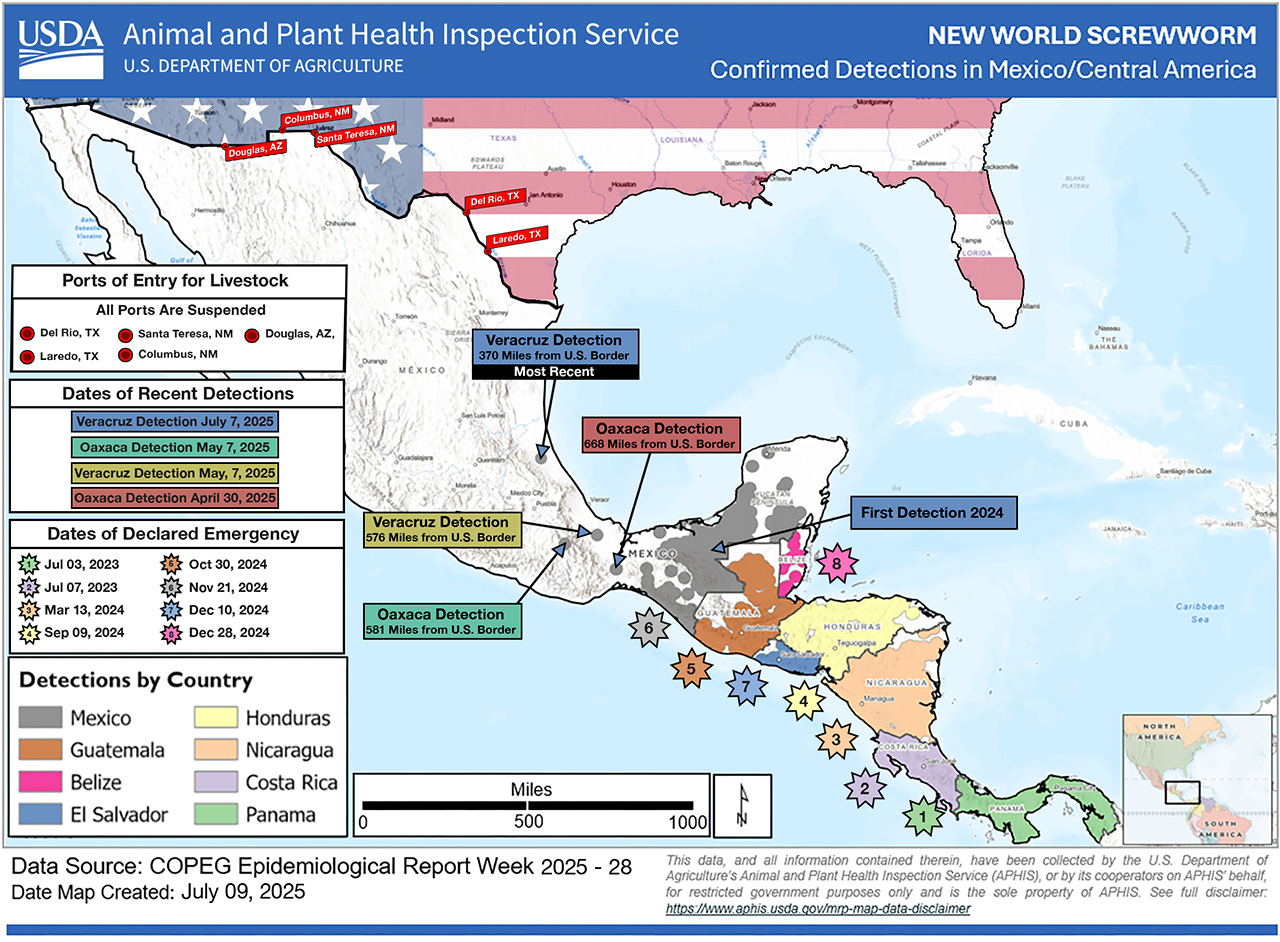
- After a case of NWS was reported 370 miles south of the United States-Mexico border in July, Secretary Rollins closed southern ports of entry to livestock trade. This new northward detection came approximately two months after northern detections were reported in Oaxaca and Veracruz, less than 700 miles away from the United States border, which triggered the closure of our ports to Mexican cattle, bison, and horses on May 11, 2025.
- USDA is investing $21 million to renovate an existing fruit fly production facility in Metapa, Mexico, which will provide an additional 60-100 million sterile flies. APHIS technical experts developed a comprehensive work plan and will continue to share their expertise to help Mexico bring this facility online as quickly as possible.
- In June, APHIS began modifying an existing building at Moore Air Base in South Texas to establish a domestic sterile insect dispersal facility. Construction of the $8.5 million facility is on track for substantial completion at the end of 2025, with capacity to process up to 100 million flies a week, sourced from the existing production facility in Panama and, eventually, the facility USDA is helping renovate in Mexico. Importantly, this is part of our extensive contingency planning should NWS one day be detected in the United States. This facility does not produce sterile flies and will only be used if USDA deems it necessary to distribute flies in the Southern United States and northern Mexico.
- USDA is rapidly exploring and seeking to validate a variety of technologies. APHIS held four public listening sessions to learn from companies, industry, academia, and the public about e-beam and x-ray technologies, potential sterile NWS strain improvements, genetically engineered flies, modular and other facilities for sterilization, and fast-tracking animal drug and treatment approvals, among other proposals. APHIS is further evaluating and validating the most promising options to help inform ongoing decision-making.
- USDA leadership and technical staff at all levels continue daily collaboration with Mexico to contain NWS within its borders.
- As part of a robust audit of Mexico’s animal health controls, APHIS conducted site visits in June to evaluate Mexico’s response and provide comprehensive feedback. As a result of inadequacies found in this audit, USDA is working diligently to help Mexico improve its surveillance, including development of a more robust trapping plan to conduct surveillance in areas of greatest priority, particularly in and around Veracruz and along the United States-Mexico border.
- APHIS published an updated national disease response strategy for NWS, and is partnering with state animal and wildlife health officials to update and finalize emergency management plans. The agency is providing training and webinars for federal and state animal and wildlife officials, Tribal partners, and veterinarians.
- APHIS made a number of technical and informational materials available to escalate communications and public outreach along the United States-Mexico border, particularly with veterinarians and animal owners. Materials such as pest ID cards and pest alerts raise awareness to be on the lookout for NWS. APHIS experts have held over 50 meetings with stakeholders to enlist their help and keep them informed about NWS developments, with several more upcoming webinars for members of the animal industry, vets, and state animal health officials.
- USDA is leveraging Agricultural Research Service (ARS) experts to continue to develop novel treatments, preventatives, and response strategies. ARS scientists are located both in Texas at the Knipling-Bushland Livestock Insects Research Laboratory and at the Panama-United States Commission for the Eradication and Prevention of Screwworm (COPEG) facility in Panama. They are evaluating new attractants and potential trap and kill systems, improving the efficiency of sterile NWS production techniques, evaluating NWS strains, including genetically engineered strains, and developing models to predict NWS northward spread, among many other projects.
- FDA has information available about current extra-label use of approved animal drugs and their role in treatment and prevention of NWS in animals.
Learn more about
USDA’s activities in response to New World Screwworm.
###
https://www.usda.gov/about-usda/new...ans-protect-united-states-new-world-screwworm