

Gert van der Hoek
In Memoriam - Editor, Senior Moderator
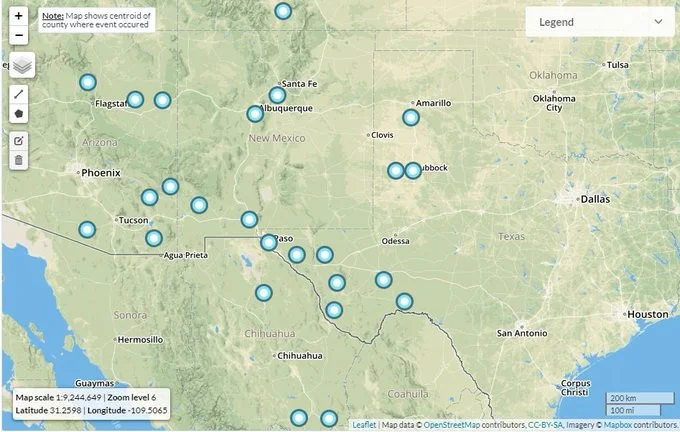
. This map shows locations of mortality events in wild rabbits suspected or confirmed to be RHDV2 in North America as of May 7, 2020.
Continued Expansion of Rabbit Hemorrhagic Disease Virus 2 in North America and Additional Instructions Regarding Mortality Event Investigations
To: Natural Resource/Conservation Managers
From: Dr. Jonathan Sleeman, Center Director, USGS National Wildlife Health Center
Date: May 7, 2020
Rabbit hemorrhagic disease virus 2 (RHDV2) has continued to spread in wild rabbits in North America. As of early May 2020, RHDV2 has been confirmed in wild rabbits in four counties (Bernalillo, Dona Ana, Eddy, and Santa Fe) in New Mexico, seven counties (Apache, Cochise, Coconino, Graham, Greenlee, Navajo, and Pima) in Arizona, six counties (El Paso, Hudspeth, Lubbock, Pecos, Randall, and Terrell) in Texas, and one county (Alamosa) in Colorado (Figure 1).
In addition, concurrent RHDV (nottyped) events have been reported in Jim?nez, Ahumada, and Allende municipalities, Chihuahua, Mexico. To date, rabbit mortality events reported by state natural resource agencies have varied from three to >1000 dead rabbits. In addition to the black-tailed jackrabbits (Lepus californicus) and desert cottontails (Sylvilagus audubonii) reported in the April 13, 2020 Wildlife Health Bulletin, RHDV2 has also been confirmed in mountain cottontails (Sylvilagus nuttallii) and antelope jackrabbit (Lepus alleni) from Arizona and eastern cottontails (Sylvilagus floridanus) from Colorado.
Continued Expansion of Rabbit Hemorrhagic Disease Virus 2 in North America and Additional Instructions Regarding Mortality Event Investigations
To: Natural Resource/Conservation Managers
From: Dr. Jonathan Sleeman, Center Director, USGS National Wildlife Health Center
Date: May 7, 2020
Rabbit hemorrhagic disease virus 2 (RHDV2) has continued to spread in wild rabbits in North America. As of early May 2020, RHDV2 has been confirmed in wild rabbits in four counties (Bernalillo, Dona Ana, Eddy, and Santa Fe) in New Mexico, seven counties (Apache, Cochise, Coconino, Graham, Greenlee, Navajo, and Pima) in Arizona, six counties (El Paso, Hudspeth, Lubbock, Pecos, Randall, and Terrell) in Texas, and one county (Alamosa) in Colorado (Figure 1).
In addition, concurrent RHDV (nottyped) events have been reported in Jim?nez, Ahumada, and Allende municipalities, Chihuahua, Mexico. To date, rabbit mortality events reported by state natural resource agencies have varied from three to >1000 dead rabbits. In addition to the black-tailed jackrabbits (Lepus californicus) and desert cottontails (Sylvilagus audubonii) reported in the April 13, 2020 Wildlife Health Bulletin, RHDV2 has also been confirmed in mountain cottontails (Sylvilagus nuttallii) and antelope jackrabbit (Lepus alleni) from Arizona and eastern cottontails (Sylvilagus floridanus) from Colorado.

