• FluTrackers.com Inc. does not provide medical advice. Information on this web site is collected from various internet resources, and the FluTrackers board of directors makes no warranty to the safety, efficacy, correctness or completeness of the information posted on this site by any author or poster. The information collated here is for instructional and/or discussion purposes only and is NOT intended to diagnose or treat any disease, illness, or other medical condition. Every individual reader or poster should seek advice from their personal physician/healthcare practitioner before considering or using any interventions that are discussed on this website. By continuing to access this website you agree to consult your personal physican before using any interventions posted on this website, and you agree to hold harmless FluTrackers.com Inc., the board of directors, the members, and all authors and posters for any effects from use of any medication, supplement, vitamin or other substance, device, intervention, etc. mentioned in posts on this website, or other internet venues referenced in posts on this website.
  • We are not asking for any donations. Do not donate to any entity who says they are raising funds for us.

USA - Florida: Child Infected by Naegleria fowleri, died

Shiloh

Editor, Senior Moderator
Source: http://www.huffingtonpost.com/2013/08/13/zachary-reyna-brain-eating-amoeba_n_3748506.html


Zachary Reyna, Florida Boy, Fighting Brain-Eating Amoeba (VIDEO)
Posted: 08/13/2013 10:17 am EDT | Updated: 08/13/2013 10:30 am EDT

A South Florida boy is fighting for his life after a seemingly harmless day in the water last week.

Zachary Reyna, a seventh grader, was knee-boarding in ditch water near his house in Fort Meyers, when he contracted Naegleria fowleri, brain-eating amoeba, through his nose...
 
USA - Florida:Another Child Infected by Naegleria fowleri

USA - Florida:Another Child Infected by Naegleria fowleri

Fox4kc.com is reporting that another child has been infected by Naegleria fowleri (one reported in AR last month). http://fox4kc.com/2013/08/13/brain-...-brain-of-another-12-yr-old-playing-in-water/
See: http://www.flutrackers.com/forum/showthread.php?t=209962

According to CDC: In the 10 years from 2003 to 2012, 31 infections were reported in the U.S. Of those cases, 28 people were infected by contaminated recreational water, and 3 people were infected after performing nasal irrigation using contaminated tap water. http://www.cdc.gov/parasites/naegleria/general.html

Naegleria fowleri (commonly referred to as the "brain-eating amoeba" or "brain-eating ameba"), is a free-living microscopic ameba, (single-celled living organism). It can cause a rare and devastating infection of the brain called primary amebic meningoencephalitis (PAM). The ameba is commonly found in warm freshwater (e.g. lakes, rivers, and hot springs) and soil. Naegleria fowleri usually infects people when contaminated water enters the body through the nose. Once the ameba enters the nose, it travels to the brain where it causes PAM, which is usually fatal. Infection typically occurs when people go swimming or diving in warm freshwater places, like lakes and rivers. In very rare instances, Naegleria infections may also occur when contaminated water from other sources (such as inadequately chlorinated swimming pool water or heated and contaminated tapwater) enters the nose. http://www.cdc.gov/parasites/naegleria/
 
Re: Parasitic meningitis case confirmed in Glades County, Florida

Re: Parasitic meningitis case confirmed in Glades County, Florida

The Huffington Post article might be confusing on one point:

When Reyna slept the whole day and night, relatives told the news station "We said, 'Oh, he just has a virus. He just has one of those 24-hour viruses.'"

If you read the original news reports and watch the video interview with Reyna's brother, the sleepiness followed what seemed like flu symptoms. As soon as the family realized that excessive sleepiness was involved, they knew something was very wrong and they took Reyna to the hospital.
 
Re: Another Child Infected by Naegleria fowleri

Re: Another Child Infected by Naegleria fowleri

[Source: Florida Health Department, full PDF document: (LINK). Edited.]


FOR IMMEDIATE RELEASE, August 13, 2013

Contact: DOH Communications (850) 529-4614

FLORIDA DEPARTMENT OF HEALTH CONFIRMS ONE CASE OF NAEGLERIA FOWLERI INFECTION


TALLAHASSEE- The Florida Department of Health (DOH) has confirmed one Florida case infected with Naegleria fowleri in Glades County.

Naegleria fowleri is a microscopic single-celled living amoeba. The amoeba can cause a rare infection of the brain called primary amebic meningoencephalitis (PAM) that destroys brain tissue and is usually fatal. The amoeba is commonly found in warm freshwater such as lakes, rivers, ponds and canals.

Infections can happen when contaminated water enters the body through the nose. Once the amoeba enters the nose, it travels to the brain where it causes PAM. Infections usually occur when temperatures increase for prolonged periods of time, which results in higher water temperatures and lower water levels. The peak season for this amoeba is July, August and September.

?The effects of PAM on the individuals who contract the amoeba are tragic," said Dr. Carina Blackmore, Interim State Epidemiologist. ?We want to remind Floridians to be wary when swimming, jumping or diving in fresh water when water temperatures are high and water levels are low. If you are partaking in recreational swimming activities during this time, please take necessary precautions and remind your family and friends to do the same."

Naegleria fowleri infections are rare. According to the Centers for Disease Control and Prevention (CDC), 28 infections were reported in the U.S. from 2003 to 2012. The infections occurred from exposure to contaminated recreational water. You cannot be infected with Naegleria fowleri by drinking contaminated water and the amoeba is not found in salt water.

Initial symptoms of PAM usually start within one to seven days after infection and may include headache, fever, nausea, or vomiting. Other symptoms can include stiff neck, confusion, loss of balance, seizures, and hallucinations. After the start of symptoms, the disease progresses rapidly.

Naegleria fowleri is found in many warm freshwater lakes, ponds and rivers in the United States, but is more common in southern states. The low number of infections makes it difficult to know why a few people have been infected compared to the millions of other people that used the same or similar waters across the U.S.

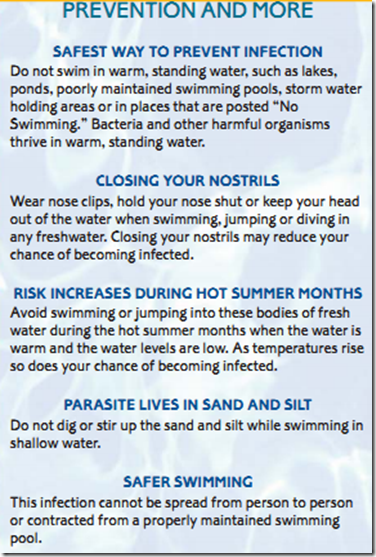
The only way to prevent PAM is to avoid participation in freshwater-related activities. You may reduce your risk by:
  • Limiting the amount of water going up your nose. Hold your nose shut, use nose clips, or keep your head above water when taking part in warm freshwater-related activities.
  • Avoid water-related activities in warm freshwater during periods of high water temperature and low water levels.
  • Avoid digging in, or stirring up, the sediment while taking part in water-related activities in shallow, warm freshwater areas.
DOH has posted a public service announcement to our Online Newsroom. View the video at http://youtu.be/I0DZMUBhI8E. We also have a version in Spanish. For more information about Naegleria fowleri, you can visit the CDC website http://www.cdc.gov/parasites/naegleria/

###


-
--------

 
Re: USA - Florida:Another Child Infected by Naegleria fowleri

Re: USA - Florida:Another Child Infected by Naegleria fowleri

Florida Reports Naegleria fowleri Infection


Photo Credit Florida DOH
# 7572


Just a little over two weeks after we learned of a case in Arkansas (see Naegleria fowleri Shuts Water Park) Florida is reporting a case of case of PAM (primary amebic meningoencephalitis) in a 12-year-old boy from Glades County, in the southern part of the state.

While exceedingly rare, every summer we hear about a small number of these infections ? usually in the southern states ? and usually linked to swimming in warm (often stagnant) fresh water ponds or lakes.
Dubbed the `brain eating amoeba? by the media, this parasitic infection of the brain is almost always fatal (just one patient out of 128 diagnosed in the United States surviving (cite) over the past 50 years.).

First, a link to local news coverage of this latest case, followed by the State of Florida?s DOH statement, then I?ll return with a bit more.


Florida boy fights infection from brain-eating amoeba

By: JEANNIE NUSS, Associated Press
LABELLE, Fla. (AP) - Health officials in Florida said Tuesday that a 12-year-old boy is fighting a rare and deadly infection that is attacking his brain.
(Continue . . . )


FOR IMMEDIATE RELEASE
Contact: DOH Communications
August 13, 2013 (850) 529-4614
FLORIDA DEPARTMENT OF HEALTH CONFIRMS ONE CASE OF NAEGLERIA FOWLERI INFECTION
TALLAHASSEE- The Florida Department of Health (DOH) has confirmed one Florida case infected
with Naegleria fowleri in Glades County. Naegleria fowleri is a microscopic single-celled living amoeba.
The amoeba can cause a rare infection of the brain called primary amebic meningoencephalitis (PAM)
that destroys brain tissue and is usually fatal. The amoeba is commonly found in warm freshwater such
as lakes, rivers, ponds and canals.

Infections can happen when contaminated water enters the body through the nose. Once the amoeba
enters the nose, it travels to the brain where it causes PAM. Infections usually occur when
temperatures increase for prolonged periods of time, which results in higher water temperatures and lower water levels. The peak season for this amoeba is July, August and September.


?The effects of PAM on the individuals who contract the amoeba are tragic," said Dr. Carina Blackmore, Interim State Epidemiologist. ?We want to remind Floridians to be wary when swimming, jumping or diving in fresh water when water temperatures are high and water levels are low. If you are partaking in recreational swimming activities during this time, please take necessary precautions and remind your family and friends to do the same."

Naegleria fowleri infections are rare. According to the Centers for Disease Control and Prevention
(CDC), 28 infections were reported in the U.S. from 2003 to 2012. The infections occurred from
exposure to contaminated recreational water. You cannot be infected with Naegleria fowleri by drinking contaminated water and the amoeba is not found in salt water.

Initial symptoms of PAM usually start within one to seven days after infection and may include
headache, fever, nausea, or vomiting. Other symptoms can include stiff neck, confusion, loss of
balance, seizures, and hallucinations. After the start of symptoms, the disease progresses rapidly.
Naegleria fowleri is found in many warm freshwater lakes, ponds and rivers in the United States, but is
more common in southern states. The low number of infections makes it difficult to know why a few
people have been infected compared to the millions of other people that used the same or similar waters across the U.S.


The only way to prevent PAM is to avoid anticipation in freshwater-related activities. You may reduce your risk by:

  • Limiting the amount of water going up your nose. Hold your nose shut, use nose clips, or keep your head above water when taking part in warm freshwater-related activities.
  • Avoid water-related activities in warm freshwater during periods of high water temperature and low water levels.
  • Avoid digging in, or stirring up, the sediment while taking part in water-related activities in
    shallow, warm freshwater areas.
The State of Florida has a 1-minute PSA on this amoebic threat, which you can view below.
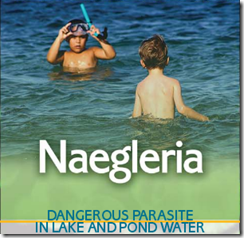
The Florida Department of Health offers some additional common sensesafety advice on how to avoid this parasite.


Photo Credit ? Florida DOH
For more information on the Naegleria parasite, you can also visit the CDC?sNaegleria webpage.

Although the primary route of infection is from swimming in shallow, warm, (usually stagnant) fresh-water lakes and streams, in 2011 we saw a couple of cases in Louisiana related to the use of Neti Pots for nasal irrigation (see FDA Advice On Safe Use Of Neti Pots).


ucm316376.jpg

Photo Credit FDA
Since millions of people swim in waters where this amoeba naturally occurs (or practice nasal irrigation with tap water) and only a small handful of infections result, the odds of acquiring this infection are exceedingly low.

Still, it makes sense to follow the simple precautions recommended by the Florida Department of Health, the CDC, and the FDA to avoid acquiring this rare, but invariably devastating infection.
 
Re: USA - Florida: Child Infected by Naegleria fowleri

Re: USA - Florida: Child Infected by Naegleria fowleri

Florida boy, 12, dies from brain-eating parasite
By Greg Botelho and Scott Thompson, CNN
updated 6:51 PM EDT, Sat August 24, 2013


(CNN) -- Zachary Reyna, a 12-year-old Florida boy stricken with a brain-eating parasite, has died, according to a post Saturday on a Facebook page that's been providing detailed updates from the boy's family.
The post indicated that the LaBelle child died Saturday afternoon.
...
http://www.cnn.com/2013/08/24/us/brain-eating-parasite-boy-dead
 
Back
Top Bottom