• FluTrackers.com Inc. does not provide medical advice. Information on this web site is collected from various internet resources, and the FluTrackers board of directors makes no warranty to the safety, efficacy, correctness or completeness of the information posted on this site by any author or poster. The information collated here is for instructional and/or discussion purposes only and is NOT intended to diagnose or treat any disease, illness, or other medical condition. Every individual reader or poster should seek advice from their personal physician/healthcare practitioner before considering or using any interventions that are discussed on this website. By continuing to access this website you agree to consult your personal physican before using any interventions posted on this website, and you agree to hold harmless FluTrackers.com Inc., the board of directors, the members, and all authors and posters for any effects from use of any medication, supplement, vitamin or other substance, device, intervention, etc. mentioned in posts on this website, or other internet venues referenced in posts on this website.
  • We are not asking for any donations. Do not donate to any entity who says they are raising funds for us.

USA - Actual ISDS flu trends

Re: USA - Actual ISDS flu trends

"Originally Posted by gsgs
I always wondered why seasonal flu-waves go down with only
~20% infected. Maybe 30% of them asymptomatic.
And only ~20 secondary infections in households.

could it be that more are breathing the virus, build shortterm immunity
but no antibodies >5 weeks later ?"


Perhaps there is a 5 week human social cycle...?
 
Last edited:
Re: USA - Actual ISDS flu trends

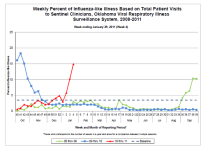
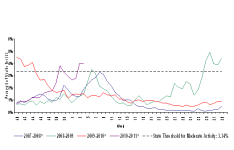
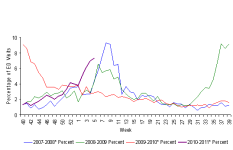
There are few seasons where an epidemic has started to increase after week 2. The image is a graph of CDC data regarding a few past years. Yet, again, there is limited data regarding novel influenza and it's complete transition to "seasonal" influenza.

(Sorry, I can't figure out how to paste this particular picture in here, but here is the link.)

http://www.cdc.gov/flu/weekly/weeklyarchives2006-2007/senILI06-07.htm

- You're welcome, Sharon :)
 
Re: USA - Actual ISDS flu trends

senILI06-07.GIF
 
Re: USA - Actual ISDS flu trends

however

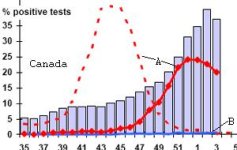
Canada, positives-rate:

attachment.php


flu-synd-ed.gif


attachment.php
 

Attachments

  • cdne3.jpg
    cdne3.jpg
    13.5 KB · Views: 0
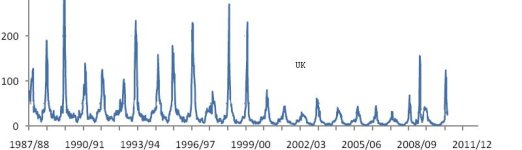
  • uk88.jpg
    uk88.jpg
    22.8 KB · Views: 0
Re: USA - Actual ISDS flu trends

Thank You, GSGS!

What is the time frame where a wave of influenza is considered a "spring wave?" and does it have to begin before a particular week or end after "official" flu season?
 
Re: USA - Actual ISDS flu trends

Louisiana:

Dr. Frank Welch, Medical Director for Louisiana's Immunization Program:

-Unusual season

-Flu problem extraordinary this year

-Maximum level, which is called 'widespread', for about three to four weeks now

-Season has also produced a number of different strains of flu

-Tough to predict when it'll peak

-It wouldn't be surprising to me if there was a new type that started coming in and we see another peak coming up in the next couple weeks

http://www.wwl.com/Flu-bug-bites-hard-in-Louisiana/9111407
 
Re: USA - Actual ISDS flu trends

Louisiana:

Dr. Frank Welch, Medical Director for Louisiana's Immunization Program:

-Unusual season

-Flu problem extraordinary this year

-Maximum level, which is called 'widespread', for about three to four weeks now

-Season has also produced a number of different strains of flu

-Tough to predict when it'll peak

-It wouldn't be surprising to me if there was a new type that started coming in and we see another peak coming up in the next couple weeks
http://www.wwl.com/Flu-bug-bites-hard-in-Louisiana/9111407

Perhaps a mutated pH1N1 that has evaded the immunity from last season and might end up being Tamiflu resistant? :rolleyes:

Dr. Welch is getting it. I just don't understand how people in positions at the state and federal level could miss all the indicators that are out there. They certainly have access to the same information most of us do and they can easily come here to get it. It's eerie how little attention is being given to this potential disaster. The tiger is crouched in the brush on the side of the road. People like us see it and are shouting while public health officials and polititians continue to saunter down the road oblivious of what is about to happen. Where are the school closure plans (I mean real closings - not over-the-weekend-bleach-all-the-doorknobs type closing). God forbid we should be inconvenienced by school closings and cancellation of large public events. And think of what it would do to the economy. It's like they are just pretending like this is just another flu season and hoping it goes away. Sorry - rant finished.
 
Re: USA - Actual ISDS flu trends

http://isds.cirg.washington.edu/distribute/countstimeseries.php?period=daily


most regions are still going up with same speed as the weeks before


NYC: still down, no sign of a reversal
Connecticut is similar to New York, but now seems to go up again
New Jersey,New York State are still going down, but at lower speed
than they went up
Florida and Georgia, also up again into the already declining trend
Tennessee still down (since late Dec.)

Utah,Boston : double-peak ?

explosive up in region VI


US-peak in week 6, I guesstiate
 
Re: USA - Actual ISDS flu trends

Louisiana has been hit hard with Influenza B. By week 52, 80% of positive influenza samples were Influenza B. Week 2, "...88% of all subtyped positives reported this week from sentinel sites are type B." Week 3, "...66% of all subtyped positives reported this week from sentinel sites are type B." The first PCR detection of 2009 A(H1N1) was noted in week 3.

http://www.flutrackers.com/forum/showthread.php?t=153953
 
Re: USA - Actual ISDS flu trends

http://isds.cirg.washington.edu/distribute/countstimeseries.php?period=daily


most regions are still going up with same speed as the weeks before


NYC: still down, no sign of a reversal
Connecticut is similar to New York, but now seems to go up again
New Jersey,New York State are still going down, but at lower speed
than they went up
Florida and Georgia, also up again into the already declining trend
Tennessee still down (since late Dec.)

Utah,Boston : double-peak ?

explosive up in region VI


US-peak in week 6, I guesstiate

Although there is an overall downward trend in many states, pH1N1 is just getting started and the serious cases and deaths are increasing with it. I don't expect a peak for pH1N1 until maybe Week 8 in Regions 2, 3 and 4 and possibly as late as Week 10 in Regions 5, 7, 8, and 10. The rest would fall somewhere in between. Depending on how dominant pH1N1 becomes relative to the seasonal strains will dictate whether we'll see double peaks or an overal extended wave on a state by state basis.
 
Re: USA - Actual ISDS flu trends

Upon further review of UT data, ILI was elevated in week 2 due to only two (out of 11) health districts reporting. In week 3, ILI was probably close to where it should be, because Bear River Health District reported in with "high/intense" activity. In week 4, Bear River Health District did not report, thus lowering ILI. http://health.utah.gov/epi/diseases/influenza/surveillance/2010-11_Season/index.html
 
Re: USA - Actual ISDS flu trends

I tend to ignore these things (extreme variation on the last date)
at ISDS.
But I hadn't seen it yet on the weekly ED-visits graphs.

Expect a correction in the next days
 
Re: USA - Actual ISDS flu trends

ahh, they have restricted access
let's see whether they will allow me access,
will allow me to copy stuff to FT ...


You must log in to view detailed data. Choose your log in method:

... not allowed through google .... send email ...


http://community.isdsdistribute.org...n?target=http://community.isdsdistribute.org/

Membership is by invitation only. If you have an invitation, click the link in the email to join.


weren't they acquired by CDC, which is a government organization ?
Why keep these flu-data secret
 
Re: USA - Actual ISDS flu trends

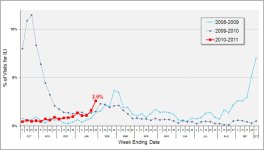
the weekly data is still public, but not the daily updates

seems that the peak was either the last week or the next week
week 6 or week 7
H3 is clearly going down, the positives-rate peaked in week 4


isdse6.JPG
 
Re: USA - Actual ISDS flu trends

With H3 dropping in some places and flu B dropping in others, you're probably right about seasonal flu peaking in Weeks 6 or 7. But, pH1N1 hasn't peaked anywhere yet that I've seen on isolates charts. I don't think that it will peak until Weeks 8 or 9, and possibly later in the west. The height of the peak is still in question and will depend, I think, upon how much of pH1 with S185T is circulating.
 
Back
Top