• FluTrackers.com Inc. does not provide medical advice. Information on this web site is collected from various internet resources, and the FluTrackers board of directors makes no warranty to the safety, efficacy, correctness or completeness of the information posted on this site by any author or poster. The information collated here is for instructional and/or discussion purposes only and is NOT intended to diagnose or treat any disease, illness, or other medical condition. Every individual reader or poster should seek advice from their personal physician/healthcare practitioner before considering or using any interventions that are discussed on this website. By continuing to access this website you agree to consult your personal physican before using any interventions posted on this website, and you agree to hold harmless FluTrackers.com Inc., the board of directors, the members, and all authors and posters for any effects from use of any medication, supplement, vitamin or other substance, device, intervention, etc. mentioned in posts on this website, or other internet venues referenced in posts on this website.
  • We are not asking for any donations. Do not donate to any entity who says they are raising funds for us.

US - WSJ reports that PAHO has revoked measles elimination status for the US - nothing on PAHO site yet... November 14, 2026 - Revoked 11/17

sharon sanders

Editor-in-Chief & President

U.S. Loses Measles-Elimination Status as Historic Resurgence Sickens Thousands​

The Pan American Health Organization, an international health body, has revoked the coveted status, sources say​

By
Liz Essley Whyte
and
Jennifer Calfas
Nov. 13, 2026 7:30 pm ET

The Pan American Health Organization, an international health body, has revoked the U.S.’s measles elimination status, people familiar with the matter said, a stunning reversal for a nation that has kept the vaccine-preventable disease at bay for decades.

more...behind a paywall...... https://www.wsj.com/health/u-s-lose...istoric-resurgence-sickens-thousands-b95e8780


-------------------------------

Our US measles forum is located here.
 

1794937434295.webp

​

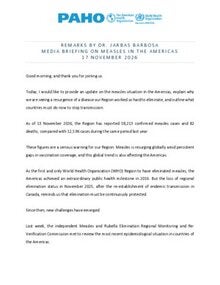
Remarks bt Dr. Jarbas Barbosa - Media Briefing on Measles in the Americas​


183048-paho-director-remarks-media-briefing-measles-nov-17-2026.jpg

Download
17 November 2026

Good morning, and thank you for joining us.

Today, I would like to provide an update on the measles situation in the Americas, explain why we are seeing a resurgence of a disease our Region worked so hard to eliminate, and outline what countries must do now to stop transmission.

As of 13 November 2026, the Region has reported 58,213 confirmed measles cases and 82 deaths, compared with 12,596 cases during the same period last year.

These figures are a serious warning for our Region. Measles is resurging globally amid persistent gaps in vaccination coverage, and this global trend is also affecting the Americas.

As the first and only World Health Organization (WHO) Region to have eliminated measles, the Americas achieved an extraordinary public health milestone in 2016. But the loss of regional elimination status in November 2025, after the re-establishment of endemic transmission in Canada, reminds us that elimination must be continuously protected.

Since then, new challenges have emerged.

Last week, the independent Measles and Rubella Elimination Regional Monitoring and Re-Verification Commission met to review the most recent epidemiological situation in countries of the Americas.

This Commission applies established objective criteria. If a country shows sustained transmission for more than 12 months from a single genotype and lineage, measles transmission is considered re-established.

The Commission concluded that endemic measles transmission has now been re-established in Bolivia, Mexico and the United States and recommended that their measles elimination status be withdrawn, a recommendation which I have accepted.


While this is a significant setback, countries are already taking action to bring their outbreaks under control. Bolivia, Mexico and the United States are implementing measures to strengthen vaccination, surveillance and outbreak response. In addition, Canada has interrupted transmission associated with the outbreak that resulted in the loss of its elimination status.

However, the current situation requires urgent attention.

Other countries in the Region are experiencing prolonged outbreaks. Continued transmission anywhere increases the risk of the virus reaching people who cannot be vaccinated and communities where immunity gaps persist.

Losing measles elimination status has broader implications than losing a public health designation. It means the virus has circulated for a prolonged period of time, putting families and communities at risk of preventable illness, hospitalization and death.

Measles is one of the most contagious diseases in the world. One infected person can transmit the virus to as many as 18 susceptible individuals. It can cause pneumonia, encephalitis, blindness, and death. It can also weaken the immune system for months after infection and, in rare cases, lead to a fatal neurological disease years after the acute infection has resolved.

Yet measles is entirely preventable. We have a safe and highly effective vaccine, and we know how to stop transmission. We have the tools, and we know how to use them.

The central challenge is the growing number of people who remain unprotected. Immunity gaps have accumulated over time, leaving many children, adolescents and adults susceptible. These gaps are often concentrated in particular geographic areas and communities, creating the conditions for rapid transmission. National-level vaccination data can mask these important disparities, providing an incomplete picture of actual population protection. Whether due to barriers to health services, missed vaccinations, misinformation, or vaccine hesitancy, these gaps create opportunities for measles to spread.

Closing these gaps helps protect babies who are too young to be vaccinated and people who cannot receive vaccines for medical reasons. Their protection depends on the immunity of those around them.

Protecting elimination requires more than responding to outbreaks. It means acting before they occur. Prevention can be carefully planned in advance and requires far fewer resources than controlling a large outbreak once transmission is established.

17 November 2026The Pan American Health Organization (PAHO) is working with countries to interrupt transmission and prevent further outbreaks. We are supporting vaccination campaigns to reach communities with low coverage, strengthening epidemiological and laboratory surveillance, supporting rapid-response teams, and helping countries investigate and contain outbreaks. This includes direct technical support for outbreak response in Brazil, Bolivia, Colombia, Guatemala, Honduras, and Peru.

The message today is therefore one of urgency, but also one of confidence. We have faced this challenge before. After endemic transmission was re-established in Venezuela and Brazil in 2018 and 2019 respectively, countries worked together to interrupt transmission, and the Region regained its measles elimination status in 2024.

The Elimination of measles is not a trophy that a country wins once and places on a shelf. It is an achievement that must be protected every day by closing immunity gaps and ensuring that every community is reached.

Our path back to elimination is clear: achieving and sustaining at least 95% coverage with both doses of the measles vaccine in every community, backed by strong surveillance and effective outbreak response.

PAHO will continue working with every country toward that goal. We know what works. We have done it before. With sustained commitment and decisive action, the Americas can eliminate measles once again.

Thank you.

Dr. Jarbas Barbosa
 
From:
"CDPH Media" <media@cdph.ca.gov>
To: "FluTrackers" <flutrackers@earthlink.net>
Subject: West Coast Health Alliance Joint Statement on U.S. Loss of Measles Elimination Status
Date: Nov 17, 2026 1:03 PM


FOR IMMEDIATE RELEASE

November 17, 2026

NR26-034

CONTACT: media@cdph.ca.gov
West Coast Health Alliance Joint Statement
The State Public Health Officials of California, Hawai'i, Oregon and Washington Recommend Vaccination Against the Measles Amid 30-year High in Cases
What You Need to Know: Following the U.S. loss of measles elimination status, the West Coast Health Alliance has issued a joint statement recommending vaccination.
SACRAMENTO – The West Coast Health Alliance (WCHA) recommends measles vaccination amid the ongoing measles outbreak across the United States, based on evidence from trusted professional medical and health organizations, such as the American Academy of Pediatrics (AAP) and the American Academy of Family Physicians (AAFP).


The United States achieved measles elimination status in 2000 with high vaccination rates. Today, the country is seeing a 30-year high in measles cases, along with outbreaks, hospitalizations and deaths.


On November 17, 2026, the Pan American Health Organization (PAHO)—the premier international public health agency for the Americas—determined that the United States no longer holds measles elimination status. This determination reflects what regional and national public health data have been warning of: measles is spreading, particularly in communities where vaccination rates have decreased.


WCHA’s recommendation for measles vaccination has not changed. People who are not fully vaccinated against measles, or who are unsure of their vaccination status, should contact a health care provider about receiving the measles, mumps and rubella (MMR) vaccine. The risk of measles has changed, and now is the time to get vaccinated. For people who are up to date on their measles vaccines, the risk remains extremely low.


WCHA believes that immunization guidance from trusted national health organizations should continue to serve as the foundation for routinely recommended immunizations and guide conversations between health care providers and families. According to the World Health Organization, measles vaccines have saved an estimated 94 million lives globally over the past 50 years. WCHA also believes that access to these vaccines, including coverage through government programs, is essential to protecting communities from a preventable disease.


WCHA believes that elimination status can be regained, but it will require high vaccination coverage, strong disease surveillance, and timely outbreak response. WCHA continues to urge the Centers for Disease Control and Prevention to support states in their efforts to strengthen measles testing capacity to meet the needs of outbreak response.


California

“In September of this year, a person with measles traveled on trains and buses from Los Angeles to the Bay Area with multiple stops along the way. Despite the large number of contacts and the ability of measles to spread easily, there were no additional cases. Why? Because of California's high rate of vaccine uptake, diseases like measles have not spread to large outbreaks," said Dr. Erica Pan, State Public Health Officer and Director of the California Department of Public Health. "Yet there are vulnerable infants and others who cannot get vaccinated, who are at risk of serious disease due to decreases in vaccination around the country and the globe. As we see record high numbers of measles patients in the U.S and beyond, get vaccinated if you haven't already."


Hawai'i

“As a travel destination, Hawai‘i is especially vulnerable to the importation of measles from widespread outbreaks globally," said Dr. Kenneth Fink, director of the Hawai‘i State Department of Health. "But local cases don’t have to turn into local outbreaks. Measles outbreaks can be prevented with high vaccination rates — ideally 95% or higher. However, Hawai‘i’s MMR vaccination rate among kindergarteners has decreased from 94.3% in 2021 to 89.3% in 2025. A high risk of potential exposure coupled with a low vaccination rate is a combination ripe for an outbreak. I strongly recommend that anyone who is not yet vaccinated talk with their healthcare provider about vaccination to protect themselves and their loved ones."


Oregon

“The measles situation is much different than it was even a few years ago. More measles cases have been reported in Oregon during 2026 than in any other year since surveillance began in 1991. Of the infections reported so far this year in Oregon, 93% are in people who have not received the MMR vaccine or whose vaccine status is unknown, and we have seen spread to other family and community members who are not vaccinated. And detection of measles in wastewater samples from across Oregon indicates that measles is much more widespread than the number of reported cases indicates," said Dr. Dean Sidelinger, health officer and state epidemiologist at Oregon Health Authority. “I urge everyone in Oregon to check their immunization status. Children are routinely recommended to receive their first MMR shot at 12 months old but can receive it as early as 6 months in light of continued spread. Talk to your child’s health care provider about MMR vaccination. Adults who don’t know if they have had two shots should consider getting an MMR shot. The risk in Oregon is greater now than in years past.”


Washington

“Measles used to be more commonly associated with international travel, but today, you could be unknowingly exposed to measles in any community in our state. Measles cases and deaths are increasing across the country, and this year Washington has seen nearly five times as many cases as were reported in all of 2025,” said Dr. Tao Sheng Kwan-Gett, Washington State Department of Health State Health Officer. “Protecting our communities starts with each of us. Check your vaccination records and make sure everyone in your family is up to date on MMR vaccine, the best protection we have against measles. Adults who aren't sure if they've been vaccinated and don’t have their shot records should get a dose of MMR vaccine because the benefits of vaccination far outweigh the risks.”


If you have questions about measles vaccination for you or your family, we encourage you to seek information from your doctor or healthcare provider.


For more information, please visit:

www.cdph.ca.gov
 
Back
Top Bottom