• FluTrackers.com Inc. does not provide medical advice. Information on this web site is collected from various internet resources, and the FluTrackers board of directors makes no warranty to the safety, efficacy, correctness or completeness of the information posted on this site by any author or poster. The information collated here is for instructional and/or discussion purposes only and is NOT intended to diagnose or treat any disease, illness, or other medical condition. Every individual reader or poster should seek advice from their personal physician/healthcare practitioner before considering or using any interventions that are discussed on this website. By continuing to access this website you agree to consult your personal physican before using any interventions posted on this website, and you agree to hold harmless FluTrackers.com Inc., the board of directors, the members, and all authors and posters for any effects from use of any medication, supplement, vitamin or other substance, device, intervention, etc. mentioned in posts on this website, or other internet venues referenced in posts on this website.
  • We are not asking for any donations. Do not donate to any entity who says they are raising funds for us.

US West Nile 2015

Ronan Kelly

Retired 2020
Link to 2014 thread; https://flutrackers.com/forum/forum...est-nile-virus/160402-us-west-nile-2014/page7

California

HUMAN CASES
YTD: 0 Counties: 0
No cases of human WNV illness have been reported positive for WNV in 2015.


DEAD BIRDS
YTD: 5 Counties: 3
There was 1 new WNV positive dead bird reported in California last week from San Diego County. This is the first indication of WNV from San Diego County this year.
5 dead birds from 3 counties have tested positive for WNV in 2015.


MOSQUITO SAMPLES
YTD: 2 Counties: 2
There was 1 new WNV positive mosquito sample reported in California last week from Santa Barbara County. This is the first indication of WNV from Santa Barbara County this year.
2 mosquito samples from 2 counties have tested positive for WNV in 2015.


SENTINEL CHICKENS
YTD: 0 Counties: 0
No sentinel chickens have tested positive for WNV in 2015.
http://westnile.ca.gov/

This year could bring record numbers of West Nile cases

04/10/2015 05:42 PM04/10/2015 05:53 PM

The potentially deadly West Nile virus is threatening to reach record highs in California this year and experts say the drought is to blame.

There were 801 cases of West Nile last year, the highest amount California has ever seen. This year, state health officials say it could be even worse. Health experts say one reason the numbers were so high last year is because it was a record hot year. Mosquitos, which carry the virus, are more abundant and active in hot temperatures.
...
http://www.yourcentralvalley.com/st...ers-of-west-nile/67903/AW0afmNMLkCo_xqXT1vmIA

APApril 10, 2015, 10:15 AM
California drought linked to West Nile virus outbreak

California saw a record number of deaths from the West Nile virus last year, and the state's drought may have contributed to the spike in infections, according to health officials.

Thirty-one infected people died in 2014, the most since California began recording West Nile cases in 2003, the state Department of Public Health said Wednesday.

There were 801 Californians who tested positive for the virus -- coming close to the record of 880 cases a decade ago.
...
http://www.cbsnews.com/news/california-drought-linked-to-west-nile-virus-outbreak/
 
California

HUMAN CASES
YTD: 0 Counties: 0
No cases of human WNV illness have been reported positive for WNV in 2015.


DEAD BIRDS
YTD: 18 Counties: 6
There were 9 new WNV positive dead birds reported in California last week from the following counties: San Diego (2), San Mateo (1), Santa Clara (3), Sonoma (2), and Stanislaus (1). This is the first indication of WNV from Sonoma and Stanislaus counties this year.
18 dead birds from 6 counties have tested positive for WNV in 2015.


MOSQUITO SAMPLES
YTD: 17 Counties: 5
There were 11 new WNV positive mosquito samples reported in California last week from the following counties: San Diego (1), and Tulare (10). This is the first WNV positive mosquito sample from San Diego County this year.
17 mosquito samples from 5 counties have tested positive for WNV in 2015.


SENTINEL CHICKENS
YTD: 0 Counties: 0
No sentinel chickens have tested positive for WNV in 2015.
http://westnile.ca.gov/
 
[h=2]West Nile in Texas ? May 21, 2015[/h] DSHS has reported the state?s first case of West Nile illness this year, a case of West Nile neuroinvasive disease in a person from Harris County.
People should reduce their risk of exposure to the mosquito-borne virus that causes it by eliminating standing water and other mosquito breeding areas; making sure door, porch and window screens are in good condition; wearing long sleeves and long pants outdoors when possible and using an insect repellent that contains DEET, picaridin, IR3535, or oil of lemon eucalyptus/para-menthane-diol.
As many as 80 percent of people who contract the virus will have no symptoms at all. Almost all others will have West Nile fever with symptoms like headache, fever, muscle and joint aches, nausea and fatigue. A very small minority will develop West Nile neuroinvasive disease, a life threatening illness that can cause neck stiffness, stupor, disorientation, coma, tremors, convulsions, muscle weakness and paralysis.
In 2014, there were 379 human cases of West Nile illness in Texas, including six deaths.
[TABLE="class: layoutBorder, border: 1, cellpadding: 0, cellspacing: 0"]
[TR]
County WN Fever WNND Total Cases [/TR]
[TR]
[TD="align: center"]Harris[/TD]
[TD="align: center"]0[/TD]
[TD="align: center"]1[/TD]
[TD="align: center"]1[/TD]
[/TR]
[TR]
[TD="align: center"]Totals[/TD]
[TD="align: center"]0[/TD]
[TD="align: center"]1[/TD]
[TD="align: center"]1[/TD]
[/TR]
[/TABLE]
 
Mosquitoes test positive for West Nile in O?Fallon, IL
POSTED 6:27 PM, MAY 29, 2015, BY STAFF WRITER

ST. CLAIR COUNTY, IL (KTVI) ? A positive West Nile mosquito batch has been reported in O?Fallon, Illinois.
...
http://fox2now.com/2015/05/29/mosquitoes-test-positive-for-west-nile-in-ofallon-il/

12-year-old New Mexican contracts West Nile virus
Child recovering from West Nile virus

UPDATED 5:59 PM MDT May 29, 2015


VALENCIA COUNTY, N.M. ?A 12-year-old Valencia County girl is at home recovering after contracting West Nile virus.

The girl was the first human case of West Nile virus reported in New Mexico this year. She was hospitalized with neuroinvasive disease, which is a more serious version of West Nile.
...
http://www.koat.com/news/12yearold-new-mexican-contracts-west-nile-virus/33287100

Pa. confirms year?s first detections of West Nile
By Myles Snyder
Published: May 29, 2015, 4:01 pm

HARRISBURG, Pa. (WHTM) ? A mosquito sample collected in York County has tested positive for West Nile virus.

The mosquito collected May 22 in Springettsbury Township is one of the first 2015 detections of West Nile, according to a Health Department news release.

The virus was also found in a bird found May 26 in Harris Township, Centre County.
...
http://abc27.com/2015/05/29/pa-confirms-years-first-detections-of-west-nile/

California

HUMAN CASES
YTD: 0 Counties: 0
No cases of human WNV illness have been reported positive for WNV in 2015.


DEAD BIRDS
YTD: 49 Counties: 8
There were 10 new WNV positive dead birds reported in California last week from the following counties: San Diego (6), Santa Clara (3), and Solano (1). This is the first indication of WNV from Solano County this year.
49 dead birds from 8 counties have tested positive for WNV in 2015.


MOSQUITO SAMPLES
YTD: 40 Counties: 6
There were 15 new WNV positive mosquito samples reported in California last week from the following counties: Orange (2), Riverside (5), and Tulare (8). This is the first indication of WNV from Orange County this year.
40 mosquito samples from 6 counties have tested positive for WNV in 2015.


SENTINEL CHICKENS
YTD: 0 Counties: 0
No sentinel chickens have tested positive for WNV in 2015.
http://westnile.ca.gov/

Tulsa Health Department detects West Nile virus mosquitoes

Posted: May 29, 2015 11:14 AM EDT Updated: May 29, 2015 11:14 AM EDT
TULSA, Okla. (AP) - Officials with the Tulsa Health Department say a sampling of mosquitoes from Tulsa County has tested positive for West Nile virus.
The months of July through October are typically the highest risk months for exposure to West Nile in Oklahoma, but the Health Department begins a mosquito surveillance program each May. And although there have been no confirmed cases of West Nile in humans, officials say it's important for residents to take precautions against the potentially deadly virus.
...
http://www.news9.com/story/29189516/tulsa-health-department-detects-west-nile-virus-mosquitoes
 
West Nile Virus


CDD - MosquitoWest Nile virus (WNV) is a reportable disease in Oklahoma. The first cases for 2015 have been confirmed in Okfuskee and McIntosh county residents. There have been no deaths. Persons are at greatest risk of exposure to infected mosquitoes from July through October in our state. Persons of any age can become ill after being bitten by an infected mosquito, but those over the age of 50 are at greater risk of developing serious illness involving the nervous system. Over 80% of people infected with the virus never become ill. If people do become ill, most cases are mild with symptoms such as a fever, headache, tiredness and body aches that go away on their own. Some people may develop a rash on the trunk of the body. In more severe cases, persons can develop meningitis or other neurologic disease.
...
http://www.ok.gov/health/Disease,_P...e_and_Mosquitoborne_Diseases/West_Nile_Virus/

Ohio
West Nile Virus Confirmed In Franklin County Mosquitoes
By THE ASSOCIATED PRESS ? JUN 2, 2015

Franklin County health officials say mosquitoes near Columbus have tested positive for West Nile virus.

The mosquitoes were trapped May 26 in Grandview Heights, just northwest of downtown, and tested the next day.
...
http://radio.wosu.org/post/west-nile-virus-confirmed-franklin-county-mosquitoes
 
[TABLE="cellpadding: 0, cellspacing: 0, height: 19"]
[TR]
[TD]
FOR IMMEDIATE RELEASE
June 10, 2015​
[/TD]
[TD]
KDHE Office of Communications
communications@kdheks.gov, 785-296-0461​
[/TD]
[/TR]
[TR]
[TD] [/TD]
[/TR]
[/TABLE]
[h=3]First Human West Nile Virus Positive Case Reported in Kansas for 2015[/h] TOPEKA, Kan. -- The Kansas Department of Health and Environment (KDHE) is reporting the first reported case of West Nile virus for 2015. The individual that tested positive is an adult from Lincoln County.
West Nile virus can be spread to people through bites from infected mosquitoes, but it is not contagious from person to person. Symptoms range from a slight headache and low-grade fever to swelling of the brain or brain tissue and in rare cases, death. People who have had West Nile virus before are considered immune.
KDHE recommends the following precautions to protect against West Nile virus:
  • When you are outdoors, use insect repellent containing an EPA-registered active ingredient on skin and clothing, including DEET, picaridin, oil of lemon eucalyptus, para-menthane-diol or IR3535. Follow the directions on the package.
  • Many mosquitoes are most active at dusk and dawn. Be sure to use insect repellent and wear long sleeves and pants at these times or consider staying indoors during these hours.
  • Make sure you have good screens on your windows and doors to keep mosquitoes out.
  • Get rid of mosquito breeding sites by emptying standing water from flower pots, buckets and barrels. Change the water in pet dishes and replace the water in bird baths weekly. Drill holes in tire swings so water drains out. Keep children's wading pools empty and on their sides when they aren't being used.

West Nile virus cases are most common in the late summer and early fall months. Through mosquito surveillance conducted in Sedgwick County, we have seen an increase in mosquitoes that can spread West Nile Virus and therefore it is not surprising to see a case this early in the summer. In 2014, there were 54 cases of West Nile virus in Kansas. In addition to tracking cases of human illnesses caused by West Nile virus, KDHE assesses the potential for West Nile virus by conducting limited mosquito surveillance, including laboratory testing. At this time, there has not been a positive mosquito sample in Kansas.
Birds are not tested for West Nile virus in Kansas and KDHE will not be collecting information about dead birds. If you find a dead bird, KDHE recommends that you wear gloves, place the bird in a plastic bag, and dispose of it in the garbage.
The Centers for Disease Control and Prevention provides this web page with additional information about West Nile virus and preventing mosquito bites:http://www.cdc.gov/features/StopMosquitoes/ or visit the KDHE website: www.kdheks.gov/westnilevirus
West Nile virus case counts are updated each Tuesday on our website here: http://www.kdheks.gov/epi/case_reports_by_county.htm

http://www.kdheks.gov/news/web_archives/2015/06102015.htm

 
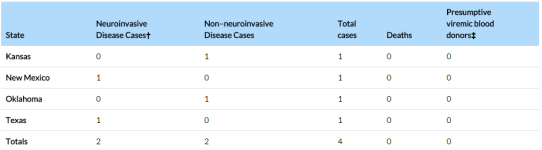
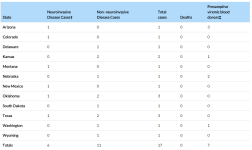
West Nile Virus Disease Cases* and Presumptive Viremic Blood Donors by State – United States, 2015 (as of June 9, 2015) West Nile.png
*Includes confirmed and probable cases.
†Includes cases reported as meningitis, encephalitis, or acute flaccid paralysis.
‡Presumptive viremic blood donors (PVDs)are people who had no symptoms at the time of donating blood through a blood collection agency, but whose blood tested positive when screened for the presence of West Nile virus. Some PVDs develop symptoms after donation.
Please refer to state health department web sites for further details regarding state case totals.

http://www.cdc.gov/westnile/statsmap...statedate.html


WNV infections in mosquitoes, birds, sentinel animals, or veterinary animals have been reported to CDC ArboNET from the following states: California, Florida, Illinois, Ohio, Oklahoma, Pennsylvania, Texas, and Utah.
West Nile virus infections in humans have been reported to CDC ArboNET from the following states: New Mexico, Oklahoma, and Texas.

http://www.cdc.gov/westnile/statsmap...statedate.html
 
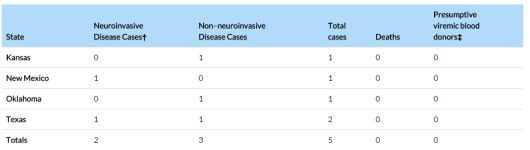
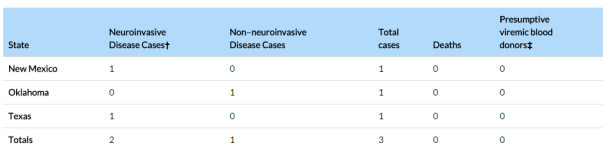
West Nile Virus Disease Cases* and Presumptive Viremic Blood Donors by State ? United States, 2015 (as of June 16, 2015)

West Nile.png *Includes confirmed and probable cases.
?Includes cases reported as meningitis, encephalitis, or acute flaccid paralysis.
?Presumptive viremic blood donors (PVDs)are people who had no symptoms at the time of donating blood through a blood collection agency, but whose blood tested positive when screened for the presence of West Nile virus. Some PVDs develop symptoms after donation.
Please refer to state health department web sites for further details regarding state case totals.

http://www.cdc.gov/westnile/statsmaps/preliminarymapsdata/histatedate.html

Data table: WNV infections in mosquitoes, birds, sentinel animals, or veterinary animals have been reported to CDC ArboNET from the following states: California, Florida, Illinois, Michigan, Nevada, Ohio, Oklahoma, Pennsylvania, Texas, Utah, and Wisconsin.

West Nile virus infections in humans have been reported to CDC ArboNET from the following states: Kansas, New Mexico, Oklahoma, and Texas.
http://www.cdc.gov/westnile/statsmaps/preliminarymapsdata/activitystatedate.html

 
Texas
West Nile case reported in Travis Ranch, mosquito spraying to begin
Written by Mathew Richards Thursday, 18 June 2015 14:58

FORNEY, Texas ? A Travis Ranch resident reported contracting the West Nile virus after being bitten by several mosquitoes outside their home on New Braunfels Trail and the Home Owners Association (HOA) says they are prepared to begin ground mosquito spraying.
Allstate
The Texas Department of State Health Services (TDSHS) confirmed the report as a West Nile fever case ? making it the second human case of West Nile virus reported this year. This first case was reported in May in Harris County and the patient contracted the more serious neuroinvasive form of the disease.
...
- See more at: http://inforney.com/local-news/item...squito-spraying-to-begin#sthash.iU08djHb.dpuf
 
West Nile Virus Disease Cases* and Presumptive Viremic Blood Donors by State – United States, 2015 (as of June 23, 2015) West Nile.png
*Includes confirmed and probable cases.
†Includes cases reported as meningitis, encephalitis, or acute flaccid paralysis.
‡Presumptive viremic blood donors (PVDs)are people who had no symptoms at the time of donating blood through a blood collection agency, but whose blood tested positive when screened for the presence of West Nile virus. Some PVDs develop symptoms after donation.
Please refer to state health department web sites for further details regarding state case totals.
http://www.cdc.gov/westnile/statsmap...statedate.html

Data table: WNV infections in mosquitoes, birds, sentinel animals, or veterinary animals have been reported to CDC ArboNET from the following states: California, Florida, Illinois, Indiana, Michigan, Nevada, Ohio, Oklahoma, Pennsylvania, Texas, Utah, Washington, and Wisconsin.

West Nile virus infections in humans have been reported to CDC ArboNET from the following states: Kansas, New Mexico, Oklahoma, and Texas.
http://www.cdc.gov/westnile/statsmap...statedate.html
 
[h=2]First Reported Delaware Human West Nile Virus Case in Two Years[/h] Date Posted: Thursday, June 25th, 2015
Categories: Delaware Health and Social Services Public Health


FIRST REPORTED DELAWARE HUMAN WEST NILE VIRUS CASE IN TWO YEARS
DOVER ?A 6-year-old Sussex County girl was briefly hospitalized with West Nile Virus (WNV) and is now recovering at home. The case is the first human WNV case reported since 2013. The mosquito-borne illness can become serious and the Division of Public Health reminds people to take precautions to avoid mosquito bites.
WNV is transmitted by mosquitoes, generally from spring to fall. Although nearly 80 percent of people infected with WNV will not become ill and only a little less than 20 percent of those infected will develop West Nile fever, with mild symptoms (fever, headache, body aches, a skin rash on the chest or back and swollen lymph glands), one in 150 people infected develop severe infection (West Nile encephalitis or meningitis).
Symptoms of severe WNV infection include headache, high fever, stiff neck, and/or tremors and muscle weakness. The elderly and those with weakened immune systems are most at risk. Anyone who experiences any of these severe symptoms should seek medical help immediately. Symptoms may progress to stupor, disorientation, coma, convulsions, paralysis, and possibly death.
?This new human case is a reminder that West Nile virus is still active in Delaware,? said Dr. Karyl Rattay, Division of Public Health Director. ?It?s tempting with the distractions of summer fun to forget to protect you and your loved ones from insect bites. These bites can cause much more serious health problems than just itching and discomfort.?
Mosquitoes can also carry Eastern equine encephalitis (EEE), and several other diseases that cause brain inflammation (encephalitis) and can be fatal to humans and animals. To avoid mosquito bites and reduce the risk of infection, individuals should:
? When outside, wear shoes, long-sleeved shirts, and pants. Mosquito netting can protect one?s face and neck, and infants in carriages, strollers, and playpens. Mosquitoes are most active at dusk and during the early-morning hours.
? Mosquito repellents containing DEET can be applied to the skin, but will last only a few hours before reapplication is necessary. Use insect repellent containing less than 50 percent DEET for adults. The current American Academy of Pediatrics and Centers for Disease Control and Prevention recommend using 10 to 30 percent DEET for children above 2 months old. The higher the strength, the longer the DEET provides protection which varies between two to five hours.
? Read labels carefully and always follow the instructions. DEET should not be used on children younger than 2 months.
? Prevent mosquitoes from entering the house by using screens and keeping windows and doorways tightly sealed. Mosquitoes prefer shallow water and tall vegetation. Eliminate standing water in your yard by changing birdbath water weekly, regularly draining pet dishes and plant pot saucers, and checking gutters, pool covers, and tarps for standing water. Store buckets, wheelbarrows, and wading pools upside down. Keep grass mowed.
In Delaware, there were no reported human WNV cases in 2014, three cases in 2013, and nine cases in 2012 with one fatality. To report suspected cases of human WNV, call the DPH Office of Infectious Disease Epidemiology at 888-295-5156.
To report high numbers of biting mosquitoes or other concerns, contact the Department of Natural Resources and Environmental Control (DNREC) Mosquito Control Section field offices:
? Glasgow Office (upstate) ? 302-836-2555, for all of New Castle County and the northern half of Kent County, including Dover.
? Milford Office (downstate) ? 302-422-1512, for the southern half of Kent County south of Dover, and for all of Sussex County.
Calls will be answered by staff from Monday through Friday between 8:00 a.m. and 4:00 p.m. Callers after business hours or during weekends or holidays should leave a message giving their name, phone number, address and a brief description of their need or problem.
For more information on DNREC Mosquito Control, call 302-739-9917 or visitwww.dnrec.delaware.gov/fw/Services/Pages/MosquitoSection.aspx.
For more information about WNV in horses, contact the Delaware Department of Agriculture at 302-698-4500 or 800-282-8685 (Delaware only).
For more general information on WNV, visit www.cdc.gov/ncidod/dvbid/westnile/index.htm.

###
Rita Landgraf, Secretary
Jill Fredel, Director of Communications
302-255-9047, Cell 302-357-7498
Email: jill.fredel@state.de.us

Delaware Health and Social Services ? Division of Public Health
http://news.delaware.gov/2015/06/25/first-reported-delaware-human-west-nile-virus-case-in-two-years/


West Nile in Texas – June 23, 2015

DSHS is reminding people about the danger posed by West Nile illness and encouraging people to protect themselves. People should reduce their risk of exposure to the mosquito-borne virus that causes it by eliminating standing water and other mosquito breeding areas; making sure door, porch and window screens are in good condition; wearing long sleeves and long pants outdoors when possible and using an insect repellent that contains DEET, picaridin, IR3535, or oil of lemon eucalyptus/para-menthane-diol.
As many as 80 percent of people who contract the virus will have no symptoms at all. Almost all others will have West Nile fever with symptoms like headache, fever, muscle and joint aches, nausea and fatigue. A very small minority will develop West Nile neuroinvasive disease, a life threatening illness that can cause neck stiffness, stupor, disorientation, coma, tremors, convulsions, muscle weakness and paralysis.
In 2014, there were 379 human cases of West Nile illness in Texas, including six deaths. [TABLE="class: layoutBorder, border: 1, cellpadding: 0, cellspacing: 0, height: 18"]
[TR]
[/TR]
[TR]
[TD]El Paso[/TD]
[TD="align: center"]0[/TD]
[TD="align: center"]1[/TD]
[TD="align: center"]1[/TD]
[/TR]
[TR]
[TD]Harris[/TD]
[TD="align: center"]0[/TD]
[TD="align: center"]1[/TD]
[TD="align: center"]1[/TD]
[/TR]
[TR]
[TD]Kaufman[/TD]
[TD="align: center"]1[/TD]
[TD="align: center"]0[/TD]
[TD="align: center"]1[/TD]
[/TR]
[TR]
[TD]Totals[/TD]
[TD="align: center"]1[/TD]
[TD="align: center"]2[/TD]
[TD="align: center"]3[/TD]
[/TR]
[/TABLE]
https://www.dshs.state.tx.us/news/updates.shtm
 
Last edited:
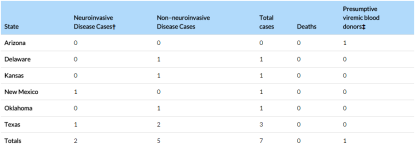
West Nile Virus Disease Cases* and Presumptive Viremic Blood Donors by State ? United States, 2015 (as of June 30, 2015)

West Nile.png *Includes confirmed and probable cases.
?Includes cases reported as meningitis, encephalitis, or acute flaccid paralysis.
?Presumptive viremic blood donors (PVDs)are people who had no symptoms at the time of donating blood through a blood collection agency, but whose blood tested positive when screened for the presence of West Nile virus. Some PVDs develop symptoms after donation.
Please refer to state health department web sites for further details regarding state case totals.
http://www.cdc.gov/westnile/statsmaps/preliminarymapsdata/histatedate.html

Data table: WNV infections in mosquitoes, birds, sentinel animals, or veterinary animals have been reported to CDC ArboNET from the following states: California, Florida, Idaho, Illinois, Indiana, Michigan, Mississippi, Missouri, Nebraska, Nevada, Ohio, Oklahoma, Pennsylvania, South Dakota, Texas, Utah, Washington, and Wisconsin.

West Nile virus infections in humans have been reported to CDC ArboNET from the following states: Arizona, Delaware, Kansas, New Mexico, Oklahoma, and Texas.

http://www.cdc.gov/westnile/statsmaps/preliminarymapsdata/activitystatedate.html
 
For Immediate Release
July 2, 2015

Contact Leah Bucco-White, Communications and Legislative Services, (402) 471-9108
leah.bucco-white@nebraska.gov

First Human Case of West Nile Virus Reported to DHHS


Note: Sound bites on this topic will be available shortly at: www.dhhs.ne.gov/audio

Lincoln ? A person in the Central District Health Department area (Hall, Hamilton, and Merrick Counties) tested positive for West Nile virus according to the Nebraska Department of Health and Human Services. The person was not hospitalized.
?This is the first human case so far this season and we expect to see more,? said Dr. Tom Safranek, State Epidemiologist for DHHS. ?West Nile virus can be a mild illness for some and serious for others. If you haven?t been taking steps to protect yourself, it?s important to start now.?

Preventive tips:
Make sure your mosquito repellent contains DEET, picaridin, lemon eucalyptus oil or IR3535.
Dress in long-sleeved shirts, pants and socks when you?re outside.
Dusk and dawn are times when mosquitoes are most active. Limit outdoor activities.
Drain standing water around your home. Standing water and warmth breed mosquitoes.
West Nile virus is transmitted to people through the bite of a mosquito that picked up the virus by feeding on an infected bird. Most people who are infected will have no symptoms or only mild flu-like symptoms. Some people will develop a fever with other symptoms like headache, body aches, vomiting, fatigue and weakness. Less than one percent of people will develop a serious illness like encephalitis or meningitis (inflammation of the brain and surrounding tissues). People over 50 and those with weakened immune systems are especially vulnerable to the disease and are more likely to experience serious consequences.

DHHS started its West Nile virus surveillance at the beginning of June. One mosquito pool tested positive in Webster County. No birds have tested positive for the virus.

WNV in Nebraska

Year Human Cases Deaths
2014 142 8
2013 226 5
2012 193 4
2011 29 0
2010 39 2

West Nile virus in humans statewide map 2002-2014 - http://1.usa.gov/1KskkBz

Subscribe to the DHHS West Nile virus webpage to get the latest updates - www.dhhs.ne.gov/wnv.
http://dhhs.ne.gov/Pages/newsroom_newsreleases_2015_july_humancase.aspx
 
Arizona
First West Nile Case Confirmed in Maricopa County
For Immediate Release: July 7, 2015
ADHS Media Contact: Holly Ward
602.542.1075 desk
480.327.7252 cell

Maricopa County Public Health Media Contact: Courtney Kreuzwiesner
602.540.5473 cell

[h=1]First West Nile Case Confirmed in Maricopa County[/h]
Health officials advise caution as monsoon rains increase mosquito activity
PHOENIX -- As the state enters monsoon season, the Arizona Department of Health Services is reminding residents to protect themselves and their homes against mosquitoes because of the risk of diseases such as West Nile virus, St. Louis encephalitis virus, and Western equine encephalitis. Maricopa County Department of Public Health (MCDPH) has confirmed the first human case of West Nile Virus in Arizona this season.
The infected individual is a male resident of Maricopa County in his late 50?s with no travel history. He experienced flu-like symptoms, but was not hospitalized and has since recovered.
?This is the time of year when we see an increase in mosquito-borne diseases that can cause serious illness, and in some cases can be deadly,? said Dr. Rebecca Sunenshine, medical director for the Disease Control Division at MCDPH. ?While this is our first confirmed case, there are likely many more out there and we expect our numbers to rise as the monsoon season continues.?
West Nile virus can cause severe illness in people and horses, although only about 20% of those infected will develop any symptoms at all, usually flu-like: fever, headache, body aches, and muscle weakness. Some people, especially the elderly, may experience severe disease including high fever, headache, neck stiffness, and/or encephalitis or inflammation of the brain, which can lead to paralysis or death. There were 108 human cases of West Nile virus reported statewide in 2014, 93 of which were in Maricopa County.
Mosquito populations increase dramatically during periods of high rainfall, and can spread serious diseases to people.
?By following a few simple guidelines you can reduce the risk of these diseases for yourself and your family,? said Dr. Cara Christ, director of the Arizona Department of Health Services.
To prevent the spread mosquito-borne diseases, please follow the prevention guidelines:
  • Wear mosquito repellant or long sleeved shirts and pants when outside.
  • Check your home for any containers that could hold water after rains or irrigation, including old tires, bottles, drums, and buckets.
  • Ensure water-holding containers are covered or turned over to protect them from mosquito eggs.
  • Make sure doors and windows have tightly fitted screens. Repair or replace screens with tears or holes in them.
  • Clean and change the water in flower vases, birdbaths, planters and animal watering pans at least once a week.
  • Repair leaky pipes and outside faucets.
Dr. Christ said people could also be infected with diseases from mosquitoes while traveling outside of Arizona. Some of the more common mosquito-borne diseases associated with travel include dengue, chikungunya, yellow fever, and malaria.
?It?s possible for someone to visit an area where there are mosquitos that carry a disease, such as dengue, and bring the disease back to Arizona,? Dr. Christ said. ?Taking a few extra precautions will not only help you protect your own health, but also the health of our entire state.?

In 2014, 108 cases of West Nile virus and one case of St. Louis encephalitis were reported among Arizona residents. In addition, 91 cases of dengue and 16 cases of chikungunya were reported among persons who had traveled outside of Arizona in 2014. Dengue and chikungunya have currently not been found in Arizona mosquitoes. For more information on mosquito-borne illness prevention, please contact the Arizona Department of Health Services at 602.364.4562 or visit us online at www.azdhs.gov.
- See more at: http://www.maricopa.gov/pr_detail.aspx?releaseID=2959#sthash.jlsHhrNw.dpuf

http://www.maricopa.gov/pr_detail.aspx?releaseID=2959
 
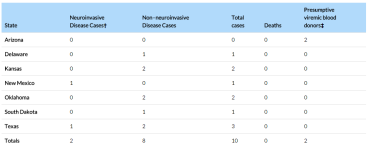
West Nile Virus Disease Cases* and Presumptive Viremic Blood Donors by State ? United States, 2015 (as of July 7, 2015)

West Nile.png
*Includes confirmed and probable cases.
?Includes cases reported as meningitis, encephalitis, or acute flaccid paralysis.
?Presumptive viremic blood donors (PVDs)are people who had no symptoms at the time of donating blood through a blood collection agency, but whose blood tested positive when screened for the presence of West Nile virus. Some PVDs develop symptoms after donation.
Please refer to state health department web sites for further details regarding state case totals.
http://www.cdc.gov/westnile/statsmaps/preliminarymapsdata/histatedate.html
...
Data table: WNV infections in mosquitoes, birds, sentinel animals, or veterinary animals have been reported to CDC ArboNET from the following states: California, Florida, Idaho, Illinois, Indiana, Michigan, Mississippi, Missouri, Nebraska, Nevada, New York, Ohio, Oklahoma, Pennsylvania, South Dakota, Texas, Utah, Washington, and Wisconsin.

West Nile virus infections in humans have been reported to CDC ArboNET from the following states: Arizona, Delaware, Kansas, New Mexico, Oklahoma, South Dakota, and Texas.
http://www.cdc.gov/westnile/statsmaps/preliminarymapsdata/activitystatedate.html


[h=4]Wyoming Reports First West Nile Virus Case of Season[/h] 7/10/2015

West Nile virus has returned to Wyoming with the season?s first case, involving a Sheridan County resident, being reported to the Wyoming Department of Health (WDH).

?We want to remind residents to take steps to protect themselves and their families from mosquito bites,? said Katie Bryan, epidemiologist with WDH. Mosquitos spread West Nile virus (WNV) when they feed on infected birds and then bite people, animals and other birds.

The ?5 D?s? of West Nile virus prevention include:

1) DAWN and 2) DUSK - Mosquitos prefer to feed at dawn or dusk, so avoid spending time outside during these times.
3) DRESS - Wear shoes, socks, long pants and a long-sleeved shirt outdoors. Clothing should be light-colored and made of tightly woven materials.
4) DRAIN - Mosquitos breed in shallow, stagnant water. Reduce the amount of standing water by draining and/or removing.
5) DEET - Use an insect repellent containing DEET (N, N-diethyl-m-toluamide). When using DEET, be sure to read and follow label instructions. Other insect repellents such as Picaridin (KBR 3023) or oil of lemon eucalyptus can also be effective.

Bryan said at least two states surrounding Wyoming have also had confirmed West Nile virus cases so far this season.

In Wyoming last year, five human WNV cases were reported. Since WNV first appeared in Wyoming in 2002, reported human cases within a year have ranged from two with no deaths to 393 and nine deaths.

Most people infected with WNV don?t have symptoms. Among those who become ill, symptoms include fever, headache, body aches, skin rash and swollen lymph nodes. A very small number develop West Nile neuroinvasive disease with symptoms such as severe headache, fever, neck stiffness, stupor, disorientation, coma, tremors, convulsions and paralysis.

http://www.health.wyo.gov/news.aspx?NewsID=839


West Nile Virus Disease Cases* and Presumptive Viremic Blood Donors by State ? United States, 2015 (as of July 14, 2015)

West Nile.png *Includes confirmed and probable cases.
?Includes cases reported as meningitis, encephalitis, or acute flaccid paralysis.
?Presumptive viremic blood donors (PVDs)are people who had no symptoms at the time of donating blood through a blood collection agency, but whose blood tested positive when screened for the presence of West Nile virus. Some PVDs develop symptoms after donation.
Please refer to state health department web sites for further details regarding state case totals.
http://www.cdc.gov/westnile/statsmaps/preliminarymapsdata/histatedate.html

Data table: WNV infections in mosquitoes, birds, sentinel animals, or veterinary animals have been reported to CDC ArboNET from the following states: California, Florida, Idaho, Illinois, Indiana, Kentucky, Michigan, Minnesota, Mississippi, Missouri, Nebraska, Nevada, New Jersey, New York, Ohio, Oklahoma, Pennsylvania, South Dakota, Tennessee, Texas, Utah, Washington, and Wisconsin.

West Nile virus infections in humans have been reported to CDC ArboNET from the following states: Arizona, Colorado, Delaware, Kansas, Montana, Nebraska, New Mexico, Oklahoma, South Dakota, Texas, Washington, and Wyoming.
http://www.cdc.gov/westnile/statsmaps/preliminarymapsdata/activitystatedate.html

NEWS RELEASE
For Immediate Release: For More Information, Contact:
July 14, 2015 Laura Cronquist
Division of Disease Control
North Dakota Department of Health
Phone: 701.328.2378
E-mail: lcronquist@nd.gov
First West Nile Virus Case of 2015 Reported in North Dakota
BISMARCK, N.D. ? The North Dakota Department of Health has confirmed the first human
case of West Nile virus (WNV) disease in 2015 in North Dakota. Additionally, two mosquito
pools from Grand Forks County have tested positive for WNV. To help avoid contracting the
virus, state and local health officials urge people to protect themselves from mosquito bites.
The patient is a female in her 40s who resides in McLean County. The patient was not
hospitalized for her illness. ?The identification of West Nile virus in a person is a reminder of the
importance of protecting ourselves from the bites of mosquitoes,? said Laura Cronquist,
epidemiologist with the North Dakota Department of Health. ?It is particularly important for
people over the age of 50 and those with other medical conditions to prevent mosquito bites, as
they are more at risk for severe complications from West Nile virus.?
NDDoH recommends residents take these precautions to avoid mosquito bites:
 Use insect repellents containing ingredients registered with the U.S. Environmental
Protection Agency ? such as DEET, picaridin, IR3535, oil of lemon eucalyptus (or PMD)
or permethrin ? and apply according to manufacturer?s instructions
 Wear protective clothing, such as long-sleeved shirts and pants
 Limit outdoor activities between dusk and dawn when mosquitoes are most likely to bite
 Eliminate stagnant water in containers around homes where mosquitoes can lay their eggs
(such as buckets, flowerpots, old tires, wading pools and birdbaths)
 Keep the grass around your home trimmed

...
http://www.ndhan.gov/data/mrNews/2015-07-14-First WNV Case NR-v.FINAL.pdf
 
County health officer: West Nile Virus 'possibly' suspected in death
Liz Kellar
lkellar@theunion.com

Nevada County Public Health officers confirmed Wednesday morning that they are working with the state in investigating a suspected West Nile virus fatality.

?We do not have a confirmed West Nile Virus case in Nevada County at this time,? Dr. Ken Cutler said in a prepared statement. ?We have preliminary results that indicate West Nile virus as a possibility in a death of a local resident. We are working with the California Department of Public Health, which is conducting further testing.?

According to Cutler, results may be available late this week or early next week. He declined to state when the death occurred or any other specifics.
...
http://www.theunion.com/news/17277797-113/county-health-officer-west-nile-virus-possibly-suspected
 
Arizona

MARICOPA COUNTY
Public Health
4041 N. Central Ave, Suite 1400
Phoenix, AZ 85012
Ph 602-506-6900
www.maricopa.gov
First West Nile Virus Deaths of 2015 Confirmed


For Immediate Release

Contact: Jeanene Fowler, Maricopa County Public Health: (602) 722-1806
Johnny Dilone, Maricopa County Environmental Services: 602-525-2423
Maricopa County Public Health Confirms
First Deaths of 2015 from West Nile Virus


PHOENIX (July 17, 2015) ? After reporting 17 lab-confirmed human cases of West Nile virus (WNV) infection this season to date, Maricopa County Department of Public Health announced today two deaths related to the disease. The first victim was an East Valley man in his early 60s with underlying health issues. The second was an East Valley woman in her 70s who also had underlying health conditions. These are the first two deaths of the 2015 West Nile virus season.

?Sadly, we are reporting two East Valley residents who died from West Nile virus; however, we know that this disease is not limited to the East Valley,? said Dr. Bob England, director of Maricopa County Department of Public Health. ?The early rains we had in June have now caught up with us and we are now seeing increases in infected people and mosquitoes throughout the Valley. This serves as a reminder to all of us all to do our part in protecting ourselves, our family and our neighborhoods.?

West Nile virus can cause severe illness in people and horses, although only about 20 percent of those infected will develop any symptoms at all. Those that do develop symptoms usually report fever, headache, body aches, and muscle weakness. Some people, especially the elderly, may experience more severe symptoms including high fever, severe headache, neck stiffness, and/or encephalitis or inflammation of the brain, which can lead to paralysis or death.

?So far we have confirmed 71 West Nile virus positive mosquito samples, which is twice as many as reported this time last year,? said Steven Goode, Maricopa County Environmental Services Department Director. ?All this is a reminder of the importance in all of us doing our part in ridding our properties of standing water, where mosquitoes breed. A little effort can go a long way in protecting the whole community from West Nile virus and other mosquito-related diseases.?

West Nile virus is transmitted through the bite of an infected mosquito. Maricopa County Health officials urge all people to ?Fight the Bite? and follow simple precautions to avoid mosquitoes and the diseases they may carry:

Use insect repellant. Apply on exposed skin when you go outdoors. Use an EPA-registered insect repellent such as those with DEET, picaridin, or even some oil of lemon eucalyptus products. Always read and follow all directions and precautions on the product label.
Wear lightweight clothing that covers your arms and legs when outdoors. Make sure doors and windows have tight fitting screens and remain closed.
Eliminate mosquito-breeding sites around the home by removing standing water in potted plants, tires, bird baths and other containers where water may collect.
Ensure that swimming pools and decorative water features are properly maintained.
Change water in flowerpots, birdbaths and pet watering bowls located outdoors at least twice per week.
West Nile virus was first found in Arizona in 2003. Since then, over 1,000 human cases have been reported. In 2014, Maricopa County had 93 cases and 12 deaths. In 2010, Maricopa County recorded its second worst West Nile virus season with 115 cases. (The worst season was in 2004 with 355 cases and 16 deaths.)

Maricopa County Environmental Services Department Vector Control continues to treat mosquito breeding habitats as well as fogging to kill the specific mosquitoes that spread West Nile virus. To report green pools or file a mosquito complaint, please call 602-506-6616 or visit FighttheBiteMaricopa.org

For more information on fogging schedules, WNV or other mosquito related diseases, please visit FighttheBiteMaricopa.org.

- See more at: http://www.maricopa.gov/pr_detail.aspx?releaseID=2973#sthash.B3EOMgoN.dpuf


Texas

Posted: Jul 17, 2015 4:09 AM EDT
Updated: Jul 17, 2015 4:09 AM EDT
West Nile virus-related death confirmed in Kleberg County
By Nikela PradierCONNECT

KINGSVILLE -
Health officials in Kleberg County are now confirming that a man?s death was caused by the West Nile virus.

79-year-old Agustin Hinojosa passed away on July 2. His family says he got sick over Father?s Day weekend and went to the hospital at that time.
...
http://www.kristv.com/story/29570151/west-nile-virus-related-death-confirmed-in-kleberg-county


Oklahoma
Sixth Case Of West Nile Virus Reported In Oklahoma
Posted: Jul 16, 2015 7:08 PM EDT
Updated: Jul 16, 2015 7:08 PM EDT

OKLAHOMA CITY (AP) -
The Oklahoma Department of Health reports a sixth victim of the west nile virus in Oklahoma this summer.

The victim lives in Oklahoma County. No information was given on the patient's age or gender. It's the second case in Oklahoma County.
...
http://www.ktul.com/story/29568165/sixth-case-of-west-nile-virus-reported-in-oklahoma

California

Two Butte County residents first West Nile virus cases in state
By Staff Reports
POSTED: 07/16/15, 10:27 AM PDT | UPDATED: 2 HRS AGO
Two Butte County residents are the first confirmed human cases of West Nile virus in California this year, according to a press release from the Butte County Public Health Department.

Like 80 percent of people infected with West Nile virus, they didn?t have symptoms of the disease, but rather it was discovered when blood they had donated was screened.

The two are unrelated to each other, but no other information was released about them.
...
http://www.chicoer.com/health/20150...esidents-first-west-nile-virus-cases-in-state
 
Louisiana

DHH Asks Residents to Take Precautions Against Mosquitoes
Health Department Confirms Three New Cases of West Nile
Friday, July 17, 2015 | Contact: Media & Communications: Phone: 225.342.1532, E-mail: dhhinfo@la.gov
Baton Rouge, La.?The Louisiana Department of Health and Hospitals (DHH) has confirmed three new cases of West Nile virus this week, the first cases of 2015. This week's new infections include two cases of neuroinvasive disease, one in DHH Region 2 and one in Region 6. The third case, also in Region 6 was asymptomatic.

About 90 percent of all West Nile virus cases are asymptomatic, while about 10 percent will develop West Nile fever. Only a very small number of infected individuals will show the serious symptoms associated with the neuroinvasive disease. Residents who are at least 65 years old are at higher risk for complications, but everyone is at risk for infection.

"There is an opportunity for you to get bitten every time you step outside, whether you're taking a quick walk to the mailbox or spending hours at the ball park," said State Health Officer Dr. Jimmy Guidry. "You need to take the proper steps to protect yourself and your home from mosquitoes every time you go outdoors."

Last year, Louisiana saw 62 cases of West Nile virus neuroinvasive disease in the state. DHH has been tracking West Nile Virus for more than a decade, and statistics about its occurrence in Louisiana can be found online at www.dhh.louisiana.gov/fightthebite.
...
http://dhh.louisiana.gov/index.cfm/newsroom/detail/3439
 
Back
Top