

Shiloh
Editor, Senior Moderator
Source: https://www.cdc.gov/fungal/candida-auris/tracking-c-auris.html [h=1]Tracking Candida auris[/h] March 29, 2019: Case Count Updated as of February 28, 2019
Candida auris is an emerging fungus that presents a serious global health threat. C. auris causes severe illness in hospitalized patients in several countries, including the United States. Patients can remain colonized with C. auris for a long time and C. auris can persist on surfaces in healthcare environments. This can result in spread of C. auris between patients in healthcare facilities.
Most C. auris cases in the United States have been detected in the New York City area, New Jersey, and the Chicago area. Strains of C. auris in the United States have been linked to other parts of the world. U.S. C. auris cases are a result of inadvertent introduction into the United States from a patient who recently received healthcare in a country where C. auris has been reported or a result of local spread after such an introduction.
Candida auris was made nationally notifiable at the 2018 Council for State and Territorial Epidemiologists (CSTE) Annual Conference. For the updated case definition and information on the nationally notifiable condition status, please see the 2018 CSTE position statement Cdc-pdf[PDF ? 16 pages]External.
U.S. Map: Clinical cases of Candida auris reported by U.S. states, as of February 28, 2019
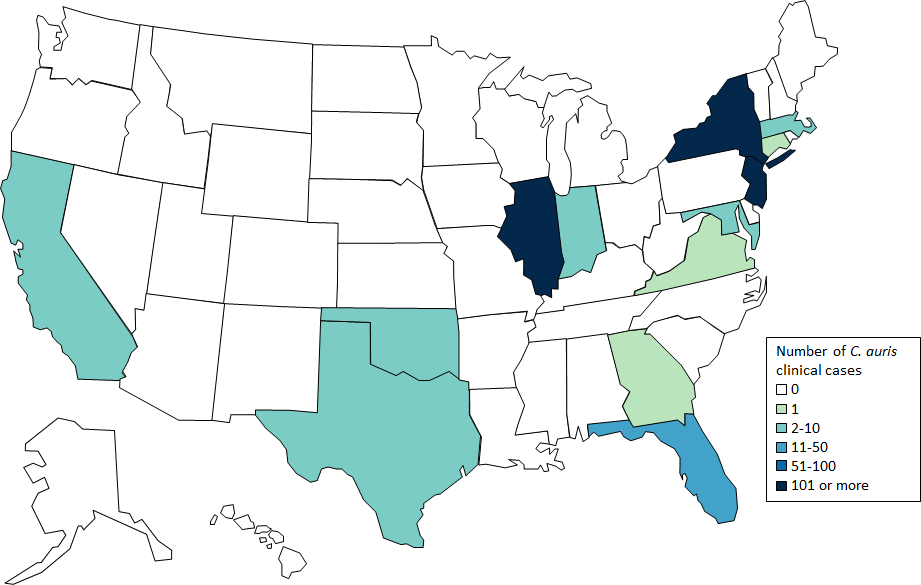
Cases reported prior to 2019 are categorized by the state where the specimen was collected. Cases reported in 2019 are categorized by the patient?s state of residence to reflect the standards of the Nationally Notifiable Disease Surveillance System. Most probable cases were identified when laboratories with current cases of C. auris reviewed past microbiology records for C. auris. Isolates were not available for confirmation. Early detection of C. auris is essential for containing its spread in healthcare facilities.
[h=4]Clinical cases of Candida auris reported by U.S. states, as of February 28, 2019[/h] [TABLE="class: table table-bordered"]
[h=4]Clinical cases of Candida auris reported by state, United States[/h] [TR]
State Number and type of clinical Candida auris cases reported [/TR]
[TR]
Confirmed Probable [/TR]
[TR]
[TD]California[/TD]
[TD]2[/TD]
[TD]0[/TD]
[/TR]
[TR]
[TD]Connecticut[/TD]
[TD]1[/TD]
[TD]0[/TD]
[/TR]
[TR]
[TD]Florida[/TD]
[TD]12[/TD]
[TD]0[/TD]
[/TR]
[TR]
[TD]Illinois[/TD]
[TD]144[/TD]
[TD]4[/TD]
[/TR]
[TR]
[TD]Indiana[/TD]
[TD]1[/TD]
[TD]0[/TD]
[/TR]
[TR]
[TD]Maryland[/TD]
[TD]3[/TD]
[TD]0[/TD]
[/TR]
[TR]
[TD]Massachusetts[/TD]
[TD]7[/TD]
[TD]0[/TD]
[/TR]
[TR]
[TD]New Jersey[/TD]
[TD]104[/TD]
[TD]22[/TD]
[/TR]
[TR]
[TD]New York[/TD]
[TD]309[/TD]
[TD]4[/TD]
[/TR]
[TR]
[TD]Oklahoma[/TD]
[TD]2[/TD]
[TD]0[/TD]
[/TR]
[TR]
[TD]Texas[/TD]
[TD]1[/TD]
[TD]0[/TD]
[/TR]
[TR]
[TD]Virginia[/TD]
[TD]1[/TD]
[TD] 0[/TD]
[/TR]
[TR]
[TD]TOTAL[/TD]
[TD]587[/TD]
[TD]30[/TD]
[/TR]
[/TABLE]
Beyond the clinical case counts reported above, an additional 1056 patients have been found to be colonized with C. auris by targeted screening in seven states with clinical cases.
CDC will update case counts monthly.
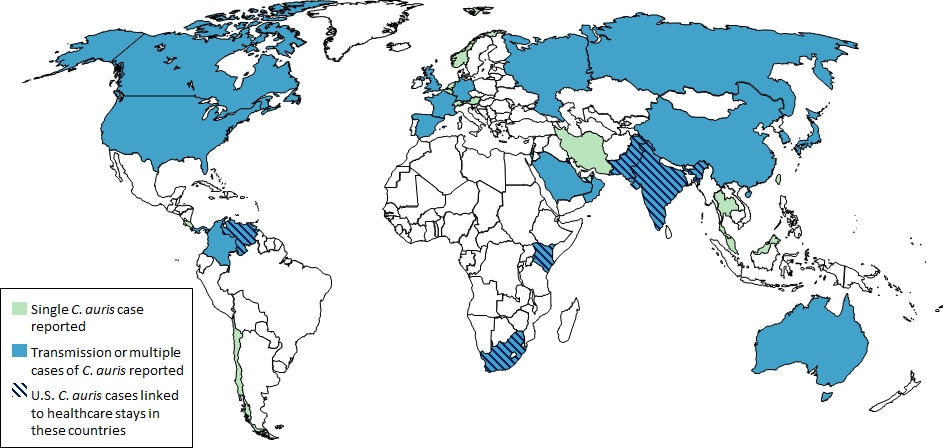
Countries from which Candida auris cases have been reported, as of February 28, 2019
Candida auris is an emerging fungus that presents a serious global health threat. C. auris causes severe illness in hospitalized patients in several countries, including the United States. Patients can remain colonized with C. auris for a long time and C. auris can persist on surfaces in healthcare environments. This can result in spread of C. auris between patients in healthcare facilities.
Most C. auris cases in the United States have been detected in the New York City area, New Jersey, and the Chicago area. Strains of C. auris in the United States have been linked to other parts of the world. U.S. C. auris cases are a result of inadvertent introduction into the United States from a patient who recently received healthcare in a country where C. auris has been reported or a result of local spread after such an introduction.
Candida auris was made nationally notifiable at the 2018 Council for State and Territorial Epidemiologists (CSTE) Annual Conference. For the updated case definition and information on the nationally notifiable condition status, please see the 2018 CSTE position statement Cdc-pdf[PDF ? 16 pages]External.
U.S. Map: Clinical cases of Candida auris reported by U.S. states, as of February 28, 2019
Cases reported prior to 2019 are categorized by the state where the specimen was collected. Cases reported in 2019 are categorized by the patient?s state of residence to reflect the standards of the Nationally Notifiable Disease Surveillance System. Most probable cases were identified when laboratories with current cases of C. auris reviewed past microbiology records for C. auris. Isolates were not available for confirmation. Early detection of C. auris is essential for containing its spread in healthcare facilities.
[h=4]Clinical cases of Candida auris reported by U.S. states, as of February 28, 2019[/h] [TABLE="class: table table-bordered"]
[h=4]Clinical cases of Candida auris reported by state, United States[/h] [TR]
State Number and type of clinical Candida auris cases reported [/TR]
[TR]
Confirmed Probable [/TR]
[TR]
[TD]California[/TD]
[TD]2[/TD]
[TD]0[/TD]
[/TR]
[TR]
[TD]Connecticut[/TD]
[TD]1[/TD]
[TD]0[/TD]
[/TR]
[TR]
[TD]Florida[/TD]
[TD]12[/TD]
[TD]0[/TD]
[/TR]
[TR]
[TD]Illinois[/TD]
[TD]144[/TD]
[TD]4[/TD]
[/TR]
[TR]
[TD]Indiana[/TD]
[TD]1[/TD]
[TD]0[/TD]
[/TR]
[TR]
[TD]Maryland[/TD]
[TD]3[/TD]
[TD]0[/TD]
[/TR]
[TR]
[TD]Massachusetts[/TD]
[TD]7[/TD]
[TD]0[/TD]
[/TR]
[TR]
[TD]New Jersey[/TD]
[TD]104[/TD]
[TD]22[/TD]
[/TR]
[TR]
[TD]New York[/TD]
[TD]309[/TD]
[TD]4[/TD]
[/TR]
[TR]
[TD]Oklahoma[/TD]
[TD]2[/TD]
[TD]0[/TD]
[/TR]
[TR]
[TD]Texas[/TD]
[TD]1[/TD]
[TD]0[/TD]
[/TR]
[TR]
[TD]Virginia[/TD]
[TD]1[/TD]
[TD] 0[/TD]
[/TR]
[TR]
[TD]TOTAL[/TD]
[TD]587[/TD]
[TD]30[/TD]
[/TR]
[/TABLE]
Beyond the clinical case counts reported above, an additional 1056 patients have been found to be colonized with C. auris by targeted screening in seven states with clinical cases.
CDC will update case counts monthly.
Countries from which Candida auris cases have been reported, as of February 28, 2019
- Single cases of C. auris have been reported from Austria, Belgium, Iran, Malaysia, the Netherlands, Norway, Switzerland, Taiwan, and the United Arab Emirates.
- Multiple cases of C. auris have been reported from Australia, Canada, China, Colombia, France, Germany, India, Israel, Japan, Kenya, Kuwait, Oman, Pakistan, Panama, Russia, Saudi Arabia, Singapore, South Africa, South Korea, Spain, the United Kingdom, the United States (primarily from the New York City area, New Jersey, and the Chicago area) and Venezuela; in some of these countries, extensive transmission of C. auris has been documented in more than one hospital.
- U.S. cases of C. auris have been found in patients who had recent stays in healthcare facilities in India, Kenya, Kuwait, Pakistan, South Africa, the United Arab Emirates, and Venezuela, which also have documented transmission.
- Other countries not highlighted on this map may also have undetected or unreported C. auris cases.