• FluTrackers.com Inc. does not provide medical advice. Information on this web site is collected from various internet resources, and the FluTrackers board of directors makes no warranty to the safety, efficacy, correctness or completeness of the information posted on this site by any author or poster. The information collated here is for instructional and/or discussion purposes only and is NOT intended to diagnose or treat any disease, illness, or other medical condition. Every individual reader or poster should seek advice from their personal physician/healthcare practitioner before considering or using any interventions that are discussed on this website. By continuing to access this website you agree to consult your personal physican before using any interventions posted on this website, and you agree to hold harmless FluTrackers.com Inc., the board of directors, the members, and all authors and posters for any effects from use of any medication, supplement, vitamin or other substance, device, intervention, etc. mentioned in posts on this website, or other internet venues referenced in posts on this website.
  • We are not asking for any donations. Do not donate to any entity who says they are raising funds for us.

US - OIE report: HP H5N1 in duck in Washington State - January 21, 2015

sharon sanders

Editor-in-Chief & President
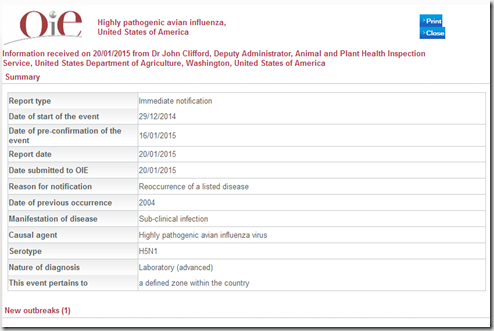
H5N1washingtonstate.JPG

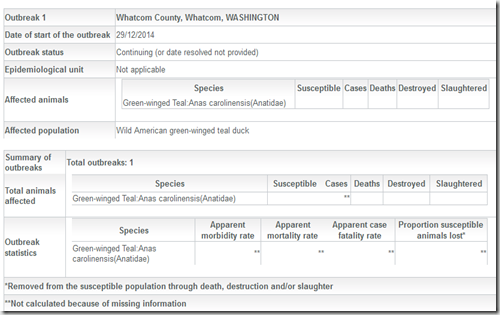
H5N1washingtonstate2.JPG


http://www.oie.int/wahis_2/public/w...=MapFullEventReport&reportid=17014&newlang=en


hat tip Michael Coston for the link.
 
[h=2]Wednesday, January 21, 2015[/h] [h=3]OIE: New Reassortant HPAI H5N1 In North America[/h]

image_thumb%25255B4%25255D.png


# 9608

Yes, you read the title right; H5N1.

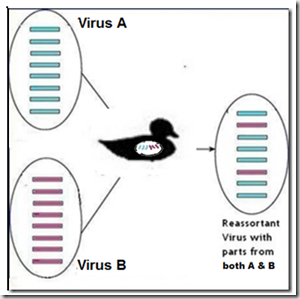
Not the same H5N1 as has been rife in Asia for the past decade, and is currently making trouble in Egypt - but a cousin -a new reassortant H5N1 with genetic components derived from both the Eurasian H5N8 virus (including the H5 HA) and by North American avian viruses.
A more complete description is provided in the OIE report below, after which I?ll be back with more.


Epidemiology
Source of the outbreak(s) or origin of infection
  • Contact with wild species
As part of the increased AI surveillance of wild birds (performed by testing hunter harvested birds), another Eurasian H5 clade 2.3.4.4 virus has been identified through whole genome sequencing of the virus isolate. Introduction of the Eurasian (EA) H5N8 virus into the Pacific Flyway sometime during late 2014 has allowed mixing with North American (AM) lineage viruses and generated new combinations with genes from both EA and AM origin (or ?reassortant? viruses) such as the EA/AM H5N2-reassortant detected in Canada and the United States.
Such findings are not unexpected as the EA-H5N8 virus continues to circulate. A novel EA/AM H5N1-reassortant clade 2.3.4.4 was isolated from an American green-winged teal in Whatcom County, Washington.
This H5N1 subtype is different from strain circulating in Asia. The gene constellation is as follows: Eurasian lineage genes (PB2, H5, NP, MP >99% identical to A/gyrfalcon/WA/41088/2014 H5N8); North American lineage genes (PB1 {98% identical to A/Northern pintail/Washington/40964/2014 H5N2}, PA, N1, NS of North American LPAI wild bird lineage. The HA cleavage site is compatible with strains that are highly pathogenic. This novel HPAI EA/AM H5N1-reassortant virus has NOT been found in commercial poultry anywhere in the United States.
H5N8 continues to impress in its ability not only to travel rapidly across continents and oceans on the wings of migratory birds, but in the number of viable reassortant viruses it has managed to spawn along the way. Last spring, in EID Journal: Describing 3 Distinct H5N8 Reassortants In Korea, we saw early indicators of this virus?s growing diversity, while just last week Taiwan reported two `new? reassortant viruses (H5N2 & H5N3).

Right now we don?t know anything about how this new reassortant virus will behave in poultry (other than being HPAI), or in non-avian species (including humans). I would posit that there is a good deal of testing & research going on right now to determine that.
Whether this turns out to be a flash in the avian flu pan, or an early glimpse of a new emerging threat, this report does remind us that influenza viruses are capable of rapid evolution, particularly through reassortment.

The number of new avian viruses that have appeared over the past couple of years (H7N9, H5N8, H5N6, H5N5, H5N3, H5N2, H10N8, etc.) illustrate that nature?s laboratory is open 24/7, and one that can easily throw us a nasty curve ball at any time.


Posted by Michael Coston at 10:53 AM


Source: http://www.nbcnews.com/health/health-news/new-bird-flu-found-u-s-duck-first-time-n291781
A green-winged teal shot by a hunter in northern Washington state has tested positive for a strain H5N1 bird flu ? but it's only a distant relative of the virus that's infected nearly 700 people globally and killed 400 of them.
It's the first case of highly pathogenic H5N1 avian influenza ever seen in the U.S. The good news is that the strain is genetically different from the strain that's circulated in China, across Asia and most recently in Egypt. It doesn't appear to have infected any people or even domestic poultry.
But it shows that wild migrating birds can carry dangerous viruses to the U.S., says Hon Ip, an expert on wildlife pathogens at the U.S. Geological Survey in Madison, Wisconsin.
"Unlike the Asian H5N1 strain that has been found in Asia, Europe, and Africa, this Washington state strain has only been found in wild waterfowl and has not been associated with human illness, nor has this new Washington state strain been found in domestic poultry," USGS said in a statement.
The U.S. Department of Agriculture will need to keep a close eye out for other birds with H5N1, Ip said...
 
[h=1]Avian Influenza[/h]
[h=3]News Update January 23, 2015[/h]
Discovery of novel highly pathogenic avian influenza H5N1 virus in USA wild birds (January 21, 2015)

A recombinant H5N1 virus belonging to the same group as other recent highly pathogenic avian influenza (HPAI) H5 viruses has been identified from a green-wing teal (Anas carolinensis) collected from a hunter-harvest surveillance project funded by the U.S. Geological Survey. The bird was sampled in Whatcom County, Washington, on December 29, 2014. This novel virus, designated EA/AM H5N1, is different from the Asian HPAI H5N1 and is a mixture of Eurasian (EA) and low pathogenic North American (AM) origin viruses.

In response to initial detections of HPAI virus in wild birds in backyard poultry in the USA and Canada, the USGS National Wildlife Health Center (NWHC) has worked closely with U.S. Department of Agriculture - Wildlife Services, U.S. Fish and Wildlife Service, Washington Department of Fish and Wildlife, and other state Wildlife Departments to implement enhanced mortality and hunter-harvest surveillance in wild birds. As of mid-January, NWHC has tested oropharyngeal/cloacal swabs from over 1,200 birds originating from California, Nevada, Oregon, and Washington, with the majority of collections focused in Washington. Of these samples, 167 were positive for avian influenza viruses by an initial molecular screening test (matrix RT-PCR) and 20 were positive for H5 subtypes by follow-up molecular testing. As a member of the National Animal Health Laboratory Network, NWHC sends H5-positive samples to USDA's National Veterinary Services Laboratories (NVSL) for further characterization. On January 21, 2015, NVSL confirmed identification of the EA/AM H5N1 virus as containing PB2, H5, NP, and MP RNA segments identical to the gyrfalcon H5N8 previously identified in Whatcom County and PB1, PA, N1, and NS RNA segments from North American low-pathogenic avian influenza viruses of wild bird origin.
Additional information on this and other winter (2014/2015) wild bird surveillance results can be found at:

Update on Avian Influenza Findings in the Pacific Flyway

OIE Notification Report from APHIS

...
http://www.nwhc.usgs.gov/disease_information/avian_influenza/index.jsp
 

USGS Statement Regarding Avian Flu Found in Washington State Green-Winged Teal

Released: 1/23/2015 5:55:02 PM

Contact Information:
U.S. Department of the Interior, U.S. Geological Survey
Office of Communications and Publishing
12201 Sunrise Valley Dr, MS 119

Reston, VA 20192 Jonathan Sleeman 1-click interview
Phone: 608-270 2401

Catherine Puckett 1-click interview
Phone: 352-278-0165

Marisa Lubeck 1-click interview
Phone: 303-526-6694

Some media are reporting that the Asian H5N1 strain of highly pathogenic avian influenza has now entered the United States. This is incorrect. The avian flu that was recently found in a green-winged teal in Washington state is a different strain and is not known to harm humans nor has it been found in domestic poultry. This Washington state strain incorporates genes from North American waterfowl-associated viruses. Unlike the Asian H5N1 strain that has been found in Asia, Europe, and Africa, this Washington state strain has only been found in wild waterfowl and has not been associated with human illness, nor has this new Washington state strain been found in domestic poultry.

...
http://www.usgs.gov/newsroom/article.asp?ID=4108&from=rss_home#.VMPKkv7F-So

 
Back
Top