• FluTrackers.com Inc. does not provide medical advice. Information on this web site is collected from various internet resources, and the FluTrackers board of directors makes no warranty to the safety, efficacy, correctness or completeness of the information posted on this site by any author or poster. The information collated here is for instructional and/or discussion purposes only and is NOT intended to diagnose or treat any disease, illness, or other medical condition. Every individual reader or poster should seek advice from their personal physician/healthcare practitioner before considering or using any interventions that are discussed on this website. By continuing to access this website you agree to consult your personal physican before using any interventions posted on this website, and you agree to hold harmless FluTrackers.com Inc., the board of directors, the members, and all authors and posters for any effects from use of any medication, supplement, vitamin or other substance, device, intervention, etc. mentioned in posts on this website, or other internet venues referenced in posts on this website.
  • We are not asking for any donations. Do not donate to any entity who says they are raising funds for us.

US - Multistate Outbreak of E. coli O157:H7 Infections Linked to Romaine Lettuce

Pathfinder

Editor, Senior Moderator
[h=3]Fresh Foods Manufacturing Co. Recalls Ready-To-Eat Salad Products Due to Possible E. coli O157:H7 Contamination[/h] [FONT=&quot]Class I Recall033-2018[/FONT]
[FONT=&quot]Health Risk: HighApr 14, 2018[/FONT]
[FONT=&quot]
[/FONT]

[FONT=&quot] [/FONT]
[FONT=&quot] Congressional and Public Affairs
Jeremy J. Emmert
(202) 720-9113
Press@fsis.usda.gov

[/FONT]

[FONT=&quot]

WASHINGTON, April 14, 2018 ? Fresh Foods Manufacturing Co., a Freedom, Pa., establishment, is voluntarily recalling approximately 8,757 pounds of ready-to-eat salad products that may be contaminated with E. coli O157:H7, the U.S. Department of Agriculture?s Food Safety and Inspection Service (FSIS) announced today.
The ready-to-eat salad products were produced from April 9, 2018 to April 12, 2018 and have a shelf life of four days. The following products are subject to recall: [View Labels (PDF Only)]
  • 11.5 oz., clear plastic containers of ready-to-eat ?CAESAR SALAD WITH CHICKEN.? The product label is marked ?Great to Go? by Market District and has a sell by date of 04/13/18-04/16/18. The case code is 81571201542.
  • 14.4 oz., clear plastic containers of ready-to-eat ?CHICKEN AND BACON? salad. The product label is marked ?Great to Go? by Market District and has a sell by date of 04/13/18 ? 04/16/18. The case code is 81571201541.
  • 14.1 oz., clear plastic containers of ready-to-eat ?CHEF SALAD WITH HAM, TURKEY, & HARD-BOILED EGG.? The product label is marked ?Great to Go? by Market District and has a sell by date of 04/13/18 ? 04/16/18. The case code is 81571201543.
  • 13.1 oz., clear plastic containers of ready-to-eat ?CHEF SALAD WITH HAM, TURKEY, & HARD-BOILED EGG.? The product label is marked ?Great to Go? by Market District and has a sell by date of 04/13/18 ? 04/16/18. The case code is 81571201545.
The products subject to recall bear establishment number ?P-40211? inside the USDA mark of inspection. These items were shipped to retail locations in Indiana, Ohio, Pennsylvania, and West Virginia.
The problem was discovered on April 13, 2018 when Fresh Foods Manufacturing Co., received notification from their romaine lettuce supplier that the romaine lettuce used by the establishment in the products was being recalled due to E. coli O157:H7 concerns. There have been no confirmed reports of adverse reactions due to consumption of these products.
Anyone concerned about an injury or illness should contact a healthcare provider. E. coli O157:H7 is a potentially deadly bacterium that can cause dehydration, bloody diarrhea and abdominal cramps 2?8 days (3?4 days, on average) after exposure the organism. While most people recover within a week, some develop a type of kidney failure called hemolytic uremic syndrome (HUS). This condition can occur among persons of any age but is most common in children under 5-years old and older adults. It is marked by easy bruising, pallor, and decreased urine output. Persons who experience these symptoms should seek emergency medical care immediately.
FSIS routinely conducts recall effectiveness checks to verify recalling firms notify theircustomers of the recall and that steps are taken to make certain that the product is no longer available to consumers. When available, the retail distribution list(s) will be posted on the FSIS website at www.fsis.usda.gov/recalls.
Consumers and members of the media with questions about the recall can contact Dan Donovan, Director of Corporate Communications, Fresh Food Manufacturing Co. at (412) 967-4551. For additional information about the recall, customers may visit GiantEagle.com/Product-Recall. Customers may also contact Giant Eagle Customer Care via GiantEagle.com/contact or at 1-800-553-2324. Giant Eagle?s Customer Care service hours are Monday through Friday, from 9 a.m. to 9 p.m. EST.
Consumers with food safety questions can "Ask Karen," the FSIS virtual representative available 24 hours a day at AskKaren.gov or via smartphone at m.askkaren.gov. The toll-free USDA Meat and Poultry Hotline 1-888-MPHotline (1-888-674-6854) is available in English and Spanish and can be reached from 10 a.m. to 6 p.m. (Eastern Time) Monday through Friday. Recorded food safety messages are available 24 hours a day. The online Electronic Consumer Complaint Monitoring System can be accessed 24 hours a day at: http://www.fsis.usda.gov/reportproblem.

[/FONT]

[FONT=&quot] [/FONT]
[FONT=&quot] [TABLE="border: 1, cellpadding: 6, cellspacing: 0"]
[TR]
[TD="class: TableHeadWhite, bgcolor: transparent, colspan: 3"]USDA Recall Classifications[/TD]
[/TR]
[TR]
[TD="class: hdrBoldBlack, width: 20%, bgcolor: transparent, align: left"]Class I[/TD]
[TD="class: BodyTextBlack, width: 80%, bgcolor: transparent, align: left"]This is a health hazard situation where there is a reasonable probability that the use of the product will cause serious, adverse health consequences or death.[/TD]
[/TR]
[TR]
[TD="class: hdrBoldBlack, width: 20%, bgcolor: transparent, align: left"]Class II[/TD]
[TD="class: BodyTextBlack, width: 80%, bgcolor: transparent, align: left"]This is a health hazard situation where there is a remote probability of adverse health consequences from the use of the product.[/TD]
[/TR]
[TR]
[TD="class: hdrBoldBlack, width: 20%, bgcolor: transparent, align: left"]Class III[/TD]
[TD="class: BodyTextBlack, width: 80%, bgcolor: transparent, align: left"]This is a situation where the use of the product will not cause adverse health consequences.[/TD]
[/TR]
[/TABLE]
[/FONT]

 
Source: https://www.cdc.gov/ecoli/2018/o157h7-04-18/index.html

Multistate Outbreak of E. coli O157:H7 Infections Linked to Romaine Lettuce


Posted April 20, 2018 4:00 PM EST


What's New?

  • Based on new information, CDC is expanding its warning to consumers to cover all types of romaine lettuce from the Yuma, Arizona growing region. This warning now includes whole heads and hearts of romaine lettuce, in addition to chopped romaine and salads and salad mixes containing romaine.
  • Do not buy or eat romaine lettuce at a grocery store or restaurant unless you can confirm it is not from the Yuma, Arizona, growing region.
  • Unless the source of the product is known, consumers anywhere in the United States who have any store-bought romaine lettuce at home should not eat it and should throw it away, even if some of it was eaten and no one has gotten sick. Product labels often do not identify growing regions; so, throw out any romaine lettuce if you’re uncertain about where it was grown. This includes whole heads and hearts of romaine, chopped romaine, and salads and salad mixes containing romaine lettuce. If you do not know if the lettuce is romaine, do not eat it and throw it away.
  • Restaurants and retailers should not serve or sell any romaine lettuce from the Yuma, Arizona growing region.
  • The expanded warning is based on information from newly reported illnesses in Alaska. Ill people in Alaska reported eating lettuce from whole heads of romaine lettuce from the Yuma, Arizona growing region.
Highlights
  • Information collected to date indicates that romaine lettuce from the Yuma, Arizona growing region could be contaminated with E. coli O157:H7 and could make people sick.
    • At this time, no common grower, supplier, distributor, or brand has been identified.
  • Advice to Consumers:
    • Do not buy or eat romaine lettuce at a grocery store or restaurant unless you can confirm it is not from the Yuma, Arizona, growing region.
    • Unless the source of the product is known, consumers anywhere in the United States who have any store-bought romaine lettuce at home should not eat it and should throw it away, even if some of it was eaten and no one has gotten sick. Product labels often do not identify growing regions; so, throw out any romaine lettuce if you’re uncertain about where it was grown. This includes whole heads and hearts of romaine, chopped romaine, and salads and salad mixes containing romaine lettuce. If you do not know if the lettuce is romaine, do not eat it and throw it away.
  • Advice to Restaurants and Retailers:
    • Restaurants and retailers should not serve or sell any romaine lettuce from the Yuma, Arizona growing region. This includes whole heads and hearts of romaine, chopped romaine, and salads and salad mixes containing romaine lettuce.
    • Restaurants and retailers should ask their suppliers about the source of their romaine lettuce.
  • CDC, public health and regulatory officials in several states, and the U.S. Food and Drug Administration are investigating a multistate outbreak of Shiga toxin-producing Escherichia coli O157:H7 (E. coli O157:H7) infections.
  • 53 people infected with the outbreak strain of E. coli O157:H7 have been reported from 16 states.
    • 31 people have been hospitalized, including five people who have developed a type of kidney failure called hemolytic uremic syndrome.
    • No deaths have been reported.
  • This investigation is ongoing, and CDC will provide updates when more information is available.

April 20, 2018

Investigation Update

State and local health officials in Alaska interviewed ill people at a correctional facility in that state to ask about the foods they ate and other exposures before they became ill. Ill people reported eating romaine lettuce. Traceback investigations show that the lettuce ill people ate came from whole heads of romaine lettuce from the Yuma, Arizona growing region.
The new information from the investigation in Alaska along with other information collected to date indicates that romaine lettuce from the Yuma, Arizona growing region could be contaminated with E. coli O157:H7 and could make people sick. Read CDC’s advice to consumers, restaurants, and retailers.
This investigation is ongoing, and CDC will provide more information as it becomes available. The new Alaska cases will be included in the next case count update; they are not reflected on the epi curve and map for this posting.


Previous Outbreak Announcements

April 18, 2018 collapsed

April 13, 2018 collapsed

Initial Announcement collapsed


At A Glance

  • Case Count: 53
  • States: 16
  • Deaths: 0
  • Hospitalizations: 31
  • Recall: No
More Information
CLICK TO VIEW CASE COUNT MAPS


CL
 
[h=1]Multistate Outbreak of E. coli O157:H7 Infections Linked to Romaine Lettuce[/h]


Posted April 25, 2018 2:30 PM EST


[h=3]What's New?[/h]
  • Thirty-one more ill people from 10 states were added to this investigation since the last update on April 18, 2018.
  • Three more states have reported ill people: Colorado, Georgia, and South Dakota.
  • The most recent illness started on April 12, 2018. Illnesses that occurred in the last two to three weeks might not yet be reported because of the time between when a person becomes ill with E. coli and when the illness is reported to CDC.

[h=3]Highlights[/h]
  • Information collected to date indicates that romaine lettuce from the Yuma, Arizona growing region could be contaminated with E. coli O157:H7 and could make people sick.
    • The investigation has not identified a common grower, supplier, distributor, or brand of romaine lettuce.
  • Advice to Consumers:
    • Do not eat or buy romaine lettuce unless you can confirm it is not from the Yuma, Arizona, growing region.
    • Product labels often do not identify growing regions; so, do not eat or buy romaine lettuce if you do not know where it was grown.
    • This advice includes whole heads and hearts of romaine, chopped romaine, and salads and salad mixes containing romaine lettuce. If you do not know if the lettuce in a salad mix is romaine, do not eat it.
  • Advice to Restaurants and Retailers:
    • Do not serve or sell any romaine lettuce from the Yuma, Arizona growing region. This includes whole heads and hearts of romaine, chopped romaine, and salads and salad mixes containing romaine lettuce.
    • Restaurants and retailers should ask their suppliers about the source of their romaine lettuce.
  • CDC, public health and regulatory officials in several states, and the U.S. Food and Drug Administration are investigating a multistate outbreak of Shiga toxin-producing Escherichia coli O157:H7 (E. coli O157:H7) infections.
  • Eighty-four people infected with the outbreak strain of E. coli O157:H7 have been reported from 19 states.
    • Forty-two people have been hospitalized, including nine people who have developed a type of kidney failure called hemolytic uremic syndrome.
    • No deaths have been reported.
  • This investigation is ongoing, and CDC will provide updates when more information is available.


[h=3]April 25, 2018[/h] [h=4]Case Count Update[/h] Since the last update on April 18, 2018, 31 more people were added to this outbreak.
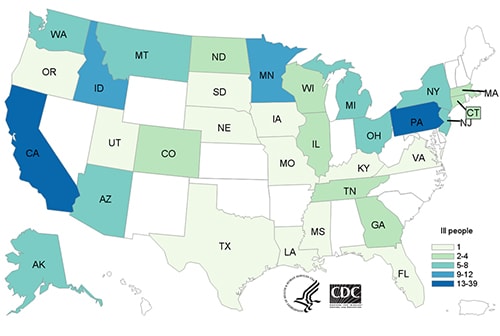
As of April 25, 2018, 84 people infected with the outbreak strain of E. coli O157:H7 have been reported from 19 states. A list of the states and the number of cases in each can be found on the Case Count Map page. Illnesses started on dates ranging from March 13, 2018 to April 12, 2018. Ill people range in age from 1 to 88 years, with a median age of 31. Sixty-five percent of ill people are female. Forty-two ill people have been hospitalized, including nine people who developed hemolytic uremic syndrome, a type of kidney failure. No deaths have been reported.
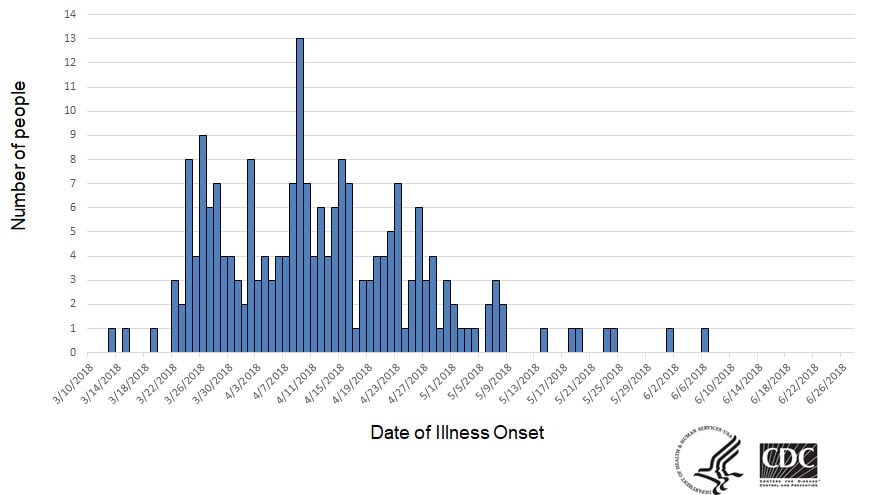
Illnesses that occurred after April 5, 2018, might not yet be reported due to the time it takes between when a person becomes ill with E. coli and when the illness is reported. This takes an average of two to three weeks.
[h=4]Investigation Update[/h] State and local health officials continue to interview ill people to ask about the foods they ate and other exposures before they became ill. Sixty-four (96%) of 67 people interviewed reported eating romaine lettuce in the week before their illness started. This percentage is significantly higher than results from a survey[787 KB] of healthy people in which 46% reported eating romaine lettuce in the week before they were interviewed.
Information collected to date indicates that romaine lettuce from the Yuma, Arizona growing region could be contaminated with E. coli O157:H7 and could make people sick. Read CDC?s advice to consumers, restaurants, and retailers.
This investigation is ongoing, and CDC will provide more information as it becomes available.
...

https://www.cdc.gov/ecoli/2018/o157h7-04-18/index.html


[h=1]Multistate Outbreak of E. coli O157:H7 Infections Linked to Romaine Lettuce[/h]


Posted April 27, 2018 1:00 PM EST


[h=3]What's New?[/h]
  • Fourteen more ill people from eight states were added to this investigation since the last update on April 25, 2018.
  • Three more states have reported ill people: Mississippi, Tennessee, and Wisconsin.
  • The most recent illness started on April 20, 2018. Illnesses that occurred in the last two to three weeks might not yet be reported because of the time between when a person becomes ill with E. coli and when the illness is reported to CDC.
  • For the latest information about the traceback investigation, visit the U.S. Food and Drug Administration website.

[h=3]Highlights[/h]
  • Information collected to date indicates that romaine lettuce from the Yuma, Arizona growing region could be contaminated with E. coli O157:H7 and could make people sick.
  • Advice to Consumers:
    • Do not eat or buy romaine lettuce unless you can confirm it is not from the Yuma, Arizona, growing region.
    • Product labels often do not identify growing regions; so, do not eat or buy romaine lettuce if you do not know where it was grown.
    • This advice includes whole heads and hearts of romaine, chopped romaine, baby romaine, organic romaine, and salads and salad mixes containing romaine lettuce. If you do not know if the lettuce in a salad mix is romaine, do not eat it.
  • Advice to Restaurants and Retailers:
    • Do not serve or sell any romaine lettuce from the Yuma, Arizona growing region. This includes whole heads and hearts of romaine, chopped romaine, baby romaine, organic romaine, and salads and salad mixes containing romaine lettuce.
    • Restaurants and retailers should ask their suppliers about the source of their romaine lettuce.
  • CDC, public health and regulatory officials in several states, and the FDA are investigating a multistate outbreak of Shiga toxin-producing Escherichia coli O157:H7 (E. coli O157:H7) infections.
  • Ninety-eight people infected with the outbreak strain of E. coli O157:H7 have been reported from 22 states.
    • Forty-six people have been hospitalized, including 10 people who have developed a type of kidney failure called hemolytic uremic syndrome.
    • No deaths have been reported.
  • This investigation is ongoing, and CDC will provide updates when more information is available.


[h=3]April 27, 2018[/h] [h=4]Case Count Update[/h] Since the last update on April 25, 2018, 14 more ill people were added to this outbreak.
As of April 26, 2018, 98 people infected with the outbreak strain of E. coli O157:H7 have been reported from 22 states. A list of the states and the number of cases in each can be found on the Case Count Map page. Illnesses started on dates ranging from March 13, 2018 to April 20, 2018. Ill people range in age from 1 to 88 years, with a median age of 31. Sixty-five percent of ill people are female. Of 87 people with information available, 46 (53%) have been hospitalized, including 10 people who developed hemolytic uremic syndrome, a type of kidney failure. No deaths have been reported.
Illnesses that occurred after April 7, 2018, might not yet be reported due to the time it takes between when a person becomes ill with E. coli and when the illness is reported. This takes an average of two to three weeks.

...
https://www.cdc.gov/ecoli/2018/o157h7-04-18/index.html


[h=1]Multistate Outbreak of E. coli O157:H7 Infections Linked to Romaine Lettuce[/h]


[h=3]At A Glance[/h]
  • Case Count: 121
  • States: 25
  • Deaths: 1
  • Hospitalizations: 52
  • Recall: No


Posted May 2, 2018 2:30 PM EST


[h=3]What's New?[/h]
  • Twenty-three more ill people from 10 states were added to this investigation since the last update on April 27, 2018. One death was reported from California.
  • Three more states have reported ill people: Kentucky, Massachusetts, and Utah.
  • The most recent illness started on April 21, 2018. Illnesses that occurred in the last two to three weeks might not yet be reported because of the time between when a person becomes ill with E. coli and when the illness is reported to CDC.

[h=3]Highlights[/h]
  • Information collected to date indicates that romaine lettuce from the Yuma, Arizona growing region could be contaminated with E. coli O157:H7 and could make people sick.
  • Advice to Consumers:
    • Do not eat or buy romaine lettuce unless you can confirm it is not from the Yuma, Arizona growing region.
    • Product labels often do not identify growing regions; so, do not eat or buy romaine lettuce if you do not know where it was grown.
    • This advice includes whole heads and hearts of romaine, chopped romaine, baby romaine, organic romaine, and salads and salad mixes containing romaine lettuce. If you do not know if the lettuce in a salad mix is romaine, do not eat it.
  • Advice to Restaurants and Retailers:
    • Do not serve or sell any romaine lettuce from the Yuma, Arizona growing region. This includes whole heads and hearts of romaine, chopped romaine, baby romaine, organic romaine, and salads and salad mixes containing romaine lettuce.
    • Restaurants and retailers should ask their suppliers about the source of their romaine lettuce.
  • CDC, public health and regulatory officials in several states, and the FDA are investigating a multistate outbreak of Shiga toxin-producing Escherichia coli O157:H7 (E. coli O157:H7) infections.
  • 121 people infected with the outbreak strain of E. coli O157:H7 have been reported from 25 states.
    • 52 people have been hospitalized, including 14 people who have developed a type of kidney failure called hemolytic uremic syndrome.
    • One death was reported from California.
  • This investigation is ongoing, and CDC will provide updates when more information is available.


[h=3]May 2, 2018[/h] [h=4]Case Count Update[/h] Since the last update on April 27, 2018, 23 more ill people were added to this outbreak.
As of May 1, 2018, 121 people infected with the outbreak strain of E. coli O157:H7 have been reported from 25 states. A list of the states and the number of cases in each can be found on the Case Count Map page. Illnesses started on dates ranging from March 13, 2018 to April 21, 2018. Ill people range in age from 1 to 88 years, with a median age of 29. Sixty-three percent of ill people are female. Of 102 people with information available, 52 (51%) have been hospitalized, including 14 people who developed hemolytic uremic syndrome, a type of kidney failure. One death was reported from California.
Illnesses that occurred after April 11, 2018, might not yet be reported due to the time it takes between when a person becomes ill with E. coli and when the illness is reported. This takes an average of two to three weeks.

...
https://www.cdc.gov/ecoli/2018/o157h7-04-18/index.html


For Immediate Release: For More Information, Contact:
May 4, 2018 Laura Cronquist
Division of Disease Control
North Dakota Department of Health
Phone: 701.328.2378
E-mail: lcronquist@nd.gov

North Dakota Department of Health Reports Case of E. coli Linked to Romaine Lettuce

BISMARCK, N.D. ? The North Dakota Department of Health (NDDoH) reports North Dakota?s
first case of E. coli infection associated with romaine lettuce originating from the Yuma, Arizona
growing region. The NDDoH has been working with the Centers for Disease Control and
Prevention (CDC), the U.S. Food and Drug Administration (FDA), and other state and local
health officials in this national investigation. A second case in ND possibly associated with the
outbreak is still under investigation.

?The FDA has stated they cannot be certain that romaine lettuce from the Yuma region is no
longer in the supply chain due to the 21-day shelf life,? said Laura Cronquist, epidemiologist
with the NDDoH. ?Food service establishments and retailers should not sell or serve any
romaine lettuce, including chopped, whole heads or hearts, that originate from Yuma, Arizona.
Consumers should not eat or buy romaine lettuce unless they can confirm it is not from the
Yuma growing region.?
...
https://health.nd.gov/media/2042/2018-5-4-nd-case-of-ecoli-linked-to-romaine-lettuce.pdf
 
[FONT=&quot]News Release
May 8, 2018
[/FONT]

[FONT=&quot]Contact information[/FONT]

Ten Minnesota illnesses linked to national E. coli outbreak associated with romaine lettuce

Health officials say do not eat romaine unless certain it is not from Yuma region

[FONT=&quot]The Minnesota Department of Health (MDH) is working with the Minnesota Department of Agriculture (MDA), the Centers for Diseases Control and Prevention (CDC), the U.S. Food and Drug Administration (FDA), and public health agencies in other states to investigate an outbreak of E. coli O157 infections associated with eating romaine lettuce.[/FONT]

[FONT=&quot]Information on the national outbreak can be found on CDC?s and FDA?s websites: CDC: E. coli and FDA Investigating Multistate Outbreak of E. coli O157:H7 Infections Likely Linked to Romaine Lettuce from Yuma Growing Region.[/FONT]

[FONT=&quot]Ten cases of E. coli O157 infection in Minnesota residents have recently been identified and linked to the multi-state outbreak. Illness onset dates range from April 20 through May 2. The cases are from both metro and greater Minnesota counties; 90 percent are female. Three cases were hospitalized, and two developed hemolytic uremic syndrome (HUS), a potentially fatal complication that can include kidney failure and other severe problems.[/FONT]

[FONT=&quot]All of the Minnesota cases interviewed by public health investigators reported exposure to romaine lettuce. Reported exposure locations include restaurants, grocery stores, and residential facilities. MDH is working with MDA to further investigate these exposures.[/FONT]

[FONT=&quot]?Do not eat, buy, or sell romaine lettuce unless you can confirm it is not from the Yuma growing region,? said Kirk Smith, manager of the Foodborne, Waterborne, Vectorborne, and Zoonotic Diseases section. ?The Yuma growing region includes part of western Arizona and extends into the Imperial Valley of southeastern California, but does notinclude Salinas Valley or other growing regions in California.? Product from the Yuma growing region should no longer be on sale; however, individuals should check their refrigerators for romaine lettuce that may have been grown in the Yuma region.[/FONT]

[FONT=&quot]Symptoms of illness caused by E. coli O157 typically include stomach cramps and diarrhea, often with bloody stools, but only a low-grade or no fever. People typically become ill two to five days after exposure, but this period can range from one to eight days. Most people recover in five to 10 days. However, E. coliO157 infections sometimes lead to HUS. Those most at risk of developing complications from E. coli O157 include children younger than 10, the elderly, and those with weakened immune systems.[/FONT]

[FONT=&quot]Diarrhea associated with E. coli O157 infections should not be treated with antibiotics, as this practice might promote the development of HUS. Anyone who believes they may have developed an E. coli O157 infection should contact their health care provider.[/FONT]

[FONT=&quot]Approximately 135 cases of E. coli O157 are reported each year in Minnesota. More information on E. coli O157 and how to prevent it can be found on the MDH E. coli website.[/FONT]

[FONT=&quot]-MDH-

http://www.health.state.mn.us/news/p...oli050818.html
[/FONT]
 
[h=1]Multistate Outbreak of E. coli O157:H7 Infections Linked to Romaine Lettuce[/h]


Posted May 16, 2018 4:00 PM EST


[h=3]What's New?[/h]
  • Twenty-three more ill people from 13 states were added to this investigation since the last update on May 9, 2018.
  • Three more states have reported ill people: Iowa, Nebraska, and Oregon.
  • CDC is updating its advice to consumers. According to the U.S. Food and Drug Administration, the last shipments of romaine lettuce from the Yuma growing region were harvested on April 16, 2018 and the harvest season is over. It is unlikely that any romaine lettuce from the Yuma growing region is still available in stores or restaurants due to its 21-day shelf life.
  • It takes two to three weeks between when a person becomes ill with E. coli and when the illness is reported to CDC. The most recent illnesses reported to CDC started when romaine lettuce from the Yuma growing region was likely still available in stores, restaurants, and in peoples? homes.

[h=3]Highlights[/h]
  • Information collected to date indicates that romaine lettuce from the Yuma growing region could have been contaminated with Shiga toxin-producing E. coli O157:H7 and made people sick.
  • According to the U.S. Food and Drug Administration, the last shipments of romaine lettuce from the Yuma growing region were harvested on April 16, 2018, and the harvest season is over. It is unlikely that any romaine lettuce from the Yuma growing region is still available in people?s homes, stores, or restaurants due to its 21-day shelf life.
  • Advice to Consumers:
    • If you have symptoms of an E. coli infection, take action and talk to your healthcare provider.
    • Follow these steps to help keep you healthy and your fruits and vegetables safer to eat.
    • Read more on general ways to prevent E. coli infection. An important step is to wash hands after using the restroom or changing diapers, before and after preparing or eating food, and after contact with animals.
  • Advice to Clinicians:
    • Antibiotics are not recommended for patients with suspected E. coli O157 infections until diagnostic testing can be performed and E. coli O157 infection is ruled out.
  • CDC, public health and regulatory officials in several states, and the FDA are investigating a multistate outbreak of E. coli O157:H7 infections.
  • 172 people infected with the outbreak strain of E. coli O157:H7 have been reported from 32 states.
    • 75 people have been hospitalized, including 20 people who have developed a type of kidney failure called hemolytic uremic syndrome.
    • One death was reported from California.
  • The Public Health Agency of Canada has identified people in several Canadian provinces infected with the same DNA fingerprint of E. coli O157:H7.
  • This investigation is ongoing, and CDC will provide updates when more information is available.


[h=3]May 16, 2018[/h] [h=4]Case Count Update[/h] Since the last update on May 9, 2018, 23 more ill people were added to this outbreak.
As of May 15, 2018, 172 people infected with the outbreak strain of E. coli O157:H7 have been reported from 32 states. A list of the states and the number of cases in each can be found on the Case Count Map page. Illnesses started on dates ranging from March 13, 2018 to May 2, 2018. Ill people range in age from 1 to 88 years, with a median age of 29. Sixty-five percent of ill people are female. Of 157 people with information available, 75 (48%) have been hospitalized, including 20 people who developed hemolytic uremic syndrome, a type of kidney failure. One death was reported from California.
Illnesses that occurred after April 21, 2018, might not yet be reported due to the time it takes between when a person becomes ill with E. coli and when the illness is reported. This takes an average of two to three weeks.
[h=4]Investigation Update[/h] According to the FDA, the last shipments of romaine lettuce from the Yuma growing region were harvested on April 16, 2018, and the harvest season is over. It is unlikely that any romaine lettuce from the Yuma growing region is still available in people?s homes, stores, or restaurants due to its 21-day shelf life. The most recent illnesses reported to CDC started when romaine lettuce from the Yuma growing region was likely still available in stores, restaurants, and in peoples? homes.
This investigation is ongoing, and CDC will provide more information as it becomes available.

...
https://www.cdc.gov/ecoli/2018/o157h7-04-18/index.html


Back
Top Bottom