• FluTrackers.com Inc. does not provide medical advice. Information on this web site is collected from various internet resources, and the FluTrackers board of directors makes no warranty to the safety, efficacy, correctness or completeness of the information posted on this site by any author or poster. The information collated here is for instructional and/or discussion purposes only and is NOT intended to diagnose or treat any disease, illness, or other medical condition. Every individual reader or poster should seek advice from their personal physician/healthcare practitioner before considering or using any interventions that are discussed on this website. By continuing to access this website you agree to consult your personal physican before using any interventions posted on this website, and you agree to hold harmless FluTrackers.com Inc., the board of directors, the members, and all authors and posters for any effects from use of any medication, supplement, vitamin or other substance, device, intervention, etc. mentioned in posts on this website, or other internet venues referenced in posts on this website.
  • We are not asking for any donations. Do not donate to any entity who says they are raising funds for us.

US - Illinois: Dog flu cases on the rise in Chicago area- its H3N2 not H3N8

Shiloh

Editor, Senior Moderator
Source: http://abc7chicago.com/pets/dog-flu-cases-on-the-rise-in-chicago-area/573127/

Dog flu cases on the rise in Chicago area
WLS
By Sarah Schulte
Updated 16 mins ago
CHICAGO (WLS) --

One local veterinarian says there's been an increase in suspected cases of canine influenza, although there is a vaccine you can get for your pet.

Buster, a 9-year-old boxer mix, is in isolation at a Lakeview animal hospital. Ollie, a Chihuahua/Jack Russell mix, is headed in the same direction.

Both dogs have been diagnosed with pneumonia, a symptom of canine influenza.

"There has been a massive outbreak of infectious respiratory disease in the city of Chicago and suburbs," said Dr. Natalie Marks, Blum Animal Hospital.

Dr. Marks says Blum Animal Hospital has seen between five and 15 cases a day.

Waiting for test results to confirm the diagnosis, Dr. Marks and other area vets suspect the dogs have the flu. The Chicago area hasn't seen such an outbreak since 2008.
Dr. Marks says canine influenza symptoms are more severe and dangerous than kennel cough..
 
Outbreak of Canine Influenza Hits Chicago Area

Cases of the illness have increased within the past two weeks

By Summer Concepcion
(Published Tuesday, Mar 31, 2015)

...
A sudden outbreak of the Canine Influenza Virus has reportedly been spreading throughout the Chicago area over in recent weeks.

According to Kimberly Cerny, the practice manager at Blum Animal Hospital in Chicago's Lakeview neighborhood, veterinarians in the area have seen a ?drastic increase in the number of severe upper respiratory cases coming into their practices and at Blum? within the past two weeks.

Cerny says there have already been numerous confirmed cases of Canine Influenza, including two that were fatal.
...

http://www.nbcchicago.com/news/local/Outbreak-of-Canine-Influenza-Hits-Chicago-Area-
 
Surge in Canine Flu Cases Demands Extra Precautions by Pet Owners

Cook County Department of Animal and Rabies Control (CCDARC) is cautioning dog owners that a recent increase in reported cases of canine infectious respiratory disease (CIRD) could last for several weeks before it subsides.

Dr. Donna Alexander, CCDARC administrator, said voluntary reporting to the Department of disease surveillance conducted by veterinarians has identified more than 1,000 cases of CIRD, or canine flu, unrelated to ?kennel cough?, as well as five fatalities. CIRD is distinguished from kennel cough by its severity, possible consequences and diagnostic confirmation.

The age of the animals presenting with CIRD symptoms vary, but more severe forms are being seen in dogs under 1 year of age and greater than 7, she said.

Symptoms include persistent and lingering cough, lethargic behavior, a poor appetite and a fever. If you observe or suspect your dog may be suffering from any or all of these symptoms, the animal should be seen by a veterinarian, Dr. Alexander said.

Additionally, she recommended that until incidents of the disease diminish, dog owners should avoid pet friendly areas such as dog parks, not allow their dogs to play with other dogs, avoid group dog training activities, and, if possible, not board their pets. Dogs can be contagious even if they are not showing any of the CIRD symptoms, Dr. Alexander said.

While CIRD is highly contagious for dogs, it is not contagious for humans or other household pets such as cats. However, the virus that causes CIRD can live on fabrics and hard surfaces and can be transmitted from person to dog if the person has come into contact with a dog carrying the virus. To avoid such transmission, Dr. Alexander recommends thorough hand-washing after touching or petting a dog.

A vaccine that counters CIRD is available and can be administered by a veterinarian. This vaccine is separate from the kennel cough vaccine.


http://www.cookcountyil.gov/animal-rabies-control-home/
 
Source: http://www.chicagotribune.com/suburb...403-story.html

Animal hospital on canine flu: 'Never seen this kind of outbreak'
By Linda Girardi Aurora Beacon-News
Dog flu hitting Fox Valley with full force

VCA Aurora Animal Hospital has a sign at its main entrance alerting dog owners of a canine influenza outbreak that has veterinarians taking precautions to prevent the spread of the highly contagious disease.
"We have a Step-Down Ward to keep dogs suspected of having the canine flu. If full-blown symptoms of presumed canine influenza show up, we place the dog in our Isolation Ward," said Veterinarian Terry Medinger, medical director of the VCA Aurora Animal Hospital...
 
Source: http://mediarelations.cornell.edu/2...uenza-outbreak-caused-by-new-strain-of-virus/
[h=1]Midwest Canine Influenza outbreak caused by new strain of virus[/h] April 12, 2015 By Joe Schwartz
ITHACA, N.Y. ? The canine influenza outbreak afflicting more than 1,000 dogs in Chicago and other parts of the Midwest is caused by a different strain of the virus than was earlier assumed, according to laboratory scientists at Cornell University and the University of Wisconsin. Researchers at Cornell say results from additional testing indicate that the outbreak is being caused by a virus closely related to Asian strains of influenza A H3N2 viruses, currently in wide circulation in southern Chinese and South Korean dog populations since being identified in 2006. There is no evidence that it can be transmitted to humans.
The outbreak in the Midwest had been attributed to the H3N8 strain of virus, which was identified in the U.S. dog population in 2004 and has been circulating since. The H3N2 virus had not been previously detected in North America. The outbreak in Chicago suggests a recent introduction of the H3N2 virus from Asia...

...It is not known if the current vaccine will provide any protection from this new virus. It does protect against H3N8, which is in circulation in some areas. Other preventive advice remains the same: In areas where the viruses are active, avoid places where dogs congregate, such as dog parks and grooming salons...
 
Over the past few months, numerous dogs have been rescued from dog meat farms in South Korea and brought to the U.S.
 
[h=2]Monday, April 13, 2015[/h] [h=3]Midwest Canine Influenza Outbreak Due To `New? Korean H3N2 Virus[/h]

image%25255B3%25255D.png


# 9931

In an unexpected turn of events, yesterday Cornell University and the University of Wisconsin announced that the canine influenza outbreak which we looked at last week (see CDC Statement On Canine Influenza In Chicago) ? which was presumed to be due to the canine H3N8 virus ? was in fact sparked by the first appearance of the Korean H3N2 virus in North America.

First the statement from Cornell University, then I?ll be back with more.

Midwest Canine Influenza outbreak caused by new strain of virus
April 12, 2015 By Joe Schwartz
ITHACA, N.Y. ? The canine influenza outbreak afflicting more than 1,000 dogs in Chicago and other parts of the Midwest is caused by a different strain of the virus than was earlier assumed, according to laboratory scientists at Cornell University and the University of Wisconsin. Researchers at Cornell say results from additional testing indicate that the outbreak is being caused by a virus closely related to Asian strains of influenza A H3N2 viruses, currently in wide circulation in southern Chinese and South Korean dog populations since being identified in 2006. There is no evidence that it can be transmitted to humans.
The outbreak in the Midwest had been attributed to the H3N8 strain of virus, which was identified in the U.S. dog population in 2004 and has been circulating since. The H3N2 virus had not been previously detected in North America. The outbreak in Chicago suggests a recent introduction of the H3N2 virus from Asia.
Testing of clinical samples from the outbreak conducted at The New York State Animal Diagnostic Laboratory at Cornell indicated that the virus was Influenza A. Further testing led researchers to believe a new strain was at fault. Subsequent testing, carried out with the assistance of the Wisconsin Veterinary Diagnostic Laboratory, identified the new subtype as H3N2. The National Veterinary Services Laboratories in Ames, IA is sequencing two isolates from this outbreak, which were isolated at Cornell, to facilitate rapid complete characterization of the viruses.
Both Influenza strains can cause high fever, loss of appetite, coughing, nasal discharge, and lethargy. Symptoms may be more severe in cases caused by the H3N2 virus. Some infected dogs may not show symptoms at all.
H3N2 has caused infection and respiratory illness in cats.
(Continue . . .)

Up until a little over a decade ago, dogs were considered largely immune to influenza infection. In 2004, however, the equine H3N8 virus mutated enough to adapt to a canine host, and began to spread among greyhounds in Florida (see EID Journal article Influenza A Virus (H3N8) in Dogs with Respiratory Disease, Florida).

Since then canine H3N8 has been sporadically reported across much of the United States. It is considered a `canine specific? virus, and there have been no reports of human infection.
The canine influenza story suddenly became more complex in 2008, when the EID Journal reported on the 2007 Transmission of Avian Influenza Virus (H3N2) to Dogs in Korea. Analyses showed that the HA and NA genes of the A/canine/Korea/01/2007 (H3N2) isolate were closely related to those identified in 2003 from chickens and doves in South Korea.

The authors wrote:

Because all genes of the canine isolates were of avian influenza virus origin, we concluded that the entire genome of the avian influenza virus had been transmitted to the dogs. Transmission of avian influenza A virus to a new mammalian species is of great concern, because it potentially allows the virus to adapt to a new mammalian host, cross new species barriers, and acquire pandemic potential.
Over the next few years this Korean H3N2 virus spread into China, and in 2011 we learned from a study that appeared in the Journal of General Virology, that in 2010 it had begun to infect cats as well (see Korea: Interspecies Transmission of Canine H3N2).

[h=5]Interspecies transmission of the canine influenza H3N2 virus to domestic cats in South Korea, 2010[/h] D.S. Song, D.J. An, H.J. Moon, M.J. Yeom, H.Y. Jung, W.S. Jung, S.J. Park, H.K. Kim, S.Y. Han, J.S. Oh, B.K. Park, J.K. Kim, H. Poo, R.G. Webster, K. Jung and B.K. Kang
[h=6]Abstract[/h] In the last 4 years, incidences of endemic or epidemic respiratory diseases associated with canine influenza H3N2 virus in Asian dogs have been reported in countries such as South Korea and China. Canine species were considered to be the new natural hosts for this virus.
However, at the beginning of 2010, influenza-like respiratory signs, such as dyspnea, were also observed among cats as well as in dogs in an animal shelter located at Seoul, South Korea. The affected cats showed 100% morbidity and 40% mortality.
We were able to isolate a virus from the lung specimen of a dead cat that had suffered from the respiratory disease, in embryonated chicken eggs. The 8 viral genes isolated were almost identical to those of the canine influenza H3N2 virus suggesting interspecies transmission of canine influenza H3N2 virus to the cat.
(Continue . . . )

As with the equine and canine strains of H3N8, we?ve not seen any evidence of human infection with this canine H3N2 virus.

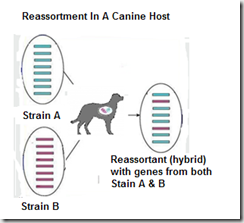
But like all influenza viruses, canine H3N2 is a continually moving target. It can not only evolve via antigenic drift, it can also pick up entire gene segments from other flu viruses via antigenic shift (aka reassortment).
image%25255B7%25255D.png


And last summer we saw evidence of just such an event, in a report appearing in the journal Epidemiology & Infection, that found a new reassortment of the canine H3N2 virus ? one that had picked up the M (matrix) gene from the 2009 H1N1 pandemic virus (see Canine H3N2 Reassortant With pH1N1 Matrix Gene).

If that sounds vaguely familiar, in 2011 (see MMWR: Swine-Origin Influenza A (H3N2) Virus Infection in Two Children) we saw a similar reassortment of swine-origin influenza A (H3N2) virus and the 2009 influenza A (H1N1) virus, producing a swine variant H3N2v with the M gene from pH1N1.

The CDC has speculated that `This M gene may confer increased transmissibility to and among humans, compared to other variant influenza viruses.? ?CDC HAN 2012 ? but once again, we?ve seen no evidence to date that canine H3N2 has transmitted to humans.
So where does this leave us?

While one cannot predict these things, the introduction of an avian-origin mammalian-adapted influenza A virus into North America certainly requires watching. This imported virus now has the ability to encounter ? and possibly reassort with ? a fresh supply of influenza viruses, including canine H3N8.

The National Veterinary Services Laboratories, in Ames, Iowa is sequencing two isolates from this outbreak to further characterize the virus. Once completed, that should tell us a lot more about the origin, and evolutionary path of this virus (including the source of its M gene).

Until then, the press release from Cornell University closes with the following advice:

Veterinary professionals are advised that diagnostic testing of samples from sick pets can be done using a broadly targeted Influenza A matrix reverse transciptase-polymerase chain reaction assay (Rt-PCR). The canine-specific Influenza A H3N8 Rt-PCR in use in several laboratories will not detect this virus. Serology is also currently not available as the H3N2 virus is different enough from H3N8 that antibodies may not cross react. However, an H3N2-specific serologic assay is under development and will be available soon.
It is not known if the current vaccine will provide any protection from this new virus. It does protect against H3N8, which is in circulation in some areas. Other preventive advice remains the same: In areas where the viruses are active, avoid places where dogs congregate, such as dog parks and grooming salons.
Owners of symptomatic dogs and cats should consult their veterinarians about testing and treatment.

Posted by Michael Coston at 7:55 AM No comments: Links to this post
Labels: Canine H3N2 H3N8

 
Source: http://www.koreaobserver.com/korean-dog-virus-infects-over-1000-dogs-in-chicago-27981/

Dog flu epidemic linked to South Korea and China
April 13, 2015
by James Hyams

...A vet who works with Busan Abandoned Pet Sanctuary (BAPS) confirmed the H3N2 strand is active in South Korea.

Leo Mendoza, manager at BAPS, said that Korea does not have a nationally organized system for reporting pet viral outbreaks and it would not be possible to precisely identify where the strand originated...

...AJ Garcia, director of Coexistence of Animal Rights on Earth (CARE), said that there is a very small chance if any, that this influenza arrived in the states with the two recent rescues by HSI, HSUS and CFAF...

...There is a cani-flu vaccination for the H3N2 virus that vets in South Korea can administer to infected dogs.
 
Update on Canine Influenza (Dog Flu) Outbreak Reported in Chicago Area


April 13, 2015 – A canine influenza A H3N2 virus is responsible for an outbreak of dog flu reported in the Chicago area according to a press release issued by Cornell University, home to the New York State Animal Diagnostic Laboratory. Dog flu is a contagious respiratory disease in dogs. Two canine influenza viruses have been identified worldwide: an influenza A H3N8 virus and an influenza A H3N2 virus. No human infections with either of these canine influenza viruses have ever been reported.

Previously, canine influenza A H3N8 viruses have been identified in U.S. dog populations. However, testing at the New York State Animal Diagnostic Laboratory and the Wisconsin Veterinary Diagnostic Laboratory suggests the dog flu virus responsible for the current outbreak in dogs is an H3N2 virus similar to Asian H3N2 dog flu viruses that have been detected in dogs in parts of Asia since 2007.

The National Veterinary Services Laboratories in Ames, IA is sequencing two isolates from this outbreak to facilitate rapid complete characterization of the viruses. A virus isolate also is being sent to the Centers for Disease Control and Prevention for additional analysis.

Signs of dog flu infection in dogs include cough, runny nose and fever, but not all dogs will show signs of illness. The severity of illness associated with dog flu in dogs can range from no signs to severe illness resulting in pneumonia and sometimes death in dogs. Tests are available to determine if a dog has been infected. CDC recommends that people concerned about dog flu in their pets speak to their veterinarian.

Almost all dogs can be susceptible to infection with canine influenza viruses, and illness tends to spread among dogs housed in kennels and shelters. A vaccine to protect dogs against canine influenza A H3N8 has been available in the United States since 2009. It is not known yet whether the H3N8 dog flu vaccine will offer protection against the H3N2 dog flu virus.

To date, there is no evidence of transmission of dog flu viruses from dogs to people and there have been no reported human infections with the canine influenza viruses. Animal studies suggest that neither virus transmits well to other companion animal species[308 KB, 10 pages] with the exception of H3N2 dog flu, which has been known to infect cats. CDC considers the human health risk posed by this dog flu outbreak to be low at this time. Once available, full genetic sequencing information on this virus will further inform the human health risk assessment. CDC will continue to watch this situation closely and provide updated information as it becomes available.

Two Dog Flu Viruses

Canine influenza A (H3N8) virus is closely related to an influenza virus found in horses for more than 40 years. Experts believe this horse influenza virus changed in a way that allowed it to infect dogs, and the first dog flu infections caused by these viruses were reported in 2004, initially in greyhounds. This virus is now considered a dog-specific lineage of influenza A (H3N8) virus.

In 2007, a canine influenza A H3N2 virus was detected in dogs in South Korea. This virus seems to have been an avian influenza virus that adapted to infect dogs. This canine H3N2 virus has since been reported in China and Thailand, and reportedly can affect cats as well as dogs. It is different from human seasonal H3N2 viruses.

For more information on dog flu, please visit:

http://www.cdc.gov/flu/news/canine-influenza-update.htm
 
Source: http://kfgo.com/news/articles/2015/...ases-climb-to-over-1100-including-six-deaths/

Chicago-area dog flu cases climb to over 1,100, including six deaths
Tuesday, April 14, 2015 4:20 p.m. CDT
By Mary Wisniewski

CHICAGO (Reuters) - At least 1,137 Chicago-area dogs have come down with a highly contagious strain of canine flu, and six have died, in the largest and longest-lasting dog flu outbreak ever seen in the region, county officials said on Tuesday.

Veterinarians began reporting cases of Canine Infectious Respiratory Disease, or CIRD, in January, said Cook County spokesman Frank Shuftan. There may be more cases than have been reported, Shuftan said.

"A lot of vets are so busy now they're having a difficult time even calling our office," Shuftan said...
 
US | Thu Apr 16, 2015 3:08pm EDT Related: U.S., Health (Reuters)
Thousands of U.S. Midwest dogs infected with Asian flu variety

CHICAGO | By Mary Wisniewski
...

It is not known how the H3N2 strain was introduced into Chicago but it could have been a dog from Asia who was a carrier and did not have active symptoms, said Keith Poulsen, diagnostic and case outreach coordinator with the Wisconsin Veterinary Diagnostic Laboratory.
Cook County officials have reported 1,137 cases in the Chicago area, with six deaths. While an exact figure for the Midwest is not available, Poulsen believes it is less than 5,000 cases.
Poulsen cautioned vet owners not to panic because the new strain is not more dangerous than the previously known H3N8 strain. Since H3N2 is new, dogs have not developed an immunity to it, he said. It also can affect cats, but not humans....
...
"Contact your veterinarian with questions," he said....

Chicago-Area Dog Flu Outbreak Rises To Over 1,000 Cases
April 15, 2015 4:19 PM ET
AUDIE CORNISH, HOST: (NPR All Things Considered)
...


EDWARD DUBOVI: The outbreak really went into full force around the Easter holiday when a number of people probably put their dogs into kennels, and so you had maybe a higher collection of dogs in smaller environments. And so this thing had an opportunity to expand very rapidly when - under those situations. But the extent of the outbreak so far is a bit surprising.
...
CORNISH: Help us understand the origins of this virus.
DUBOVI: Well, this is a little difficult to actually pin down. We've had a virus in the dog population in the United States since 2004. However, as we did some subsequent testing and the outbreak got a bit bigger, it became evident that this was not the normal canine influenza virus that we have been seeing in the U.S. And the preliminary evidence so far is that this virus is probably one that came out of Asia.
And it - as it turns out, our requirements for movement of companion animals into the United States are fairly lax. And we certainly have situations now where animal rescue groups are rescuing dogs in China and Korea from their meat markets, and we know for a fact that, in fact, some of those dogs have found their way into the Chicago area...

Actually dog importation rules were recently ratcheted up in July 2014:

https://www.federalregister.gov/arti...n-of-live-dogs

The requirements mostly rely on vaccination requirements, some controversial. I don't see anything really helpful like quarantine requirements or testing for active disease, but I hesitate to urge even more federal regulations because they are driven by politics and lobbying and can easily do more harm to animal health than good.
I think large non-profits should consult with someone like Dubovi before they launch rescue operations. They can afford to do that and to do helpful screening with some real science backing it.
 
New developments in Midwestern canine influenza outbreak

April 17, 2015
by Nik Hawkins

New laboratory tests show that a strain of canine influenza virus (CIV) associated with more than 1,000 sick dogs throughout the Midwest, including one dog in Madison, is virtually identical to an Asian strain of the virus and is not a mutated form.

A week ago, initial tests at the Wisconsin Veterinary Diagnostic Laboratory (WVDL) and Cornell University identified the strain as H3N2, which has previously only been seen in Asia and is different than the H3N8 strain circulating in North America. Genetic sequencing conducted at the National Veterinary Service Laboratory in Ames, Iowa, now confirms that the H3N2 strain found in the Midwest is almost identical to its Asian counterpart and was likely brought to the United States by an infected animal.

"This means there is no evidence of genetic reassortment," says Kathy Toohey-Kurth, virology section head at WVDL. "This is good news because mutations are unpredictable, and we would not necessarily know what the safety implications are for humans or other animals."

There is no evidence at this time that the H3N2 CIV strain can infect humans; it is distinctly different from human seasonal influenza H3N2 strains. However, the Asian H3N2 CIV strain has been reported to infect domestic cats.

"No cats have reported positive in the United States at this time," says Keith Poulsen, WVDL diagnostic and case outreach coordinator and clinical assistant professor at the UW-Madison School of Veterinary Medicine (SVM). "Two cats and a dog, housemates of the infected dog in the Madison area, tested negative today despite showing clinical signs of the virus. It's possible the tests were done too late to catch the viral shedding phase. Either way, it's good news for those animals."

Both CIV strains can cause persistent cough, runny nose, and fever. A small percentage of dogs will develop more severe clinical signs, and some will not show any symptoms at all. The infection has been associated with some deaths.

Neither CIV strain is related to the highly pathogenic H5N2 avian flu, which has been reported in Wisconsin this week; they are completely different strains that affect separate species.

The commercially available vaccines for CIV are made to protect against the H3N8 strain, and their effectiveness against the H3N2 strain is unknown at this time, but it is likely to be less effective.

"We're still recommending that owners vaccinate their dogs because H3N8 is still around," says Sandi Sawchuk, primary care veterinarian at UW Veterinary Care (UWVC) and SVM clinical instructor.

UWVC veterinarians also recommend taking the following measures to minimize risk to pets:

  • Limit direct dog-to-dog contact. This is especially important with unknown dogs and any dogs displaying clinical signs, including cough, running nose, and fever. If your dog shows any of these signs, contact your veterinarian and do not take your dog to a boarding facility, dog daycare, dog park, or other public space.
  • The virus will live in the environment for 24 to 48 hours in the majority of cases, but washing with soap and water is very effective at inactivating influenza virus.
  • Wash your hands and change your clothes if you work with or are exposed to sick dogs before handling your own pets at home. This also applies to veterinarians in practice.
In addition to these recommendations, the WVDL has compiledinformation and sampling guidelines for veterinarians, and the SVM Shelter Medicine Program and Koret Shelter Medicine Program at the University of California, Davis, have compiled CIV resources for animal shelters.

http://www.news.wisc.edu/23684
 
Source: http://abc7chicago.com/pets/more-than-35-dogs-sick-with-flu-at-paws-tinley-park-shelter/687426/

More than 35 dogs sick with flu at PAWS Tinley Park shelter
WLS
By Ravi Baichwal
Updated 12 mins ago

TINLEY PARK, Ill. (WLS) --
The PAWS shelter in south suburban Tinley Park is closed after several dogs have contracted the flu, the shelter said.

Between 35-40 dogs are sick with the virus; although only 12 of the cases were confirmed, PAWS says the virus is so highly contagious that they have stopped testing.

"It's very bad, most of our dogs if not all of them have it - the few that we have that don't have it will have it because it's so highly contagious," said Candy Staros, a volunteer with PAWS. "If you've got one positive test, you're going to have everyone testing positive."...
 
Source: http://patch.com/illinois/tinleypark/dog-tinley-park-shelter-dies-canine-flu

Dog at Tinley Park Shelter Dies of Canine Flu
Staff cared for the 3-year-old chihuahua until his last moments as they continue to fight the flu among its animals.
By Lauren Traut (Patch Staff) May 11, 2015

The battle against a rampant canine flu continues at a shelter in Tinley Park, and staff now reports its first canine casualty. A 3-year-old chihuahua battling the flu for a week died over the weekend.

?We sadly lost a little soldier this weekend,? Tinley Park PAWS staff wrote on the shelter?s Facebook page. ?RIP Johnny Suede.

?He was well taken care of until the end.?

The organization has about 30 dogs in recovery, but many dogs are still sick. P.A.W.S. is giving the sick dogs oxygen and IV fluids, as well as hand-feeding them. Staff is seeking the public?s help with funding following the recent outbreak of canine flu...
 
Back
Top