• FluTrackers.com Inc. does not provide medical advice. Information on this web site is collected from various internet resources, and the FluTrackers board of directors makes no warranty to the safety, efficacy, correctness or completeness of the information posted on this site by any author or poster. The information collated here is for instructional and/or discussion purposes only and is NOT intended to diagnose or treat any disease, illness, or other medical condition. Every individual reader or poster should seek advice from their personal physician/healthcare practitioner before considering or using any interventions that are discussed on this website. By continuing to access this website you agree to consult your personal physican before using any interventions posted on this website, and you agree to hold harmless FluTrackers.com Inc., the board of directors, the members, and all authors and posters for any effects from use of any medication, supplement, vitamin or other substance, device, intervention, etc. mentioned in posts on this website, or other internet venues referenced in posts on this website.
  • We are not asking for any donations. Do not donate to any entity who says they are raising funds for us.

US drought: Rising Corn Prices and Your Grocery Bill worldwide

Shiloh

Editor, Senior Moderator
Source: http://blogs.smartmoney.com/advice/2012/07/18/rising-corn-prices-and-your-grocery-bill/

Jul 18, 2012, 10:00 AM
Rising Corn Prices and Your Grocery Bill
By Jack Hough

Corn prices are nearing the record highs of last summer as the U.S. Midwest suffers its worst drought since 1956. Shoppers should expect higher grocery bills, because corn is used in three-quarters of supermarket products.

But don?t panic. Overall cost hikes are likely to be modest...
 
Re: US: Rising Corn Prices and Your Grocery Bill

Re: US: Rising Corn Prices and Your Grocery Bill

More than half the U.S. is suffering from drought

Midwest corn belt hit by lack of rain and sky-high temps

July 22, 2012 12:04 am
By Tyrel Linkhorn / Block News Alliance

TOLEDO, Ohio -- Mark Drewes has never seen it drier in Henry County.
The 51-year-old farmer from Custar, Ohio, sows corn in Wood, Putnam, Henry and Hancock counties in northwest Ohio. Some of his fields are doing better than others, but it's all dry.

"[Conditions] are pretty tough," he said. "We've been below normal rainfall for seven months straight now, and it's reached the point of being almost beyond critical. The crop has irreversible damage."

Two months of hot, arid conditions have devastated fields across much of the United States, leaving many farmers watching both their fields and their profits dry up.

Climatologists say this summer's drought, now covering more than half the United States, is the most widespread since 1956.

And it's likely to get worse.


Read more: http://www.post-gazette.com/stories...-suffering-from-drought-645677/#ixzz21MiAT6pd
 
Re: US: Rising Corn Prices and Your Grocery Bill

Re: US: Rising Corn Prices and Your Grocery Bill

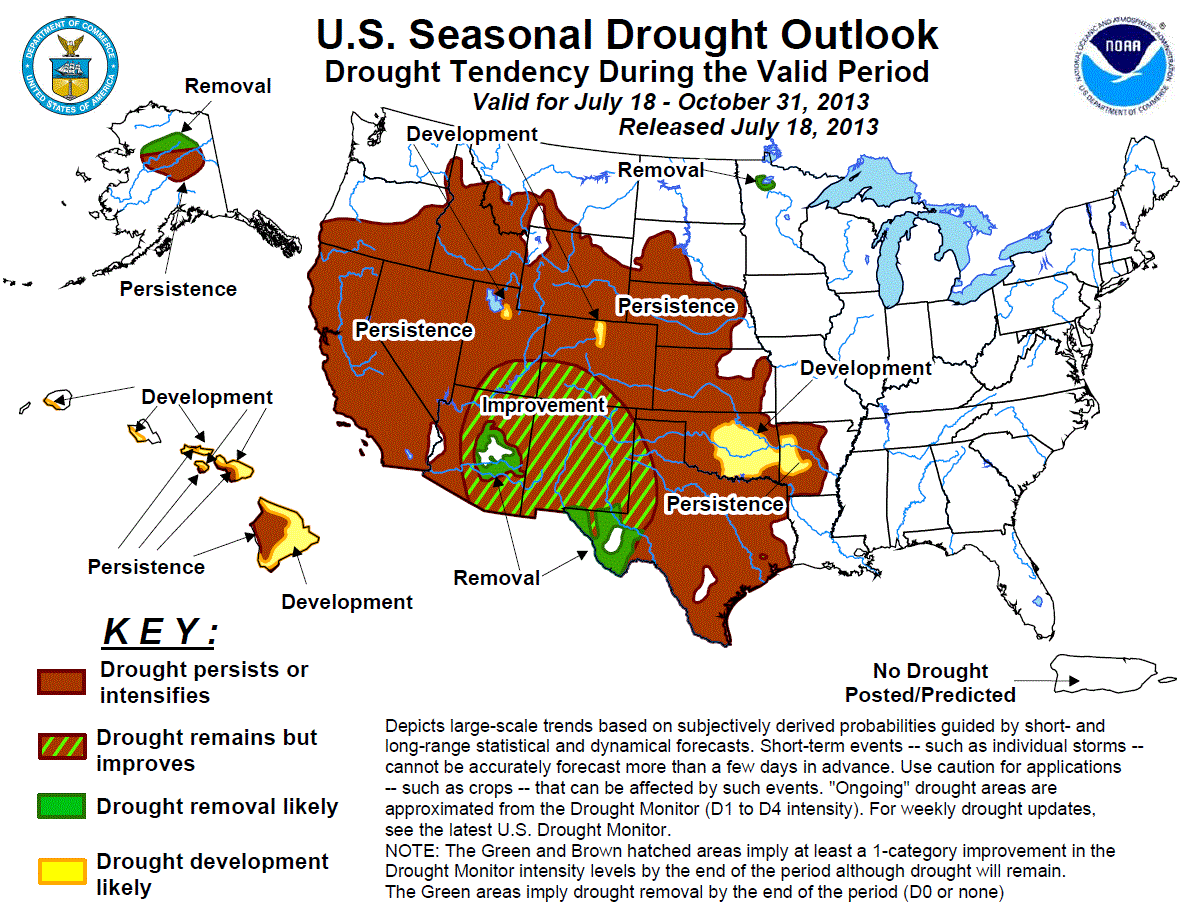
<TABLE border=0 cellSpacing=0 cellPadding=2 width=533 align=center><TBODY><TR><TD align=center> </TD></TR><TR><TD align=center>[FONT=Verdana,arial](Click on image to enlarge)[/FONT]</TD></TR><TR><TD></TD></TR><TR><TD align=center>[FONT=Verdana,arial]PDF Version of Seasonal Drought Outlook Graphic [/FONT]</TD></TR><TR><TD></TD></TR><TR><TD>[FONT=verdana,arial,serif]Latest Seasonal Assessment - Dryness and drought, exacerbated by above-normal temperatures, have been increasing both in extent and intensity across much of the central and northern U.S. Based upon the July 10 U.S. Drought Monitor, nearly 61 percent of the contiguous U.S. was in drought (D1-D4), the highest such value for the U.S. Drought Monitor since its inception in 2000. The drought and heat arrived at a critical time for Midwestern agriculture, especially corn. The combination of heat and dryness has severely reduced the quality and quantity of the corn and soybean crop, with 38 percent of the corn and 30 percent of the soybeans rated as poor or very poor as of July 15 by NASS/USDA. Some states, such as Kentucky, Missouri, and Indiana, had over 70 percent of their corn adversely rated. Unfortunately, drought is expected to develop, persist, or intensify across these areas, and temperatures are likely to average above normal. Some widely-scattered relief may come in the form of cold front passages or organized thunderstorm clusters (MCSs), but widespread relief for much of the area is not expected. In the Southeast, recent widespread thunderstorm activity has slightly eased drought there, and the 3-month outlook favors increased odds for above normal precipitation along the central Gulf. This is due to the greater likelihood of a tropical system affecting these areas and from sea-breeze triggered thunderstorms. Therefore, some improvement is expected across the Deep South, from coastal Texas eastward to South Carolina. Across the Southwest, the odds favor an active (wet) southwest monsoon in both the 1- and 3-month precipitation outlooks. As a result, improvement is anticipated across much of Arizona and western New Mexico as the summer monsoon continues, with some improvement in other parts of the region. Drought persistence is the best bet across the remaining portions of the Western U.S. since late summer and early fall are typically dry. In Hawaii, subnormal seasonal rainfall is expected which should maintain drought on the leeward (west) sides while expanding it toward the windward (east) sides. Lastly, an El Ni?o Watch continues, with the forecaster consensus reflecting increased chances of an El Ni?o beginning in July-September. [/FONT]
[FONT=verdana,arial,serif]Forecaster: D. Miskus[/FONT]
[FONT=verdana,arial,serif]Next Outlook issued: August 2, 2012 at 8:30 AM EDT[/FONT]
[FONT=verdana,arial,serif]Seasonal Drought Outlook Discussion[/FONT]


</TD></TR></TBODY></TABLE>

http://www.cpc.ncep.noaa.gov/products/expert_assessment/seasonal_drought.html
 
Re: US: Rising Corn Prices and Your Grocery Bill

Re: US: Rising Corn Prices and Your Grocery Bill

Agricultural Weather and Drought Update ? 7/20/12

<!--New time date format-->Posted by Brad Rippey, USDA Meteorologist, Office of the Chief Economist, on July 20, 2012 at 2:30 PM


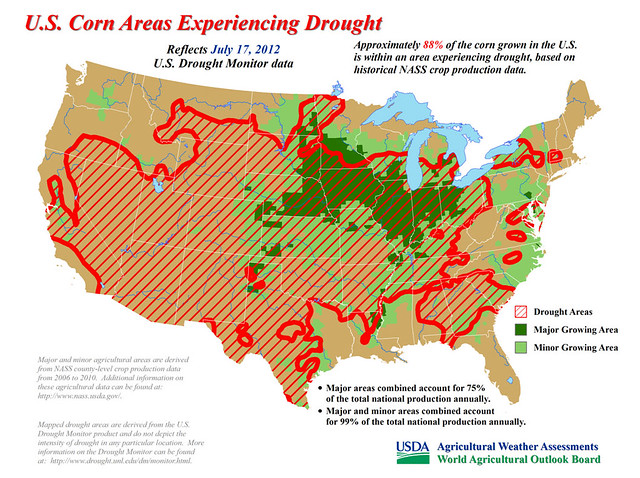
Approximately 88% of the corn grown in the U.S. is within an area experiencing drought, based on historical NASS crop production data. (Click to enlarge map)


Visit www.usda.gov/drought for the latest information regarding USDA?s Drought Disaster response and assistance.

The drought of 2012 has rapidly expanded and intensified, covering 64% of the contiguous United States ? according to the U.S. Drought Monitor ? by July 17. Three months ago, that figure stood at 37%, and at the beginning of the year, only 28% of the lower 48 states had drought coverage.

Even more dramatic change in drought coverage has occurred in the Midwest. The latest Drought Monitor indicated that 88% of the U.S. corn and 87% of the soybeans were within an area experiencing drought. As recently as early June, less than 20% of the corn and soybeans were considered to be in a drought area.


Outlook: Across the central Plains and the middle Mississippi Valley, searing, triple-digit heat and dry conditions will persist through much of next week. Meanwhile, scattered showers may provide limited and localized relief to drought-stressed crops and pastures across the northern and eastern Corn Belt. However, high temperatures will return to much of the Midwest for at least part of next week, following several days of favorably cooler weather in the central and eastern Corn Belt.

http://blogs.usda.gov/2012/07/20/agricultural-weather-and-drought-update-72012/
 
Re: US: Rising Corn Prices and Your Grocery Bill

Re: US: Rising Corn Prices and Your Grocery Bill

Corn, corn gluten and HFCS are in a lot of processed foods. The rise in the price of corn will directly impact these products. The rise in the cost of HFCS may cause a rise in the cost of alternative sweeteners such as sugar, honey, maple syrup, Stevie and artificial sweeteners. HFCS are significantly cheaper than most if not all of the alternatives. A lot of livestock depend on soybeans, corn and silage (ground up green corn stalks, ears and husks) for a significant portion of their diet. I would expect the prices of meat, milk and cheese, poultry and eggs to rise along with farm raised fish from the US. Dog foods that use corn may also be forced to use alternitive and more expensive grains or pay for the more expensive corn and pass the expence on to their customers.
 
Re: US: Rising Corn Prices and Your Grocery Bill

Re: US: Rising Corn Prices and Your Grocery Bill

US drought getting worse; Illinois in 'extreme drought'

Friday, July 27, 2012
July 27, 2012 (CHICAGO) -- The widest drought to grip the United States in decades is getting worse with no signs of abating, a new report warned Thursday, as state officials urged conservation and more ranchers considered selling cattle.

The drought covering two-thirds of the continental U.S. had been considered relatively shallow, the product of months without rain, rather than years. But Thursday's report showed its intensity is rapidly increasing, with 20 percent of the nation now in the two worst stages of drought -- up 7 percent from last week.
...
Other states are seeing conditions rapidly worsen. Illinois -- a key producer of corn and soybeans -- saw its percentage of land in extreme or exceptional drought balloon from just 8 percent last week to roughly 71 percent as of Thursday, the Drought Monitor reported.
...
Nationwide, ranchers have been selling off large numbers of animals they can't graze and can't afford to buy feed for. The nation's cattle inventory, at 97.8 million head, is the smallest since the U.S. Department of Agriculture began a July count in 1973.

More...
http://abclocal.go.com/wls/story?section=news/national_world&id=8750982

-----------------------------------------------------------------------------------
drmon.gif


http://droughtmonitor.unl.edu/
 
Re: US drought: Rising Corn Prices and Your Grocery Bill

Re: US drought: Rising Corn Prices and Your Grocery Bill

Drought seen slashing U.S. corn crop to five-year low

By Sam Nelson
CHICAGO | Tue Aug 7, 2012 9:25am EDT

(Reuters) - The worst drought in more than half a century in America's Corn Belt has slashed the corn crop to the lowest in five years, leading to a plunge of corn supplies to the smallest in 17 years by next summer, a Reuters poll of 21 analysts showed on Monday.
...
Updated weather forecasts do little to change that scenario since the corn crop is basically done for the year, leading to little hopes for improvements in crop output.
...
Because of the drought, corn prices this summer soared to record highs of more than $8 per bushel. That has led analysts to lower their forecasts for the amount of corn that will be harvested and to scale back their outlooks for corn usage.

"With the supply falling we have to start rationing demand. I sense importers are not utilizing U.S. corn now but are buying Brazilian corn and the ethanol output dropped in July," said Jerry Gidel, analyst for Rice Dairy LLC.
...

More...
http://www.reuters.com/article/2012/08/07/us-usa-agriculture-corn-idUSBRE87603P20120807
-----------------------------------------------------------------------------------------------------------------

U.S. drought could pinch world's poor, says think tank IFPRI

Mon Aug 6, 2012 4:14pm EDT

WASHINGTON, Aug 6 (Reuters) - Drought in the U.S. farm belt may result in higher prices for poor people around the world, according to the head of an agricultural think tank who on Monday also recommended a halt to ethanol production from corn.

Shenggen Fan, director general of the International Food Policy Research Institute, said the global spike in food prices in 2008 showed how poor crops and tight supplies have wide impact. I FP RI is the analytical arm of a coalition of agricultural research facilities.
...
More than 60 percent of the continental United States, including prime grain territory, is under moderate to exceptional drought. The Agriculture Department was scheduled to make its first estimate of the fall harvest on Friday. Some private analysts say the corn crop could be the smallest in a decade.

Full text:
http://www.reuters.com/article/2012/08/06/usa-ethanol-idUSL2E8J68KK20120806

 
Re: US drought: Rising Corn Prices and Your Grocery Bill worldwide

Source: http://money.cnn.com/2012/08/09/news/economy/food-prices-index/index.htm?iid=HP_LN&hpt=hp_t3

U.S. drought drives up food prices worldwide
By Aaron Smith @CNNMoney August 9, 2012: 9:11 AM ET

NEW YORK (CNNMoney) -- The drought that's drying up the Heartland isn't just an American problem. It's causing food prices to surge worldwide.

Food prices jumped 6% in July, after three months of declines, according to the United Nations' monthly Food Price Index released Thursday. The main drivers behind the increase? Grain prices. And more specifically, corn prices, which have hit record highs in recent weeks...
 
Re: US drought: Rising Corn Prices and Your Grocery Bill worldwide

Drought may cost billions in U.S. food exports

By Steve Hargreaves @CNNMoney August 2, 2012: 11:48 AM ET


snip

The United States accounts for over half the global export market for corn and nearly half of the soybean market. Some corn ends up in products like cereal and soda, but the biggest chunk is used as feedstock for pork, chicken and beef.

http://money.cnn.com/2012/08/02/news/economy/drought-food-exports/index.htm?iid=EL
 
Re: US drought: Rising Corn Prices and Your Grocery Bill worldwide

Source: http://www.france24.com/en/20120822-us-corn-soy-prices-hit-records-drought-lingers

22 August 2012 - 00H17
US corn, soy prices hit records as drought lingers

AFP - US corn and soybean prices closed at new record highs Tuesday as a new survey showed worse-than-expected crop damage from a brutal drought across the country's central breadbasket.

The price of corn jumped 1.7 percent to $8.3875 a bushel, while soybeans finished at $17.3025 a bushel, up 2.8 percent from Tuesday.

That left the corn price up 68 percent from June and soybeans 39 percent higher...
 
Re: US drought: Rising Corn Prices and Your Grocery Bill worldwide

Interesting article on this from USA Today that discusses how farmers are using Facebook and Craigslist to hunt for reasonably priced stocks of hay.

The article also gives some info on current supply and prices.

USA Today:

"The U.S. Department of Agriculture estimates this year's hay harvest will total 120 million tons, down from 131 million last year. The USDA this month opened 3.8 million acres of conservation land for emergency hay harvesting and grazing.

...Sellers came from as far away as Canada for Thursday's weekly sale at Rock Valley Hay Auction Co. in Rock Valley, Iowa, says Jeanette Van Grootheest. Alfalfa hay sold for as much as $330 a ton; the top price on Sept. 1, 2011, was $190 a ton.

...Alex Danbman, a Milledgeville, Ill.,...says it's been a bad year: "We should be getting 3.5 to 4 tons an acre," he says. "We're getting a ton to a ton and a half."
 
Re: US drought: Rising Corn Prices and Your Grocery Bill worldwide

http://trib.com/news/state-and-regional/wyoming-faces-worst-hay-crop-in-decades/article_b9a19955-6807-5190-9656-48f381fa97ae.html
August 18, Associated Press ?
[snip]
Hay is Wyoming?s biggest cash crop, and it also is suffering the most from a lack of rain earlier in the season. USDA crop yield estimates released late the week of August 13 project Wyoming?s overall hay harvest in 2012 to yield about 925,000 acres of hay. If realized, that would make 2012 the single worst year for Wyoming hay acreage since the Dust Bowl days of 1934.
[snip]
Other crops are faring better, particularly sugar beets and dry edible beans...
 
Re: US drought: Rising Corn Prices and Your Grocery Bill worldwide

Source: http://www.cnn.com/2012/09/15/us/drought-impact/index.html?hpt=hp_c1

From dry rivers to dead deer, drought's impact felt everywhere
By Greg Botelho, CNN
updated 12:54 PM EDT, Sat September 15, 2012

CNN) -- Well before Hurricane Isaac hit Louisiana and brought localized heavy flooding, the weather story of the summer was not about an abundance of water -- it was the lack thereof.

And it still is.

Farmers and residents in 40 states know this all too well, as this summer's blend of low rainfall and extreme heat has created a crisis for many. Over a recent six-week stretch, the U.S. Department of Agriculture designated 1,692 counties as disaster areas due to the drought. The department notes about 80% of agricultural land in the country is affected, making this year's drought more far-reaching than any since the 1950s.

The impact has been felt by farmers and ranchers nationwide, but they're hardly alone. Outdoor activities, commercial transportation and wildlife have been impacted by the drought, in myriad ways...
 
Back
Top