• FluTrackers.com Inc. does not provide medical advice. Information on this web site is collected from various internet resources, and the FluTrackers board of directors makes no warranty to the safety, efficacy, correctness or completeness of the information posted on this site by any author or poster. The information collated here is for instructional and/or discussion purposes only and is NOT intended to diagnose or treat any disease, illness, or other medical condition. Every individual reader or poster should seek advice from their personal physician/healthcare practitioner before considering or using any interventions that are discussed on this website. By continuing to access this website you agree to consult your personal physican before using any interventions posted on this website, and you agree to hold harmless FluTrackers.com Inc., the board of directors, the members, and all authors and posters for any effects from use of any medication, supplement, vitamin or other substance, device, intervention, etc. mentioned in posts on this website, or other internet venues referenced in posts on this website.
  • We are not asking for any donations. Do not donate to any entity who says they are raising funds for us.

US declares Public Health Emergency - Temporary travel ban on foreign nationals who have recently visited China

penguinsix

Well-known member
https://www.cnbc.com/2020/01/31/whit...afternoon.html

"The Trump administration on Friday declared the coronavirus a public health emergency in the United States, and announced that people who pose a risk of transmitting the disease will temporarily be suspended entry into the U.S.

Health and Human Services Secretary Alex Azar said that President Donald Trump signed an order for the U.S. to deny entry to foreign nationals who have traveled to China within the past two weeks, aside from the immediate family of U.S. citizens...."
 
I heard this myself.


FluTrackers.com
@FluTrackers
?
5m
US - 2019-nCov declared as a public health emergency. Mandatory 14 day quarantine for US citizens who have traveled thru Hebei. Foreign nationals (except family) who have traveled inside China in the last 14 day will be denied entry to the US. from White House news conf. now.
 
[h=1][/h] The National Emergencies Act (NEA) (Pub.L. 94–412, 90 Stat. 1255, enacted September 14, 1976, codified at 50 U.S.C. ? 1601–1651) is a United States federal law passed to end all previous national emergencies and to formalize the emergency powers of the President.

The Act empowers the President to activate special powers during a crisis but imposes certain procedural formalities when invoking such powers. The perceived need for the law arose from the scope and number of laws granting special powers to the executive in times of national emergency. Congress can terminate an emergency declaration with a joint resolution signed into law.[SUP][1][/SUP] Powers available under this Act are limited to the 136 emergency powers Congress has defined by law.[SUP][2][/SUP]


https://en.wikipedia.org/wiki/National_Emergencies_Act


----------------------------------------------------------

[h=1]Public Health Service Act[/h]
The Public Health Service Act is a United States federal law enacted in 1944.[SUP][2][/SUP] The full act is captured under Title 42 of the United States Code (The Public Health and Welfare), Chapter 6A (Public Health Service).[SUP][3][/SUP]

The act clearly established the federal government's quarantine authority for the first time. It gave the United States Public Health Service responsibility for preventing the introduction, transmission and spread of communicable diseases from foreign countries into the United States.[SUP][4][/SUP]

The Public Health Service Act granted the original authority for scientists and special consultants to be appointed "without regard to the civil-service laws", known as a Title 42 appointment.[SUP][5][/SUP]


https://en.wikipedia.org/wiki/Public_Health_Service_Act
 
[h=1]Determination that a Public Health Emergency Exists[/h]


As a result of confirmed cases of 2019 Novel Coronavirus (2019-nCoV), on this date and after consultation with public health officials as necessary, I, Alex M. Azar II, Secretary of Health and Human Services, pursuant to the authority vested in me under section 319 of the Public Health Service Act, do hereby determine that a public health emergency exists and has existed since January 27, 2020, nationwide. [TABLE="cellspacing: 0"]
[TR]
[TD="colspan: 1"]01/31/2020

_____________________________
Date[/TD]
[TD="colspan: 1"] [/TD]
[TD="colspan: 1"]/s/

_____________________________
Alex M. Azar II[/TD]
[/TR]
[/TABLE]


[h=3]More Emergency and Response Information[/h]
https://www.phe.gov/emergency/news/healthactions/phe/Pages/2019-nCoV.aspx
 
FOR IMMEDIATE RELEASE
January 31, 2020

Contact: HHS Press Office
202-690-6343
media@hhs.gov


Secretary Azar Declares Public Health Emergency for United States for 2019 Novel Coronavirus


Health and Human Services Secretary Alex M. Azar II declared a public health emergency for the entire United States to aid the nation’s healthcare community in responding to 2019 novel coronavirus.

“While this virus poses a serious public health threat, the risk to the American public remains low at this time, and we are working to keep this risk low,” Secretary Azar said. “We are committed to protecting the health and safety of all Americans, and this public health emergency declaration is the latest in the series of steps the Trump Administration has taken to protect our country.”

The emergency declaration gives state, tribal, and local health departments more flexibility to request that HHS authorize them to temporarily reassign state, local, and tribal personnel to respond to 2019-nCoV if their salaries normally are funded in whole or in part by Public Health Service Act programs. These personnel could assist with public health information campaigns and other response activities.

The Centers for Disease Control and Prevention is working closely with state health departments on disease surveillance, contact tracing, and providing interim guidance for clinicians on identifying and treating coronavirus infections. HHS is working with the Department of State to assist in bringing home Americans who had been living in affected areas of mainland China. HHS divisions also are collaborating with industry to identify and move forward with development of potential diagnostics, vaccines, and therapeutics to detect, prevent, and treat 2019-nCoV infections.

In declaring the public health emergency, Secretary Azar acted within his authority under the Public Health Service Act. This declaration is retroactive to January 27, 2020.

This U.S. public health emergency declaration follows a declaration by the World Health Organization that spread of the virus constituted a public health emergency of international concern.

# # #


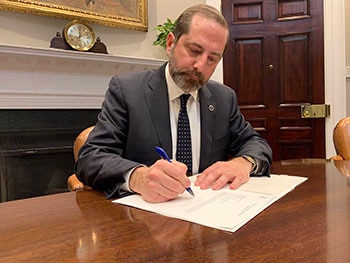
phe-signing-1.31_0.jpg

Secretary Azar signs the Public Health Emergency Declaration


...
https://www.hhs.gov/about/news/2020/...ronavirus.html
 
Proclamation on Suspension of Entry as Immigrants and Nonimmigrants of Persons who Pose a Risk of Transmitting 2019 Novel Coronavirus


HEALTHCARE


Issued on: January 31, 2020

The United States has confirmed cases of individuals who have a severe acute respiratory illness caused by a novel (new) coronavirus (“2019-nCoV”) (“the virus”) first detected in Wuhan, Hubei Province, People’s Republic of China (“China”). The virus was discovered in China in December 2019. As of January 31, 2020, Chinese health officials have reported approximately 10,000 confirmed cases of 2019-nCoV in China, more than the number of confirmed cases of Severe Acute Respiratory Syndrome (SARS) during its 2003 outbreak. An additional 114 cases have been confirmed across 22 other countries; in several of these cases, the infected individuals had not visited China. More than 200 people have died from the virus, all in China.

Coronaviruses are a large family of viruses. Some cause illness in people and others circulate among animals, including camels, cats, and bats. Animal coronaviruses are capable of evolving to infect people and subsequently spreading through human-to-human transmission. This occurred with both Middle East Respiratory Syndrome and SARS. Many of the individuals with the earliest confirmed cases of 2019-nCoV in Wuhan, China had some link to a large seafood and live animal market, suggesting animal-to-human transmission. Later, a growing number of infected individuals reportedly did not have exposure to animal markets, indicating human-to-human transmission. Chinese officials now report that sustained human-to-human transmission of the virus is occurring in China. Manifestations of severe disease have included severe pneumonia, acute respiratory distress syndrome, septic shock, and multi-organ failure.

Neighboring jurisdictions have taken swift action to protect their citizens by closing off travel between their territories and China. On January 30, 2020, the World Health Organization declared the 2019-nCoV outbreak a public health emergency of international concern.

Outbreaks of novel viral infections among people are always of public health concern, and older adults and people with underlying health conditions may be at increased risk. Public health experts are still learning about the severity of 2019-nCoV. An understanding of the key attributes of this novel virus, including its transmission dynamics, incubation period, and severity, is critical to assessing the risk it poses to the American public. Nonetheless, the Centers for Disease Control and Prevention (CDC) has determined that the virus presents a serious public health threat.

The CDC is closely monitoring the situation in the United States, is conducting enhanced entry screening at 5 United States airports where the majority of travelers from Wuhan arrive, and is enhancing illness response capacity at the 20 ports of entry where CDC medical screening stations are located. The CDC is also supporting States in conducting contact investigations of confirmed 2019-nCoV cases identified within the United States. The CDC has confirmed that the virus has spread between two people in the United States, representing the first instance of person-to-person transmission of the virus within the United States. The CDC, along with state and local health departments, has limited resources and the public health system could be overwhelmed if sustained human-to-human transmission of the virus occurred in the United States. Sustained human-to-human transmission has the potential to have cascading public health, economic, national security, and societal consequences.

During Fiscal Year 2019, an average of more than 14,000 people traveled to the United States from China each day, via both direct and indirect flights. The United States Government is unable to effectively evaluate and monitor all of the travelers continuing to arrive from China. The potential for widespread transmission of the virus by infected individuals seeking to enter the United States threatens the security of our transportation system and infrastructure and the national security. Given the importance of protecting persons within the United States from the threat of this harmful communicable disease, I have determined that it is in the interests of the United States to take action to restrict and suspend the entry into the United States, as immigrants or nonimmigrants, of all aliens who were physically present within the People’s Republic of China, excluding the Special Administrative Regions of Hong Kong and Macau, during the 14-day period preceding their entry or attempted entry into the United States. I have also determined that the United States should take all necessary and appropriate measures to facilitate orderly medical screening and, where appropriate, quarantine of persons allowed to enter the United States who may have been exposed to this virus.

NOW, THEREFORE, I, DONALD J. TRUMP, President of the United States, by the authority vested in me by the Constitution and the laws of the United States of America, including sections 212(f) and 215(a) of the Immigration and Nationality Act (INA), 8 U.S.C. 1182(f) and 1185(a), and section 301 of title 3, United States Code, hereby find that the unrestricted entry into the United States of persons described in section 1 of this proclamation would, except as provided for in section 2 of this proclamation, be detrimental to the interests of the United States, and that their entry should be subject to certain restrictions, limitations, and exceptions. I therefore hereby proclaim the following:

Section 1. Suspension and Limitation on Entry. The entry into the United States, as immigrants or nonimmigrants, of all aliens who were physically present within the People’s Republic of China, excluding the Special Administrative Regions of Hong Kong and Macau, during the 14-day period preceding their entry or attempted entry into the United States is hereby suspended and limited subject to section 2 of this proclamation.

Sec. 2. Scope of Suspension and Limitation on Entry.

(a) Section 1 of this proclamation shall not apply to:

(i) any lawful permanent resident of the United States;

(ii) any alien who is the spouse of a U.S. citizen or lawful permanent resident;

(iii) any alien who is the parent or legal guardian of a U.S. citizen or lawful permanent resident, provided that the U.S. citizen or lawful permanent resident is unmarried and under the age of 21;

(iv) any alien who is the sibling of a U.S. citizen or lawful permanent resident, provided that both are unmarried and under the age of 21;

(v) any alien who is the child, foster child, or ward of a U.S. citizen or lawful permanent resident, or who is a prospective adoptee seeking to enter the United States pursuant to the IR-4 or IH-4 visa classifications;

(vi) any alien traveling at the invitation of the United States Government for a purpose related to containment or mitigation of the virus;

(vii) any alien traveling as a nonimmigrant under section 101(a)(15)(C) or (D) of the INA, 8 U.S.C. 1101(a)(15)(C) or (D), as a crewmember or any alien otherwise traveling to the United States as air or sea crew;

(viii) any alien seeking entry into or transiting the United States pursuant to an A-1, A-2, C-2, C-3 (as a foreign government official or immediate family member of an official), G-1, G-2, G-3, G-4, NATO-1 through NATO-4, or NATO-6 visa;

(ix) any alien whose entry would not pose a significant risk of introducing, transmitting, or spreading the virus, as determined by the CDC Director, or his designee;

(x) any alien whose entry would further important United States law enforcement objectives, as determined by the Secretary of State, the Secretary of Homeland Security, or their respective designees based on a recommendation of the Attorney General or his designee; or

(xi) any alien whose entry would be in the national interest, as determined by the Secretary of State, the Secretary of Homeland Security, or their designees.

(b) Nothing in this proclamation shall be construed to affect any individual’s eligibility for asylum, withholding of removal, or protection under the regulations issued pursuant to the legislation implementing the Convention Against Torture and Other Cruel, Inhuman or Degrading Treatment or Punishment, consistent with the laws and regulations of the United States.

Sec. 3. Implementation and Enforcement. (a) The Secretary of State shall implement this proclamation as it applies to visas pursuant to such procedures as the Secretary of State, in consultation with the Secretary of Homeland Security, may establish. The Secretary of Homeland Security shall implement this proclamation as it applies to the entry of aliens pursuant to such procedures as the Secretary of Homeland Security, in consultation with the Secretary of State, may establish.

(b) Consistent with applicable law, the Secretary of State, the Secretary of Transportation, and the Secretary of Homeland Security shall ensure that any alien subject to this proclamation does not board an aircraft traveling to the United States.

(c) The Secretary of Homeland Security may establish standards and procedures to ensure the application and implementation of this proclamation at United States seaports and in between all ports of entry.

(d) An alien who circumvents the application of this proclamation through fraud, willful misrepresentation of a material fact, or illegal entry shall be a priority for removal by the Department of Homeland Security.

Sec. 4. Orderly Medical Screening and Quarantine. The Secretary of Homeland Security shall take all necessary and appropriate steps to regulate the travel of persons and aircraft to the United States to facilitate the orderly medical screening and, where appropriate, quarantine of persons who enter the United States and who may have been exposed to the virus. Such steps may include directing air carriers to restrict and regulate the boarding of such passengers on flights to the United States.

Sec. 5. Termination. This proclamation shall remain in effect until terminated by the President. The Secretary of Health and Human Services shall, as circumstances warrant and no more than 15 days after the date of this order and every 15 days thereafter, recommend that the President continue, modify, or terminate this proclamation.

Sec. 6. Effective Date. This proclamation is effective at 5:00 p.m. eastern standard time on February 2, 2020.

Sec. 7. Severability. It is the policy of the United States to enforce this proclamation to the maximum extent possible to advance the national security, public safety, and foreign policy interests of the United States. Accordingly:

(a) if any provision of this proclamation, or the application of any provision to any person or circumstance, is held to be invalid, the remainder of this proclamation and the application of its provisions to any other persons or circumstances shall not be affected thereby; and

(b) if any provision of this proclamation, or the application of any provision to any person or circumstance, is held to be invalid because of the lack of certain procedural requirements, the relevant executive branch officials shall implement those procedural requirements to conform with existing law and with any applicable court orders.

Sec. 8. General Provisions. (a) Nothing in this proclamation shall be construed to impair or otherwise affect:

(i) the authority granted by law to an executive department or agency, or the head thereof; or

(ii) the functions of the Director of the Office of Management and Budget relating to budgetary, administrative, or legislative proposals.

(b) This proclamation shall be implemented consistent with applicable law and subject to the availability of appropriations.

(c) This proclamation is not intended to, and does not, create any right or benefit, substantive or procedural, enforceable at law or in equity by any party against the United States, its departments, agencies, or entities, its officers, employees, or agents, or any other person.

IN WITNESS WHEREOF, I have hereunto set my hand this thirty-first day of January, in the year of our Lord two thousand twenty, and of the Independence of the United States of America the two hundred and forty-fourth.

DONALD J. TRUMP

https://www.whitehouse.gov/president...l-coronavirus/

 
[h=1]DHS Issues Restrictions On Inbound Flights With Individuals Who Have Been In China[/h] Release Date:
February 2, 2020

WASHINGTON — In response to the evolving threat of the novel coronavirus, and to minimize the risk of spreading within the United States, the Department of Homeland Security (DHS) today will begin enforcing restrictions for all passenger flights to the United States carrying individuals who have recently traveled from the People’s Republic of China. In accordance with the President’s Proclamation and at the direction of Acting Secretary Chad F. Wolf, the restrictions will begin for flights commencing after 5:00 p.m. EST on Sunday, February 2nd, and will direct the arrival of U.S. citizens who have traveled in China within 14 days of their arrival to one of seven designated airports, where the United States Government has enhanced public health resources in order to implement enhanced screening procedures. The administration is taking these actions to protect the American people.

Additionally, U.S. citizens who have been in Hubei province within 14 days of their return will be subject to up to 14 days of mandatory quarantine to ensure they are provided proper medical care and health screening. U.S. citizens who have been in other areas of mainland China within 14 days of their return will undergo proactive entry health screening and up to 14 days of self-quarantine with health monitoring to ensure they have not contracted the virus and do not pose a public health risk. Generally, foreign nationals (other than immediate family of U.S. citizens, permanent residents, and flight crew) who have traveled in China within 14 days of their arrival, will be denied entry into the United States.

“While the overall risk to the American public remains low, funneling all flights with passengers who have recently been in China is the most important and prudent step we can take at this time to decrease the strain on public health officials screening incoming travelers. These steps will also expedite the processing of U.S. citizens returning from China, and ensure resources are focused on the health and safety of the American people,” said DHS Acting Secretary Chad F. Wolf. “We realize this could provide added stress and prolong travel times for some individuals, however public health and security experts agree these measures are necessary to contain the virus and protect the American people. To minimize disruptions, CBP and air carriers are working to identify qualifying passengers before their scheduled flights. Once back in the U.S., it’s imperative that individuals honor self-quarantine directives to help protect the American public.”

“The American public can be assured that DHS and its component agencies are taking decisive action to analyze the threat, minimize risk, and slow the spread of the virus by working closely with CDC health professionals and interagency partners involved in this whole-of-government effort,” he added.

DHS and the Transportation Security Administration (TSA) have coordinated extensively with air carriers and the Centers for Disease Control and Prevention to designate the seven U.S. airports at which CDC will seek to identify potentially ill persons.

Americans flying to the United States from China will be re-routed to the following airports at no cost to the traveler:
  • John F. Kennedy International Airport (JFK), New York;
  • Chicago O’Hare International Airport (ORD), Illinois;
  • San Francisco International Airport (SFO), California;
  • Seattle-Tacoma International Airport (SEA), Washington;
  • Daniel K. Inouye International Airport (HNL), Hawaii;
  • Los Angeles International Airport, (LAX), California; and
  • Hartsfield-Jackson Atlanta International Airport (ATL), Georgia.
Although the CDC expects more cases of the coronavirus in the U.S., the risk of infection for Americans remains low, and all agencies are working aggressively to monitor this continuously evolving situation and to keep the public educated and informed:
  • American air travelers should be aware that if they have been to China in the last 14 days, they will be routed through one of seven airports to undergo enhanced health screenings.
  • Any individual traveling from China who has either been in Hubei Province or other areas of the mainland and is showing symptoms associated with the virus will be screened and subject to mandatory quarantine by medical professionals at a nearby facility.
  • If a traveler who spent time in China, but outside the Hubei province, is re-routed through one of the seven airports and shows no symptoms following a health screening, they will be re-booked to their destination and asked to “self-quarantine” at their homes.
  • CBP and air carriers are working together to identify and rebook any passengers that meet these criteria, however other travelers without a nexus to China may also be routed through one of these seven airports if it is discovered mid-flight that someone else on their flight has been in China in the last 14 days.
  • Travelers showing symptoms should be prepared for the possibility of prolonged delay to avoid spreading the infection.
For the latest information on the outbreak, visit CDC’s Novel Coronavirus 2019 website.

Topics:

Secretary of Homeland Security
Keywords:

Department of Homeland Security (DHS),
Travel Security
Last Published Date: February 2, 2020

https://www.dhs.gov/news/2020/02/02...bound-flights-individuals-who-have-been-china
 
The virus thus far is continuing to spread inexorably, with the case load rising monotonically upward in all countries. Thus far, no country has managed to arrest, much less reverse this trend.

Seen that we are currently using the full resources of the medical community on only a small number of cases, that is very worrying. The intensity of the care will decline as more cases stretch the available resources, possibly resulting in a vicious circle that ends in a pandemic.
Are much more drastic measures, including curfews and such getting serious analysis and consideration?
 
Back
Top