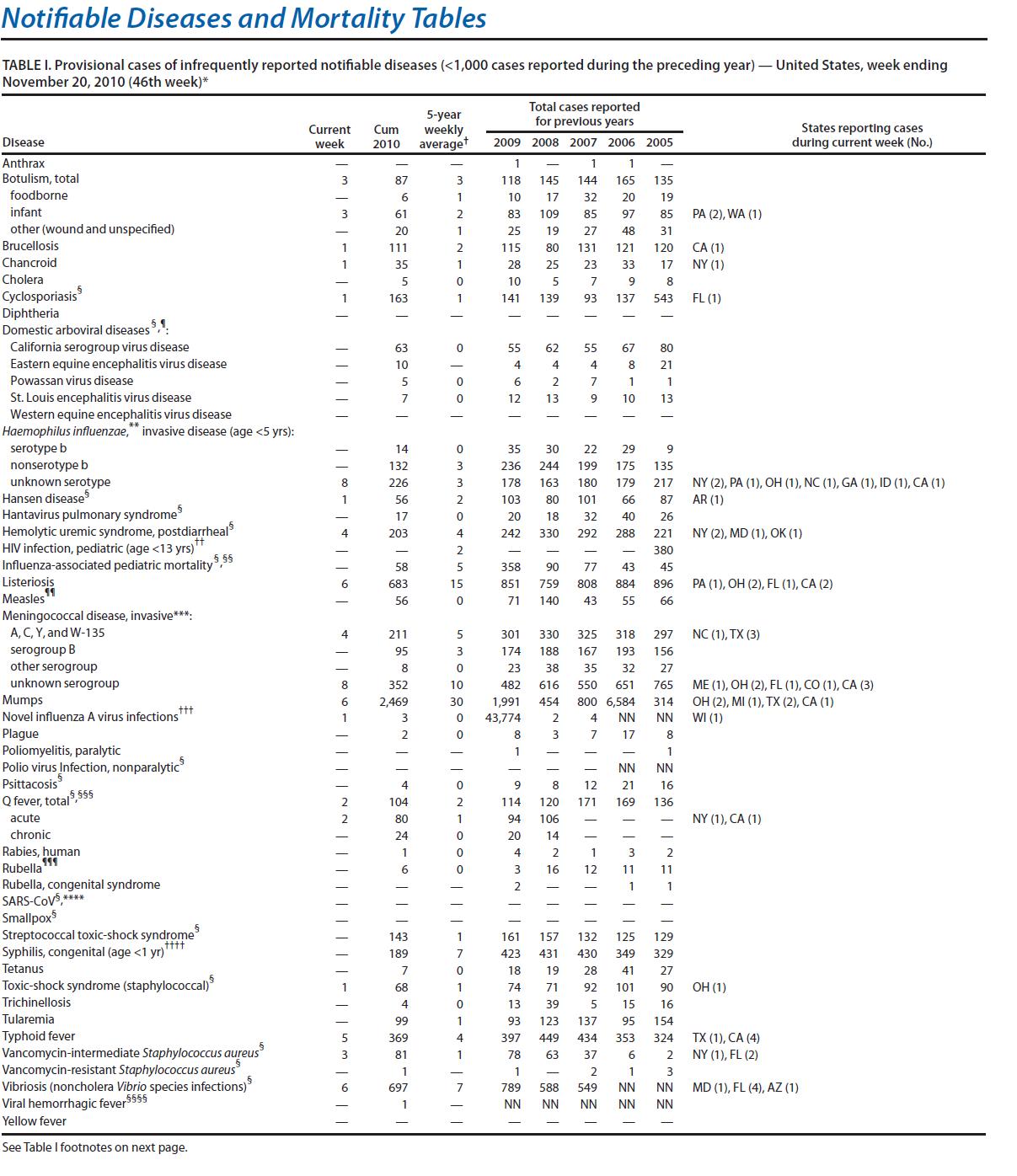
Re: US CDC, MMWR 11/24/10: Three human infections with triple reassortant H3N2 influenza virus reported in 2010.
Suggested citations:
(1) US Centers for Diseases Control and Prevention, Have you Heard? Nov 12 2010,
http://www.cdc.gov/media/subtopic/heard.htm#h3n2
(2) US Centers for Diseases Control and Prevention, FluView Week 44, Nov. 6 2010,
http://www.cdc.gov/flu/weekly/
(3) World Health Organization, Influenza Update no. 120, Nov. 22 2010,
http://www.who.int/csr/disease/influenza/2010_11_22_GIP_surveillance/en/index.html
Excerpts:
(...)
Human infections with other influenza viruses:
Swine-origin H3N2 virus infection in the US
On 12 November, 2010, the United States Centers for Disease Control and Prevention (US CDC), reported
two sporadic cases of human infection with triple reassortant swine origin influenza A(H3N2) viruses. The two cases
occurred in separate states, are not believed to be epidemiologically linked to each other, and both occurred in the vicinity of live pigs. Both patients have fully recovered from their illness.
The viruses isolated from both patients had
some genetic differences further suggesting that two cases were not linked.
Investigations thus far have not shown any evidence of community transmission of these viruses.
For more information visit: (
LINK) or (
LINK)
The
first detection in a human of
the triple reassortant swine A(H3N2) virus was in
2005 in Ontario Canada. Since then human cases have been reported nearly every year. All cases have
fully recovered and
no increased severity has been associated with the infection with these viruses in humans.
In North America, A(H3N2) viruses in pigs emerged around 1998-99, when the human influenza A(H3N2) viruses entered into swine population and
reassorted with other influenza viruses already circulating in pigs. The A(H3N2) viruses currently circulating in the swine population in US and Canada
contain gene segments from avian-like, swine-like, and human-like viruses.
Early identification and investigation of human infections with novel influenza A viruses is critical to evaluate the extent of the outbreak and possible human-to-human transmission and WHO continues to encourage member states to investigate and report these events.(3)
(...)
-
(...)
November 12, 2010
Reports of Human Infections with Swine Origin Influenza A (H3N2)
The November 12, 2010 FluView reports two human infections with swine origin influenza A (H3N2) viruses in the United States.
Test samples from
two patients submitted by Wisconsin and Pennsylvania have been confirmed at CDC as positive for
swine origin triple-reassortant (tr) H3N2 influenza viruses?viruses that normally infect pigs.
While human infection with swine influenza viruses is rare, it can occur.
This is most likely to occur when people are in close proximity to infected pigs, such as in pig barns and livestock exhibits housing pigs at fairs.
Both of the patients with confirmed trH3N2 infection reported in FluView were in the vicinity of live pigs.
Dates of illness onset in the two patients are more than six weeks apart and
the viruses from the two patients have some genetic differences, confirming that these two cases are not linked.
Ongoing
investigations in both states have not shown any evidence of community transmission of these viruses.
The most likely scenario at this point is that these are
two isolated cases of human infection with swine influenza viruses that, while very rare, do occur from time to time.
(...)
The viruses identified in Pennsylvania and Wisconsin are
similar to viruses that infected a patient in Iowa in September 2009, a patient in Kansas in August 2009 and a patient in Minnesota in May 2010.
(...)
The
patient in Pennsylvania lives in an area where live pigs are farmed and the
patient in Wisconsin became sick two days after attending a state fair where pigs were exhibited. (1)
-
(...)
Novel Influenza A Virus:
Two cases of human infection with a novel influenza A virus were reported:
one case by the Wisconsin Department of Health Services and
one case by the Pennsylvania Department of Health.
Both patients were infected with a swine origin influenza A (H3N2) virus similar to the
three other swine origin influenza A (H3N2) viruses previously identified in 2009 and 2010.
The Wisconsin case reported contact with pigs in the week preceding symptom onset on September 8, 2010 and
required hospitalization.
No contact with pigs has been identified in the Pennsylvania case in the week before symptom onset on October 24, 2010; however
the case lives in an area close to pig farms.
Both patients have fully recovered from their illness.
The cases are not related and the viruses from these two cases have some genetic differences, indicating that they did not come from the same source.
Although both investigations are ongoing, there is
no evidence of human-to-human transmission with this virus in either case.
Early identification and investigation of human infections with novel influenza A viruses is critical to evaluate the extent of the outbreak and possible human-to-human transmission.
Surveillance for human infections with novel influenza A viruses continues year round.
For additional information on these cases and swine influenza, see (
LINK).(2)
(...)
-
------