• FluTrackers.com Inc. does not provide medical advice. Information on this web site is collected from various internet resources, and the FluTrackers board of directors makes no warranty to the safety, efficacy, correctness or completeness of the information posted on this site by any author or poster. The information collated here is for instructional and/or discussion purposes only and is NOT intended to diagnose or treat any disease, illness, or other medical condition. Every individual reader or poster should seek advice from their personal physician/healthcare practitioner before considering or using any interventions that are discussed on this website. By continuing to access this website you agree to consult your personal physican before using any interventions posted on this website, and you agree to hold harmless FluTrackers.com Inc., the board of directors, the members, and all authors and posters for any effects from use of any medication, supplement, vitamin or other substance, device, intervention, etc. mentioned in posts on this website, or other internet venues referenced in posts on this website.
  • We are not asking for any donations. Do not donate to any entity who says they are raising funds for us.

US CDC Influenza Lab Closed After H5N1 Accidently Sent to Another Government Laboratory 6 Weeks Ago, Plus Moratorium on Movement of All Biological Mat

sharon sanders

Editor-in-Chief & President
From: "Media@cdc.gov (CDC)" <sohco@cdc.gov></sohco@cdc.gov> <small>[Add to Address Book]</small>
To: MMWR-MEDIA@LISTSERV.CDC.GOV
Subject: Embargoed until 12:30 p.m. ET: CDC Press Release: CDC Director Releases After-Action Report on Recent Anthrax Incident; Highlights Steps to Improve Laboratory Quality and Safety
Date: Jul 11, 2014 11:04 AM


[FONT=&quot]Press Release[/FONT]

[FONT=&quot]Embargoed until 12:30 PM, ET [/FONT]
[FONT=&quot]Friday, July 11, 2014 [/FONT]

[FONT=&quot]Contact: [/FONT] [FONT=&quot]CDC Media Relations [/FONT]
[FONT=&quot]404-639-3286[/FONT]

[FONT=&quot]CDC Director Releases After-Action Report on Recent Anthrax Incident; Highlights Steps to Improve Laboratory Quality and Safety[/FONT]
[FONT=&quot]The Centers for Disease Control and Prevention (CDC) released a report today that reviews the early June incident that involved the unintentional exposure of personnel to potentially viable anthrax at the CDC’s Roybal Campus. The report identifies factors found to have contributed to the incident; and highlights actions taken by the agency to address these factors and prevent future incidents. Based on a review of all aspects of the June incident, CDC concluded that while it is not impossible that staff members were exposed to viable B. anthracis, it is extremely unlikely that this occurred. None of the staff who was potentially exposed has become ill with anthrax.
[/FONT]
[FONT=&quot]
[/FONT]
[FONT=&quot]While finalizing this report, CDC leadership was made aware that earlier this year a culture of non-pathogenic avian influenza was unintentionally cross-contaminated at the CDC influenza laboratory with the highly pathogenic H5N1 strain of influenza and shipped to a BSL-3 select-agent laboratory operated by the United States Department of Agriculture (USDA). There were no exposures as a result of that incident.
[/FONT]

[FONT=&quot]The CDC influenza laboratory is now closed and will not reopen until adequate procedures are put in place. Further investigation, review, and action is underway.
[/FONT]
[FONT=&quot]
[/FONT]
[FONT=&quot]As a result of these two incidents, CDC is issuing, effective immediately, a moratorium on the movement (i.e., transfer inside or outside the agency) of biological materials (i.e., infectious agents, active or inactivated specimens) from BSL3 or BSL-4 facilities. The moratorium will remain in place pending review by an advisory committee.
[/FONT]
[FONT=&quot]
[/FONT]
[FONT=&quot]Based on an internal review called for by the CDC Director, the report released today concludes that the scientists’ failure to follow an approved, written study plan that met all laboratory safety requirements led to dozens of employees being potentially exposed. The report also found that there was a lack of standard operating procedures to document when biological agents are properly inactivated in laboratories as well as a lack of adequate laboratory oversight of scientists performing work in these labs. The report concludes that the critical nature of CDC investigations to detect and respond to naturally occurring and man-made events with select agents while ensuring the safety of staff are paramount and should be guided by the highest standards.
[/FONT]
[FONT=&quot]
[/FONT]
[FONT=&quot] In response to these incidents, CDC has initiated following steps, in addition to the moratorium:[/FONT]
[FONT=&quot] 1. [/FONT] [FONT=&quot]Established a high-level working group, reporting to the CDC Director, to, among other duties, accelerate improvements in laboratory safety, review and approve, on a laboratory-by-laboratory basis, resumed transfer of biological materials outside of BSL3 and BSL4 laboratories, and serve as the transition group for the single point of accountability on laboratory safety called for in the review of the potential exposure to anthrax incident.[/FONT]
[FONT=&quot] 2. [/FONT] [FONT=&quot]Begun the process of establishing an external advisory group for laboratory safety. Invitations to participate in this group will be issued by July 18, 2014.[/FONT]
[FONT=&quot] 3. [/FONT] [FONT=&quot]Initiated an investigation to determine root causes that led to contamination of another avian influenza virus by the H5N1 virus. [/FONT]
[FONT=&quot] 4. [/FONT] [FONT=&quot]Reported the incident through the proper channels to the select agent oversight body, APHIS. [/FONT]
[FONT=&quot] 5. [/FONT] [FONT=&quot]Established a review group, under the direction of CDC’s Associate Director for Science, to look at the systems, procedures, and personnel issues leading to this event and means of preventing similar events in the future. This review will be done in conjunction with the internal investigation and in coordination with the working group.[/FONT]
[FONT=&quot] 6. [/FONT] [FONT=&quot]Undertaking appropriate personnel action expeditiously. [/FONT]

[FONT=&quot]CDC has also implemented or is in the process of implementing the following key recommendations highlighted in the report to address the root causes of the anthrax incident:[/FONT]
· [FONT=&quot]CDC will establish a CDC-wide single point of accountability for laboratory safety. [/FONT]
· [FONT=&quot]The Bioterrorism Rapid Response and Technology (BRRAT) Laboratory will not be conducting work with any select agent until a series of reviews and approvals are completed. BRRAT laboratory scientists do not have access to select agents, which have been placed in storage-only mode. These restrictions will remain in place until changes have been put in place to prevent similar future incidents. [/FONT]
• [FONT=&quot]Appropriate personnel action will be taken with respect to individuals who contributed to or were in a position to prevent this incident.[/FONT]
• [FONT=&quot]All inactivation procedures for laboratories working with select agents and other dangerous pathogens throughout CDC are being carefully reviewed and will be updated as needed.[/FONT]
• [FONT=&quot]CDC will improve its response to future internal incidents by the rapid establishment of an incident command structure, as CDC uses for external events.[/FONT]
• [FONT=&quot]The implications for the use of select agents, including for CDC’s regulatory functions through CDC’s Division of Select Agents and Toxins will be carefully reviewed to incorporate any lessons learned.[/FONT]
[FONT=&quot]
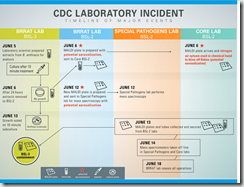
The report details the specifics of the June incident. The incident originated when a biosafety level 3 (BSL3) laboratory at CDC prepared B. anthracis samples for use at lower biosafety levels (i.e., BSL 2) in other CDC labs where live bacteria are not required for the research. Preparation of bacteria in this manner is routinely done within the CDC campus; however, in this instance, the lab used a procedure that may not have adequately inactivated the samples. Thus, the potentially infectious samples were moved and used for experimentation by researchers in these lower biosafety level laboratories, who believing the samples were inactivated, were not wearing adequate personal protective equipment while handling the material. [/FONT]

[FONT=&quot]The procedure used by CDC to deactivate the bacteria in this incident had been examined previously for effectiveness. Two laboratories, one at CDC and the other at the Michigan Department of Community Health, conducted experiments to determine the effectiveness of the formic acid/acetonitrile protein extraction procedure for inactivating B. anthracis. Both laboratories found that the extraction procedure completely inactivated preparations of B. anthracis cells after 10 minutes. However, these CDC experiments using B. anthracis spores showed that a very small number of spores remained viable, even after 24 hours of treatment with the extraction chemicals. This result is not unexpected as bacterial spores are typically much more resistant to chemical inactivation than bacterial cells. After the incident was recognized, environmental testing for B. anthracis was done in the three CDC BSL-2 laboratories that had received specimens from the BSL-3 laboratory to determine if any of the bacteria had been disseminated more broadly. No evidence of environmental contamination was found. [/FONT]

[FONT=&quot]Although a sterility check done by the BSL-3 lab showed that the anthrax preparation had not been inactivated after a 10-minute extraction, the preparation had been extracted for 24 hours before transfer to the BSL-2 labs. At that point, all or the great majority of B. anthracis cells and spores would have been inactivated. [/FONT]

 
Re: US CDC Influenza Lab Closed After H5N1 Accidently Sent to Another Government Laboratory 6 Weeks Ago, Plus Moratorium on Movement of All Biological Materials from BSL-3 & 4 labs - June 11, 2014 Media release

Re: US CDC Influenza Lab Closed After H5N1 Accidently Sent to Another Government Laboratory 6 Weeks Ago, Plus Moratorium on Movement of All Biological Materials from BSL-3 & 4 labs - June 11, 2014 Media release

In a press conference CDC Director Frieden said he is "astonished, upset, anger, lost sleep."
 
Re: US CDC Influenza Lab Closed After H5N1 Accidently Sent to Another Government Laboratory 6 Weeks Ago, Plus Moratorium on Movement of All Biological Materials from BSL-3 & 4 labs - June 11, 2014 Media release

Re: US CDC Influenza Lab Closed After H5N1 Accidently Sent to Another Government Laboratory 6 Weeks Ago, Plus Moratorium on Movement of All Biological Materials from BSL-3 & 4 labs - June 11, 2014 Media release

hat tip Michael Coston

Friday, July 11, 2014

CDC Announces Another Serious Biosecurity Incident


image%25255B3%25255D.png

BSL-4 Lab Worker - Photo Credit ?USAMRIID


# 8826

It?s been a bad summer for US government labs, with two high profile biosecurity incidents involving `select agents? ? the most dangerous types of pathogens ? reported over the past couple of weeks.
First, there was the potential anthrax exposure incident (see CDC Statement On Possible Lab Exposure To Anthrax), reported on June 19th, followed last week by the discovery of several vials of unsecured smallpox at an FDA lab in Bethesda, Md. (see CDC Media Statement on Newly Discovered Smallpox Specimens).
Today during a hastily called press conference, a visibly concerned CDC director Thomas Frieden announced a third incident ? the accidental shipment of H5N1 contaminated samples to aUSDA lab roughly six weeks ago ? that was only just reported to the CDC?s senior management a couple of days ago.

Dr. Friedan also announced that at least two of the above mentioned smallpox vials contained viable virus, a bit of a surprise given its age (60 years) and storage environment.
All of this is likely to further inflame the debate over `Gain of Function? (GOF) research, a topic which we?ve discussed often in the past (see The Debate Over Gain Of Function Studies Continues , Lipsitch & Galvani: GOF Research Concerns, H7N9: Reigniting The `Gain Of Function? Research Debate).


This from the CDC?s press release ........


(we have posted the press release above s.s )
 
Re: US CDC Influenza Lab Closed After H5N1 Accidently Sent to Another Government Laboratory 6 Weeks Ago, Plus Moratorium on Movement of All Biological Materials from BSL-3 & 4 labs - June 11, 2014 Media release

Re: US CDC Influenza Lab Closed After H5N1 Accidently Sent to Another Government Laboratory 6 Weeks Ago, Plus Moratorium on Movement of All Biological Materials from BSL-3 & 4 labs - June 11, 2014 Media release

CDC closes 2 labs following safety breaches

By Tony Pugh
McClatchy Washington Bureau

...
The bird flu incident, which began at the CDC?s influenza laboratory in Atlanta, was discovered on May 23 but wasn?t reported to senior CDC officials until July 7. Frieden didn?t hear of the situation until July 9.

When asked Friday about the six-week delay in reporting the incident, Frieden told reporters: ?I can think of no valid explanation.?
...
Frieden said he was most distressed by the procedural breakdowns that led to the bird flu scare at the CDC?s influenza laboratory...

The harmless bird flu was being prepared for shipment to another laboratory when it was contaminated with a highly-pathogenic H5N1 influenza, which has caused large outbreaks in domestic poultry in Asia and the Middle East.

When the other lab received the bird flu shipment from CDC, it was tested and found on May 23 to be contaminated with H5N1. The CDC was notified and confirmed the contamination occurred in their lab.

The investigation is underway to determine how the cross-contamination occurred, but Frieden acknowledged, ?we may not know for certain exactly what happened, but we?ll do everything we can to find out.?
...
http://www.sacbee.com/2014/07/11/6550431/cdc-suspends-shipment-of-infectious.html
 
Re: US CDC Influenza Lab Closed After H5N1 Accidently Sent to Another Government Laboratory 6 Weeks Ago, Plus Moratorium on Movement of All Biological Materials from BSL-3 & 4 labs - June 11, 2014 Media release

Re: US CDC Influenza Lab Closed After H5N1 Accidently Sent to Another Government Laboratory 6 Weeks Ago, Plus Moratorium on Movement of All Biological Materials from BSL-3 & 4 labs - June 11, 2014 Media release

C.D.C. Closes Anthrax and Flu Labs After Accidents

By DONALD G. McNEIL Jr.JULY 11, 2014
...
Scientists doing the most controversial work ? efforts to make pathogens more lethal or more transmissible ? say the research helps predict mutations that might arise in nature so that vaccines can be designed.

But other scientists feel that creating superstrains is unacceptably dangerous because lab accidents are more common than is often acknowledged, as Dr. Frieden?s announcement indicated.

The revelations at the C.D.C. renewed calls for a moratorium by opponents of such ?gain of function? research aimed at making viruses more dangerous, ostensibly to see what potential vaccines against them should contain.

?This has been a nonstop series of bombshells, and this news about contamination with H5N1 is just incredible,? said Peter Hale, founder of the Foundation for Vaccine Research, which lobbies for more funding for vaccines but opposes ?gain of function? research. ?You can have all the safety procedures in the world, but you can?t provide for human error.?

At the C.D.C. itself, Dr. Frieden said, staff members who knowingly failed to follow procedures or who failed to report dangerous incidents will be disciplined. A committee of experts will be convened to revise procedures.

In the flu-related incident, a C.D.C. lab accidentally contaminated a sample of less-dangerous H9N2 bird flu, which it was preparing for shipment to an Agriculture Department laboratory, with the H5N1 bird flu strain.

Though the contamination was discovered on May 23, Dr. Frieden said that he was dismayed to discover that senior C.D.C. officials were not informed until July 7, and that he was told only 48 hours ago.

Nonetheless, he said, ?we have a high degree of confidence that no one was exposed.? The flu material was handled in high-biosafety-level labs in both agencies, and the workers wore breathing apparatuses.

In theory, the flu-related accident could have been much worse than the anthrax one.
...
http://www.nytimes.com/2014/07/12/science/cdc-closes-anthrax-and-flu-labs-after-accidents.html?_r=0
 
Re: US CDC Influenza Lab Closed After H5N1 Accidently Sent to Another Government Laboratory 6 Weeks Ago, Plus Moratorium on Movement of All Biological Materials from BSL-3 & 4 labs - June 11, 2014 Media release

Re: US CDC Influenza Lab Closed After H5N1 Accidently Sent to Another Government Laboratory 6 Weeks Ago, Plus Moratorium on Movement of All Biological Materials from BSL-3 & 4 labs - June 11, 2014 Media release

Here's some previous accidents that we know about. (Corporate labs in these cases.)

http://timesofindia.indiatimes.com/Health--Science/Science/Virus-mix-up-by-lab-could-have-resulted-in-pandemic/articleshow/4230882.cms
Virus mix-up by lab could have resulted in pandemic
Agencies | Mar 6, 2009, 12.02 AM IST

It's emerged that virulent H5N1 bird flu was sent out by accident from an Austrian lab last year and given to ferrets in the Czech Republic before anyone realised. As well as the risk of it escaping into the wild, the H5N1 got mixed with a human strain, which might have spawned a hybrid that could unleash a pandemic...

http://effectmeasure.blogspot.com/2005/04/cleaning-fridge-of-pandemic-virus.html
Tuesday, April 12, 2005
Cleaning the fridge of pandemic virus

What would you call it if a pandemic flu virus that killed several million people was sent to 5000 laboratories in 18 countries as part of a routine kit for quality control and certification purposes (meaning it might be handled by relatively inexperienced personnel)?...
 
Re: US CDC Influenza Lab Closed After H5N1 Accidently Sent to Another Government Laboratory 6 Weeks Ago, Plus Moratorium on Movement of All Biological Materials from BSL-3 & 4 labs - July 11, 2014 Media release

Summary of the Inadvertent Shipment of an Influenza Virus H5N1-containing Laboratory Specimen

(Appendix A from the Report on the Potential Exposure to Anthrax , 7/11/2014)

JULY 11, 2014 ? On July 9, 2014, CDC?s select agent office and agency leadership were notified that a low-pathogenic avian influenza sample was inadvertently cross-contaminated with a select agent, the highly pathogenic H5N1 influenza virus, before being shipped from an influenza laboratory to the US Department of Agriculture Southeast Poultry Research Laboratories (SEPRL). The H5N1 influenza was a contaminant of a low-pathogenic avian influenza virus specimen that is not a select agent. Since the influenza laboratory was unaware of the contamination, appropriate select agent transfer procedures were not followed. Because the materials were handled during shipping as ?category B? (standard shipping procedures for infectious agents) and all laboratory work in both institutions was carried out in enhanced BSL-3 facilities, there does not appear to be any safety risk posed by this incident.

Investigation of the incident thus far found that contamination of the low-pathogenic influenza virus specimen with the highly pathogenic H5N1 influenza virus occurred during laboratory work at the CDC, leading to samples being shipped without the appropriate level of permitting, notifications, or safety precautions. All work with live virus at SEPRL was conducted in their APHIS select agent approved BSL3 facilities. The ongoing investigation also has revealed unacceptable delays in reporting of the inadvertent shipment of the select agent, which was shipped on March 12, 2014, informed to CDC by SEPRL to have been contaminated on May 23, 2014, and confirmed by CDC to have been contaminated in the following days. The H5N1-containing contaminated specimens at both SEPRL and CDC have been or will be destroyed. Confirmation of the contaminated specimens was conducted without notification of the supervisory chain of command including division, center, and CDC leadership.


In response to this incident, and in conjunction with the response to the June 2014 incident of potential exposure to anthrax, CDC has initiated the following steps:
  1. Established a high-level working group, reporting to the CDC Director, to, among other duties, accelerate improvements in laboratory safety; review and approve, on a laboratory-by-laboratory basis, resumed transfer of biological materials outside of BSL-3 and BSL-4 laboratories; and serve as the transition group for the single point of accountability on laboratory safety.
  2. Begun the process of establishing an external advisory group for laboratory safety.
  3. Initiated an investigation to determine root causes that led to contamination of another avian influenza virus by the H5N1 virus.
  4. Reported the incident through the proper channels to the select agent oversight body, APHIS.
  5. Established a review group, under the direction of CDC?s Associate Director for Science, to look at the systems, procedures, and personnel issues leading to this event and means of preventing similar events in the future. This review will be done in conjunction with the internal investigation and in coordination with the working group.
  6. Undertaking appropriate personnel action expeditiously.
Beyond these specific steps, the CDC-wide moratorium on any biological material leaving any CDC BSL-3 or BSL-4 laboratory (with effect from July 11, 2014) applies to this laboratory.

http://www.cdc.gov/flu/news/h5n1-influenza-shipment.htm
 
Re: US CDC Influenza Lab Closed After H5N1 Accidently Sent to Another Government Laboratory 6 Weeks Ago, Plus Moratorium on Movement of All Biological Materials from BSL-3 & 4 labs - July 11, 2014 Media release

Source: http://globalnews.ca/news/1446238/what-happened-at-the-cdc-flu-lab/


July 11, 2014 4:44 pm
What happened at the CDC?s flu lab?
Helen Branswell By Helen Branswell Medical reporter, The Canadian Press

Today the director of the U.S. Centers for Disease Control made a startling announcement.

Dr. Tom Frieden?s communications team had called a news conference, ostensibly to report on the organization?s investigation into a laboratory accident that took place at the CDC involving anthrax.

But shortly before Frieden?s conference call was to take place, the Atlanta-based agency sent out an embargoed news release about what he was going to discuss. And it contained a bombshell: The CDC?s influenza division, one of the leading flu laboratories in the world, recently sent another lab a sample of flu contaminated with live H5N1 virus...
 
Re: US CDC Influenza Lab Closed After H5N1 Accidently Sent to Another Government Laboratory 6 Weeks Ago, Plus Moratorium on Movement of All Biological Materials from BSL-3 & 4 labs - July 11, 2014 Media release

hat tip Michael Coston

Upcoming House Sub-Committee Hearing On Lab Safety


CDC Anthrax Timeline ? Credit CDC

# 8830

Even before Friday?s announcement by the CDC that one of their labs had accidentally shipped H5N1 contaminated virus samples to a USDA lab, the House Energy and Commerce Oversight and Investigations Subcommittee had scheduled a hearing on last month?s CDC Anthrax incident (see CDC Statement On Possible Lab Exposure To Anthrax).

Hearing Notice: Subcommittee on Oversight and Investigations to Examine Anthrax Incident
July 8, 2014
Director of the Centers for Disease Control and Prevention to Testify on Recent Anthrax Exposure
The Subcommittee on Oversight and Investigations, chaired by Rep. Tim Murphy (R-PA), has scheduled a hearing for Wednesday, July 16, 2014, at 10 a.m. in room 2123 of the Rayburn House Office Building. The hearing is entitled ?Review of CDC Anthrax Lab Incident.? Dr. Tom Frieden, Director of the Centers for Disease Control and Prevention (CDC), will be among the witnesses testifying.
(Continue . . .)
An incident which was closely followed by the equally disturbing discovery of six vials of unsecured smallpox at an FDA lab in Bethesda, Md. (seeCDC Media Statement on Newly Discovered Smallpox Specimens).

Despite their age (vials dated 1954), and a sub-optimal storage environment for decades, on Friday we learned that samples taken from two of the vials were still viable, and growing in a CDC Lab (see CDC Announces Another Serious Biosecurity Incident).
The third - and arguably most serious incident ? involved the cross contamination of H9N2 samples with highly pathogenic H5N1, and then shipping them to an unsuspecting USDA lab in Georgia. Worse, once the discovery was made by the USDA lab, the incident went `unreported? to upper management at the CDC for another six weeks.


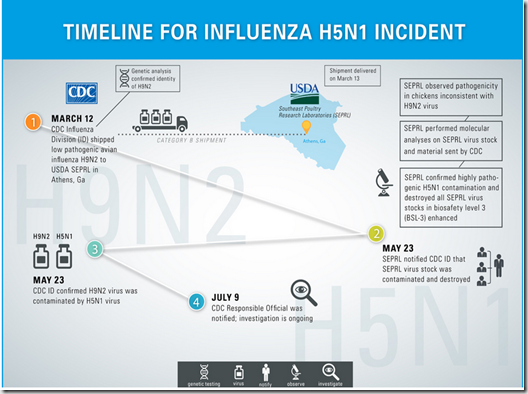
March 12


  • CDC Influenza Division (ID) shipped low pathogenic avian influenza H9N2 to USDA SEPRL in Athens, Ga
    Genetic analysis confirmed identity of H9N2
  • Shipment delivered on March 13 to USDA Southeast Poultry Research Laboratories (SEPRL) (Athens GA)
    SEPRL observed pathogenicity in chickens inconsistent with H9N2 virus
    SEPRL performed molecular analyses on SEPRL virus stock and material sent by CDC
    SEPRL confirmed highly pathogenic H5N1 contamination and destroyed all SEPRL virus stocks in biosafety level 3 (BSL-3) enhanced
May 23
  • SEPRL notified CDC ID that SEPRL virus stock was contaminated and destroyed
May 23


  • CDC ID confirmed H9N2 virus was contaminated by H5N1 virus
July 9


  • CDC Responsible Official was notified; investigation is ongoing
A revelation that led to another press release from the House Sub-Committee on Friday, which indicates a widening of the scope of the hearing scheduled for Wednesday.

Upton, Murphy Comment On Additional CDC Safety Failures
July 11, 2014
CDC Head Will Testify on Recent Anthrax Incident WEDNESDAY
WASHINGTON, DC ? House Energy and Commerce Committee Chairman Fred Upton (R-MI) and Oversight and Investigations Subcommittee Chairman Tim Murphy (R-PA) responded to the latest announcement by the Centers for Disease Control and Prevention (CDC) on additional safety breaches. As part of the ongoing investigation into the potential exposure of more than 80 workers at a CDC lab in Atlanta to live anthrax, committee leaders earlier this week sent letters to the CDC and HHS Inspector General seeking documents and information. CDC Director Dr. Tom Frieden is scheduled to testify before the Oversight and Investigations Subcommittee next Wednesday, July 16, at 10 a.m.
Chairman Upton commented, ?The repeated breakdown in protocols and safety failures involving the world?s deadliest germs and pathogens is wholly unacceptable. The consequences of such carelessness could not be more dire. This latest revelation underscores the need for our investigation and the importance of next week's hearing to review the safety measures and practices at the CDC. Past fixes by CDC several years ago apparently were not followed and not adequately implemented. We will seek to find out why CDC thinks its latest actions will prove more effective than past efforts, and whether congressional intervention may be necessary. We look forward to hearing directly from Dr. Frieden next Wednesday and will seek his firm commitment that such safety lapses are over.?
Subcommittee Chairman Murphy added, ?With the release of today?s report, we?ve learned the dangerous transfer of possible live anthrax bacteria by the CDC?s Atlanta lab was not an isolated incident by a rogue scientist, but rather one of multiple mishaps over the last several years that were violations, or apparent violations, of federal regulations for handling deadly biological material. These repeated safety failures raise grave concerns about the CDC?s ability to ensure strict procedures, protocols, and training are followed and an area we will examine further at Wednesday?s Oversight and Investigations Subcommittee hearing.?
House E&C Subcommittee hearings are usually broadcast live at this link:

All of this comes after several years of debate over the safety of government and university laboratories, and concerns over potentially dangerous work on DURC (Dual Use of Concern) and GOF (Gain of Function) research projects.

For those unfamiliar with the lexicon of biomedical research, GOF research involves the creation of viruses and/or bacteria with enhanced virulence, transmissibility, or host range while DURC is defined as:

. . . life sciences research that, based on current understanding, can be reasonably anticipated to provide knowledge, information, products, or technologies that could be directly misapplied to pose a significant threat with broad potential consequences to public health and safety, agricultural crops and other plants, animals, the environment, materiel, or national security
Proponents of these types of research projects argue that the risks of an accidental release are small, that they can open up new avenues of knowledge in the world of bioengineering, and perhaps tip us off as to the what pathogens have the most pandemic potential, and even help in the early development of a vaccine.

Opponents argue that these potential benefits are overstated, and the risks of an accidental release from one of the hundreds of labs doing this type of work are underappreciated (see The Debate Over Gain Of Function Studies Continues).

While we don?t know what Dr. Frieden will say before the subcommittee on Wednesday, on Friday he did say:

?And fundamentally, and this is relation to the previous question from the wall street journal as well, one of the things that we want to do is reduce the number of laboratories that work with dangerous agents to the absolute minimum necessary. Reduce the number of people who have access to those laboratories to the absolute minimum necessary. Reduce the number of dangerous pathogens we work with in those laboratories.?

This week, you can expect to see a good deal of media coverage of this topic, but a good one to start your week with is this from Reuters:


ANALYSIS-How to fix U.S. biosecurity leaks? Close some labs

Source: Reuters - Mon, 14 Jul 2014 05:00 GMT
By Sharon Begley and Julie Steenhuysen
July 14 - In the wake of disclosures that top government labs mishandled anthrax, smallpox and avian flu, U.S. health authorities are considering the once unthinkable: cutting the burgeoning number of labs working with the planet's most dangerous microbes.
(Continue . . . )
In 2012 we saw a year-long self imposed moratorium on controversial GOF research by a group of major researchers, to allow time for `public discussion and scientific debate? of the issue, but in the end, very little of that actually took place.

Instead ? except for the occasional scathing newspaper editorial (see NYTs An Engineered Doomsday) ? this debate has been largely conducted in academic circles or in research journals.

Now, the debate finds itself once again on the front page, and this time it will be conducted under the formidable shadow of three very high-profile biosecurity lapses in what are assumed to be the best, and safest, labs in the country.

Which means that advocates of GOF & DURC research have a big job ahead of them to convince an increasingly skeptical public, and traditionally risk adverse politicians, of the wisdom and safety of continuing ? particularly in anything less than the highest biosecurity settings.

Stay tuned.

Posted by Michael Coston at <a class="timestamp-link" href="http://afludiary.blogspot.ca/2014/07/upcoming-house-sub-committee-hearing-on.html" rel="bookmark" title="permanent link"><abbr class="published" itemprop="datePublished" title="2014-07-14T08:04:00-04:00">8:04 AM</abbr>
 
Re: US CDC Influenza Lab Closed After H5N1 Accidently Sent to Another Government Laboratory 6 Weeks Ago, Plus Moratorium on Movement of All Biological Materials from BSL-3 & 4 labs - July 11, 2014 Media release

From CNN 7-17-14: CDC?s Lab Problems Have Ripple Effect on Other Problems

http://www.cnn.com/2014/07/17/health/cdc-lab-problems/index.html

(CNN) -- The lab mishaps at the Centers for Disease Control and Prevention are having "broad impacts," compromising care for patients with diseases like tuberculosis and chikungunya and potentially slowing work overseas on Ebola and MERS, according to a CDC official.
(snip)
The transfer moratorium means laboratories around the world can no longer depend on the CDC to help them diagnose unusual diseases such as drug-resistant tuberculosis, Middle East respiratory syndrome, Rocky Mountain spotted fever and typhus, said Michael Shaw, deputy director of the CDC's office of infectious diseases.

"The CDC is one of the only places that can diagnose these diseases," Shaw said.

Hardest hit, health experts say, may be TB patients.

Because of the transfer moratorium, some patients have been unable to find out what type of TB they have. That means their doctors don't know which antibiotic to prescribe, according to Kelly Wroblewski, director of infectious disease programs at the Association of Public Health Laboratories.
(snip)
The CDC is one of only three public health labs in the United States that can do quick testing on drug-resistant tuberculosis specimens to see which antibiotic might work the best. The other two, in California and New York, might be able to handle some of the overflow, Wroblewski said.

The CDC will also be turning away about 100 samples per week that need to be checked for chikungunya, a mosquito-borne disease that's risen to record levels in Puerto Rico, the U.S. Virgin Islands and other parts of the Caribbean, according to Shaw?
 
Re: US CDC Influenza Lab Closed After H5N1 Accidently Sent to Another Government Laboratory 6 Weeks Ago, Plus Moratorium on Movement of All Biological Materials from BSL-3 & 4 labs - July 11, 2014 Media release

Media Statement

<!--Contact Head-->For Immediate Release: Thursday, July 24, 2014
Contact: Division of News & Electronic Media
(404) 639-3286


<!--End Contact Head--><!--Content-->New safety protocols in place, first CDC lab resumes transfer of inactivated materials out of high-containment laboratory

Clinical TB lab first to meet enhanced safety review
<!--
p0515-chemical-injuries.jpg
Spilled bottle of pills.


-->
After intensive review by CDC?s internal Laboratory Safety Improvement Working Group (internal working group), CDC Director Tom Frieden, M.D., M.P.H., has lifted the moratorium on a specific type of material transfer for the CDC?s Clinical Tuberculosis Laboratory. The moratorium remains in place for other high-containment (BSL-3 and BSL-4) laboratories. Labs supporting direct patient care are receiving priority review.

The BSL-3 Clinical TB Lab uses a ?heat kill? process to inactivate tuberculosis bacteria isolated from patients. It then sends the killed bacteria to a lower-level BSL-2 CDC lab for genetic analysis, rapidly telling clinicians whether their patients carry multi-drug-resistant (MDR) strains of tuberculosis and which drugs will be most effective. Old tests took weeks to yield results; the new test takes only two days.

The plan submitted by the TB lab to the internal working group details safety procedures for each step of the TB inactivation process. The plan includes risk assessment; rules for personal protective equipment; validation (including observation of key steps by a second, highly trained and certified lab technician) that the heat-kill process was conducted correctly and that any living organisms were killed; strict limits on lab access; medical monitoring of lab personnel; and back-up tests. The lab is and has been certified under Clinical Laboratory Improvement Amendments (CLIA) federal standards, and the lab?s testing results and quality-control is reviewed in real time by a CLIA technical supervisor. The TB lab was not one of the two labs involved in recent incidents; those two labs remain closed.

The TB lab?s plan was reviewed and approved by each member of the internal working group; by Mike Bell, M.D., CDC?s new Director of Laboratory Safety; and by Dr. Frieden.

The internal working group continues its lab-by-lab review of safety procedures. The reviews focus on two main aspects of safety:

  • Each lab must demonstrate that its protocols for key control points ? such as inactivation of a pathogen ? are not only being used but that they are being used by appropriately trained and supervised individuals.
  • Each lab is expected to establish redundant controls, similar to the two-key system used in other contexts for critical control points. For example, in the TB lab when heat is used to kill a pathogen, a second trained lab technician will witness the process to make sure the right temperature is used for the right amount of time. Both individuals then sign off on the process.
  • As an additional safeguard, there will be unannounced safety inspections?by internal auditors.
No single set of procedures can be used for every lab, as different labs deal with different pathogens and do different kinds of work. Thus safeguards are tailored to each individual lab.

On July 11, 2014, Dr. Frieden halted transfer of all biological materials from CDC laboratories in response to incidents in which CDC employees might have been exposed to viable anthrax and in which a highly pathogenic influenza virus contaminated a low pathogenic influenza virus sample sent to a Department of Agriculture high-containment lab. While there appear to have been neither human exposures nor illness as a result of these incidents, CDC immediately undertook a series of remedial actions.
These actions include:

  • The moratorium on biological material leaving all CDC BSL-3 and BSL-4 labs.
  • Appointment of Dr. Bell to be Director of Laboratory Safety and serve as the single point of accountability to improve all laboratory safety protocols and practices and procedures; and establishment of the internal working group headed by Dr. Bell.
  • Reevaluation and improvement of inactivation procedures in all BSL-3 and BSL-4 labs.
  • Establishment of an external working group, made up of leading scientists, which will be part of the Advisory Committee to the Director of CDC.
  • An investigation to determine the root causes that led to contamination of H5N1 in the influenza laboratory.
  • Establishment of a review group under the Associate Director for Science to look at procedures leading to these events and ways to prevent them in the future. This review will be done in conjunction with the internal investigation and in coordination with the external working group.
  • Disciplinary action as appropriate for any staff member who knowingly departed from lab safety protocols or who knew about lab safety incidents and didn't report them promptly.
  • Considering the implications of these events for the handling of select agents and virulent pathogens more broadly, not just within CDC but throughout the scientific community.
http://www.cdc.gov/media/releases/2014/s0724-lab.html?s_cid=cdc_homepage_whatsnew_001
 
Back
Top