• FluTrackers.com Inc. does not provide medical advice. Information on this web site is collected from various internet resources, and the FluTrackers board of directors makes no warranty to the safety, efficacy, correctness or completeness of the information posted on this site by any author or poster. The information collated here is for instructional and/or discussion purposes only and is NOT intended to diagnose or treat any disease, illness, or other medical condition. Every individual reader or poster should seek advice from their personal physician/healthcare practitioner before considering or using any interventions that are discussed on this website. By continuing to access this website you agree to consult your personal physican before using any interventions posted on this website, and you agree to hold harmless FluTrackers.com Inc., the board of directors, the members, and all authors and posters for any effects from use of any medication, supplement, vitamin or other substance, device, intervention, etc. mentioned in posts on this website, or other internet venues referenced in posts on this website.
  • We are not asking for any donations. Do not donate to any entity who says they are raising funds for us.

Update on Tamiflu Resistance

mixin

Well-known member
The WHO weekly update

27 October 2010 -- For this reporting period, two additional cases of influenza H1N1 (2009) viruses carrying the H275Y substitution have been reported. It brings the cumulative total to 313 so far.

Geographical distribution of oseltamivir resistance by the WHO regions (as of 27 October 2010)
AFRO:1, EMRO:1 EURO: 101, PAHO: 85, SEARO: 0, WPRO:125

http://www.who.int/csr/disease/influenza/weekly_update_oseltamivir_resistant_20101108.pdf

:tiphat: gs Tracking resistance in Japan:

5-18-2010: This paper is a preliminary 25 December 2009 interim report was published in IASR (2) of the follow-up.

A/H1N1pdm 6,089 isolated strains were analyzed. As a result, oseltamivir-resistant strains were detected 69 strains, the incidence was 1.13%. The reported incidence in the first report in December 2009 was 1.6% (2) increase at this time of the emergence of oseltamivir-resistant strains have not been observed. The isolates analyzed in the Research A/H1N1pdm around was the majority were taken at random. However, some influenza hospitalization surveillance (severe disease deaths) need to consider that the end results include cases investigated on a priority basis and no drug therapy was successful from samples. In addition, 7 strains of 69 strains of oseltamivir-resistant strains were susceptible strain detected a mixed sequence of oseltamivir-resistant strains (H275H / Y) had a.

As of November 5:
6973 isolates tested
76 were resistant
1.09%


http://translate.google.com/transla...nflu.html#taiseikabu&sl=ja&tl=en&hl=&ie=UTF-8
 
Re: Update on Tamiflu Resistance

Japan's National Institute of Infectious Diseases (NIID submitted 22 isolates today at GISAID, including at least one from Korea and a couple from Laos. Fourteen were sampled in late 2010 and 8 are from this year.

15 are characterized as oseltamivir sensitive, YHY; 2 are resistant to both oseltamivir and peramivir; one of which is YYY and the other shows a mixed signal YXY. Five are uncharacterized; one is YHY, one is YYY and the other three are YXY. Based on how the others tested, it might be speculated that one is sensitive and the other four are resistant.

We can hope that this isn't an accurate representation of all the cases.

ETA: I looked at the previous 8 submissions from the same area and none of those were resistant; however, 3 out of 30 have an X at position G158 (or nucleotide G515)... the mutation linked to vax escape.
 
Re: Update on Tamiflu Resistance

Regarding the recent Eurosurveillance report: Increased detection in Australia and Singapore of a novel influenza A(H1N1)2009 variant with reduced oseltamivir and zanamivir sensitivity due to a S247N neuraminidase mutation http://www.flutrackers.com/forum/showthread.php?t=168992

I spent some time looking through all the GISAID sequences.

I only found 2 that had the double mutation S247N and H275Y:
A/Victoria/2132/2009 and A/Perth/29/2011; apparently they aren't releasing very many from the new varient. I also found ~34 with S247N but not H275Y. The June 1 WHO update states the cumulative total for H275Y is 508.

The additional mutation discussed in the article is I223, so we probably should be watching for that one, too.

Here are the amino acids,nucleotide positions, non-mutated and mutated letters:
I223R = 667,668,669 = ATA AGA
S247N = 739,740,741 = AGT AAT
H275Y = 823,824,825 = CAC TAC
 
Re: Update on Tamiflu Resistance

<!--[if gte mso 9]><xml> <w:WordDocument> <w:View>Normal</w:View> <w:Zoom>0</w:Zoom> <w:Compatibility> <w:BreakWrappedTables/> <w:SnapToGridInCell/> <w:WrapTextWithPunct/> <w:UseAsianBreakRules/> </w:Compatibility> <w:BrowserLevel>MicrosoftInternetExplorer4</w:BrowserLevel> </w:WordDocument> </xml><![endif]--><!--[if gte mso 10]> <style> /* Style Definitions */ table.MsoNormalTable {mso-style-name:"Table Normal"; mso-tstyle-rowband-size:0; mso-tstyle-colband-size:0; mso-style-noshow:yes; mso-style-parent:""; mso-padding-alt:0cm 5.4pt 0cm 5.4pt; mso-para-margin:0cm; mso-para-margin-bottom:.0001pt; mso-pagination:widow-orphan; font-size:10.0pt; font-family:"Times New Roman";} </style> <![endif]-->[FONT=&quot]Sorry to harp on again but...[/FONT]
Just counting cases is not enough. We are using these numbers to gauge how close H1N1(2009) is to rendering our main antiviral drug useless; cases from immuno-compromised patients and those from random samples of the circulating strain have a very different meaning and importance.
The WHO are obviously aware of this as this paragraph shows.
Associated clinical history information has been scarce. Based on available data, among Japanese oseltamivir resistant viruses, the vast majority were from cases treated or prophylaxed with oseltamivir. However, from NIC UK, the percentage of resistant viruses from cases with no known exposure to oseltamivir increased from 11% in the 2009-2010 season to at least 28% in the 2010-2011 season.
The problem, once again, is data collection. If the returning countries only supply the number of cases without any clinical history we are never going to understand what is going on. All that is need are two supplementary questions.
Is there evidence that the patient had been exposed to Oseltamivir?
Is the patient's immune system compromised to some extent?
The first filters out those who are likely to have developed the resistance as part of their treatment and the second separates out those who have the additional complication of having an inadequate immune response and may be producing copious numbers of weird and wonderful mutations that survive in them but would be quickly dispatched by a robust immune response. A ‘no’ to both questions leaves us with a much better estimate of the level of resistance in the circulating wild type strains, which is what we need to know.
The other data is also important as in can be used to inform decisions on the likelihood of resistance emergence if there is widespread Tamiflu prescription in the general population.
 
Re: Update on Tamiflu Resistance

JJackson...Agreed

Very concerning also that the rate of increase and pattern is on a par with evolution of 100% resistance in old seasonal H1N1 in the space of months (I think it was about 9 months before resistance reached 100% pretty much eerywhere)

Add to this a 7.2% flu share of all mortality around the el-paso area at present and death set at epidemic levels nationally against a very backdrop of a very low flu incidence in the US, and I think trouble may be ahead.

I hope TPTB are starting to plan for this at both a national and global level.
 
Re: Update on Tamiflu Resistance

The WHO includes pie charts for the oseltamivir resistance catagories; in the other resistance thread, I posted one from a year ago comparing it to the last update.
http://www.flutrackers.com/forum/showthread.php?t=123546&page=12

289 cases were reported as of May 19, 2010 compared to 509 now.

First % are for 2010, second % for now:

25%, 25% immunosuppressed patients
26% + 6%, 34% associated with drug use
8%, 13% no known drug use, including known/possible h2h transmission
35%, 28% preliminary notification

Link for the May 19, 2010 report
http://www.who.int/csr/disease/swineflu/oseltamivirresistant20100521.pdf
 
Re: Update on Tamiflu Resistance

JJackson,
I can't find your quote.
However, from NIC UK, the percentage of resistant viruses from cases with no known exposure to oseltamivir increased from 11% in the 2009-2010 season to at least 28% in the 2010-2011 season.

Are they saying that cases just in the UK have increased that much?
 
Re: Update on Tamiflu Resistance

Thanks cpg; I didn't see that report.

[snips]

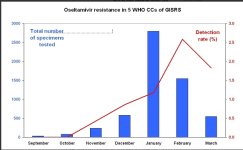
From September 2010 to March 2011, of 5814 A(H1N1) viruses tested in 5 WHO Collaborating Centres (CCs) of GISRS, 89 (1.5%) were resistant to oseltamivir. The overall monthly detection rate of resistance to oseltamivir ranged between 0% and 2.6% and increased slightly from October 2010, then declined in March 2011 (Figure 1). However, the detection rate and trend vary in individual WHO CCs. In Japanese viruses, the highest detection rate of 5.8% was reported in March 2011, with a consistent, though slight, increasing trend observed since December 2010 (Table 1). All these resistant viruses were associated with a histidine to tyrosine substitution at amino acid 275 (H275Y) in the neuraminidase.

Outside of the WHO CCs, based on TESSY/EuroFlu reporting, from September 2010 to March 2011, National Influenza Centres (NICs) in Europe tested 3080 A(H1N1) viruses, of which 91 (2.95%) were resistant to oseltamivir. Similarly, a slight increase in the detection rate was observed up to February 2011, but dropped significantly in March. Outside Europe, NIC Singapore reported one detection in February of oseltamivir resistant virus to FluNet.

Tami Resistance Detection.jpg
 
Re: Update on Tamiflu Resistance

There was a group of 50 isolates submitted at GISAID today.

Looking through the NA segements, I found one with S247N, Louisiana/03/2011 and another with H275Y, Maryland/04/2011. None from this group had I223R, which was also mentioned in the Eurosurveillance article linked a few posts above.
 
Re: Update on Tamiflu Resistance

Mixin they only mentioned i223r as an example of resistance to be on the lookout for.

They could of used any number of resistant sub types but chose 1223r because in the past it has been related to relenza resistance in extremely rare cases that were mostly inviro.

We all need to be on the lookout for resistance at all times but H274y is definitely becoming a major problem for Tamiflu as it did a few years ago.

Why the heck would you currently recommend or use Tamiflu when for the vast majority of the population Relenza has been proven to be at least as good if not better. Go figure.
 
Re: Update on Tamiflu Resistance

GISAID has a new group of 30 submissions from Japan. There are 20 NA segments, 5 of which are characterized as oseltamivir resistant.

None had either of these:
I223R = 667,668,669 = ATA AGA
S247N = 739,740,741 = AGT AAT
 
Re: Update on Tamiflu Resistance

National Institute of Infectious Diseases, Japan has released 40 isolates at GISAID, 34 NA segments. The following are noted to be oseltamivir resistant:

A/AKITA/5/2011,2011/02/03
A/WAKAYAMA-C/6/2011,2011/01/16
A/OITA/72/2011,2011/02/08
A/OITA/77/2011,2011/02/10
A/CHIBA/1027/2011,2011/01/11
A/KAGAWA/1/2011,2011/01/31
A/NARA/54/2011,2011/02/21
A/ISHIKAWA/70/2011,2011/03/01
A/IBARAKI/103/2011,2011/02/10
A/IBARAKI/104/2011,2011/02/10
A/IBARAKI/106/2011,2011/02/16
A/IBARAKI/107/2011,2011/02/16
A/IBARAKI/108/2011,2011/02/16
A/GIFU/21/2011,2011/01/19
A/TOCHIGI/64/2011,2011/02/23
A/NAGASAKI-C/58/2009,2009/10/26
A/NARA/56/2011,2011/02/21
A/NARA/59/2011,2011/03/02
A/HOKKAIDO/93/2011,2011/02/28

A/MIYAZAKI/40/2011,2011/02/18 has 740 (S274N) but not 823

Edited: Originally I included (2) A/SHIGA/28/2011,2011/01/04 because I saw the mutation in the alignment; but after I checked the information sheet against my findings, I saw that both are noted to be sensitive. They sequenced it twice; one passaged with MDCK1, then MDCK1 +1.
 
Re: Update on Tamiflu Resistance

From today's WHO report:

29 June 2011 ‐‐ For this reporting period (15‐29 June 2011), 56 cases of influenza A(H1N1)2009 virus carrying the H275Y substitution have been reported. It brings the cumulative total to 565 since April 20092.

The incidence of viruses resistant to antivirals remains very low, with no recent reports of case clusters. Recommendations for the clinical management of influenza A(H1N1)2009 remain as summarized in the Weekly Epidemiology Record, No. 8, 18 February 20113

[note]
1. Cases reported for the period between week 35, 2010 and week 16, 2011 in Infectious Agents Surveillance Report, Japan. This figure includes 8 samples that are mixed populations H275Y ‐H275H/Y

******************
I've added the new pie chart percents to the others I posted earlier in this thread.

25%, 25%, 23% immunosuppressed patients
32%, 34%, 37% associated with drug use
8%, 13%, 17% no known drug use, including known/possible h2h transmission
35%, 28%, 23% preliminary notification

http://www.who.int/csr/disease/influenza/2011_07_01_weekly_web_update_oseltamivir_resistance.pdf
 
Re: Update on Tamiflu Resistance

France's Institut Pasteur submitted a small series of sequences at GISAID recently and I thought they were especially interesting.

There were a total of 7 isolates which appear to be samples taken from the same man over a period of a couple of months. It is not noted that these are from the same person but each characterization states it's from a 24yo male in the region France / Region Ile-de-France. I sometimes see 2 or 3 samples from the same person; but I can't remember ever seeing this many. Two were noted to be oseltamivir resistant but only one (in red) had the mutation.

I listed the HAs by sample date, collection date, Sensitive, Resistant and the mutation so you could see how they change (or not) with time. Notice all the mixed signals (M,R,W,Y) toward the end.

A/Paris/7976/2010, 2009/11/20 Sensitive = C823
T549C,A567G,T658A,C1408T,C1665T

A/Paris/7975/2010, 2009/11/26 Resistant = C823
T549C,A567G,T658A,C1296M,C1408T,C1665T

A/Paris/7974/2010, 2009/12/09 Resistant = C823T
T549C,A567G,T658A,A1303C,C1408T,C1665T

A/Paris/7973/2010, 2009/12/15 S = C823
T549C,A567G,T658A,C1296M,C1408T,C1665T

A/Paris/1156/2010, 2010/01/04 S = C823
G340R,T549C,A567G,T658A,G1012A,C1296M,A1303C,C1408T,C1665T

A/Paris/1157/2010, 2010/01/28 S = C823
T549C,A567G,T658A,A722R,G1012A,G1171A,C1296M,C1408T,C1665T

A/Paris/1159/2010, 2010/01/28 S = C823
G340R,G435R,T549C,A567G,G610R,T658A,T698W,A764R,G1012R, T1013Y,C1296M,A1303C,C1383M,C1408T,T1602Y,C1665T

A/Paris/1158/2010, 2010/02/11 S = C823
T549C,A567G,G610R,T658A,T1013Y,A1303C,C1383M,C1408T,C1665T
 
Re: Update on Tamiflu Resistance

Update on oseltamivir resistance in influenza A(H1N1)2009 viruses
13 July 2011 --

For this reporting period (29 June - 13 July 2011), no new cases of oseltamivir resistant pandemic influenza A(H1N1)2009 viruses have been reported. It brings the cumulative total to 565 since April 2009.

http://www.who.int/csr/disease/influenza/2011_07_15_weekly_web_update_oseltamivir_resistance.pdf.

The pie chart did change a bit; this report's figures are added:

25%, 25, 23 immunosuppressed patients
26% + 6%, 34, 37 associated with drug use
8%, 13, 17 no known drug use, including known/possible h2h transmission
35%, 28, 23 preliminary notification
 
Re: Update on Tamiflu Resistance

27 July 2011 -- For this reporting period (13-27 July 2011), 1 case of influenza A(H1N1)2009 virus carrying the H275Y substitution has been reported.

It brings the cumulative total to 566 since April 20092.
http://www.who.int/influenza/survei..._weekly_web_update_oseltamivir_resistance.pdf


10 August 2011 -- For this reporting period (27 July - 10 August 2011), no new cases of oseltamivir resistant influenza A(H1N1)2009 viruses have been reported. It brings the cumulative total to 566 since April 20091. Information on clinical background of reported cases of oseltamivir resistance is known for 77% of the cases, with the remaining cases having insufficient clinical information available or ongoing investigations.

Within the cases where clinical information is known (n=436), 131 (30%) have occurred in severely immunocompromised patients and 305 (70%) in non immunocompromised patients. Within the latter, 69% (210 cases) of the cases were associated with drug use, including cases occurring during or after oseltamivir treatment and/or
peramivir treatment and associated with post-exposure prophylaxis, and 31% (95 cases) have occurred in patients who had not used antiviral drugs prior to occurrence of the resistant virus, including known or suspected cases of person to person transmission.

More detailed information on previously reported cases has recently been published: Calatayud, L. et al. Oseltamivir-resistant pandemic (H1N1) 2009 virus infection in England and Scotland, 2009?2010.
Emerg Infect Dis. 2011 Oct; [Epub ahead of print]. Available from:

http://www.cdc.gov/eid/content/17/10/pdfs/11-0117.pdf

The incidence of viruses resistant to antivirals remains very low, with no recent reports of case clusters.

Recommendations for the clinical management of influenza A (H1N1) 2009 remain as summarized in the Weekly Epidemiology Record, No. 8, 18 February 20112

http://www.who.int/influenza/survei..._weekly_web_update_oseltamivir_resistance.pdf
 
Back
Top